
Skip to Content
  • オフィス

    オフィス

    北米・南米
    • Atlanta
    • Austin
    • Bogota
    • Boston
    • Buenos Aires
    • Chicago
    • Dallas
    • Denver
    • Houston
    • Los Angeles
    • Mexico City
    • Minneapolis
    • Monterrey
    • Montreal
    • New York
    • Rio de Janeiro
    • San Francisco
    • Santiago
    • São Paulo
    • Seattle
    • Silicon Valley
    • Toronto
    • Washington, DC
    ヨーロッパ・中東・アフリカ
    • Amsterdam
    • Athens
    • Berlin
    • Brussels
    • Copenhagen
    • Doha
    • Dubai
    • Dusseldorf
    • Frankfurt
    • Helsinki
    • Istanbul
    • Johannesburg
    • Kyiv
    • Lisbon
    • London
    • Madrid
    • Milan
    • Munich
    • Oslo
    • Paris
    • Riyadh
    • Rome
    • Stockholm
    • Vienna
    • Warsaw
    • Zurich
    アジア・オーストラリア
    • Bangkok
    • Beijing
    • Bengaluru
    • Brisbane
    • Ho Chi Minh City
    • Hong Kong
    • Jakarta
    • Kuala Lumpur
    • Manila
    • Melbourne
    • Mumbai
    • New Delhi
    • Perth
    • Shanghai
    • Singapore
    • Sydney
    • Tokyo
    全てのオフィス
  • アルムナイ
  • メディア
  • お問い合わせ
  • 東京オフィス
  • Japan | 日本語

    地域と言語を選択

    グローバル
    • Global (English)
    北米・南米
    • Brazil (Português)
    • Argentina (Español)
    • Canada (Français)
    • Chile (Español)
    • Colombia (Español)
    ヨーロッパ・中東・アフリカ
    • France (Français)
    • DACH Region (Deutsch)
    • Italy (Italiano)
    • Spain (Español)
    • Greece (Elliniká)
    アジア・オーストラリア
    • China (中文版)
    • Korea (한국어)
    • Japan (日本語)
  • Saved items (0)
    Saved items (0)

    You have no saved items.

    後で閲読、共有できるようにするためにブックマークしてください

    Explore Bain Insights
Bain.com(グローバルサイト)
Founder's Mentality®
  • Overview
  • About
    Bain.com(グローバルサイト)
    Founder's Mentality®

    About

    • About Founder's Mentality
    • About Micro-battles
  • Podcast
  • Book
  • Blog
  • オフィス
    メインメニュー

    オフィス

    • 北米・南米
      オフィス
      北米・南米
      • Atlanta
      • Austin
      • Bogota
      • Boston
      • Buenos Aires
      • Chicago
      • Dallas
      • Denver
      • Houston
      • Los Angeles
      • Mexico City
      • Minneapolis
      • Monterrey
      • Montreal
      • New York
      • Rio de Janeiro
      • San Francisco
      • Santiago
      • São Paulo
      • Seattle
      • Silicon Valley
      • Toronto
      • Washington, DC
    • ヨーロッパ・中東・アフリカ
      オフィス
      ヨーロッパ・中東・アフリカ
      • Amsterdam
      • Athens
      • Berlin
      • Brussels
      • Copenhagen
      • Doha
      • Dubai
      • Dusseldorf
      • Frankfurt
      • Helsinki
      • Istanbul
      • Johannesburg
      • Kyiv
      • Lisbon
      • London
      • Madrid
      • Milan
      • Munich
      • Oslo
      • Paris
      • Riyadh
      • Rome
      • Stockholm
      • Vienna
      • Warsaw
      • Zurich
    • アジア・オーストラリア
      オフィス
      アジア・オーストラリア
      • Bangkok
      • Beijing
      • Bengaluru
      • Brisbane
      • Ho Chi Minh City
      • Hong Kong
      • Jakarta
      • Kuala Lumpur
      • Manila
      • Melbourne
      • Mumbai
      • New Delhi
      • Perth
      • Shanghai
      • Singapore
      • Sydney
      • Tokyo
    全てのオフィス
  • アルムナイ
  • メディア
  • お問い合わせ
  • 東京オフィス
  • Japan | 日本語
    メインメニュー

    地域と言語を選択

    • グローバル
      地域と言語を選択
      グローバル
      • Global (English)
    • 北米・南米
      地域と言語を選択
      北米・南米
      • Brazil (Português)
      • Argentina (Español)
      • Canada (Français)
      • Chile (Español)
      • Colombia (Español)
    • ヨーロッパ・中東・アフリカ
      地域と言語を選択
      ヨーロッパ・中東・アフリカ
      • France (Français)
      • DACH Region (Deutsch)
      • Italy (Italiano)
      • Spain (Español)
      • Greece (Elliniká)
    • アジア・オーストラリア
      地域と言語を選択
      アジア・オーストラリア
      • China (中文版)
      • Korea (한국어)
      • Japan (日本語)
  • Saved items  (0)
    メインメニュー
    Saved items (0)

    You have no saved items.

    後で閲読、共有できるようにするためにブックマークしてください

    Explore Bain Insights
Founder's Mentality®
  • 業界別プラクティス
    • 業界別プラクティス

      • 航空宇宙、防衛、政府関連
      • 農業
      • 化学製品
      • インフラ、建設
      • 消費財
      • 金融サービス
      • ヘルスケア
      • 産業機械、設備
      • メディア、エンターテインメント
      • 金属
      • 採掘・鉱業
      • 石油、ガス
      • 紙、パッケージ
      • プライベートエクイティ
      • 公共、社会セクター
      • 小売
      • テクノロジー
      • 通信
      • 交通
      • 観光産業
      • 公益事業、再生可能エネルギー
  • 機能別プラクティス
    • 機能別プラクティス

      • カスタマー・エクスペリエンス
      • サステイナビリティ、 社会貢献
      • Innovation
      • 企業買収、合併 (M&A)
      • オペレーション
      • 組織
      • プライベートエクイティ
      • マーケティング・営業
      • 戦略
      • アドバンスド・アナリティクス
      • Technology
      • フルポテンシャル・トランスフォーメーション
  • Digital
  • 知見/レポート
  • ベイン・アンド・カンパニーについて
    • ベイン・アンド・カンパニーについて

      • ベインの信条
      • 活動内容
      • 社員とリーダーシップ
      • プレス・メディア情報
      • クライアントの結果
      • 受賞歴
      • パートナーシップを結んでいる団体
      Further: Our global responsibility
      • ダイバーシティ
      • 社会貢献
      • サステイナビリティへの取り組み
      • 世界経済フォーラム(WEF)
      Learn more about Further
  • キャリア
    人気検索キーワード
    • デジタル
    • 戦略
    前回の検索
      最近訪れたページ

      Content added to saved items

      Saved items (0)

      Removed from saved items

      Saved items (0)

      Founder's Mentality Blog

      The Second-generation Role: Maintain the Magic

      The Second-generation Role: Maintain the Magic

      Children of company founders need to carry on their parents' missions.

      著者:James Allen

      • min read

      記事

      The Second-generation Role: Maintain the Magic
      en

      I spent this past week in Mumbai, Delhi and Bangalore talking to founders—or as Indians tend to call them, “promoters.”

      A recurrent theme was the role of the second generation—the sons and daughters of the founder. It’s an issue that also came up during recent trips to China and South America.

      Here’s a typical situation I’ve encountered five times in three countries over the last three weeks:

      1. The company is a very successful business, founded by the father (and, in one case, the mother) who has recently moved to the chairman role.
      2. The founder has brought in a professional CEO who is working to bring in the right systems and processes to take the company to the next level.
      3. There are inevitable tensions at times between the founders and their new CEOs as the two seek to balance the benefits of maintaining the original founding culture and organization against the benefits of adapting the culture and organization to its new scale and the resulting need for greater professionalism.
      4. The son or daughter of the founder, having benefited from a first-class education and often a stint in a blue-chip company, has now re-entered the company, with the implicit understanding that they are being groomed to take over from the CEO.

      In my conversations, we talked about this as a classic triad—the Chairman-Founder, the Professional CEO and the Child of the Founder—and discussed the following questions:

      • What role should the “Child of the Founder” play—both immediately and over the medium-term?
      • Based on the answer, what is the best career path for the Child of the Founder?

      The common instinct of the Child of the Founder, as discussed by a son of the founder of a Chinese luxury business: “Managing the triad is difficult, and my instinct is to play to my strengths, helping the CEO professionalize the company. I have a good education and good work experience and this seems like the right first step. I’m currently helping my father and the CEO on M&A work.”

      The Child of the Founder, understandably, wants to help the CEO and their parent, the Chairman-Founder, to continue to professionalize the company. When it comes to the benefits of scale/scope versus the benefits of Founder’s MentalitySM, as shown on the Founder’s Mentality 2X2 graphic, the common instinct of the Child of the Founder is to help the company gain further benefits of scale and scope (see Figure 1).
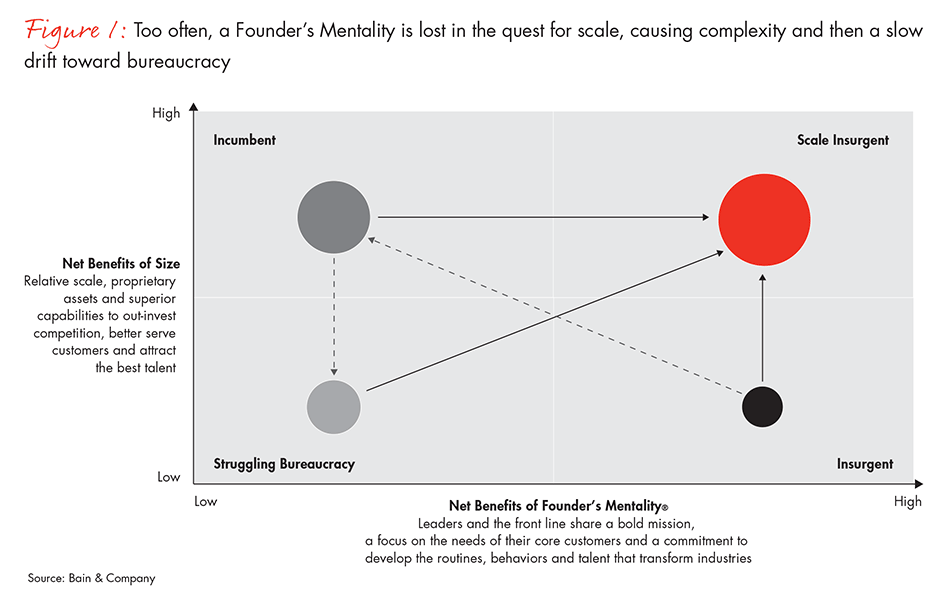

      While this instinct is understandable, it also is wrong in most cases if their goal (and the Founder’s goal) is for the Child of the Founder to take over the company. In this sort of a generational transfer of company leadership from Founder to Child, the most threatened aspect of the company is its Founder’s Mentality—the sense of insurgency, the owner mindset, and the obsession with customers and front line. The Professional CEO will handle the “Benefits of scale and scope” axis and bring in additional professional managers as needed to help with this mission.

      But who, if not the Child of the Founder, will take over the Founder’s Mentality?

      With newly minted professional education and experience, the children of founders instinctively want to bring that professionalism to their family business. But in most cases, what the company actually needs is for them to carry on their parents’ mission. Rather than become the group professional, this suggests strongly that they should become the voice of the front line and voice of the customer. It suggests that the best career path for them is to start at the front line of the business, not its center—to work with the “kings” of the organization (those responsible for delivering the company’s products and services every day), not the “court” (those responsible for supporting the kings with professional services). The Child of the Founder should be mission-driven—to continue the insurgency—and obsessed with culture—to maintain the owner mindset.

      Learn more

      About the Founder's Mentality

      The three elements of the Founder's Mentality help companies sustain performance while avoiding the inevitable crises of growth.

      This is often not a conclusion that the Child of the Founder or the Founder wants to hear, and these conversations aren’t always easy ones to have. The typical objections, from highly emotional to more dispassionate, are:

      • “I didn’t waste two years at business school and four years at an investment bank [or blue-chip company or top consulting firm] just to come back and work on a shop floor.” (Or, from the Founder: “I didn’t pay for an Ivy League education to train a job assistant!”)
      • “The firm desperately needs professionals that understand this business—why isn’t it right that I jump in and help here, rather than do something every first-year recruit could do?”
      • “To become the next CEO, I need to run a professionally run firm, not the personality-driven firm of my parent. Isn’t the whole point to move the company on from my parent’s time?”

      The answer to these questions, quite simply, is that Founder’s Mentality is magic dust. Growing to leadership in your industry and maintaining the sense of Founder’s Mentality is rare. Companies that do both, like AB InBev or Ikea, become industry leaders. What the Child of the Founder can do to truly differentiate the company is to provide insights on both scale and scope and Founder’s Mentality. Education and experience in blue-chip firms can help with the first dimension. But the Child of the Founder needs to round out that experience if they are to be the voice of the front line and customers, to be the culture carrier. Spending time on the front line is not a bad idea if you will someday be the champion of that front line.

      Of course, if the founder hasn’t brought in professional management and the Triad doesn’t exist, then the role of the Child of the Founder can be different. In that case, the company needs his or her newly acquired skills to support the transition to more professional management. Of course, in that case the Child of the Founder also has to work on maintaining the company’s Founder’s Mentality. This is a very tall order. In most cases, the correct action of the parent is to complete the TRIAD. Bringing in a Professional CEO will give the Child of the Founder the time and space they need to take over—not just from the Professional CEO but from the Founder-Chairman as well.

      Maintaining the magic dust of the Founder’s Mentality is often the most important mission of the Child of the Founder. They’ll need their education and blue-chip experience too. But let’s start on the shop floor.

      著者
      • Headshot of James Allen
        James Allen
        Advisory Partner, London
      関連するコンサルティングサービス
      • 戦略
      チェンジ・マネジメント
      Micro-battles and the Journey to Scale Insurgency

      Discrete, fast-moving initiatives bring focus to strategic choices and help companies rediscover the art of getting stuff done.

      詳細
      戦略
      The Founder's Mentality: How to Overcome the Predictable Crises of Growth

      The Founder's Mentality® can help businesses achieve lasting, profitable growth.

      詳細
      戦略
      Barriers and Pathways to Sustainable Growth: Harnessing the Power of the Founder's Mentality

      Some companies have been able to anticipate and address the internal obstacles to growth.

      詳細
      創業メンタリティ
      The Magic of Founder-led Companies

      Companies with their founder present performed twice as well as their peers in the S&P 500 over the past decade.

      詳細
      戦略
      What Business Leaders Need to Know About AI Sovereignty

      Aligning business strategy with national AI priorities is necessary to compete and scale.

      詳細
      First published in 10月 2013
      Tags
      • 戦略
      • 創業メンタリティ

      クライアント支援事例

      戦略 Jump-starting innovation for a telecom solutions provider

      ケーススタディを見る

      戦略 New products propel profitability for metals manufacturer

      ケーススタディを見る

      戦略 An auctioneer makes a winning online bid

      ケーススタディを見る

      お気軽にご連絡下さい

      私達は、グローバルに活躍する経営者が抱える最重要経営課題に対して、厳しい競争環境の中でも成長し続け、「結果」を出すために支援しています。

      ベインの知見。競争が激化するグローバルビジネス環境で、日々直面するであろう問題について論じている知見を毎月お届けします。

      *プライバシーポリシーの内容を確認し、合意しました。

      プライバシーポリシーをご確認頂き、合意頂けますようお願い致します。
      Bain & Company
      お問い合わせ Sustainability Accessibility Terms of use Privacy Cookie Policy Sitemap Log In

      © 1996-2026 Bain & Company, Inc.

      お問い合わせ

      How can we help you?

      • ビジネスについて
      • プレス報道について
      • 採用について
      全てのオフィス