
Skip to Content
  • Standorte

    Standorte

    North & Latin America
    • Atlanta
    • Austin
    • Bogota
    • Boston
    • Buenos Aires
    • Chicago
    • Dallas
    • Denver
    • Houston
    • Lisbon
    • Los Angeles
    • Mexico City
    • Minneapolis
    • Monterrey
    • Montreal
    • New York
    • Rio de Janeiro
    • San Francisco
    • Santiago
    • São Paulo
    • Seattle
    • Silicon Valley
    • Toronto
    • Washington, DC
    Europe & Africa
    • Amsterdam
    • Athens
    • Berlin
    • Brussels
    • Copenhagen
    • Düsseldorf
    • Frankfurt
    • Helsinki
    • Istanbul
    • Johannesburg
    • Kyiv
    • Lisbon
    • London
    • Madrid
    • Milan
    • München
    • Oslo
    • Paris
    • Rome
    • Stockholm
    • Warsaw
    • Wien
    • Zürich
    Middle East
    • Doha
    • Dubai
    • Riyadh
    Asia & Australia
    • Bangkok
    • Beijing
    • Bengaluru
    • Brisbane
    • Ho Chi Minh City
    • Hong Kong
    • Jakarta
    • Kuala Lumpur
    • Manila
    • Melbourne
    • Mumbai
    • New Delhi
    • Perth
    • Seoul
    • Shanghai
    • Singapore
    • Sydney
    • Tokyo
    Alle Standorte Anzeigen
  • Alumni
  • Presse
  • Newsletter
  • Kontakt
  • DACH-Region | Deutsch

    Wählen Sie Ihre Region und Sprache

    Global
    • Global (English)
    North & Latin America
    • Brazil (Português)
    • Argentina (Español)
    • Canada (Français)
    • Chile (Español)
    • Colombia (Español)
    Europe, Middle East, & Africa
    • France (Français)
    • DACH-Region (Deutsch)
    • Italy (Italiano)
    • Spain (Español)
    • Greece (Elliniká)
    Asia & Australia
    • China (中文版)
    • Korea (한국어)
    • Japan (日本語)
  • Saved items (0)
    Saved items (0)

    You have no saved items.

    Inhalte, für die Sie sich interessieren, werden hier gespeichert und können später gelesen oder weitergeleitet werden.

    Explore Bain Insights
  • Branchenkompetenzen
    Hauptmenü

    Branchenkompetenzen

    • Luft- und Raumfahrt, Verteidigung
    • Agrarwirtschaft
    • Chemieindustrie
    • Infrastruktur und Bauwirtschaft
    • Konsumgüter
    • Finanzdienstleistungen
    • Gesundheitswesen
    • Maschinen- und Anlagenbau
    • Medienwirtschaft
    • Metallindustrie
    • Bergbau
    • Öl und Gas
    • Papier- und Verpackungsindustrie
    • Private Equity
      Branchenkompetenzen
      Private Equity
      • Due Diligence
      • Exit Planning
      • Firm Strategy & Operations
      • Portfolio Value Creation
    • Öffentlicher Sektor und Sozialwesen
    • Einzelhandel
    • Technologie
    • Telekommunikation
    • Transportwesen
    • Reise- und Freizeitbranche
    • Versorgung und erneuerbare Energien
  • Managementkompetenzen
    Hauptmenü

    Managementkompetenzen

    • Customer Experience
    • ESG
    • Innovation
    • M&A
    • Operations
    • People & Organization
    • Private Equity
    • Sales & Marketing
    • Strategie
    • KI, Einblicke und Lösungen
    • Technologie
    • Transformation
  • Digital
  • Publikationen
    Hauptmenü

    Publikationen

    • Branchenthemen
    • Managementthemen
    • Bain-Bücher
    Alle Publikationen
    Ausgewählte Themen
    • Resilienz in der globalen Krise
    • M&A Report
    • Private Equity Podcast
    • Midyear Private Equity Report
    • Agile
    • Engineering Report
    • Digital Transformation
    • Elements of Value®
    • Firm of the Future
    • Nachhaltigkeitsstudie
    • Macro Trends
    • Future of Consumption
    • Weltwirtschaftsforum (WEF)
  • Über uns
    Hauptmenü

    Über uns

    • Was wir bieten
    • Unser Ansatz
    • Unser Team
    • Game Changer Award
    • Female Allstar Board
    • Messbare Ergebnisse (EN)
    • Auszeichnungen
    • Globale Partnerschaften
    • The Mission
    Further: Our global responsibility
    • Vielfalt & Chancengleichheit
    • Soziale Verantwortung
    • Sustainability
    Erfahren Sie mehr zu "Further"
  • Karriere
    Hauptmenü

    Karriere

    • Dein Einstieg
      Karriere
      Dein Einstieg
      • Find Your Place
      • Unsere Arbeitsbereiche
      • Unsere Teams
      • Angebote für Studierende
      • Praktika & Programme
      • Recruiting-Events
    • Arbeiten bei Bain
      Karriere
      Arbeiten bei Bain
      • Blog: Inside Bain
      • Karriere Stories
      • Unsere Bainies
      • Office-Standorte
      • Weiterentwicklung
      • Affinity Groups
      • Deine Benefits
    • Impact Stories
    • Deine Bewerbung
      Karriere
      Deine Bewerbung
      • Das erwartet dich
      • Der Interviewprozess
    FIND JOBS
  • Standorte
    Hauptmenü

    Standorte

    • North & Latin America
      Standorte
      North & Latin America
      • Atlanta
      • Austin
      • Bogota
      • Boston
      • Buenos Aires
      • Chicago
      • Dallas
      • Denver
      • Houston
      • Lisbon
      • Los Angeles
      • Mexico City
      • Minneapolis
      • Monterrey
      • Montreal
      • New York
      • Rio de Janeiro
      • San Francisco
      • Santiago
      • São Paulo
      • Seattle
      • Silicon Valley
      • Toronto
      • Washington, DC
    • Europe & Africa
      Standorte
      Europe & Africa
      • Amsterdam
      • Athens
      • Berlin
      • Brussels
      • Copenhagen
      • Düsseldorf
      • Frankfurt
      • Helsinki
      • Istanbul
      • Johannesburg
      • Kyiv
      • Lisbon
      • London
      • Madrid
      • Milan
      • München
      • Oslo
      • Paris
      • Rome
      • Stockholm
      • Warsaw
      • Wien
      • Zürich
    • Middle East
      Standorte
      Middle East
      • Doha
      • Dubai
      • Riyadh
    • Asia & Australia
      Standorte
      Asia & Australia
      • Bangkok
      • Beijing
      • Bengaluru
      • Brisbane
      • Ho Chi Minh City
      • Hong Kong
      • Jakarta
      • Kuala Lumpur
      • Manila
      • Melbourne
      • Mumbai
      • New Delhi
      • Perth
      • Seoul
      • Shanghai
      • Singapore
      • Sydney
      • Tokyo
    Alle Standorte Anzeigen
  • Alumni
  • Presse
  • Newsletter
  • Kontakt
  • DACH-Region | Deutsch
    Hauptmenü

    Wählen Sie Ihre Region und Sprache

    • Global
      Wählen Sie Ihre Region und Sprache
      Global
      • Global (English)
    • North & Latin America
      Wählen Sie Ihre Region und Sprache
      North & Latin America
      • Brazil (Português)
      • Argentina (Español)
      • Canada (Français)
      • Chile (Español)
      • Colombia (Español)
    • Europe, Middle East, & Africa
      Wählen Sie Ihre Region und Sprache
      Europe, Middle East, & Africa
      • France (Français)
      • DACH-Region (Deutsch)
      • Italy (Italiano)
      • Spain (Español)
      • Greece (Elliniká)
    • Asia & Australia
      Wählen Sie Ihre Region und Sprache
      Asia & Australia
      • China (中文版)
      • Korea (한국어)
      • Japan (日本語)
  • Saved items  (0)
    Hauptmenü
    Saved items (0)

    You have no saved items.

    Inhalte, für die Sie sich interessieren, werden hier gespeichert und können später gelesen oder weitergeleitet werden.

    Explore Bain Insights
  • Branchenkompetenzen
    • Branchenkompetenzen

      • Luft- und Raumfahrt, Verteidigung
      • Agrarwirtschaft
      • Chemieindustrie
      • Infrastruktur und Bauwirtschaft
      • Konsumgüter
      • Finanzdienstleistungen
      • Gesundheitswesen
      • Maschinen- und Anlagenbau
      • Medienwirtschaft
      • Metallindustrie
      • Bergbau
      • Öl und Gas
      • Papier- und Verpackungsindustrie
      • Private Equity
      • Öffentlicher Sektor und Sozialwesen
      • Einzelhandel
      • Technologie
      • Telekommunikation
      • Transportwesen
      • Reise- und Freizeitbranche
      • Versorgung und erneuerbare Energien
  • Managementkompetenzen
    • Managementkompetenzen

      • Customer Experience
      • ESG
      • Innovation
      • M&A
      • Operations
      • People & Organization
      • Private Equity
      • Sales & Marketing
      • Strategie
      • KI, Einblicke und Lösungen
      • Technologie
      • Transformation
  • Digital
  • Publikationen
    • Publikationen

      • Branchenthemen
      • Managementthemen
      • Bain-Bücher
      Alle Publikationen
      Ausgewählte Themen
      • Resilienz in der globalen Krise
      • M&A Report
      • Private Equity Podcast
      • Midyear Private Equity Report
      • Agile
      • Engineering Report
      • Digital Transformation
      • Elements of Value®
      • Firm of the Future
      • Nachhaltigkeitsstudie
      • Macro Trends
      • Future of Consumption
      • Weltwirtschaftsforum (WEF)
  • Über uns
    • Über uns

      • Was wir bieten
      • Unser Ansatz
      • Unser Team
      • Game Changer Award
      • Female Allstar Board
      • Messbare Ergebnisse (EN)
      • Auszeichnungen
      • Globale Partnerschaften
      • The Mission
      Further: Our global responsibility
      • Vielfalt & Chancengleichheit
      • Soziale Verantwortung
      • Sustainability
      Erfahren Sie mehr zu "Further"
  • Karriere
    Häufige Suchanfragen
    • Agil
    • Digital
    • Strategie
    Vorherige Suchanfragen
      Zuletzt besuchte Seiten

      Content added to saved items

      Saved items (0)

      Removed from saved items

      Saved items (0)

      Brief

      Are Global Insurers Too Big to Succeed?

      Are Global Insurers Too Big to Succeed?

      Not if they simplify the organization to reduce costs and accelerate growth.

      Von Jed Fallis, Ron Kermisch and Thomas Olsen

      • Min. Lesezeit
      }

      Brief

      Are Global Insurers Too Big to Succeed?
      en

      In an industry that puts great stock in the balance sheet, one might expect that bigger is better. Yet somehow large, global insurers have consistently underperformed their smaller peers, delivering returns on equity (ROE) that are about 200 basis points lower than those of their national and regional peers, and a similar difference is seen between global and national insurers’ total shareholder returns. The gap in ROE stems from higher costs and slower premium growth (see Figure 1). Other than the scale benefits that seem to accrue to investment platforms, this performance raises the question: Are global insurers too big to succeed?

      We think otherwise. Bigger insurers can deliver a lower-cost, higher-growth model. To do so, they must address the heart of the problem: complexity.

      As companies add more products and geographic markets, they tend to get more complex, and complexity becomes the silent killer of growth. To be sure, this problem pervades most industries, not just insurance. Globally, only one large company in nine have been able to grow their profits and revenues by 5.5% or more over a 10-year period, and earn back their cost of capital, Bain & Company research shows. Complexity also explains why 85% of executives blame internal factors for their shortfall, not external ones beyond their control.

      Reining in complexity has become crucial for insurance carriers, as they face a macro environment characterized by low interest rates and subdued economic and demographic growth. The rise of aggregators and an advertising arms race have led to intense price competition in many insurance markets, so with limited leeway to raise prices, insurers must look to productivity gains to raise their ROE.

      Insurers must deal with three flavors of complexity: business, process and organizational. Many have started to address business complexity, usually by shedding unprofitable lines. However, until insurers get serious about addressing process and organizational complexity, they will not be able to compete effectively. Complexity of operations makes most global insurers slower, costlier and less responsive to customer demands. They’re burdened by years of adding processes, systems, products and features, and rarely removing outdated ones. Agents and employees find it harder to explain products to customers or to understand how all the products fit together. At many large insurers, basic customer service, such as paying claims and calling back customers who have questions about their coverage, lags service provided in industries that have set a higher bar.

      It’s hard to be simple


      Why is complexity so difficult to eradicate? We have seen three pitfalls that commonly snare insurers.

      A focus on cutting costs, not complexity. Many insurers have been through cost-reduction programs that typically follow a similar pattern. They start by benchmarking each aspect of the organization and identifying high-cost areas. They haggle over targets for cost reduction in each area and then launch headcount-reduction programs to meet those targets, often using crude tools, such as reducing spans and layers, to push through changes. Invariably, though, costs come back, because the nature of work has not really changed. Tackling spans and layers alone does not get to the root causes of complexity.


      global-insurers-too-big-to-succeed-fig01_embed

      Failure to tackle issues “in the seams.” If a company reengineers and automates processes to reduce rework and minimize delays, shouldn’t it be able to drastically simplify decisions and reduce costs? That’s fine in theory, but in practice (to paraphrase management consultant Peter Drucker), the strong organizational silos in insurance eat Six Sigma black belts for lunch. Every organizational structure creates boundaries between departments, geographic units or lines of business, and people must collaborate across these seams. The largest global insurers, with their entrenched silos, find it difficult to do this. As a result, single-function efforts aimed at tackling complexity are doomed to fail—P&C underwriting optimization, for instance, can’t succeed without a connection to the claims unit.

      Risk aversion encourages complexity to creep back. Complexity results from many small decisions compounding on each other. Each decision—customizing a process within claims, for example, or adding a layer of control to audit underwriting—might have been reasonable from a narrow perspective. But in aggregate, the decisions lead to costly, harmful complexity. Most insurers have a risk-averse “belt and suspenders” culture, which manifests through narrow solutions to single-point problems. Given that culture, complexity is bound to come back. A permanent solution requires a shift in mindset, to emphasize discipline around simplicity.

      One large global insurer made several attempts to reshape its cost base, at first focusing on specific functional areas and then tackling spans and layers. But these efforts did not address the underlying complexity. Overly long decision-making processes undermined initiatives to be more responsive to customers—for example, actions following underwriting decisions were drawn out because too many national, regional and global decision makers weighed in. This particular insurer has since made substantial strides in reshaping its cost structure and becoming more customer centered, by focusing on simplicity.

      Ultimately, reducing complexity in a large enterprise requires careful planning and orchestration, yet at a fast pace. From our work advising and studying insurance companies, we have discerned three practical guidelines that can help senior leaders balance the short- and long-term concerns, to achieve a successful transformation.

      Jed Fallis, a partner with Bain's Financial Services practice, describes common pitfalls that snare large insurers and shares three steps they can take to reduce complexity and drive long-term profitable growth.

      1. Change the nature of the work


      Executives who decide to tackle organizational complexity sometimes start by drawing boxes on a page, in an effort to build a simpler organizational structure. In our experience, it’s more effective to start by redesigning the work itself, which entails being structurally agnostic about the nature of the work.

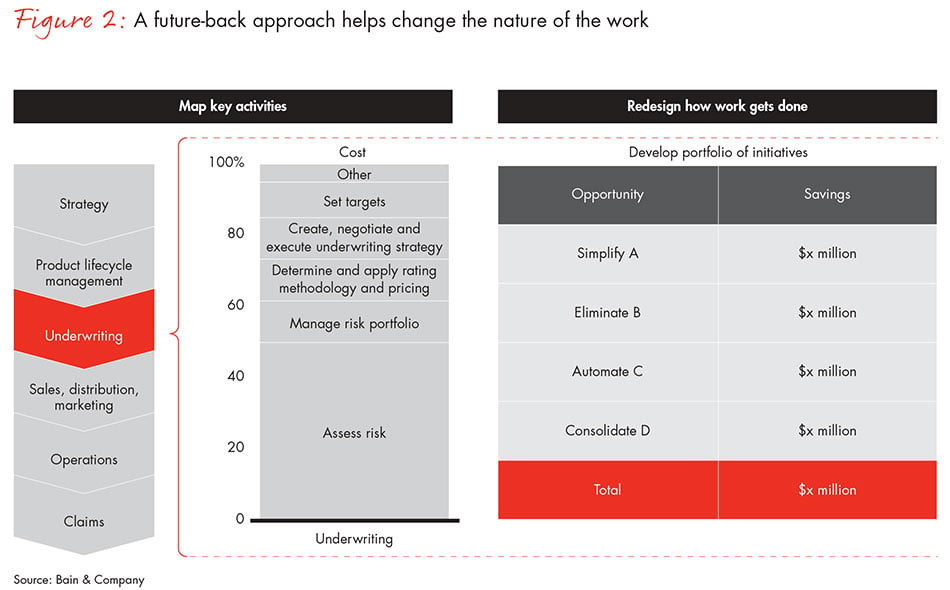
      The key to this exercise is to take a future-back approach. Rather than mapping the minutiae of current processes and attempting to refine them, start with the core elements of the value chain, project the future state of the market and the company’s desired position, and design how work should get done. This forces management to make breakthroughs in decision making and work processes.

      As part of a broader redesign of its operating model, one global insurer reviewed how pricing and underwriting decisions were made in individual countries. Applying a structurally agnostic lens to this question helped reveal the need for global oversight and control, as well as local (or national) authority. It became clear that the insurer did not need a regional layer in between. The company virtually eliminated the regional layer, saving cost and materially improving responsiveness to customers.

      A future-back approach could also highlight opportunities to make operational improvements. At another global insurer, executives envisioned how the underwriting operation would need to look in the future (see Figure 2). That led the firm to completely change how it prepared underwriting quotes. For example, rather than having senior underwriters oversee the entire process, junior staff could draw up the initial quotes and leave more complicated quotes for senior staff to review.

      global-insurers-too-big-to-succeed-fig02_embed

      2. Realign the operating model


      Once the core nature of the work has been defined, the next step is to overlay the appropriate operating model. Returning to the seams between departments, geographic units and lines of business, it’s important to define these seams in a way that reflects how the company creates value, promotes better decision making and balances operating-unit accountability with economies of scale. Realignment thus involves the way people interact across these seams. A decision made by the underwriting group has implications for the claims group and the agents. Similarly, a new approach by the audit group has implications for underwriting. Where two parts of the business don’t align, complexity abounds—and costs rise and customers suffer.

      The global insurer mentioned earlier found that different parts of its business needed substantial realignment. Senior management changed the structure of accountability for the core business units. Parts of operations that had previously been run as a separate vertical were brought under direct control of the unit, while the remaining operations shifted to a shared services group, in order to realize benefits of scale. To pull this off, the company clarified the relationship and accountability between business units and the shared services group. That ensured clear ownership of the businesses without fragmenting operations. The company sorted out a similar balance in other parts of the business.

      These and other changes to the operating model helped the insurer reduce costs by more than hundreds of millions annually while improving the overall experience for both customers and employees. Fewer layers led to better, faster decisions with less effort. And reducing the number of matrix reporting relationships allowed employees to spend more time on high-priority customer segments and initiatives.

      Many other global insurers, including AIG, Zurich and others, have publicly recognized the importance of redesigning the operating model—and not just adjusting the global reporting matrix—for cost reduction and performance improvement. But they are taking different routes on redesign.

      AIG, for example, has been overhauling its operating model to decentralize decision making, provide more accountability to business leaders and move to a more variable cost structure. The company is now realizing improvements in operating expenses and ROE.

      Zurich recently announced a reorganization that highlighted the importance of the regional management structure to improve customer relationships and reduce costs. CEO Mario Greco noted that the previous “fragmented structure” added to costs and made interactions with customers more complex; sometimes units within the company found themselves competing against one another.

      3. Sustain the change to keep complexity from creeping back


      Ultimately, a realigned operating model with simplified operations should put a company in a better position to sustain a lean stance over the long term. Of course, sustaining change is not easy. These shifts in organizational structure by major insurers underscore that complexity is an insidious enemy moving from products and geographies to customer segments, in an attempt to creep back into new seams. At a minimum, senior-level controls can be put in place, like elevating all new spending requests to the CFO. A permanent solution, though, involves building a culture obsessed with simplicity.

      To change behaviors accordingly, companies must introduce a mix of incentives and reinforcement. Leaders at all levels need to become aware of how their decisions can compound or add hidden complexity to the organization.

      Finally, what keeps a company on track to embrace simplicity is executives’ behaviors. Employees will be more motivated to resist adding bad costs and complexity when they see the senior team doing the same. With the entire organization focused on the simplest route to delighting customers, insurers raise the odds of accelerating profitable growth.

      Jed Fallis and Thomas Olsen are partners with Bain & Company’s Financial Services practice and are based in Toronto and Singapore, respectively. Ron Kermisch is a Boston-based partner with Bain’s Organization practice.


      global-insurers-too-big-to-succeed-fig01_full

      global-insurers-too-big-to-succeed-fig02_full
      Autoren
      • Headshot of Jed Fallis
        Jed Fallis
        Partner, Toronto
      • Headshot of Ron Kermisch
        Ron Kermisch
        Advisory Partner, Boston
      • Headshot of Thomas Olsen
        Thomas Olsen
        Partner, New York
      Kontaktieren Sie uns
      Verwandte Branchen
      • Finanzdienstleistungen
      Ähnliche Beratungsangebote
      • Organisation
      • Performance Improvement
      Wie wir Sie unterstützen können
      • Shared Services
      Finanzdienstleistungen
      Winning Operating Models for Global Insurance Companies

      Before tinkering with boxes and dotted lines, build the crucial bridge between the strategy and the detailed organization design.

      Mehr erfahren
      Versicherungswirtschaft
      Bain-Studie zur Kundenzufriedenheit in der Assekuranz: Global Edition 2016

      Noch lassen Deutschlands Versicherer großes Potenzial ungenutzt.

      Mehr erfahren
      Finanzdienstleistungen
      Thomas Olsen: Are Global Insurers Too Big to Succeed?

      Three ways insurers can successfully cut down on complexity.

      Mehr erfahren
      Finanzdienstleistungen
      How to Breathe New Life into Life Insurance

      Life insurers can reinvigorate themselves by setting bold goals, attacking legacy costs and investing in technology to drive a step change in efficiency and an improved customer experience.

      Mehr erfahren
      Finanzdienstleistungen
      Six Provocations to Future-Proof Your Bank

      From erosion of customers’ trust to disruption of the ecosystem, banks face a reckoning.

      Mehr erfahren
      First published in November 2016
      Markierungen
      • Finanzdienstleistungen
      • Organisation
      • Performance Improvement
      • Shared Services

      Wie wir unsere Kunden unterstützt haben

      Nachhaltigkeit Voluntary Carbon Markets: A Bank Moves Early to Seize the Opportunity

      Kundenbeispiel lesen

      Performance Improvement Lean Six Sigma solves a commercial bank's growth problem

      Kundenbeispiel lesen

      Informationstechnologie Bridging the Gap Between Business and Technology

      Kundenbeispiel lesen

      Möchten Sie mit uns in Kontakt bleiben?

      Wir unterstützen Führungskräfte weltweit, die kritischen Themen in ihrem Unternehmen zu adressieren. Gemeinsam schaffen wir nachhaltige Veränderungen und Ergebnisse.

      Bain Insights. Unsere Perspektive auf die kritischen Themen, mit denen sich international agierende Unternehmen konfrontiert sehen, finden Sie monatlich in Ihrem Postfach.

      *Ich habe die Datenschutzerklärung gelesen und akzeptiere sie.
      Bitte lesen Sie die Datenschutzerklärung und akzeptieren Sie diese.
      Bain & Company
      Contact us Sustainability Accessibility Rechtliche Hinweise Impressum Datenschutz Cookie-Richtlinie Sitemap Log In

      © 1996-2026 Bain & Company, Inc.

      Kontaktieren Sie Bain

      Wie können wir Ihnen helfen?

      • Business inquiry
      • Career information
      • Press relations
      • Partnership request
      • Speaker request
      Alle weltweiten Büros