
Skip to Content
  • オフィス

    オフィス

    北米・南米
    • Atlanta
    • Austin
    • Bogota
    • Boston
    • Buenos Aires
    • Chicago
    • Dallas
    • Denver
    • Houston
    • Los Angeles
    • Mexico City
    • Minneapolis
    • Monterrey
    • Montreal
    • New York
    • Rio de Janeiro
    • San Francisco
    • Santiago
    • São Paulo
    • Seattle
    • Silicon Valley
    • Toronto
    • Washington, DC
    ヨーロッパ・中東・アフリカ
    • Amsterdam
    • Athens
    • Berlin
    • Brussels
    • Copenhagen
    • Doha
    • Dubai
    • Dusseldorf
    • Frankfurt
    • Helsinki
    • Istanbul
    • Johannesburg
    • Kyiv
    • Lisbon
    • London
    • Madrid
    • Milan
    • Munich
    • Oslo
    • Paris
    • Riyadh
    • Rome
    • Stockholm
    • Vienna
    • Warsaw
    • Zurich
    アジア・オーストラリア
    • Bangkok
    • Beijing
    • Bengaluru
    • Brisbane
    • Ho Chi Minh City
    • Hong Kong
    • Jakarta
    • Kuala Lumpur
    • Manila
    • Melbourne
    • Mumbai
    • New Delhi
    • Perth
    • Shanghai
    • Singapore
    • Sydney
    • Tokyo
    全てのオフィス
  • アルムナイ
  • メディア
  • お問い合わせ
  • 東京オフィス
  • Japan | 日本語

    地域と言語を選択

    グローバル
    • Global (English)
    北米・南米
    • Brazil (Português)
    • Argentina (Español)
    • Canada (Français)
    • Chile (Español)
    • Colombia (Español)
    ヨーロッパ・中東・アフリカ
    • France (Français)
    • DACH Region (Deutsch)
    • Italy (Italiano)
    • Spain (Español)
    • Greece (Elliniká)
    アジア・オーストラリア
    • China (中文版)
    • Korea (한국어)
    • Japan (日本語)
  • Saved items (0)
    Saved items (0)

    You have no saved items.

    後で閲読、共有できるようにするためにブックマークしてください

    Explore Bain Insights
  • 業界別プラクティス
    メインメニュー

    業界別プラクティス

    • 航空宇宙、防衛、政府関連
    • 農業
    • 化学製品
    • インフラ、建設
    • 消費財
    • 金融サービス
    • ヘルスケア
    • 産業機械、設備
    • メディア、エンターテインメント
    • 金属
    • 採掘・鉱業
    • 石油、ガス
    • 紙、パッケージ
    • プライベートエクイティ
    • 公共、社会セクター
    • 小売
    • テクノロジー
    • 通信
    • 交通
    • 観光産業
    • 公益事業、再生可能エネルギー
  • 機能別プラクティス
    メインメニュー

    機能別プラクティス

    • カスタマー・エクスペリエンス
    • サステイナビリティ、 社会貢献
    • Innovation
    • 企業買収、合併 (M&A)
    • オペレーション
    • 組織
    • プライベートエクイティ
    • マーケティング・営業
    • 戦略
    • アドバンスド・アナリティクス
    • Technology
    • フルポテンシャル・トランスフォーメーション
  • Digital
  • 知見/レポート
  • ベイン・アンド・カンパニーについて
    メインメニュー

    ベイン・アンド・カンパニーについて

    • ベインの信条
    • 活動内容
    • 社員とリーダーシップ
    • プレス・メディア情報
    • クライアントの結果
    • 受賞歴
    • パートナーシップを結んでいる団体
    Further: Our global responsibility
    • ダイバーシティ
    • 社会貢献
    • サステイナビリティへの取り組み
    • 世界経済フォーラム(WEF)
    Learn more about Further
  • キャリア
    メインメニュー

    キャリア

    • ベインで働く
      キャリア
      ベインで働く
      • Find Your Place
      • ベインで活躍する機会
      • ベインのチーム体制
      • 学生向けページ
      • インターンシップ
      • 採用イベント
    • ベインでの体験
      キャリア
      ベインでの体験
      • Blog: Inside Bain
      • キャリアストーリー
      • 社員紹介
      • Where We Work
      • 成長を後押しするサポート体制
      • アフィニティ・グループ
      • 福利厚生
    • Impact Stories
    • 採用情報
      キャリア
      採用情報
      • 採用プロセス
      • 面接内容
    FIND JOBS
  • オフィス
    メインメニュー

    オフィス

    • 北米・南米
      オフィス
      北米・南米
      • Atlanta
      • Austin
      • Bogota
      • Boston
      • Buenos Aires
      • Chicago
      • Dallas
      • Denver
      • Houston
      • Los Angeles
      • Mexico City
      • Minneapolis
      • Monterrey
      • Montreal
      • New York
      • Rio de Janeiro
      • San Francisco
      • Santiago
      • São Paulo
      • Seattle
      • Silicon Valley
      • Toronto
      • Washington, DC
    • ヨーロッパ・中東・アフリカ
      オフィス
      ヨーロッパ・中東・アフリカ
      • Amsterdam
      • Athens
      • Berlin
      • Brussels
      • Copenhagen
      • Doha
      • Dubai
      • Dusseldorf
      • Frankfurt
      • Helsinki
      • Istanbul
      • Johannesburg
      • Kyiv
      • Lisbon
      • London
      • Madrid
      • Milan
      • Munich
      • Oslo
      • Paris
      • Riyadh
      • Rome
      • Stockholm
      • Vienna
      • Warsaw
      • Zurich
    • アジア・オーストラリア
      オフィス
      アジア・オーストラリア
      • Bangkok
      • Beijing
      • Bengaluru
      • Brisbane
      • Ho Chi Minh City
      • Hong Kong
      • Jakarta
      • Kuala Lumpur
      • Manila
      • Melbourne
      • Mumbai
      • New Delhi
      • Perth
      • Shanghai
      • Singapore
      • Sydney
      • Tokyo
    全てのオフィス
  • アルムナイ
  • メディア
  • お問い合わせ
  • 東京オフィス
  • Japan | 日本語
    メインメニュー

    地域と言語を選択

    • グローバル
      地域と言語を選択
      グローバル
      • Global (English)
    • 北米・南米
      地域と言語を選択
      北米・南米
      • Brazil (Português)
      • Argentina (Español)
      • Canada (Français)
      • Chile (Español)
      • Colombia (Español)
    • ヨーロッパ・中東・アフリカ
      地域と言語を選択
      ヨーロッパ・中東・アフリカ
      • France (Français)
      • DACH Region (Deutsch)
      • Italy (Italiano)
      • Spain (Español)
      • Greece (Elliniká)
    • アジア・オーストラリア
      地域と言語を選択
      アジア・オーストラリア
      • China (中文版)
      • Korea (한국어)
      • Japan (日本語)
  • Saved items  (0)
    メインメニュー
    Saved items (0)

    You have no saved items.

    後で閲読、共有できるようにするためにブックマークしてください

    Explore Bain Insights
  • 業界別プラクティス
    • 業界別プラクティス

      • 航空宇宙、防衛、政府関連
      • 農業
      • 化学製品
      • インフラ、建設
      • 消費財
      • 金融サービス
      • ヘルスケア
      • 産業機械、設備
      • メディア、エンターテインメント
      • 金属
      • 採掘・鉱業
      • 石油、ガス
      • 紙、パッケージ
      • プライベートエクイティ
      • 公共、社会セクター
      • 小売
      • テクノロジー
      • 通信
      • 交通
      • 観光産業
      • 公益事業、再生可能エネルギー
  • 機能別プラクティス
    • 機能別プラクティス

      • カスタマー・エクスペリエンス
      • サステイナビリティ、 社会貢献
      • Innovation
      • 企業買収、合併 (M&A)
      • オペレーション
      • 組織
      • プライベートエクイティ
      • マーケティング・営業
      • 戦略
      • アドバンスド・アナリティクス
      • Technology
      • フルポテンシャル・トランスフォーメーション
  • Digital
  • 知見/レポート
  • ベイン・アンド・カンパニーについて
    • ベイン・アンド・カンパニーについて

      • ベインの信条
      • 活動内容
      • 社員とリーダーシップ
      • プレス・メディア情報
      • クライアントの結果
      • 受賞歴
      • パートナーシップを結んでいる団体
      Further: Our global responsibility
      • ダイバーシティ
      • 社会貢献
      • サステイナビリティへの取り組み
      • 世界経済フォーラム(WEF)
      Learn more about Further
  • キャリア
    人気検索キーワード
    • デジタル
    • 戦略
    前回の検索
      最近訪れたページ

      Content added to saved items

      Saved items (0)

      Removed from saved items

      Saved items (0)

      Article

      A Proven Approach to Decarbonized Loan Portfolios

      A Proven Approach to Decarbonized Loan Portfolios

      Our four-part methodology helps banks align with the Paris Agreement and create value in the transition.

      著者:Christian Graf and Marjolijn Brakenhoff

      • min read

      Article

      A Proven Approach to Decarbonized Loan Portfolios

      At the October 31 – November 12, 2021, UN Climate Change Conference in Glasgow, climate scientists and world leaders are mapping the roads to a decarbonized future. Paving those roads, deal by deal over the coming decades, is a job that will largely fall to banking leaders.

      By financing new technology and infrastructure projects, banks will be crucial to reaching the Paris Agreement’s targets. Most banks are already chasing sustainable investment strategies. Scores of banks, including some of the world’s biggest, have signed on to the Net-Zero Banking Alliance.

      It’s a complex journey for any bank, fraught with blind spots and competing interests, but we can help. We have developed an end-to-end solution that balances sustainability with financial performance. While other accepted methodologies exist, they have weaknesses, leaving gaps in their assessments of the entire loan portfolio of a bank (including small and medium-sized enterprises).

      Our proven methodology, on the other hand, gives you clarity on your portfolio emissions and opens a pathway to decarbonization. Our four-part approach is applicable across any region or industry (see Figure 1).

      Figure 1
      Our end-to-end approach to portfolio decarbonization consists of four parts

      These four elements—namely, determining emissions targets, data scaling and monitoring, mitigation and client engagement, and portfolio optimization—are interrelated. Addressing them all in a careful sequence is therefore critical. Our multifaceted approach allows our clients to move quickly, setting the basis for future refinements while testing their alignment with their decarbonization goals.

      Determining emissions targets

      For any bank, the first step in the decarbonization process is understanding the emissions produced by a loan portfolio’s underlying assets, a process that involves advanced analytics.

      To measure a portfolio’s emissions footprint and create a pathway toward reducing that footprint, we use a combined top-down and bottom-up approach. From the top down, we take national targets and reduce them to sector and subsector levels in order to determine the fair share of responsibility for a given industry or company. And from the bottom up, we analyze the recipients of a bank’s loans and identify the key causes of their carbon emissions.

      Such data can be inconsistent, often covering only a small sample of a given portfolio. But we use improved data collection to triangulate the best possible set of numbers.

      Once we determine the emissions footprint of a given portfolio, we can use company goals, subsector benchmarks, and industry forecasts to determine the fair share of the targets being imposed upon them. This lets a portfolio manager know how many high-emissions assets would require mitigation measures to reach the bank’s overall goals.

      Data scaling and monitoring

      Decarbonization efforts depend largely on the effective use of expanded data sets. This gets easier every day as companies gather more objective data on energy and fuel use, lighting and heating, machinery and furnace emissions, and more. We help clients enrich those data sources and supplement them with secondary sources, such as government agencies and external vendors. The accuracy of these measurements will improve over time, requiring an adjustable model.

      We find that a lot of banks can do a lot more with manual data gathering as well. Account managers can assess their clients’ emissions by collecting information in sector-specific, fully digitalized annual questionnaires. Our teams also bring to the table a close working relationship with EcoVadis, the leading platform for environmental, social, and corporate governance (ESG) ratings and related supply chain improvement.

      Such data enrichment generates insights that can help banks identify opportunities for reducing greenhouse gas emissions. We help our banking clients design and implement dashboards to monitor these values and use them to steer portfolio decisions. This trend will continue as artificial intelligence augments the ways in which banks can monitor their client’s assets.

      Mitigation and client engagement

      Banks possess a unique power to foster green technologies and create transparency around emissions footprints. Impact loans and differential pricing are just two ways banks can incentivize their clients to adopt mitigation strategies. We’ve seen banks offer their clients lower interest rates and payment flexibility based on ESG achievements.

      Driving sustainability initiatives can benefit banks, not merely by generating new revenue streams; our research shows that less sustainable clients are roughly twice as likely to be in arrears than more sustainable ones. As shown in our recent brief, this was true even when controlling for initial risk ratings and other variables.

      We help our banking clients encourage mitigation strategies across their portfolios by prioritizing their initiatives based on impact and ease of implementation. Effective client engagement and communication are critical. We recommend that banks establish an ESG advisory desk to offer 360-degree value proposition to their clients, with potential advice on certifications, assessments, ratings, and more.

      Portfolio optimization

      With clear targets, enriched data, and mitigation strategies in place, we then help you settle upon a transition path that addresses the high-emissions underperformers in your portfolio and helps them transition to a more sustainable future.

      For example, in our experience, working closely with and in some cases offboarding the least sustainable 5% of clients in a portfolio can significantly improve its financial performance while also lowering its emissions intensity. The reduction of emissions correlates with lower default risk, which, in turn, increases average portfolio profitability (see Figure 2).

      Figure 2
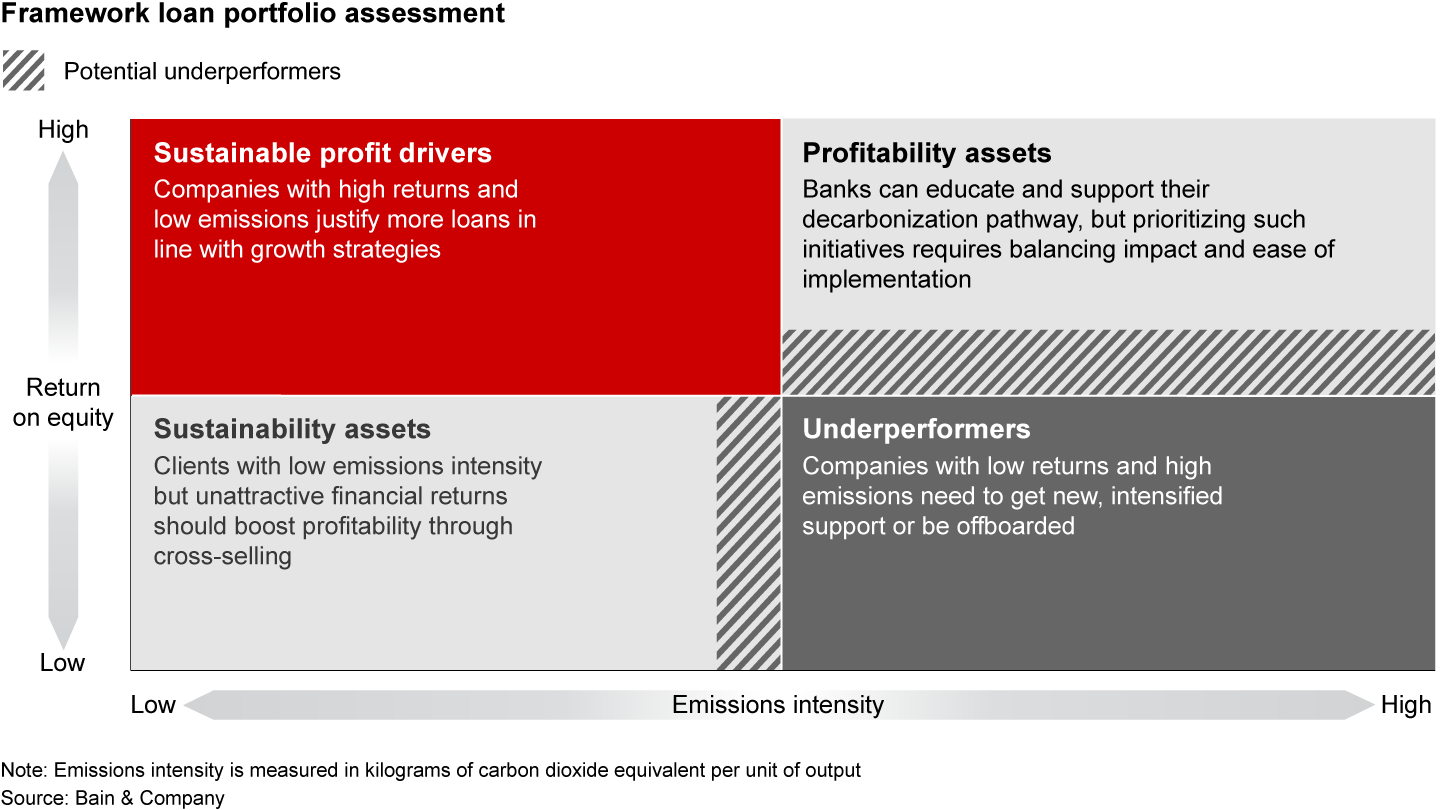
      Our framework supports creating a point of view on sustainability client optimization
      Our framework supports creating a point of view on sustainability client optimization
      Our framework supports creating a point of view on sustainability client optimization

      Toward a more sustainable future

      The race to decarbonize is accelerating across the banking industry. Europe's central banks have made funds available for ESG investment. Several regulatory bodies around the world are planning to require companies to report climate risk information, including the European Commission and the US Securities and Exchange Commission. The SEC's chairman said in July that such information could include "metrics related to greenhouse gas emissions."

      Another factor in the shift is investor demand as clients consider sustainability when choosing and promoting their banks. These trends point to a future in which banks will play a leading role in the global fight to reduce greenhouse gas emissions by the middle of this century.

      As the leading banks aim to get out in front of these trends, our four-part framework provides a pragmatic and comprehensive approach to decarbonizing loan portfolios. It covers parts of a bank’s portfolio that are overlooked by other approaches, and it proves that profitability and sustainability need not be seen as competing virtues.

      著者
      • Headshot of Christian Graf
        Christian Graf
        パートナー, Munich
      • Marjolijn Brakenhoff
        Alumni, Amsterdam
      関連業種
      • 金融サービス
      • 銀行
      関連するコンサルティングサービス
      • サステイナビリティ、社会貢献
      金融サービス
      Glass building with staggered terraces featuring green trees.
      Redesigning a Bank’s Climate Strategy for Growth

      By supporting its customers through the climate transition, this bank will create value for shareholders while meeting its climate goals.

      詳細
      金融サービス
      Hand inserting a card into an ATM machine.
      A Bold New Strategy Restores a Bank to a Leadership Position

      Its holistic approach to simplification, execution discipline, and digitalization has proved transformational.

      詳細
      サステイナビリティ、社会貢献
      Can Microchips Turbocharge Sustainability Improvement?

      NXP Semiconductor CEO Kurt Sievers on the role technology can play in helping companies achieve their environmental ambition.

      詳細
      金融サービス
      From Laggard to Leader: Desjardins Evolves Member Centricity for the Digital Age

      We helped this Canadian financial institution meet members’ rising expectations and radically improve its Net Promoter Score—and its bottom line.

      詳細
      金融サービス
      Voluntary Carbon Markets: A Bank Moves Early to Seize the Opportunity

      We helped BankCo define the market and draw a blueprint for its participation.

      詳細
      First published in 10月 2021
      Tags
      • サステイナビリティ、社会貢献
      • 金融サービス
      • 銀行

      クライアント支援事例

      Digital A European Banking Giant Rises to the Fintech Challenge

      ケーススタディを見る

      Further℠ Redesigning a Bank’s Climate Strategy for Growth

      ケーススタディを見る

      チェンジ・マネジメント The change process unlocks potential and profits

      ケーススタディを見る

      お気軽にご連絡下さい

      私達は、グローバルに活躍する経営者が抱える最重要経営課題に対して、厳しい競争環境の中でも成長し続け、「結果」を出すために支援しています。

      ベインの知見。競争が激化するグローバルビジネス環境で、日々直面するであろう問題について論じている知見を毎月お届けします。

      *プライバシーポリシーの内容を確認し、合意しました。

      プライバシーポリシーをご確認頂き、合意頂けますようお願い致します。
      Bain & Company
      お問い合わせ Sustainability Accessibility Terms of use Privacy Cookie Policy Sitemap Log In

      © 1996-2026 Bain & Company, Inc.

      お問い合わせ

      How can we help you?

      • ビジネスについて
      • プレス報道について
      • 採用について
      全てのオフィス