
Skip to Content
  • オフィス

    オフィス

    北米・南米
    • Atlanta
    • Austin
    • Bogota
    • Boston
    • Buenos Aires
    • Chicago
    • Dallas
    • Denver
    • Houston
    • Los Angeles
    • Mexico City
    • Minneapolis
    • Monterrey
    • Montreal
    • New York
    • Rio de Janeiro
    • San Francisco
    • Santiago
    • São Paulo
    • Seattle
    • Silicon Valley
    • Toronto
    • Washington, DC
    ヨーロッパ・中東・アフリカ
    • Amsterdam
    • Athens
    • Berlin
    • Brussels
    • Copenhagen
    • Doha
    • Dubai
    • Dusseldorf
    • Frankfurt
    • Helsinki
    • Istanbul
    • Johannesburg
    • Kyiv
    • Lisbon
    • London
    • Madrid
    • Milan
    • Munich
    • Oslo
    • Paris
    • Riyadh
    • Rome
    • Stockholm
    • Vienna
    • Warsaw
    • Zurich
    アジア・オーストラリア
    • Bangkok
    • Beijing
    • Bengaluru
    • Brisbane
    • Ho Chi Minh City
    • Hong Kong
    • Jakarta
    • Kuala Lumpur
    • Manila
    • Melbourne
    • Mumbai
    • New Delhi
    • Perth
    • Shanghai
    • Singapore
    • Sydney
    • Tokyo
    全てのオフィス
  • アルムナイ
  • メディア
  • お問い合わせ
  • 東京オフィス
  • Japan | 日本語

    地域と言語を選択

    グローバル
    • Global (English)
    北米・南米
    • Brazil (Português)
    • Argentina (Español)
    • Canada (Français)
    • Chile (Español)
    • Colombia (Español)
    ヨーロッパ・中東・アフリカ
    • France (Français)
    • DACH Region (Deutsch)
    • Italy (Italiano)
    • Spain (Español)
    • Greece (Elliniká)
    アジア・オーストラリア
    • China (中文版)
    • Korea (한국어)
    • Japan (日本語)
  • Saved items (0)
    Saved items (0)

    You have no saved items.

    後で閲読、共有できるようにするためにブックマークしてください

    Explore Bain Insights
  • 業界別プラクティス
    メインメニュー

    業界別プラクティス

    • 航空宇宙、防衛、政府関連
    • 農業
    • 化学製品
    • インフラ、建設
    • 消費財
    • 金融サービス
    • ヘルスケア
    • 産業機械、設備
    • メディア、エンターテインメント
    • 金属
    • 採掘・鉱業
    • 石油、ガス
    • 紙、パッケージ
    • プライベートエクイティ
    • 公共、社会セクター
    • 小売
    • テクノロジー
    • 通信
    • 交通
    • 観光産業
    • 公益事業、再生可能エネルギー
  • 機能別プラクティス
    メインメニュー

    機能別プラクティス

    • カスタマー・エクスペリエンス
    • サステイナビリティ、 社会貢献
    • Innovation
    • 企業買収、合併 (M&A)
    • オペレーション
    • 組織
    • プライベートエクイティ
    • マーケティング・営業
    • 戦略
    • アドバンスド・アナリティクス
    • Technology
    • フルポテンシャル・トランスフォーメーション
  • Digital
  • 知見/レポート
  • ベイン・アンド・カンパニーについて
    メインメニュー

    ベイン・アンド・カンパニーについて

    • ベインの信条
    • 活動内容
    • 社員とリーダーシップ
    • プレス・メディア情報
    • クライアントの結果
    • 受賞歴
    • パートナーシップを結んでいる団体
    Further: Our global responsibility
    • ダイバーシティ
    • 社会貢献
    • サステイナビリティへの取り組み
    • 世界経済フォーラム(WEF)
    Learn more about Further
  • キャリア
    メインメニュー

    キャリア

    • ベインで働く
      キャリア
      ベインで働く
      • Find Your Place
      • ベインで活躍する機会
      • ベインのチーム体制
      • 学生向けページ
      • インターンシップ
      • 採用イベント
    • ベインでの体験
      キャリア
      ベインでの体験
      • Blog: Inside Bain
      • キャリアストーリー
      • 社員紹介
      • Where We Work
      • 成長を後押しするサポート体制
      • アフィニティ・グループ
      • 福利厚生
    • Impact Stories
    • 採用情報
      キャリア
      採用情報
      • 採用プロセス
      • 面接内容
    FIND JOBS
  • オフィス
    メインメニュー

    オフィス

    • 北米・南米
      オフィス
      北米・南米
      • Atlanta
      • Austin
      • Bogota
      • Boston
      • Buenos Aires
      • Chicago
      • Dallas
      • Denver
      • Houston
      • Los Angeles
      • Mexico City
      • Minneapolis
      • Monterrey
      • Montreal
      • New York
      • Rio de Janeiro
      • San Francisco
      • Santiago
      • São Paulo
      • Seattle
      • Silicon Valley
      • Toronto
      • Washington, DC
    • ヨーロッパ・中東・アフリカ
      オフィス
      ヨーロッパ・中東・アフリカ
      • Amsterdam
      • Athens
      • Berlin
      • Brussels
      • Copenhagen
      • Doha
      • Dubai
      • Dusseldorf
      • Frankfurt
      • Helsinki
      • Istanbul
      • Johannesburg
      • Kyiv
      • Lisbon
      • London
      • Madrid
      • Milan
      • Munich
      • Oslo
      • Paris
      • Riyadh
      • Rome
      • Stockholm
      • Vienna
      • Warsaw
      • Zurich
    • アジア・オーストラリア
      オフィス
      アジア・オーストラリア
      • Bangkok
      • Beijing
      • Bengaluru
      • Brisbane
      • Ho Chi Minh City
      • Hong Kong
      • Jakarta
      • Kuala Lumpur
      • Manila
      • Melbourne
      • Mumbai
      • New Delhi
      • Perth
      • Shanghai
      • Singapore
      • Sydney
      • Tokyo
    全てのオフィス
  • アルムナイ
  • メディア
  • お問い合わせ
  • 東京オフィス
  • Japan | 日本語
    メインメニュー

    地域と言語を選択

    • グローバル
      地域と言語を選択
      グローバル
      • Global (English)
    • 北米・南米
      地域と言語を選択
      北米・南米
      • Brazil (Português)
      • Argentina (Español)
      • Canada (Français)
      • Chile (Español)
      • Colombia (Español)
    • ヨーロッパ・中東・アフリカ
      地域と言語を選択
      ヨーロッパ・中東・アフリカ
      • France (Français)
      • DACH Region (Deutsch)
      • Italy (Italiano)
      • Spain (Español)
      • Greece (Elliniká)
    • アジア・オーストラリア
      地域と言語を選択
      アジア・オーストラリア
      • China (中文版)
      • Korea (한국어)
      • Japan (日本語)
  • Saved items  (0)
    メインメニュー
    Saved items (0)

    You have no saved items.

    後で閲読、共有できるようにするためにブックマークしてください

    Explore Bain Insights
  • 業界別プラクティス
    • 業界別プラクティス

      • 航空宇宙、防衛、政府関連
      • 農業
      • 化学製品
      • インフラ、建設
      • 消費財
      • 金融サービス
      • ヘルスケア
      • 産業機械、設備
      • メディア、エンターテインメント
      • 金属
      • 採掘・鉱業
      • 石油、ガス
      • 紙、パッケージ
      • プライベートエクイティ
      • 公共、社会セクター
      • 小売
      • テクノロジー
      • 通信
      • 交通
      • 観光産業
      • 公益事業、再生可能エネルギー
  • 機能別プラクティス
    • 機能別プラクティス

      • カスタマー・エクスペリエンス
      • サステイナビリティ、 社会貢献
      • Innovation
      • 企業買収、合併 (M&A)
      • オペレーション
      • 組織
      • プライベートエクイティ
      • マーケティング・営業
      • 戦略
      • アドバンスド・アナリティクス
      • Technology
      • フルポテンシャル・トランスフォーメーション
  • Digital
  • 知見/レポート
  • ベイン・アンド・カンパニーについて
    • ベイン・アンド・カンパニーについて

      • ベインの信条
      • 活動内容
      • 社員とリーダーシップ
      • プレス・メディア情報
      • クライアントの結果
      • 受賞歴
      • パートナーシップを結んでいる団体
      Further: Our global responsibility
      • ダイバーシティ
      • 社会貢献
      • サステイナビリティへの取り組み
      • 世界経済フォーラム(WEF)
      Learn more about Further
  • キャリア
    人気検索キーワード
    • デジタル
    • 戦略
    前回の検索
      最近訪れたページ

      Content added to saved items

      Saved items (0)

      Removed from saved items

      Saved items (0)

      レポート

      10 Proven Actions to Advance Diversity, Equity, and Inclusion

      10 Proven Actions to Advance Diversity, Equity, and Inclusion

      Our research finds evidence that 10 specific tactics—some common, others underused—are particularly effective at advancing diversity, equity, and inclusion in the workplace.

      著者:Julie Coffman, Elyse Rosenblum, Andrea D'Arcy, and Laura Thompson Love

      • min read
      }

      レポート

      10 Proven Actions to Advance Diversity, Equity, and Inclusion
      en

      As America’s largest companies and their CEOs increasingly embrace a new leadership role in advancing racial equity, they face a confounding question: What really works? Despite decades of research and a growing corporate focus on diversity, equity, and inclusion (DEI) over the past few years, many executives are unsure what actions are most effective at increasing diverse representation, improving feelings of inclusion, or making progress on other DEI goals.

      Written in collaboration with

      Written in collaboration with

      GoLLogo-200-50.png


      Integrating DEI into organizational practices is nuanced, complex work—and relatively nascent. Robust, comparable multiyear DEI outcomes data is hard to come by. Even among those companies most committed to defining and measuring DEI progress, results take time, and there are few benchmarks against which to measure them.

      Many studies exist of specific employer DEI efforts or practices that have led to strong DEI outcomes, but parsing through that literature to make data-driven decisions is challenging. At Bain and at Grads of Life, we frequently hear C-suite leaders say, “I don’t know where to start,” or “the amount of information and tools is overwhelming.” Many simply want a blueprint for what’s been effective for other companies.

      To that end, we have developed a short list of the strongest evidence-based DEI actions, based on a thorough review of more than 100 research sources, primarily academic literature, and informed by our experiences supporting our clients and engaging with DEI thought leaders (see our methodology below).

      Ultimately, we found 10 actions worthy of increased employer attention and investment today:

      • Express C-suite commitment and formalize accountability

      • Adopt a skills-first approach to talent acquisition

      • Diversify talent pipelines through work-based experiences

      • Provide family-sustaining wages and benefits

      • Communicate skills-based career pathways

      • Offer voluntary DEI training for all

      • Listen to and learn from experiences of employees

      • Invest resources in cross-training and upskilling

      • Create mentoring and sponsorship programs

      • Build a diverse supply chain

      Each of the actions above resulted in one or more positive outcomes for an organization’s diverse or underrepresented talent, including:

      • improved rates of recruitment and hiring;
      • increased levels of representation in an organization;
      • increased feelings of engagement and belonging; and
      • increased rates of retention and internal promotion.

      We also examined how widely implemented these actions are, and, for those not yet widely implemented, we examined the biggest barriers to accelerating adoption. We evaluated these actions within a framework that spans all the core areas of business operations (see Figure 1).

      Figure 1
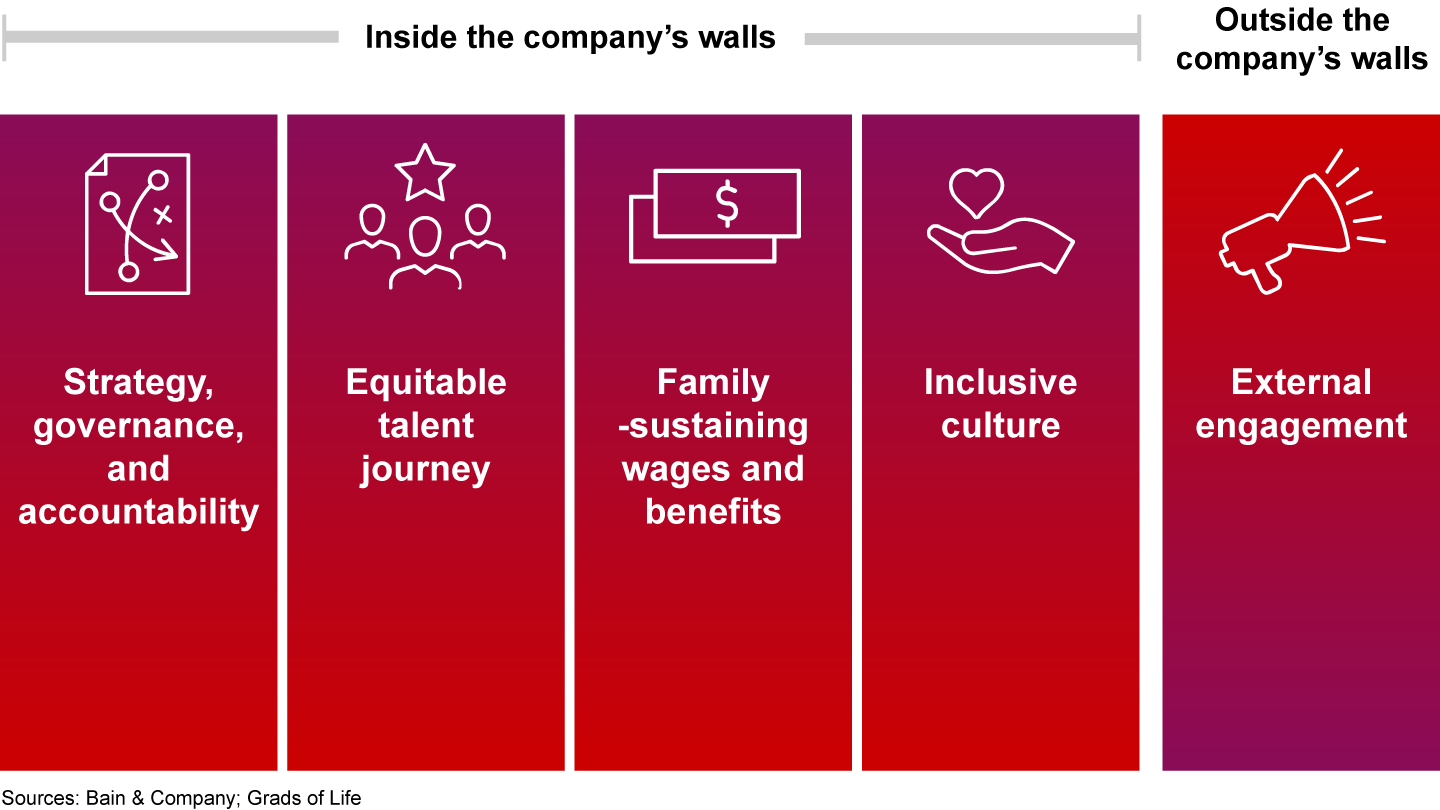
      The most effective diversity, equity, and inclusion strategies span key areas of business operations inside and outside of the company’s walls

      Our analysis also revealed that half of the 10 actions are not yet mainstream despite the strong research behind them. Employers should prioritize these actions and explore how to overcome potential barriers to implementation. The remaining actions are already quite common, yet companies need to be aware of important nuances in order to implement them effectively. While many employers already have experience with these actions, there are ways to connect them more effectively to DEI strategy and outcomes (see Figure 2).

      Figure 2
      The 10 most effective actions include 5 that are not yet mainstream and 5 that, though common, can often be deployed more effectively

      We also found that a combination of several, or all, of these actions is more powerful than any one action on its own. While many of these actions alone can drive improvements, when taken together, the actions are mutually reinforcing: The more you implement, the greater likelihood of seeing strong DEI outcomes. In conjunction with this report, Bain & Company and Grads of Life have released The DEI Opportunity Identifier, a self-assessment tool that allows companies to assess themselves against all the DEI actions described here as well as many others.

      Take the Assessment

      How Is Your Company Doing on Its DEI Journey?

      To assess your best opportunities to advance, explore this demo version of the DEI Opportunity Identifier built by Bain & Company and Grads of Life.

      In each of the individual action pages that comprise this report, we present a synthesis of insights from the research about the action, analyze what it takes to successfully implement each action, and explore why some of the actions are not yet pervasive among US employers despite their strong evidence base.

      How employers can take action

      Many employers have already articulated or expanded a commitment to diversity over the past year. There are several concrete ways employers can use the information in this report to help fulfill those commitments.

      • Connect and learn: Consider joining a local or national business coalition committed to adopting actions such as the ones articulated here. OneTen, the Business Roundtable’s Multiple Pathways Initiative, CEO Action for Diversity & Inclusion, and the New York Jobs CEO Council are all examples of corporate coalitions focused on taking action to increase equity through employment. Many of them engage in frequent peer learning, knowledge sharing, tool development, and, in some cases, technical assistance on implementation.
      • Assess and invest: Explore which of the 10 key actions outlined in this report are ripe for further investment at your company. While these actions are defined to be universally applicable to companies of all sizes and industries, DEI looks different at every company, and each company is at a different place on its DEI journey; individual context remains essential in analyzing what to do from here. We encourage employers to conduct a self-assessment on progress against goals using the Opportunity Identifier and to explore ways to apply the evidence-based actions described here to their organizations.
      • Measure and report: Similar to most business strategies, DEI comes with continuous learning and improvement. There is still much to discover about the nuanced approaches to these actions that are most effective in driving results. We encourage employers to rigorously measure outcomes of each intervention and, where possible, report on those outcomes to employees, researchers, and other employers to help inform working knowledge in this field.

      How investors can take action

      Investors are increasingly interested in, and demanding, meaningful human capital data as one means of assessing a corporation’s total value. Over the past two years, a global outcry for racial justice, coupled with the effects of the Covid-19 crisis, have resulted in increased scrutiny from investors, consumers, and other stakeholders on environmental, social, and corporate governance factors that help paint a picture of a company’s total social impact. We encourage investors to use the data and evidence in this report to monitor and measure key human capital actions and their outcomes among the companies in which they invest and to use their position to influence companies to be more transparent on DEI data.

      We hope that other stakeholders, including members of the philanthropic community, grassroots organizers, and policymakers, also find value in the findings summarized here and will take the opportunity to share relevant insights with their networks. Investments into DEI have positive effects that go far beyond the four walls of a corporation; they ultimately lead to greater community and national prosperity and well-being.

      This report would not have been possible without the significant research, analysis, writing and editing support of Kelly Graham, Joana Ortiz, Alanna Rodgers, and Nandita Jariwala. We thank them for their significant contributions.

      About Grads of Life

      We work with leading employers to create inclusive talent strategies that deliver both social impact and business benefits. Through our data-driven approach, we help companies understand their current positioning and create customized engagements to help them achieve their goals.

      Further - Our Global Responsibility

      Further is our collective ambition to create a more sustainable, equitable, and inclusive world. A journey to transform businesses and communities for the better.

      • Appendix: Our methodology

        To arrive at the list of research-backed actions presented in this report, we began with nearly 200 actions that we believed, through our own expertise and knowledge of the literature, positively influenced DEI outcomes. We reviewed more than 100 academic research sources, drawing primarily on 3 groups of literature: DEI research, academic and business literature on frontline workers of color, and literature on “good jobs” or “quality jobs.”

        To be included in our study, a practice must demonstrate at least one “positive DEI outcome” for businesses with respect to supporting diverse talent. “Diverse talent” is a broad set of distinct employee groups defined by specific demographic characteristics, including but not limited to individuals who are women, racially diverse, LGBTQ and/or gender nonconforming, employees with disabilities, and military veterans. Many of the research sources we reviewed focused specifically on Black, Latinx, and women employees.

        Positive DEI outcomes are defined as:

        • improved rates of recruitment and hiring of diverse talent;
        • increased levels of representation of diverse talent within an organization;
        • increased feelings of engagement and belonging among diverse talent; and
        • increased rates of retention and internal promotion among diverse talent.

        The actions covered in this report represent a synthesis of the 200 initial actions considered. We combined several granular actions to improve readability and action orientation.

        Pervasiveness

        We define pervasiveness as follows:

        • more common—practice observed in greater than 50% of companies from available sources;
        • less common—practice observed in less than 50% of companies from available sources.

        We reviewed four sources of data to arrive at our understanding of pervasiveness:

        • Just Capital’s Corporate Racial Equity Tracker, a publicly available online database with analysis of the 100 largest companies and the prevalence of 22 data points related to racial equity, roughly half of which are reflected in this report;
        • a 2020 survey of more than 500 Year Up alumni describing experiences of young adults moving to a virtual work environment and broader observations on actions implemented by their employers related to DEI;
          • (This survey was fielded in October 2020 among Year Up’s 18,000 alumni, largely millennials and Gen Zers, who are representative of the full American experience. We received 552 completed survey responses from alumni with varying backgrounds. Respondents were 56% male and 42% female, with 98% being between 20 and 38 years old. The majority were nonwhite, with 40% identifying as Black or African American, 32% as Hispanic or Latino, 14% as Asian, 5% as white, and 4% as two or more races.)
        • data from more than 500 entries on the Opportunity Navigator, a free and publicly available self-assessment tool created by Grads of Life and Talent Rewire that invites self-assessment on key actions related to diversity, equity, and inclusion, 100% of which are reflected in this report; and
        • after reviewing these three sources, we added an additional layer of analysis based on our respective client work and anecdotal observation of pervasiveness.

        Limitations and key assumptions

        The actions included in this report may not represent the only actions with a strong evidence base, and we encourage and invite feedback and suggested additions based on additional literature and academic insight.

        We recognize that our calculation of pervasiveness is an imperfect measure and that the sources referenced are a sample of companies but not an exhaustive review.

        We additionally acknowledge our bias in the analysis of actions, including the “why it works” and the “adoption curve” sections. As consultants working with organizations on DEI strategy for more than 20 years, we recognize that our experiences and anecdotal observations working in partnership with companies inherently influence our analysis of each practice.

        Finally, we recognize that understanding what drives DEI outcomes is, overall, still a nascent academic field. We have been advised by several leading academics in this space that there is still much to uncover about which contextual factors and sets of actions lead to improvements over time, and ultimately, employer willingness to share their experiences with these actions, along with their outcomes data, is a key necessary step in improving the body of literature further.

      著者
      • Headshot of Julie Coffman
        Julie Coffman
        パートナー, Chicago
      • Elyse Rosenblum
        Managing Director and Founder, Grads of Life, Boston
      • Headshot of Andrea D'Arcy
        Andrea D'Arcy
        パートナー, Boston
      • Laura Thompson Love
        Senior Director, Thought Leadership and Content, Grads of Life, Boston
      関連するコンサルティングサービス
      • Diversity, Equity & Inclusion
      CEO Insights: The Talent Imperative
      The Business of Belonging

      Why making everyone feel included is smart strategy.

      詳細
      CEOアジェンダ
      Future-Proofing Your Organization

      Prepare your team to stay ahead in the post-pandemic world.

      詳細
      Diversity, Equity & Inclusion
      POWERful Women's Annual State of the Nation 2025

      Bain & Company collaborated with POWERful Women on their annual report on female representation in the UK energy industry.

      詳細
      CEOアジェンダ
      Stars Come Out in a Crisis; Don’t Let Them Fade

      Faced with Covid-19, companies have put their best talent on their most critical projects; continuing that will be critical.

      詳細
      Diversity, Equity & Inclusion
      Unlocking China's Female Leadership Potential: An Actionable Path Forward

      Closing the workplace gender gap creates a more prosperous future for everyone.

      詳細
      First published in 8月 2021
      Tags
      • CEO Insights: The Talent Imperative
      • CEOアジェンダ
      • Diversity, Equity & Inclusion

      クライアント支援事例

      顧客戦略、マーケティング Inspiring retail employees to think and act like owners

      ケーススタディを見る

      戦略 Jump-starting innovation for a telecom solutions provider

      ケーススタディを見る

      業績改善 Lean Six Sigma solves a commercial bank's growth problem

      ケーススタディを見る

      お気軽にご連絡下さい

      私達は、グローバルに活躍する経営者が抱える最重要経営課題に対して、厳しい競争環境の中でも成長し続け、「結果」を出すために支援しています。

      ベインの知見。競争が激化するグローバルビジネス環境で、日々直面するであろう問題について論じている知見を毎月お届けします。

      *プライバシーポリシーの内容を確認し、合意しました。

      プライバシーポリシーをご確認頂き、合意頂けますようお願い致します。
      Bain & Company
      お問い合わせ Sustainability Accessibility Terms of use Privacy Cookie Policy Sitemap Log In

      © 1996-2026 Bain & Company, Inc.

      お問い合わせ

      How can we help you?

      • ビジネスについて
      • プレス報道について
      • 採用について
      全てのオフィス