

論説

Big Data and analytics may be new to some industries, but the oil and gas industry has long dealt with large quantities of data to make technical decisions. In their quest to learn what lies below the surface and how to bring it out, energy companies have, for many years, invested in seismic software, visualization tools and other digital technologies.
Now, the rise of pervasive computing devices—affordable sensors that collect and transmit data—as well as new analytic tools and advanced storage capabilities are opening more possibilities every year. Oil producers can capture more detailed data in real time at lower costs and from previously inaccessible areas, to improve oilfield and plant performance. For example, they can pair real-time down-hole drilling data with production data of nearby wells to help adapt their drilling strategy, especially in unconventional fields.
These analytic advantages could help oil and gas companies improve production by 6% to 8%. Bain finds that these advantages are typical of those found for companies across industries. Our survey of more than 400 executives in many sectors revealed that companies with better analytics capabilities were twice as likely to be in the top quartile of financial performance in their industry, five times more likely to make decisions faster than their peers and three times more likely to execute decisions as planned.
Analytical leaders, however, are still the exception. Our survey showed that only about 4% of companies across industries have the capabilities to use advanced data analytics to deliver tangible business value. While some oil and gas companies have invested in their analytics capabilities, many struggle to get their arms around this powerful new opportunity.
We often find that senior executives understand the concepts around Big Data and advanced analytics, but their teams have difficulty defining the path to value creation and the implications for technology strategy, operating model and organization. Too often, companies delegate the task of capturing value from better analytics to the IT department, as a technology project.
In practice, a business unit should lead the effort because it requires cross-functional ownership and participation. Some companies commit to ambitious technology transformations in search of analytic nirvana, but these transformations may feel like a 10-year march and often fail to generate enough value along the way.
At the moment, advanced analytics applications in the oil and gas industry tend to focus on cost-reduction efforts. However, Bain Principal Hasan Shafi predicts that in the future, these capabilities will be utilized in key decision-making processes. In order to apply advanced analytics effectively, companies must get three things right.
Our experience shows that developing the capability to produce value from advanced data analytics is a C-level agenda item, requiring the sustained focus of the senior management team—not just the CIO or CTO. Three critical questions should form the basis of an effective advanced-data analytics strategy:
- Which applications of Big Data will produce the most value for our company?
- Which organizational model will help us achieve that value?
- Do we have the right capabilities and talent to make the most of our data?
Which applications of Big Data will produce the most value?
Not all data is Big Data, of course, and not all analytics require the horsepower and organizational model that Big Data applications typically require. Still, advanced analytics can play an important role in improving productivity in unconventionals, conventionals and midstream operations in oil and gas.
Unconventionals. Because of the vast number of wells required in unconventional production and the speed with which producers construct them, data plays a critical role in the decisions that create value. Operators make decisions every day in the field, typically with limited involvement by central functions. Analytic capabilities help producers collect and analyze data on subsurface and geographic characteristics to improve their ability to characterize shale basins in detail, with less trial and error. We see three areas in particular where advanced analytics capabilities can help give producers an edge:
- Geology interpretation. Analyzing the geology below the surface and comparing it against well performance can help companies improve their ability to characterize shale basins with less trial and error.
- New well delivery. Better analytics can improve the way companies manage the entire process of drilling and connecting a well, reducing lag time and minimizing the number of wells in process at a time. For example, transmitting microseismic, 3D imaging over fiber-optic cables can improve new well delivery performance.
- Well and field optimization. Collecting and analyzing massive volumes of geologic, operational and performance data, each with many variables constantly changing, can help companies improve and optimize drilling parameters, well spacing and completions techniques, especially as they drill more wells and bring them online.
Conventionals. Fewer decisions and wells are involved, but producers can still improve performance with access to more data than they had before. They can also move beyond measurement into predictive tools with a range of pattern-recognition techniques that help them spot trends, intervene early and create repeatable solutions with predictable outcomes. For example, sensors deep in the wells or on drilling equipment send a constant stream of information that can help producers understand if or when a piece of equipment might fail. As these sensors become less expensive, their numbers grow into the thousands and beyond, generating large volumes of information. Integrating this data into operations improves calibration and visualization capabilities, reducing technical risks.
Midstream. Data analytics can help monitor pipelines and equipment and allow a more predictable and precise approach to maintenance. For example, sensors can indicate when equipment comes under unusual stress, allowing operators to perform preventive shutdowns or interventions that may avoid accidents or spills. By way of illustration, a leading compressor manufacturer developed custom sensor models and used predictive analytic software to actively monitor the readings provided from these sensors, which has helped it schedule preventive maintenance of equipment for its midstream customers.
Which organizational model will help capture that value?
Knowing the value inherent in better analytics is just the start. How should oil and gas executives define an organizational model—including the right structure, processes and decision rights—that will encourage timely, cross-functional collaboration and put the right data in the hands of decision makers?
Many oil and gas companies rely on operating models that focus on functional excellence, and they develop clear handoffs from one function to the next. This works well for predictable processes that follow moderate schedules. But the model breaks down when decisions must be made quickly—as in unconventional production. The handoffs for any given shale well can involve functions like geology, drilling, completions, construction, land, regulatory and production, and any of these may be involved at different points of the well construction process. Operators might have hundreds of wells active or in development, putting the functional model under significant strain.
Consider, for example, the new well delivery process, where performance metrics such as the time from spud to hookup or the dead time between steps require visibility into activity data from each function involved. If the functions (including land, regulatory, pad construction, drilling, completions and operations) run on different systems and rely on differently constructed data models, it becomes very difficult to have a clear, integrated view of what is happening in the field.
Some companies address this challenge by deploying an asset-based organizational model, rather than a functional one. In this model, all the key functions are deployed in the field and report into one geographically based organizational structure. In our experience, the model works well at the site or division level, but may not scale to the level of a large international organization.
This kind of fast-paced, decision-driven environment requires better planning, which is also a precondition for, and a benefit of, better data and the advanced analytics capabilities that can make sense of it. Companies with more advanced analytics capabilities are more efficient in managing the range of data (including seismic, drilling logs, operational parameters such as drill bit RPMs and weight on bit, frack performance data and production rates) that help optimize well design and production. Each function may have a lot of data, but unless the operating model can weave it together and place a “single version of the truth” in the right hands at the right time, it is difficult to improve performance.
Regardless of which model a company operates under, executives need to create a pathway for collaboration among functions, with better systems and processes that allow not only for rapid and integrated sharing of data, but also for organized decision making with clear lines of accountability.
Do we have the right capabilities and talent to make the most of our data?
Companies that build better analytics capabilities concentrate their efforts in three areas: technology architecture, interaction between IT and the business, and hiring and retaining strong analytic talent.
Technology architecture. As in other industries, many oil and gas companies have complex, legacy IT systems that have evolved over decades, and which now contain many different islands of disparate data sets. Adding real-time, unstructured, large volumes of data multiplies the problem—but that’s where valuable insights arise.
In oil and gas, key understandings emerge from linking various types of data to a well or set of wells. The business side sometimes underestimates how difficult this can be. Many systems lack unique well identification numbers, which are essential for tracking the metadata on each well. It’s not always clear who should assign the ID—the reservoir engineers, the regulatory department or the land department.
In addition, many systems prioritize financial tracking and reporting, and barriers may exist between these and the operational systems that collect and manage important geologic and performance data. Wells need clear designations that are consistent across systems, but often the data remains isolated in financial and operational silos. In other words, most companies design these systems for the financial needs of the center, rather than the operational needs of the field.
But companies can become more nimble and effective by carefully focusing their IT investments on the most critical areas and saying no to requests that fall outside that focus. Some organizations with significant legacy investments take a two-track approach that includes a long-term plan to modernize the entire IT stack while allowing a well-funded (but well-bounded) separate program that moves quickly on the most important opportunities. For example, one leading international oil company implemented a sophisticated Hadoop analytic platform on Amazon Web Services’ cloud infrastructure and limited the touchpoints with its legacy technology infrastructure—a strategy that helped keep it cost-effective and agile.
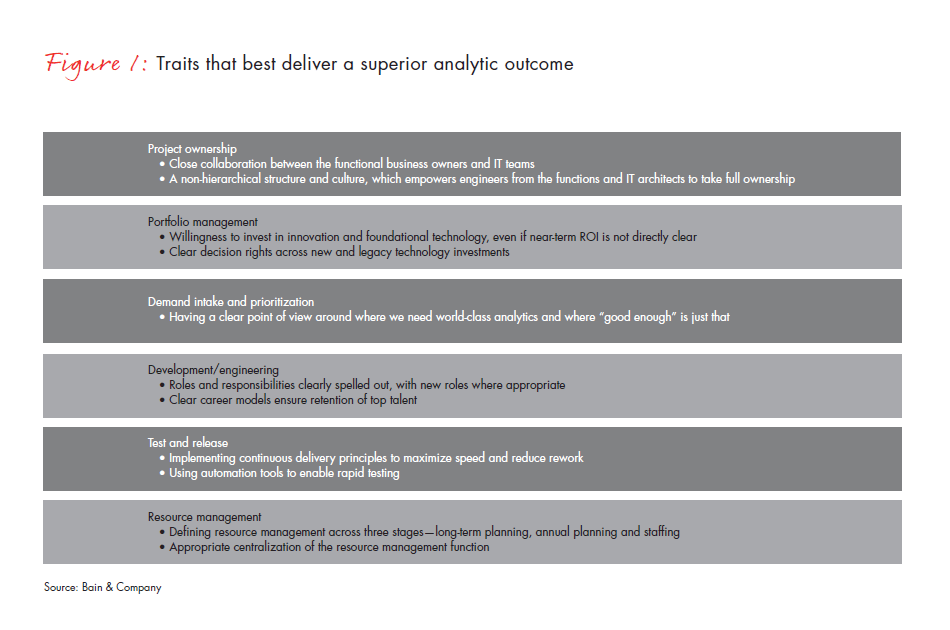
Business-IT engagement. The IT functions in most oil and gas companies were designed to automate back-office support functions as cost-effectively as possible. To the extent that IT enabled the business, it did so in steady, well-scoped and largely predictable projects that didn’t require quick and cross-functional collaboration.
As that’s changing, IT should organize around decisions rather than functionally siloed processes (see Figure 1). This relationship between IT and the business should evolve into a real-time collaboration with less friction. Clearly the solution is not to build a siloed unit focused on the Big Data opportunity. For analytics to have a significant effect on the company’s performance, it must be integrated into day-to-day operations.
Analytic talent. Analytic talent is a scarce resource and the talent profile in demand is not typically found within oil and gas IT functions. IT organizations historically hired talent that had product expertise in business intelligence (BI) tools, or they hired or outsourced talent to produce periodic and mostly static BI reports and to run back-office systems. Typically, the geologists and engineers employed by the functions do not have expertise in the latest analytic tools.
What’s more, the IT talent issue in most oil and gas companies extends to the architecture group. As cloud and open-source architectures become more popular, IT groups may find themselves less familiar with the latest technologies and, more importantly, may not feel empowered to make the changes that best-in-class companies are embracing.
But oil and gas executives should avoid the temptation of trying to solve this issue just by throwing high-priced analytic labor at the problem. The right talent model should balance industry knowledge with analytic skills in a model focused on solving specific problems and identifying new opportunities. This capabilities upgrade should include people who understand open-source models, cloud technologies, pervasive computing and iterative development methodologies. Executives should keep in mind their goal of a model that enables better collaboration among domain experts, IT architects, tool specialists and experienced analytic resources.
Oil and gas companies will need to improve their analytics capabilities in order to compete in an industry where decisions are moving faster and the stakes are growing ever higher. Creating a world-class analytics capability takes time and investment, and it can only happen with a sustained focus by top management. Senior executives should avoid delegating this challenge to their IT function; rather, they should work closely with IT leaders to transform their companies into data-driven organizations. Now is the time to develop a plan that maps an organization’s ambitions against its capabilities—and describes the path toward a world-class, advanced analytics capability.
Vishy Padmanabhan is a partner in Bain & Company’s Dallas office. He works with the firm’s Global Oil & Gas practice, and is also a member of the Global IT practice.
First published in 3月 2014