

論説

Just about every leadership team we know is wrestling with one big question: How can data and analytics create real value and defend us from disruption? After all, no CEO wants to be "Netflix’ed" or "Amazon’ed."
As companies’ data balloons, signs of analytics-based innovation are appearing across industries, and the application of machine learning, robotics and automation are fast becoming reality. Even the most analog of companies are scrambling to invest in analytics. Their hopes are high, their investments substantial; but the results have been inconsistent at best.
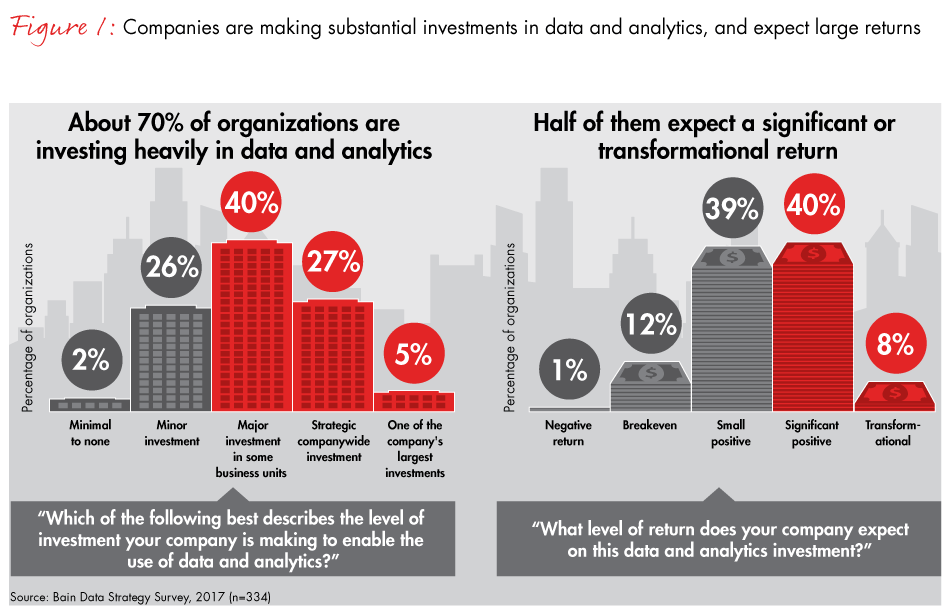
In a recent Bain survey of 334 executives, more than two-thirds said their companies were investing heavily in Big Data. Not surprisingly, 40% expected to see a "significantly positive" impact on returns, with another 8% predicting "transformational" results (see Figure 1).
Chris Brahm, who leads Bain's global Advanced Analytics practice, shares six principles, which if implemented correctly, can help companies reach their full potential of advanced analytics.
Despite these high expectations, 30% of these executives said they lack a clear strategy for embedding data and analytics in their companies. In our experience, too many companies focus on investing in the technology and talent associated with advanced analytics, without thinking through the broader changes they will need to make to fully deploy analytics and get favorable results.
Data and analytics believers love to cite how Netflix deftly uses analytics to personalize the user experience and secure some of the most popular entertainment content available today, elevating its cachet in the market. Incumbent companies are also using advanced analytics to transform their business models. Think of Progressive Insurance and its plug-in car devices that allow customers to earn discounts for safe driving, or Walt Disney World’s colorful MagicBands, which have transcended their customer-tracking mission to serve as Instagram-friendly symbols of a special vacation just waiting to happen.
These success stories leave late adopters wondering what big steps they can take to catch up. Many will rush to invest in the latest analytics software and infrastructure vendors and hire data scientists, but the ultimate winners will align these investments with their strategic and organizational needs in ways that lead to action and results. For a company trying to figure out how to succeed, here’s what we recommend:
Put business science before data science. A company’s advanced analytics goals should reflect the company’s broader aims, allowing it to amplify its most profitable products, services and processes. Coca-Cola, for example, has been using sophisticated social listening tools to spot influencers who could help the company promote its signature brand to key customer groups. Healthcare providers have deployed predictive analytics to direct preventative care, yielding better patient outcomes and lower costs.
Design the analytics with "the last mile" of adoption in mind. The best analytics solutions emerge when data scientists and business stakeholders work together, set success requirements early and keep end users central to decisions. As the team makes critical design choices, such as the right analytics method, members will need to consider how end users will act on those results. Unstructured data and machine learning are in the vanguard today, but they're not always the most intuitive options for frontline employees who handle nuanced customer situations in tight time frames. Sometimes the analytics simply get in the way of organizational dynamics. In many retail organizations, for example, merchants routinely override sophisticated local store assortment algorithms. This might be the right answer in some cases, but if an organization is going to invest in analytics innovation, it should anticipate and plan through the potential barriers to adopting the output of those investments.
Look well beyond the traditional analytics. Companies have long relied on structured enterprise data from their core systems and trade sources to inform their decision making. Now, more companies are experimenting with unstructured data from social media, web scraping, customer interaction transcripts, log files, sensor data, images and other publicly available content. Insurers, for example, are tapping new data sources to help them evaluate risk, just as sharing-economy companies use social media and web data to identify customers that might harm their brands. Advanced machine learning techniques are also helping companies automate even sophisticated processes that only knowledge workers previously handled. Simply put, the bar for what constitutes a competitive analytics capability in most businesses is rising.
Find the shortest path from insight to action. More data isn’t necessarily better. In fact, it’s often the opposite. Rather than collecting more data, most companies would gain more from maximizing the yield on their existing data and becoming nimble enough to act on insights quickly. After all, the value comes from the action and not the input. To illustrate the difference, compare a major airline that sends the same generic customer survey to its most valuable customers after every flight with one that uses its operational data to identify customers on a delayed flight so that it can send a preemptive apology and coupon. The former airline collects the same performance data; it’s just not using it. The latter one is mobilizing existing data to build loyalty.
Test, learn and iterate. The savviest companies don’t wait until they have the perfect analytics solution in place. They jump in and pilot their new approaches on real customers and processes, even if their tools are barely viable, and then they continuously hone them. This agile approach represents a huge shift for companies used to slower, waterfall-based processes that aim for "perfect" analytic results—a virtually impossible goal the first time out. Algorithms are never perfect; they’re designed to adapt as new information emerges. Consider how far e-commerce recommendation engines have come. A few years ago, these engines would serve pointless toy recommendations to a customer who recently bought a doll for the birthday of a friend’s child. Companies spotted these missed opportunities, updated their algorithms to tune out one-time purchases, and now can recommend products that more closely reflect customers’ interests, increasing the odds of a sale.
Manage the advanced analytics transition with purpose. Advanced analytics will take a company only so far if it lacks a sound operating model to bridge strategy and execution across departments and functions. Senior managers must define who does the work and how, and what capabilities the company needs, both in talent and technology. Executives will wrestle with how much to centralize their analytics capabilities, governance and operations. They’ll weigh the potential use of data at the front line against the technology and data infrastructure investments those efforts require. And they will revisit these questions as business needs evolve. Even analytics leaders such as Facebook and Google have changed their operating models over time, adjusting the level of central vs. distributed leadership and activity as their needs change.
The amount of available data is expected to almost double between now and 2020, when it will likely hit 44 zetabytes, according to IDC Digital Universe. The scale, scope and complexity of the data and the businesses that use it have bypassed the ability of humans to process it without intelligent automation. Advanced analytics is simply not an option—it is an imperative for any large organization.
One e-commerce CEO summed it up: "We are a small company, but we have 30K SKUs. Just to price those intelligently, and not by the same rudimentary ‘cost-plus’ factor, would literally take 100% of our people capacity. Yet with advanced analytics, I can price an SKU based on how many competitors carry that SKU, how they price it, how much it costs, and we can even factor in the past behaviors and value of an individual customer who might be looking at that particular SKU—and that is almost all automated. These advances in analytics have enormous economic leverage in my business."
Companies must respond to the advanced analytics imperative. This means closing any results gaps and reducing the "time to measurable impact" from their analytics investments. With a pragmatic approach, companies can realize the full potential of advanced analytics.
Chris Brahm is a partner who leads Bain & Company’s global Advanced Analytics practice. Lori Sherer is also a partner on the Advanced Analytics practice. Both are based in San Francisco.
First published in 8月 2017