
Skip to Content
  • オフィス

    オフィス

    北米・南米
    • Atlanta
    • Austin
    • Bogota
    • Boston
    • Buenos Aires
    • Chicago
    • Dallas
    • Denver
    • Houston
    • Los Angeles
    • Mexico City
    • Minneapolis
    • Monterrey
    • Montreal
    • New York
    • Rio de Janeiro
    • San Francisco
    • Santiago
    • São Paulo
    • Seattle
    • Silicon Valley
    • Toronto
    • Washington, DC
    ヨーロッパ・中東・アフリカ
    • Amsterdam
    • Athens
    • Berlin
    • Brussels
    • Copenhagen
    • Doha
    • Dubai
    • Dusseldorf
    • Frankfurt
    • Helsinki
    • Istanbul
    • Johannesburg
    • Kyiv
    • Lisbon
    • London
    • Madrid
    • Milan
    • Munich
    • Oslo
    • Paris
    • Riyadh
    • Rome
    • Stockholm
    • Vienna
    • Warsaw
    • Zurich
    アジア・オーストラリア
    • Bangkok
    • Beijing
    • Bengaluru
    • Brisbane
    • Ho Chi Minh City
    • Hong Kong
    • Jakarta
    • Kuala Lumpur
    • Manila
    • Melbourne
    • Mumbai
    • New Delhi
    • Perth
    • Shanghai
    • Singapore
    • Sydney
    • Tokyo
    全てのオフィス
  • アルムナイ
  • メディア
  • お問い合わせ
  • 東京オフィス
  • Japan | 日本語

    地域と言語を選択

    グローバル
    • Global (English)
    北米・南米
    • Brazil (Português)
    • Argentina (Español)
    • Canada (Français)
    • Chile (Español)
    • Colombia (Español)
    ヨーロッパ・中東・アフリカ
    • France (Français)
    • DACH Region (Deutsch)
    • Italy (Italiano)
    • Spain (Español)
    • Greece (Elliniká)
    アジア・オーストラリア
    • China (中文版)
    • Korea (한국어)
    • Japan (日本語)
  • Saved items (0)
    Saved items (0)

    You have no saved items.

    後で閲読、共有できるようにするためにブックマークしてください

    Explore Bain Insights
  • 業界別プラクティス
    メインメニュー

    業界別プラクティス

    • 航空宇宙、防衛、政府関連
    • 農業
    • 化学製品
    • インフラ、建設
    • 消費財
    • 金融サービス
    • ヘルスケア
    • 産業機械、設備
    • メディア、エンターテインメント
    • 金属
    • 採掘・鉱業
    • 石油、ガス
    • 紙、パッケージ
    • プライベートエクイティ
    • 公共、社会セクター
    • 小売
    • テクノロジー
    • 通信
    • 交通
    • 観光産業
    • 公益事業、再生可能エネルギー
  • 機能別プラクティス
    メインメニュー

    機能別プラクティス

    • カスタマー・エクスペリエンス
    • サステイナビリティ、 社会貢献
    • Innovation
    • 企業買収、合併 (M&A)
    • オペレーション
    • 組織
    • プライベートエクイティ
    • マーケティング・営業
    • 戦略
    • アドバンスド・アナリティクス
    • Technology
    • フルポテンシャル・トランスフォーメーション
  • Digital
  • 知見/レポート
  • ベイン・アンド・カンパニーについて
    メインメニュー

    ベイン・アンド・カンパニーについて

    • ベインの信条
    • 活動内容
    • 社員とリーダーシップ
    • プレス・メディア情報
    • クライアントの結果
    • 受賞歴
    • パートナーシップを結んでいる団体
    Further: Our global responsibility
    • ダイバーシティ
    • 社会貢献
    • サステイナビリティへの取り組み
    • 世界経済フォーラム(WEF)
    Learn more about Further
  • キャリア
    メインメニュー

    キャリア

    • ベインで働く
      キャリア
      ベインで働く
      • Find Your Place
      • ベインで活躍する機会
      • ベインのチーム体制
      • 学生向けページ
      • インターンシップ
      • 採用イベント
    • ベインでの体験
      キャリア
      ベインでの体験
      • Blog: Inside Bain
      • キャリアストーリー
      • 社員紹介
      • Where We Work
      • 成長を後押しするサポート体制
      • アフィニティ・グループ
      • 福利厚生
    • Impact Stories
    • 採用情報
      キャリア
      採用情報
      • 採用プロセス
      • 面接内容
    FIND JOBS
  • オフィス
    メインメニュー

    オフィス

    • 北米・南米
      オフィス
      北米・南米
      • Atlanta
      • Austin
      • Bogota
      • Boston
      • Buenos Aires
      • Chicago
      • Dallas
      • Denver
      • Houston
      • Los Angeles
      • Mexico City
      • Minneapolis
      • Monterrey
      • Montreal
      • New York
      • Rio de Janeiro
      • San Francisco
      • Santiago
      • São Paulo
      • Seattle
      • Silicon Valley
      • Toronto
      • Washington, DC
    • ヨーロッパ・中東・アフリカ
      オフィス
      ヨーロッパ・中東・アフリカ
      • Amsterdam
      • Athens
      • Berlin
      • Brussels
      • Copenhagen
      • Doha
      • Dubai
      • Dusseldorf
      • Frankfurt
      • Helsinki
      • Istanbul
      • Johannesburg
      • Kyiv
      • Lisbon
      • London
      • Madrid
      • Milan
      • Munich
      • Oslo
      • Paris
      • Riyadh
      • Rome
      • Stockholm
      • Vienna
      • Warsaw
      • Zurich
    • アジア・オーストラリア
      オフィス
      アジア・オーストラリア
      • Bangkok
      • Beijing
      • Bengaluru
      • Brisbane
      • Ho Chi Minh City
      • Hong Kong
      • Jakarta
      • Kuala Lumpur
      • Manila
      • Melbourne
      • Mumbai
      • New Delhi
      • Perth
      • Shanghai
      • Singapore
      • Sydney
      • Tokyo
    全てのオフィス
  • アルムナイ
  • メディア
  • お問い合わせ
  • 東京オフィス
  • Japan | 日本語
    メインメニュー

    地域と言語を選択

    • グローバル
      地域と言語を選択
      グローバル
      • Global (English)
    • 北米・南米
      地域と言語を選択
      北米・南米
      • Brazil (Português)
      • Argentina (Español)
      • Canada (Français)
      • Chile (Español)
      • Colombia (Español)
    • ヨーロッパ・中東・アフリカ
      地域と言語を選択
      ヨーロッパ・中東・アフリカ
      • France (Français)
      • DACH Region (Deutsch)
      • Italy (Italiano)
      • Spain (Español)
      • Greece (Elliniká)
    • アジア・オーストラリア
      地域と言語を選択
      アジア・オーストラリア
      • China (中文版)
      • Korea (한국어)
      • Japan (日本語)
  • Saved items  (0)
    メインメニュー
    Saved items (0)

    You have no saved items.

    後で閲読、共有できるようにするためにブックマークしてください

    Explore Bain Insights
  • 業界別プラクティス
    • 業界別プラクティス

      • 航空宇宙、防衛、政府関連
      • 農業
      • 化学製品
      • インフラ、建設
      • 消費財
      • 金融サービス
      • ヘルスケア
      • 産業機械、設備
      • メディア、エンターテインメント
      • 金属
      • 採掘・鉱業
      • 石油、ガス
      • 紙、パッケージ
      • プライベートエクイティ
      • 公共、社会セクター
      • 小売
      • テクノロジー
      • 通信
      • 交通
      • 観光産業
      • 公益事業、再生可能エネルギー
  • 機能別プラクティス
    • 機能別プラクティス

      • カスタマー・エクスペリエンス
      • サステイナビリティ、 社会貢献
      • Innovation
      • 企業買収、合併 (M&A)
      • オペレーション
      • 組織
      • プライベートエクイティ
      • マーケティング・営業
      • 戦略
      • アドバンスド・アナリティクス
      • Technology
      • フルポテンシャル・トランスフォーメーション
  • Digital
  • 知見/レポート
  • ベイン・アンド・カンパニーについて
    • ベイン・アンド・カンパニーについて

      • ベインの信条
      • 活動内容
      • 社員とリーダーシップ
      • プレス・メディア情報
      • クライアントの結果
      • 受賞歴
      • パートナーシップを結んでいる団体
      Further: Our global responsibility
      • ダイバーシティ
      • 社会貢献
      • サステイナビリティへの取り組み
      • 世界経済フォーラム(WEF)
      Learn more about Further
  • キャリア
    人気検索キーワード
    • デジタル
    • 戦略
    前回の検索
      最近訪れたページ

      Content added to saved items

      Saved items (0)

      Removed from saved items

      Saved items (0)

      M&A Report

      What Consumer Goods Companies Are Learning from Alternative Deals

      What Consumer Goods Companies Are Learning from Alternative Deals

      As more companies try corporate venture capital deals and alliances, they’re also learning how to avoid the pitfalls.

      著者:Peter Horsley, Joost Spits, Sam Rovit, and Maria Kurenova

      • min read
      }

      レポート

      What Consumer Goods Companies Are Learning from Alternative Deals
      en
      At a Glance
      • Our survey found that a vast majority of consumer goods companies expect the number of deals, including alternative deals, to stay the same or increase over the next three years.
      • But alternative deals don’t always deliver, with nearly 40% of partnerships and corporate venture capital investments in the industry underperforming expectations.
      • Some of this may come from a lack of strong senior management commitment, unclear governance, poor cultural fit, mistrust, or vague key performance metrics.

      This article is part of Bain's 2023 M&A Report.

      Explore the report

      Kraft Foods wants to quickly bring new plant-based products to market, so it begins a joint venture with food tech start-up NotCo, using the company’s artificial intelligence capabilities to develop cobranded products. AB InBev wants to unlock new revenue streams in e-commerce and distribution, so it creates the BEES business-to-business platform and marketplace, partnering with other consumer packaged goods companies to offer a whole suite of products as well as value-added services to customers, thus driving growth and providing a lifeline to small businesses in many parts of the world.

      It may be too soon to call it a boom, but in growing numbers, traditional consumer goods companies hoping to achieve their strategic goals are eschewing scale M&A for a range of alternative deals, such as partnerships and corporate venture capital (CVC), that are better suited for the times. When we analyzed the top 15 consumer goods deals in 2022, we saw an increase in such M&A options. And in a survey of industry business leaders, a vast majority see the number of deals staying the same or increasing over the next three years (see Figure 1).

      Figure 1
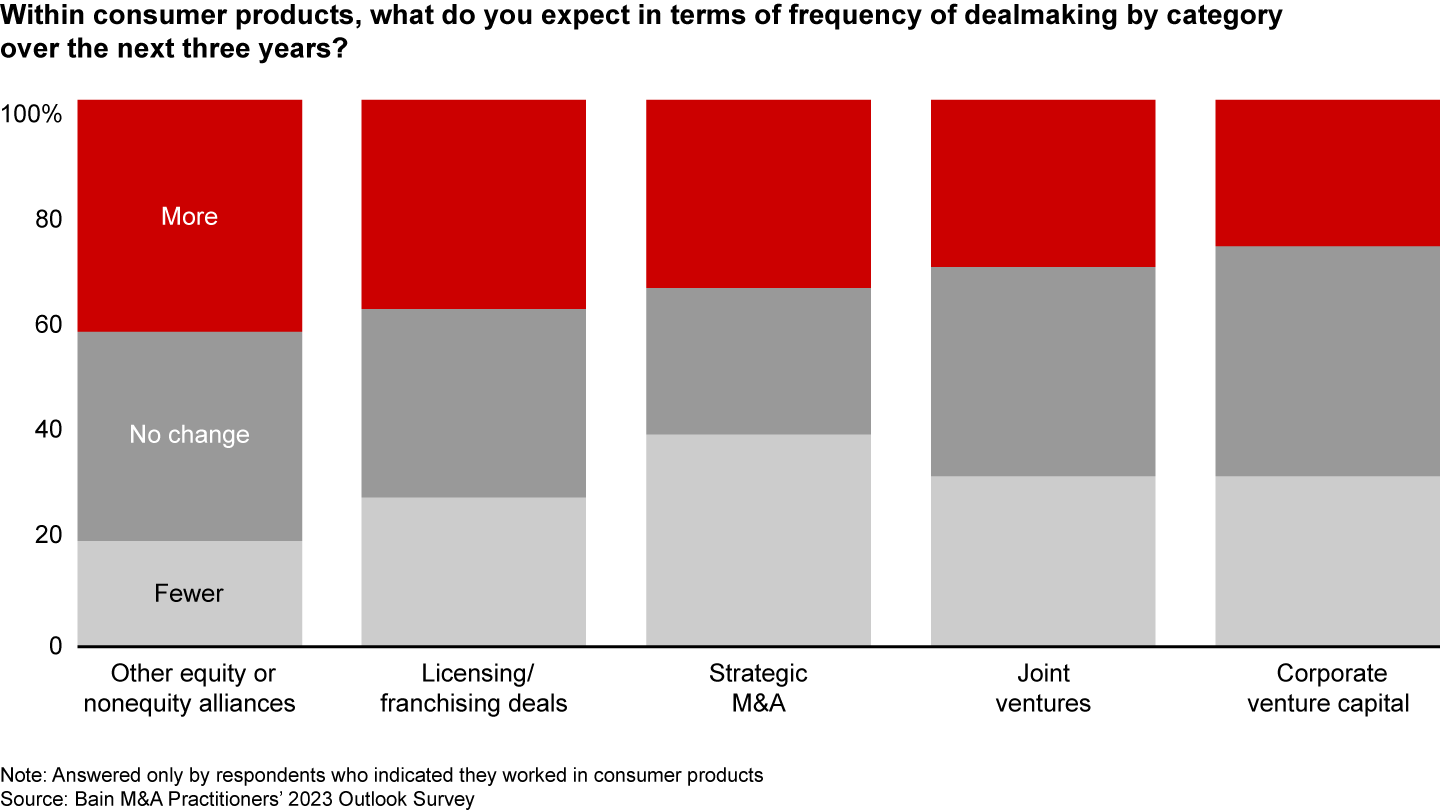
      Consumer products companies expect more alliances and licensing deals over the next three years
      Consumer products companies expect more alliances and licensing deals over the next three years
      Consumer products companies expect more alliances and licensing deals over the next three years

      What’s behind this shift? The increasingly strict antitrust environment in particularly consolidated sectors and regions of the consumer goods industry makes scale deals iffy and take longer to complete, especially in categories with strong leading companies. Alternative deals position a company to explore a broad range of inorganic growth options without making a majority investment. Some companies divest a brand to a joint venture to manage balance sheets. And alternative deals can help mitigate risk inherent in traditional scale M&A by allowing management teams to get to know each other via a partnership or minority investment prior to acquisition.

      Indeed, while scale deals still deliver critical value in the right areas of the business, more companies are relying on a broader suite of M&A options. In the first nine months of 2022 alone, we’ve seen divestitures or spin-offs announced by Kellogg, Vista, Grupo Bimbo, Unilever, and a host of others. While distribution-focused partnerships still abound to build scale in new markets, the past few years have introduced new reasons for joining forces. For example, companies are forming joint ventures and alliances to more hastily address environmental, social, and corporate governance concerns. Kraft’s recent joint venture with NotCo allows it to bring plant-based products to market quickly and with lower up-front investment than an outright acquisition.

      The strict antitrust environment in consolidated sectors and regions makes scale deals iffy and take longer to complete.

      Likewise, large consumer goods companies are turning to CVC to create new platforms and to deal with digital disruption, e-commerce evolution, and consumer trends in fast-changing categories such as health and wellness. Another benefit of CVC: Companies learn how to partner with others in the venture portfolio to boost the odds of success for start-ups, bringing new insights and products back into their own business.

      Partnerships and venture investing help companies explore new ways to rapidly build resiliency in the face of uncertainty. For example, as consumer attitudes and tastes swiftly evolve, alternative deals allow companies to be thoughtful about where they place their bets by exploring these trends with limited up-front financial investment.

      As alternative deals become an increasingly viable option, companies are adapting their M&A playbooks to accommodate. The best companies ensure that strategy dictates what types of deals should be pursued, always giving partnerships and CVC teams clear mandates that tie back to strategy. They keep the screening aperture open and active while they look for potential deals and partners. They build a platform team with the objective of bringing value back into the firm, and they develop learning loops across the M&A team and the business to improve the process over time. Importantly, they adapt the corporate culture and build the skills to handle the complexities of these deals—investing to learn how to structure joint ventures, for example, or where and how to insert executive talent.

      But many companies are learning that even though alternative deals may be more popular, they don’t always succeed. Our survey found that nearly 40% of partnerships and CVC investments in the consumer products industry fail to meet or exceed expectations. Digging deeper into the reasons, we found four common pitfalls—and the best way to avoid them. It starts with asking four fundamental questions.

      What’s the strategic imperative? Nearly 40% of executives surveyed cited lack of strong senior management commitment as a top reason for failure of partnerships. In the best cases, senior leaders show commitment by clearly articulating its purpose. They paint a picture for their teams of how the alliance or joint venture advances company strategy and purpose and the role it will play in achieving core objectives in the coming months and years. This holds true for CVC as well. We’ve heard from several practitioners that without a clear rationale, they feel as if they’re doing CVC just to do CVC.

      Do we have a repeatable model with clear governance? Another failure point shared by participants was “unclear governance structure/decision rights.” Based on our conversations with practitioners, this frequently takes two forms. First, multinationals pursuing alternative deals sometimes fail to ensure regional coordination. Regional regulations often require coordination among central and regional business units and legal teams as part of setting up an alliance. Coordinating decision rights, regulatory timelines, and other critical elements of a deal can speed up the alliance creation across the organization and prevent roadblocks early in the partnership. A second issue: Defining governance and decision rights among the partners themselves is critical up front. Winners address these as part of their playbook for repeatable M&A.

      Companies making corporate venture capital investments need solid metrics to determine success across the entire portfolio of investments.

      Are we concerned enough about cultural fit? Our survey found that more than 45% of M&A practitioners in consumer products viewed “lack of strong cultural fit and/or trust” as a top reason for unsuccessful alliances and joint ventures. Many practitioners assume that cultural fit isn’t as important in partnership deals as it is in traditional scale M&A. That’s an oversight that is especially damaging when incumbents create alliances or joint ventures with insurgents. Just as in a scale deal, cultural fit should be a criterion assessed up front. Companies can leverage some of the same diligence best practices from the M&A process and tailor them to a partnership setting (see the chapter “How to Avoid the Fault Lines Sending Tremors through Cultural Integration in M&A”).

      How are we measuring success? Key performance metrics that were unclear or not aligned with value was cited as a cause of CVC failure for 45% of survey respondents. It was a particular challenge for CVC deals. Companies making these investments need to apply a lesson from venture investors—they always have solid metrics to determine success across the entire portfolio of investments. But there’s a complication. Financial return is not the only (and often not the most important) reason consumer goods companies should be doing venture-stage investing. They can increase the probability of success for portfolio companies through targeted access to the networks, client bases, and product expertise, as well as to talent, technology, and other capabilities. At the same time, the parent company can benefit from the portfolio company’s innovations and talent. With that in mind, the best practitioners set financial and qualitative metrics (e.g., number of partnerships with business, adoption of technology) that measure all these benefits in a way that connects to their strategic goal. Picking the right metric starts with a clear articulation of the CVC’s alignment with strategy.

      As they look to alternative deals, more consumer goods companies are learning that success requires a solid understanding of how these deals are different, how to build the right set of skills, and how this new game of M&A, more than traditional dealmaking, can help them advance their strategy to outpace competitors.

      Read the Next Chapter

      M&A in Diversified Industrials: ESG Plays Drive Breakthrough Capabilities

      Read our 2023 M&A Report

      Download the PDF Explore the report
      著者
      • Headshot of Peter Horsley
        Peter Horsley
        パートナー, London
      • Headshot of Joost Spits
        Joost Spits
        パートナー, Boston
      • Headshot of Sam Rovit
        Sam Rovit
        パートナー, Chicago
      • Headshot of Maria Kurenova
        Maria Kurenova
        パートナー, Atlanta
      関連業種
      • 消費財
      関連するコンサルティングサービス
      • 企業買収、合併(M&A)
      M&A Report
      Consumer Products M&A

      As category consolidation gets harder, the better option is more targeted M&A.

      詳細
      Insurgent Brands
      Insurgent Q&A: Chomps Cofounder Rashid Ali

      “Our retail expansion story isn’t about taking share—it’s about growing the category.”

      詳細
      企業買収、合併(M&A)
      What Agency Consolidation Means for CMOs

      As agency holding companies get bigger and deeper, CMOs must rethink ownership, integration, and how to stay in control.

      詳細
      M&A Report
      Consumer Products M&A

      Large companies are buying insurgent brands to regain their growth momentum, but they need a new playbook to make them succeed.

      詳細
      消費財
      Shift to Vertical: David Haines, Group CEO, Flora Food Group

      What does it take to stay connected to your customers when scale and complexity threaten to pull you away? 

      詳細

      Overview

      • Looking Back at M&A in 2022

      • Looking Ahead to M&A in 2023

      Hot Topics

      • M&A in Times of Turbulence: Lessons from the Last Recession

      • When Buying (vs. Building) Is the Right Move for Engine 2

      • Tougher Times: Putting the Diligence Back in Due Diligence

      • How to Avoid the Fault Lines Sending Tremors through Cultural Integration in M&A

      Industry Views

      • Aerospace and Defense M&A

      • Automotive and Mobility M&A

      • Banking M&A

      • Consumer Goods M&A

      • Diversified Industrials M&A

      • Energy and Natural Resources M&A

      • Healthcare and Life Sciences M&A

      • Insurance M&A

      • Media and Entertainment M&A

      • Payments M&A

      • Retail M&A

      • Technology M&A

      • Telecommunications M&A

      • Wealth and Asset Management M&A

      Regional Perspectives

      • Brazil M&A

      • India M&A

      • Japan M&A

      • Middle East M&A

      First published in 1月 2023
      Tags
      • Insurgent Brands
      • M&A Report
      • 企業買収、合併(M&A)
      • 消費財

      クライアント支援事例

      A Food Company’s Bold Play to Restore Margin and Growth

      ケーススタディを見る

      サステイナビリティ、社会貢献 A Consumer Products Giant Accelerates Its Sustainability Agenda

      ケーススタディを見る

      顧客戦略、マーケティング Designing a Sales Compensation Plan Based on an Unusual Metric

      ケーススタディを見る

      お気軽にご連絡下さい

      私達は、グローバルに活躍する経営者が抱える最重要経営課題に対して、厳しい競争環境の中でも成長し続け、「結果」を出すために支援しています。

      ベインの知見。競争が激化するグローバルビジネス環境で、日々直面するであろう問題について論じている知見を毎月お届けします。

      *プライバシーポリシーの内容を確認し、合意しました。

      プライバシーポリシーをご確認頂き、合意頂けますようお願い致します。
      Bain & Company
      お問い合わせ Sustainability Accessibility Terms of use Privacy Cookie Policy Sitemap Log In

      © 1996-2026 Bain & Company, Inc.

      お問い合わせ

      How can we help you?

      • ビジネスについて
      • プレス報道について
      • 採用について
      全てのオフィス