

論説
A few years ago, Marcia Blenko and Bain colleague Paul Rogers wrote an article in Harvard Business Review called "Who Has the 'D'?" Its central point: companies that are best at getting things done specify who is responsible for every role in major decisions. Identifying and assigning the key roles—Recommend, Agree, Perform, Input and, of course, Decide—cuts through all the frustrating debates about (for instance) whether finance or a business unit should determine investment levels, and whether marketing or engineering has the final say on a product's features. The article introduced a decision-rights tool we call RAPID®, which encapsulates all the roles in an easy-to-remember acronym.
But perhaps we should have called the article "Who Has the 'R'?" or "Who Has the 'I'?" The reason is that many companies take the original title too literally: they pay close attention to the Decide role but too little attention to the others. As a result, their decision-and-execution processes continue to hit bumps and barriers.
In this article we will try to redress the balance. We'll look at each of the four supporting roles in detail—what it is, what can go wrong and how to make things right.
The Recommend role
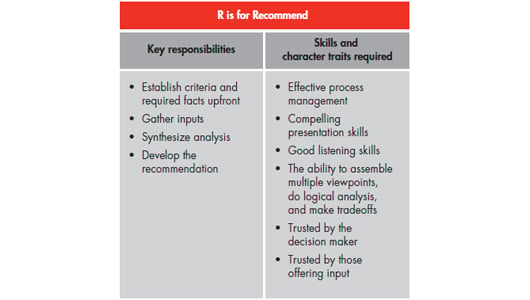
What it is. The R role typically involves 80 percent of the work in a decision. The recommender gathers relevant input and proposes a course of action—sometimes alternative courses, complete with pros and cons. Rs are the quarterbacks of the decision process, coordinating the other roles so that the decision maker's choices are as clear, simple and timely as possible. If they do their job correctly, R's will usually see their recommendations accepted by the D.
Getting the R right. Some organizations fail to identify an R, thus forestalling a decision. When one mining company, for example, was expanding into a new region, corporate headquarters was pushing to create an external relations organization to support the new mine. Headquarters assumed the regional vice president (RVP) would develop a recommendation for the new structure. The RVP expected headquarters to do it—after all, it was their idea. The upshot: a big delay, until the responsible executives eventually clarified the R role.
Other organizations have too many recommenders. A media company we worked with gave all of its editorial units an R on content, which led to recurrent bottlenecks. It solved the problem when it assigned one person to integrate the inputs, set priorities and recommend tradeoffs. Even two Rs is too many. If a business unit prepares a full-scale case recommending an acquisition while finance prepares a recommendation against it, the CEO will have to get to the bottom of both views, and the decision will take longer than it should.
To succeed, a company needs to specify the right recommender for each key decision and ensure that those individuals set decisions up for success. R's can start by sitting down with decision makers to establish the parameters for the decision, the form of the recommendation and the level of rigor required. They can then clarify decision roles and processes and map out a series of meetings to gather the necessary input and signoffs. A large technology company tries to capture these best practices by arming every R with a checklist of issues to consider, such as "Who should be consulted to develop a complete recommendation?" and "What is the right tradeoff between rigor and speed for the recommendation?"
The Input role
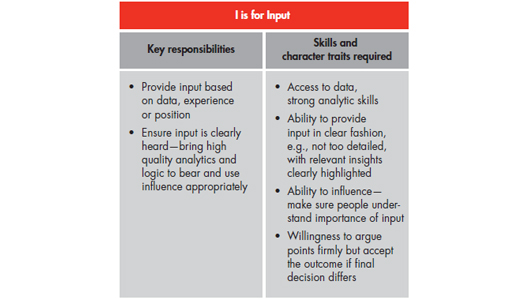
What it is. People who offer input into a recommendation provide necessary information and points of view. They help the recommender assess whatever tradeoffs the decision may require. When decisions are based primarily on analytics, people in the I role provide the statistics and interpretations. Another I job is helping to think through the implications of the decision, such as risks and implementation challenges. Note, however, that the I role is strictly advisory. Recommenders should consider all input, but they don't have to reflect every point of view in the final recommendation.
Getting the I right. Ideally, the I group includes everyone with relevant data, expertise or experience. It should also include people who will be responsible for implementation, along with individuals in parts of the organization affected by the decision. Including these folks ensures that downstream issues are considered, thus improving decision quality and speeding buy-in. Serving as an I is a big responsibility, and people in most high-performing organizations earn the right to influence a decision by providing credible, high-quality analytics and logic.
What can go wrong? Companies with inclusive cultures often put too many people in an I role. Dozens of unnecessary people in meetings clog the process without improving decision quality.
And sometimes senior executives get involved in topics that are best delegated. A consumer products company we're familiar with developed a process to ensure that top leaders focused only on major innovations. That was a wise move, but unfortunately the company never spelled out which decisions required their input. Soon the executives found themselves arguing about matters such as the height of the letters on product packages rather than focusing on more important issues.
Other companies, however, don't have enough people in an I role and don’t get the specific input they need. At a pharmaceutical company, the drug-development decision process included input relating to scientific and medical factors but didn't include sufficient input about payers' willingness to cover the drug. As a result, the company found itself investing in pharmaceuticals that insurers were unlikely to pay for.
Best-practice companies not only define the right Input roles; they also ensure that the designated individuals can provide high-quality input on a timely basis. A retailer, for instance, realized it needed better input into decisions regarding what products to stock and at what price points. So the company created a set of standard templates that allowed assistant brand managers to provide the necessary analysis. That helped their supervisors, the brand managers, to make better decisions and to make them faster.
The Agree role
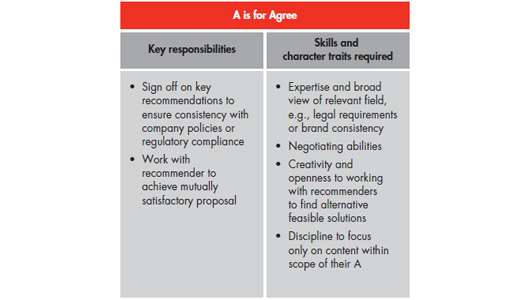
What it is. Unlike the I, the A is a form of input that can’t be ignored. If the person holding an A doesn’t agree, the “recommender” and the “agreer” must work together to find an agreeable solution. In rare circumstances, if the “recommender” and the “agreer” cannot find a mutually agreeable solution, the “recommender” moves forward, noting the “agreer’s” dissent, and the “decider” makes the decision with all perspectives in mind. The classic example of an A is a legal or regulatory signoff, but in fact, many situations lend themselves to A-type approval. A safety executive may need to sign off on a change in work processes. A brand manager may have to agree that a given decision won’t hurt the brand. Risk management and finance functions often play an A role to ensure that decisions fit the company’s overall risk profile and budget constraints.
Getting the A right. Since too many people in the A role creates gridlock, top-performing companies set a high bar for who should have an A. Many decisions require no A at all. Others may need only one or two. Agreement should always be part of developing the recommendation—that is, it should come before the decision, not after it. Ideally, the recommender and the A work things out between themselves, with the R amending the proposal until the the A’s concerns are addressed.
It's important to specify not just the A role but the scope to which the A applies. At a medical device company, the group responsible for regulatory compliance had to sign off on the company's marketing brochures. Regulatory managers reached the point where they were exercising their A on every aspect of the brochures, including the colors. That made little sense, and it meant that every brochure took too long to produce. When the company reassigned decision rights, it gave regulatory an A role only on the text of a brochure to be sure it was compliant with federal regulations.
Companies run into other sorts of A-related difficulties as well. Some recommendations may be missing an essential A—and when the absence is discovered, the decision has to be revisited. Some people in the A role may wait for the decision rather than weighing in on the recommendation; when they slap down what they wrongly believe is a veto card, they undermine the decision maker’s authority, cause further delay, and miss the opportunity to ensure their perspectives contribute to a robust recommendation. Occasionally a company will assign an A to a senior executive just because that individual “should have a chance to weigh in.” But that confuses the I role with the A.
Leading companies typically reduce the need for constant signoffs by providing guidelines to their businesses. Only if a decision goes outside the guidelines does it require an approval from someone in an A role. Take a retail bank that for years had run a cumbersome process to create direct mail campaigns. Every mailing required approvals from Finance (on the financial assumptions) and Risk (on the mailing's loss rate projections). Even identical campaigns required a reexamination of these assumptions and projections. The company saved a great deal of time and frustration when it began providing guidelines for the mailings. Now, marketing managers could make their own decisions about mailings as long as they stayed with the guidelines. Mailings outside of the guidelines, such as a new offer or a mailing to a new population, continued to require scrutiny and approval by Finance and Risk.
There are times, of course, when a recommender feels that the A is constraining the recommendation too much and proceeds with the recommendation, highlighting the A's concerns. A telecommunications company, for instance, decided to launch a worldwide standard for contracts for select global customers. But every local legal office in the company assumed it had an A and effectively blocked the decision. To break through, the company acknowledged the concerns but said that the decision might go forward anyway. In effect, the decision maker was prepared to take the risks that the local legal offices had flagged.
When a company begins to specify decision roles, many people who thought they had A responsibilities will be redefined into the I role. This may feel like a demotion, so it's important that everyone understand both the merits of an A role and the importance of an I role. Leaders need to reinforce the significant benefits to decision making when A and I roles are properly defined.
The Perform role
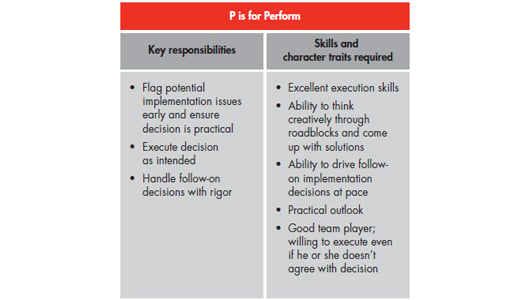
What it is. The P role defines who is accountable for implementation. Best-practice companies typically define P's and gather input from them early in the process. That lets the P's flag implementation issues and encourages them to buy in to the decision they will be executing. In situations where the P is not known early, companies need to assign a P promptly once a decision is made to ensure a timely transition to the execution phase.
Getting the P right. Sometimes the P is never defined, so a decision is never implemented. A beverage company, for instance, decided to relocate its IT center of excellence to a European city. But no one was assigned the P, so no one began looking for office space, figuring out how to consolidate current IT operations with the new center and so on. When a new CIO came on board, she reopened the entire decision, which meant that the company, in effect, had to make the same decision twice.
Once a major decision is made and moved into execution, of course, it will likely involve a set of significant follow-on decisions. Implementation teams need to apply the same rigor and RAPID-style analysis to these execution-related decisions that they applied to the original one.
Decisions: A team sport
Specifying the individual who is responsible for a major decision—assigning the D—is obviously critical to good decision making. But it is less than half the story. Ds can't do their job without great recommendations, insightful input and the right signoffs. A robust recommendation with the right input, cleared with folks who have to agree, makes for a fast, high-quality decision. And a decision obviously has no effect unless someone—the P—is accountable for executing it.
Companies that are best at decisions turn in better financial performance, and it's not hard to see why. People know their roles. Decisions move smoothly from recommendation to execution. The organization hums. Assigning all these roles, training people to understand their responsibilities and following through to ensure appropriate behaviors all require a concerted effort. But they hold the key to high performance.
Marcia W. Blenko is a partner with Bain & Company and leads the firm's Global Organization practice. Jenny Davis-Peccoud is a practice area senior director for Bain's Global Organization practice.

Decide & Deliver
Learn more about the five steps that leading organizations use to make great decisions quickly and execute them effectively.
First published in 8月 2011