

論説

Structure follows strategy.
Business historian Alfred Chandler proposed his thesis in 1962, observing that successful companies evolve their organizational structures based on their strategies. Chandler described how four American conglomerates that dominated their industries from the 1920s onward shifted from a functional, monolithic organizational form to a more loosely coupled multidivisional structure in order to address the challenges of growth and diversification.
Chandler’s insight that the organization must evolve to support strategy still holds true. But the challenge has become more complex as organizations must now be designed to support many more growth avenues, including new products, new steps of the value chain, new geographies, new customer segments and new channels.
Too often, companies make one of two missteps. Some fail to evolve their organization quickly enough to match a shift in strategy. A European technology company, for instance, stifled the growth of an innovative product by keeping it highly integrated with the existing core business, which starved it of the resources, management focus and flexibility needed to realize its potential.
The second mistake is to move full steam ahead with a new organization design that does not match how the business will actually create value. Consider the financial services company that moved from multiple independent divisions to a more integrated model in order to encourage cross-selling. Gearing the organization around this relatively small opportunity added complexity, slowed decision making and distracted the divisions from realizing major growth opportunities in their individual businesses.
So how can companies avoid these mistakes and ensure that they forge that link between strategy and organization? They need to go beyond structure to define their entire operating model, the blueprint for how resources are organized and operated to deliver the strategy. All elements of the operating model—structure, accountabilities, governance, essential behaviors as well as the way people, processes and technology get integrated to deliver key capabilities—must be explicitly designed to support the strategy. With this high-level blueprint defined, more detailed organization design can follow. (For an overview of operating model design, see the Bain Brief “Winning operating models that convert strategy to results.”)
The crucial first step in designing an appropriate operating model is to translate the strategy into a set of design principles—simple yet specific statements defining what the organization must do to enable execution of the strategy. A carefully drafted set of design principles, typically between 7 and 15 statements, helps align the leadership team around objective criteria for designing the operating model. This approach can apply to an entire company, a business unit or an individual function.
Defining what matters most
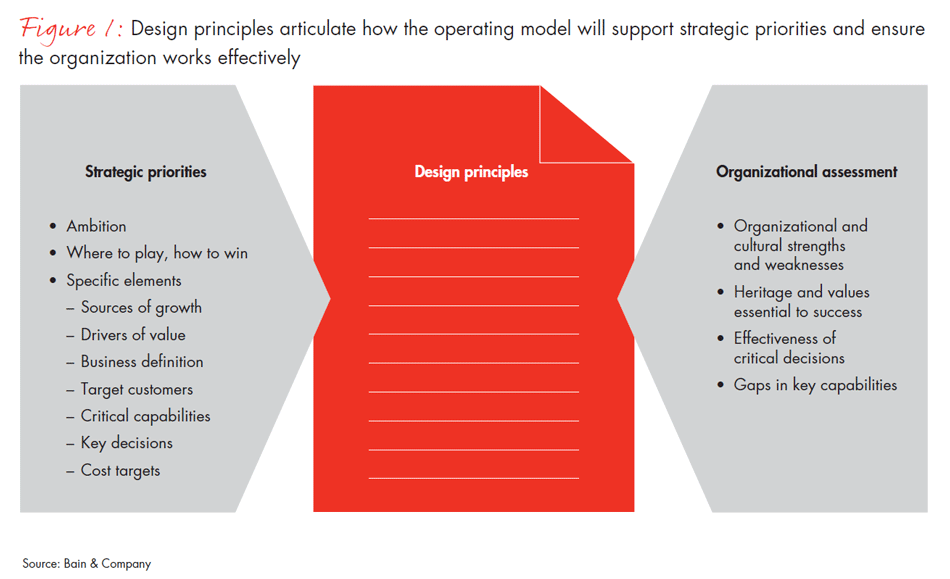
Design principles specify strategic requirements that the operating model must support. They also pinpoint aspects of the current organization that could hinder the future strategy and therefore must change, as well as organizational strengths that should be preserved (see Figure 1). While principles can cover a lot of ground, they usually address some combination of the following areas that are most relevant to their business:
Focus on the specific sources of value in the business. For example, a historically US-centered food company that was expanding internationally established a principle to “ensure a strong focus on our high-priority growth markets.” And Olam International, the Singapore-based commodities trading company, has a clear principle of optimizing the supply chain right up to the farm gate. As a consequence, Olam makes sure that local managers give relationships with local farmers the highest priority, because those farmers start the value chain.
Call out the critical decisions. The right operating model should make it easier to make important decisions quickly and effectively. Good principles often highlight specific types of decisions that the new model should facilitate. For instance, a technology company articulated the need to “improve how product roadmap decisions reflect customer requirements.” A consumer products company stated that “execution of global brands, including pricing and promotion decisions, should be highly devolved.”
Define scope and business boundaries appropriately, ensuring that the model reflects opportunities for customer-, cost- and capability-sharing across the businesses. A consumer products company recognized that the market had evolved and its product should in the future be managed globally in many respects. It defined its principle: “Product development and branding should be managed globally while maintaining local sales, marketing and customer insight.”
Explain which capabilities are essential to fulfilling strategic goals, such as “support a repeatable product design process that balances customer requirements and technical feasibility” or “allow us to easily add and subtract businesses.” The latter principle, for instance, would infer an operating model that maintains minimal integration across its business units.
One beverage company identified winning with 25-year-old male customers as a strategic priority. So one of its design principles highlighted insights into these customers and point-of-sale execution as two capabilities the operating model needed to emphasize.
Articulate organizational strengths to preserve or weaknesses to address. A company that had acquired a series of businesses, all selling to the same customers, articulated a principle to “ensure that how we go to market makes it easy for our distributors to do business with us.” A medium-sized, high-growth company specified the need to “professionalize our processes and improve coordination across product areas while minimizing bureaucracy.”
Where firm culture plays a major role, aspects of the culture can be called out. One company that runs an online marketplace and has grown through many acquisitions has a principle to “preserve the entrepreneurial spirit that had driven our past success.” This statement guided the new model to include business units with leaders retaining many of their general manager responsibilities.
Clarify the role of the center in leveraging scale and expertise. A chemicals company established a principle that “the model will have a bias for simplicity and local-market focus. Organizational elements that add complexity or centralize activities must unambiguously add value.” Another specified that “any unit that generates more than 80% of the demand for a shared service will have responsibility for managing that service.” And a global business services company made it clear that the new model should leverage expertise at the center with its principle that “all major bids will be supported by a global bid team.”
Putting design principles to work
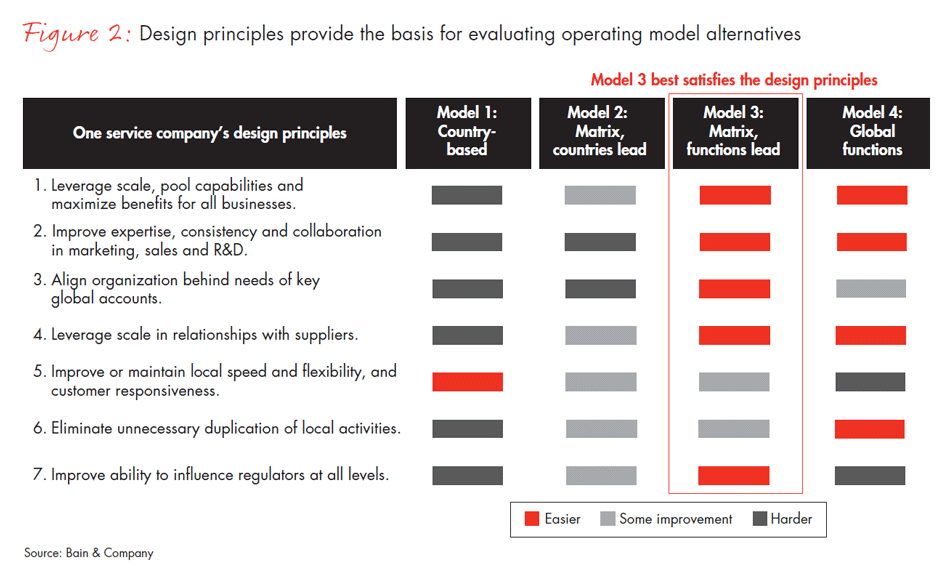
Practical use of design principles comes when a senior executive team evaluates different operating model options. One service company had spent a decade acquiring businesses to build a global powerhouse, but its operating model did not fully leverage the company’s scale or global capabilities in activities such as common purchasing or branding. The executive team split into two factions, one arguing for a strong country-based model while the other pushed for a more centralized model.
So the team drew up, and aligned on, seven principles aimed at improving local strength and flexibility while using global scale to better advantage. Based on those principles, senior leaders could objectively evaluate four operating model options, and the process allowed them to make a clear choice of a matrix model with functions leading in select areas where scale and expertise mattered, such as procurement and branding. The model also specified mechanisms to promote collaboration with the countries (see Figure 2).
Aligning the senior executive team on principles before getting into debates on operating model solutions ultimately will accelerate development of the model. Senior leaders themselves need to spend sufficient time debating, refining and then using the principles so that they take full ownership. Delegation simply does not work.
Passing the “dog food” test
Across industries and countries, effective principles share three characteristics.
First, they’re grounded in facts in order to bring objectivity to a charged environment. When companies decide their operating model needs to change, the discussions that follow can degrade into emotional defenses of the status quo. Principles informed by a fact-based strategy encourage impartiality, highlighting gaps and forcing difficult choices.
Second, they’re specific enough to help senior management make trade-offs. A large industrial company decided to redesign its operating model several years ago, and the senior team spent substantial time articulating design principles. But the CEO worried that some principles were too generic to help them evaluate different operating model options. “Can any of them equally apply to a dog food company as to us?” he asked.
His question, while tongue in cheek, crystallized a real challenge: Generic statements such as “leverage scale” or “create a streamlined organization” initially feel good because people readily accept them, but they have little explanatory power. Any successful operating model starts with specific, clear principles that will help distinguish between operating model choices. For a sports apparel and equipment maker, for instance, the generic “improve collaboration across different categories” contains less useful direction than “make it easy for us to deliver coordinated head-to-toe apparel and footwear to stores in time for the season.”
Third, effective principles stay brief. The best sets of principles fit on one page. If they exceed 10 or so, it’s best to identify the ones that should be weighted most heavily.
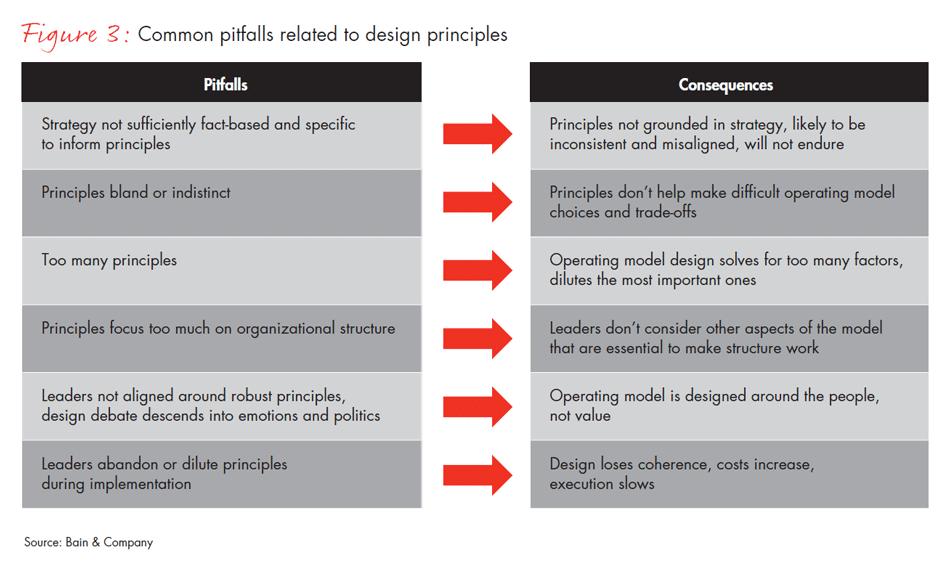
Tripping up on these three characteristics can derail the process. And there are a few other pitfalls that leaders should anticipate and avoid (see Figure 3).
A beacon for employees
Ultimately, strong, specific design principles underpin all successful operating models. Construction of a house proceeds most effectively when the owner, architect and general contractor have detailed discussions first about the important design features and resolve potential problems before construction starts. Similarly, writing and debating the principles for an operating model design gives senior executives a chance to address the most vital issues, identify potential problems and resolve ambiguity. Strong design principles synthesize choices that leaders have made about what matters most. That precludes unnecessary debates from reopening later on.
Moreover, they endure. One manufacturing company that redesigned its operating model five years ago still uses the same principles to explain the model to employees as well as to test the merit of proposed additional organizational changes. The best principles serve as a constant beacon when the operating model is implemented and as it evolves.
Marcia Blenko is an advisory partner with Bain & Company’s Organization practice. James Root is the leader of the practice in Asia-Pacific. They are based, respectively, in Boston and Hong Kong.
First published in 4月 2015