

論説

概要
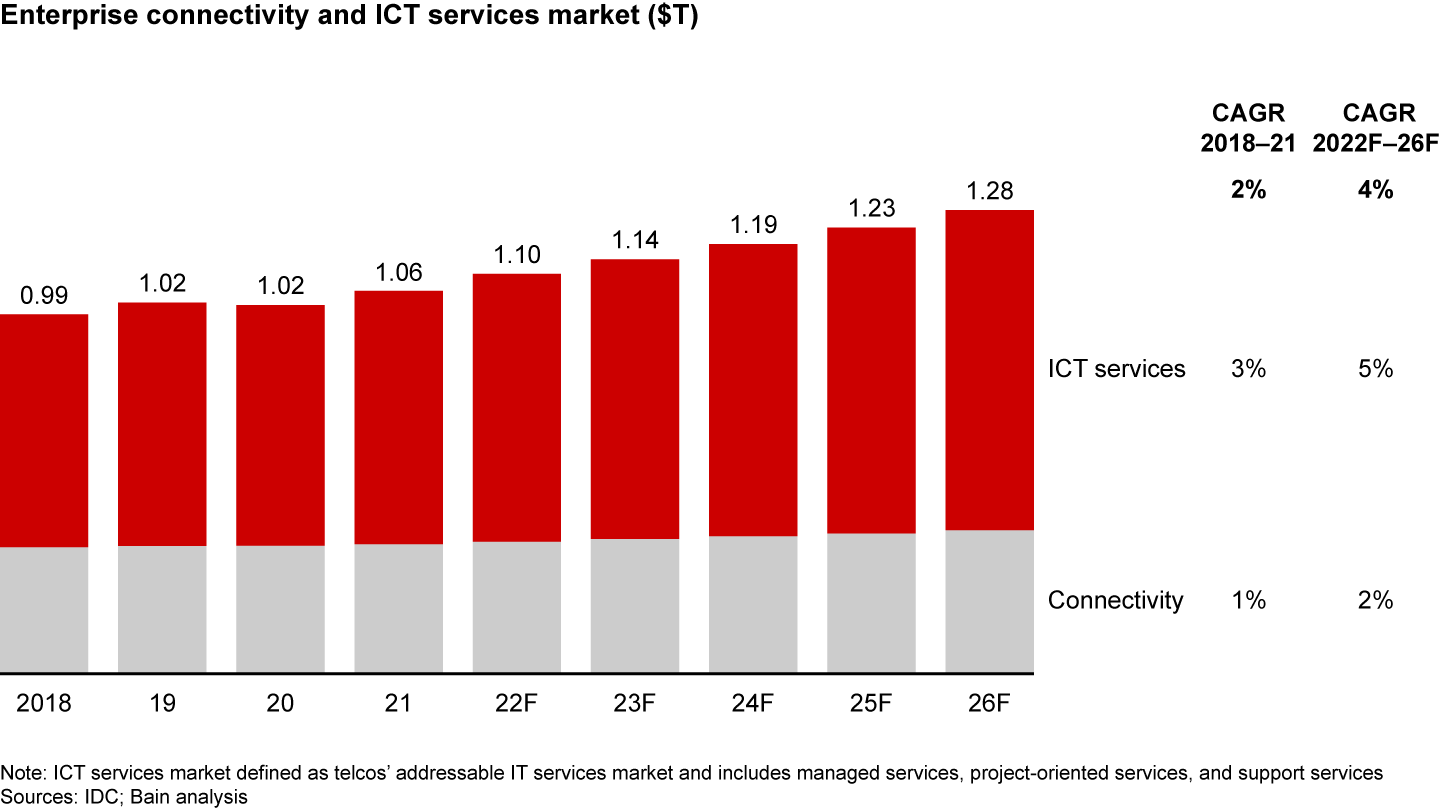
- While the telco connectivity market is flat, the market for enterprise information and communication technology (ICT) services is projected to grow 5% annually through 2026.
- CIOs and IT buyers frequently struggle to build and maintain the internal capabilities needed to manage increasingly critical, but complex, technology.
- While most CIOs and IT buyers see value in hiring a single, trusted partner to help them with their ICT portfolio, telcos rank low on the list of potential “smart orchestrators” in many customer segments.
- Nevertheless, telcos have an opening to capture the opportunity—especially among underserved midsize enterprises—if they identify the right value proposition and execute quickly, with the right operating disciplines.
As telecommunications companies search for ways to jump-start growth, many executives are underestimating the opportunity presented by a sector in which they have long struggled: technology services.
Telcos find themselves at a precarious juncture. Their valuations have sagged in recent years, even amid surging demand for connectivity services during the pandemic. Mobile market penetration has reached the saturation point; global revenues from consumer connectivity services were flat from 2018 to 2021 and are projected to grow only 1% annually through 2026, according to Bain & Company analysis of IDC data. As a result, telcos are increasingly looking to their enterprise businesses for growth.
Information and communication technology (ICT) services could provide much of the fuel if telcos can capture a meaningful piece of the 5% annual growth projected for the global enterprise ICT services market through 2026 (see Figure 1). But most telcos are underinvesting and underprepared in this area.
Figure 1

It’s understandable that telcos might hesitate to go all in on ICT services, given the industry’s track record. Consider that many telcos’ ICT profit margins are stuck in the single digits (or worse). Although leading telcos have achieved margins around 20%, on par with many technology service providers, that’s far from the norm.
But this market is evolving, and telcos have a chance to turn things around. Businesses’ operations and innovation activities increasingly depend on technology, but the array of choices grows more vast and complex by the day. For many enterprises, this creates an unmet need: a single, trusted partner who can help them orchestrate the technology. This ICT smart orchestrator, as we call it, would help enterprises select the right technologies, integrate or bundle them for the organization’s use, and support both the organization’s migration to the portfolio of new technologies and their ongoing operation. For most enterprises, this portfolio of technologies would encompass connectivity across all devices; collaboration services, such as unified communications and contact centers; cloud infrastructure; and cybersecurity.
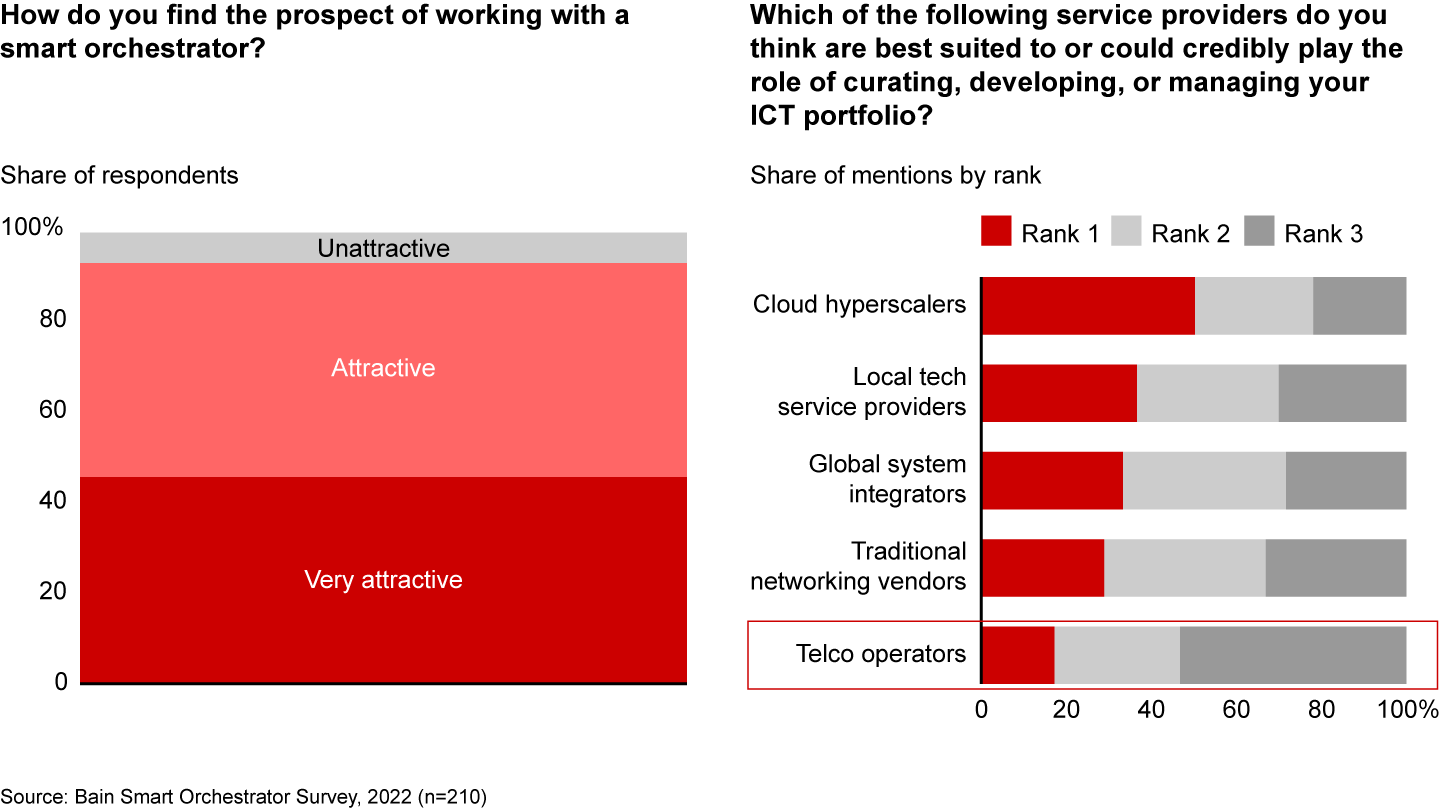
About 93% of CIOs and IT buyers find the proposition of hiring a smart orchestrator attractive, according to a 2022 Bain survey. However, telcos ranked last among the types of companies that survey respondents perceived as best suited to fill the role (see Figure 2). So, if telcos are going to seize this opportunity, they’ll clearly have to change what they’ve been doing.
Figure 2

What might explain executives’ skepticism toward telcos succeeding in the smart orchestrator role? Some telcos have tried for more than 20 years to crack the code in ICT. Some have offered largely bespoke outsourcing services to the largest enterprises and governments. However, they’ve had trouble transitioning these clients to standard, repeatable offerings that support the horizontal scale required for a successful IT-outsourcing economic model.
Meanwhile, some telcos have doubled down on professional services, but they’ve failed to conquer the different disciplines of an inherently low-margin, people-based business (a much different animal than the high-margin, infrastructure-based traditional telco model). Many telcos have actually inhibited the growth of their ICT services businesses by managing them in the same way as their core connectivity business.
Others still have struggled to add value beyond resale, relegating themselves to being a sales channel for original equipment manufacturers or cloud providers, with only single-digit gross margins to show for it.
The bottom line: If telcos are going to find profitable growth in this sector, they need a different proposition. And they’ll have to move fast or risk getting trapped in the lowest-growth, lowest-margin corner of this sector.
Telcos’ opportunity
Despite telcos’ ICT struggles to date, there’s a strong argument that they’re well positioned to succeed in this smart orchestrator role. They own valuable technology infrastructure assets that could give them an advantage as an ICT services provider, including terrestrial networks, subsea cables, satellites, and building access. As cloud adoption increases, enterprise technology is becoming more network-centric, with applications hosted in the cloud and accessed from multiple devices and locations. That inherently puts telcos at the heart of enterprises’ ICT activities.
Furthermore, our survey found that telcos are a preferred smart orchestrator among medium-sized enterprises, one of the customer segments with the greatest need for such a vendor.
On either end of the market are companies that don’t strongly need a smart orchestrator’s support. On one end are enterprises with complex technology requirements—such as large banks, oil companies, and technology firms—that have the resources to build in-house capabilities to meet those needs. They’ve historically hired ICT vendors (including telcos) but are now opting for in-house management of their increasingly complex ICT demands. On the other end of the spectrum are businesses (often small companies) with less sophisticated technology requirements that can be easily met with off-the-shelf products.
Stuck in the middle are enterprises that have highly complex technology requirements but lack the internal capabilities to manage those needs themselves. That’s where the smart orchestrator plays best, and many of those potential customers are midsize enterprises that ranked telcos high on their list of preferred smart orchestrators.
The trick for telcos will be serving those customers in a standard, repeatable way. Professional services will remain critical for migrating enterprise customers to a new portfolio of ICT services, but leading telcos will find a way to provide digitally supported, cost-effective managed services at scale.
Key steps
In our work with telcos worldwide, we’ve found that three things are critical to success in ICT services.
1. Identify the strongest value proposition. What do you want to be known for as a smart orchestrator? The most effective telcos start with a small set of offerings—ensuring they serve real customer needs and add value beyond simple resale—and build from there. The right offerings are those that take advantage of the telco’s existing core capabilities and can be standardized to serve multiple clients.
2. Build, buy, and partner. Effective companies strike the right combination of partnerships, acquisitions, and organic augmentation of existing capabilities. To date, telcos have typically tried to enter the ICT services market by building capabilities in-house or buying them. That has often proven costly and requires the telco to manage a lot of complexity. Furthermore, in many cases, telcos end up offering ICT services that customers don’t want or need.
But telcos don’t necessarily need to do it all on their own. An effective approach is to form partnerships with technology companies to wrap their services around a telco’s core offerings, with the telco providing value by orchestrating the package of products and services for customers. Then the telco can tuck in acquisitions as needed to fill specific gaps.
3. Balance two distinct but closely related businesses. Many telco executives recognize that they’ve inhibited the growth and profitability of their ICT services businesses by managing them in the same way they do their traditional connectivity business, particularly the focus on cost management through lean operations and providing more self-service options for customers.
Leading telcos apply a different playbook to managing their ICT businesses, with metrics and operating rhythms used by established leaders in the IT services industry. They invest in hiring and retraining the right talent, creating a suitable sales organization, and developing an agile operating model to support enterprises’ ICT needs, which ultimately drives additional revenue.
That’s not to say cost discipline is less important in ICT businesses. Effective ICT organizations tightly and dynamically manage their workforce to ensure the most profitable deployment of their people. But in contrast to the connectivity business, ICT services businesses almost always need to increase their headcount in support of growth, especially where these additional people are billed out to clients at healthy margins.
By applying distinct strategies for each business, telcos can better serve the diverse needs of their customers.
Emerging leaders
Since the smart orchestrator model is still emerging, it’s instructive to look at examples of early leaders to get a picture of the full potential. One of the first proponents of this approach was US-based Cincinnati Bell. It’s been able to win and serve large-scale enterprise accounts that have geographic footprints extending well beyond Cincinnati Bell’s incumbent local exchange carrier network territory. The company embraced the reality of different business rules and buying patterns in connectivity and ICT services. It made bold moves early to create a dual set of capabilities that could distinctly target and serve each of these areas yet work in sync, regardless of whether the customer lead came through the connectivity or ICT services side of the house. It also increased its scale and service offerings through acquisitions, and its IT services and hardware business grew from about $385 million in revenue in 2017 to $828 million last year.
Australia has also become one of the more active proving grounds. Telstra Purple, the ICT services arm of the local telco market leader, has made strides to improve the profitability of its network applications and services (NAS) business—which generates around $3 billion in annual revenue—by instilling disciplines from leading IT services providers. Within the first two years of Telstra Purple’s formation, the NAS business’s profit margin grew from about 3% in the first half of 2019 to 19% in the second half of 2020, through the integration of various acquired companies, improvement in product mix, and tighter management of people resources.
Nexon Asia Pacific, a private equity–owned ICT services business that caters to medium-sized enterprises, provides managed services that wrap around offerings from hyperscalers and other technology companies. Understanding what clients value and will pay for, Nexon carefully tunes its propositions to the needs of mid-market customers—including migration support, training, 24/7 support services, and analytics. The result is a growing business with sticky customers and a strong margin profile.
Orro Group, another private equity–backed venture, has taken a slightly different tack. Here, the business has partnered closely with the likes of Cisco to provide scale and credibility to win large accounts. It has also underpinned its value proposition with a scaled, digital managed services platform that provides customers with a single “pane of glass” view and puts them in control.
Time to act
Given the strong growth projections for ICT services, it’s hard to imagine a growth-oriented strategy for telcos (particularly incumbents) that doesn’t include a plan to capitalize on this opportunity. And while telcos have ground to make up in the sector, they have an opening now to do so—especially among midsize enterprises.
Nevertheless, this market won’t automatically come to telcos, and competitors are moving fast. Telcos that act now to determine their ambition within ICT services will have the best chance to seize the opportunity.
First published in 5月 2023