

レポート

概要
- Digital technologies are important enablers of change in energy and resource companies and are accelerating efforts to adapt to the energy and resource transition.
- Nearly every company has a successful pilot to share, but it’s proving harder to scale these experiments into full-scale digital transformations.
- Some of the reasons that initiatives flounder include an inability to focus on the most valuable projects, a lack of clarity on who’s accountable, and pilot programs that weren’t designed to scale.
- To scale digital initiatives successfully, companies focus on the cases that will deliver the most value, prepare to scale from the beginning, and put in place the right orchestration.
This article is part of Bain's 2021 Energy and Natural Resources Report.
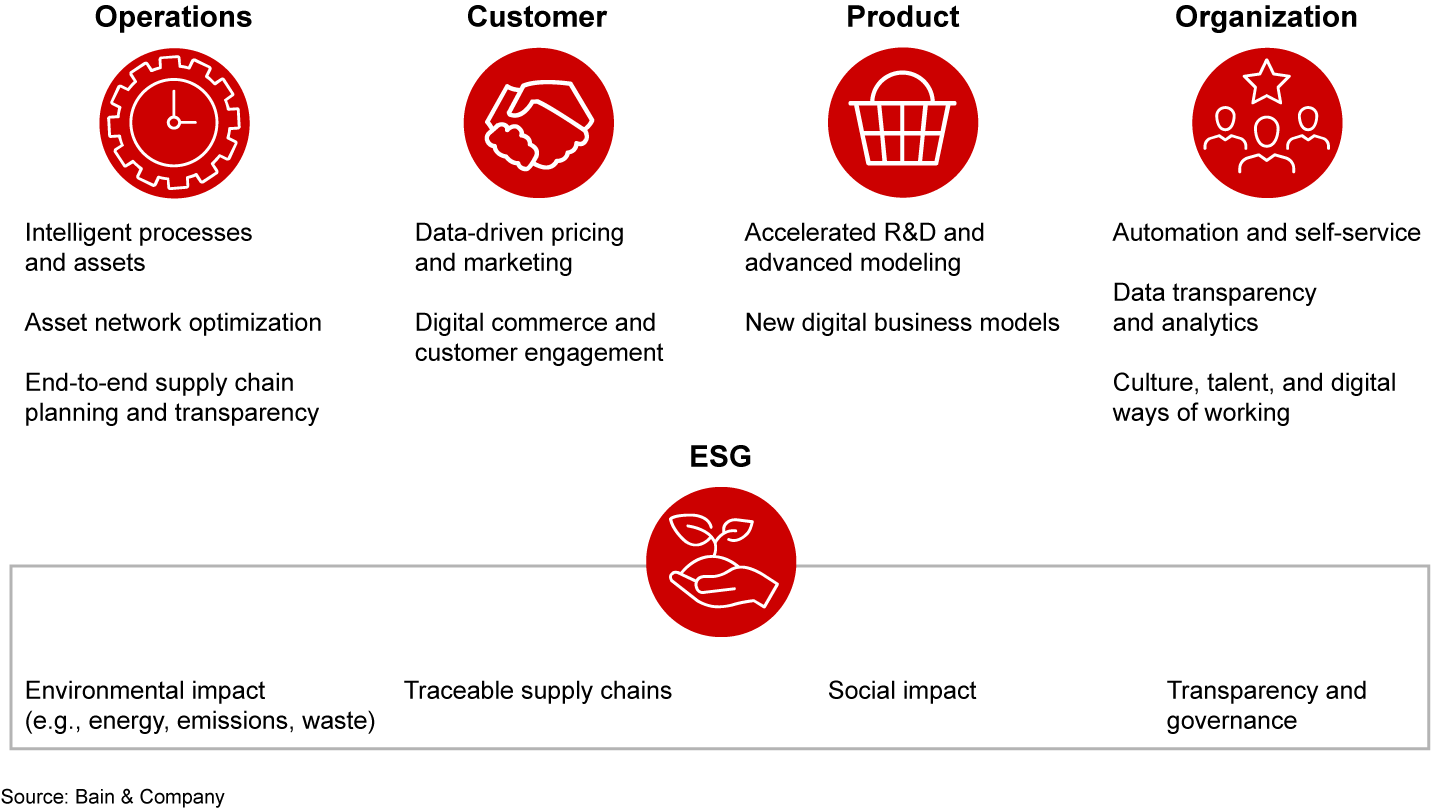
Digital technologies, and the new ways of working that accompany them, are proving to be critical enablers for a broad spectrum of capabilities in companies across industries. Energy and natural resources companies are accelerating digital transformation efforts across a wide range of use cases, such as improving productivity in operations, elevating customer experience, pursuing new business models, or enhancing organizational performance.
Digital technologies are also accelerating energy and resource companies’ efforts to reach their environmental, social, and corporate governance (ESG) goals. Digital can not only improve efficiency and free up funds for the energy transition, it can also have a direct impact on the environmental footprint, supply chain traceability, or governance transparency. One global chemicals group, for instance, used digital technology to create better transparency on its environmental performance, which has helped it reduce energy consumption and carbon emissions. A European energy company deployed technology to automate GPS-guided bulldozers and trenchers to improve productivity and reduce costs for the construction of solar plants. And a global supplier of agricultural commodities successfully commercialized and scaled a sustainability platform that provided transparency on a range of ESG goals across the entire supply chain and for a range of food categories (see Figure 1).
Figure 1

Unfortunately, while nearly every company has a successful pilot story to share, very few have scaled up their digital experiments to the point of delivering significant value for the entire organization. Bain’s research finds that only 8% of companies say they’re getting their money’s worth out of their investment in digital. What makes digital so much harder than other transformations, and what have some companies learned that has helped them beat the odds?
Among the reasons that many efforts struggle:
- lack of focus on scaling the few cases that will make the difference
- pursuing technology for technology’s sake, without a clear business problem statement
- inability to scale pilots that succeeded in controlled environments, but were too fragile to accommodate real-world conditions in the field
- unclear accountabilities and governance that employed a clear strategy and roadmap, but had little follow-through because the line leadership wasn’t bought in
- difficulty sustaining, so after a couple months, as the impact deteriorates, teams went back to old ways of working
- too much risk that made it difficult to experiment if the cost of failure seemed too high
- lack of change management, particularly in painting a compelling picture of what the positive future will look like. Some critical stakeholders worried about the impact of digital change on individuals or didn’t buy into the benefits digital has to offer.
The details may differ, but the themes are consistent: not enough buy-in from the front line, not prioritizing the digital effort, failure to scale and sustain, and, ultimately, results that don’t flow to the bottom line.
Making business transformation the goal
By contrast, companies that have successfully scaled their digital initiatives treat these as critical business transformations. The ones that scale and stick are those that embody the business goals of the initiative, deploy technology in the service of those goals, and ensure continuous sponsorship and accountability. In our work, four actions have been crucial for scaling digital transformations.
Focus on value. Since digital transformations are really business transformations, they need to focus on business priorities and scale the few initiatives that will create the most value. It may seem obvious to focus on problems that deliver results, but transformations often gravitate toward the issues that can be solved rather than what the company should solve. Teams need to avoid becoming distracted by technology opportunities that don’t sustain or create value or are too complex to rapidly deliver results. Better to focus on initial cases that combine high value with ease of deployment to build momentum, and over time graduate to more complex situations. This demonstrates the value of implementation and scaling and begins to build a track record.
One energy company that had run several pilot projects found it was getting very little return on its investment and solving few business problems. A fresh analysis identified boiler reliability as critical to efficiency. While there was pressure to chase a technology solution for predictive maintenance, the team deconstructed the problem and decided this was one case to scale because it delivered significant value. It then launched pilots that mixed traditional condition monitoring with advanced analytics.
Within three months, this initiative identified several subcomponents on the brink of failure, which it avoided through preventative maintenance, saving enough to cover the cost of the project up to that point. It then went on to target benefits equivalent to 10% of the asset group’s value. The lesson for this group: Focus on what creates value and don’t feel compelled to develop a completely advanced solution if a mixture of traditional and new measures will get the job done.
Prepare to scale from Day 1. Initiatives are more likely to scale across the company when designed with that goal in mind. For example, a mining company began transforming its operations by looking for similarities in technology infrastructure, capabilities, and the constraints and pain points in its production processes that could unlock material value. This helped the company identify a set of scaling vectors—that is, repeatable themes (for example, business problem, situation, technology, and capabilities) that it could scale rapidly, allowing it to gain valuable experience quickly. Taking the example of operations, these scaling vectors can be along specific production assets, a process, or a piece of equipment that can be repeated across the organization. Other scaling vectors may focus on technology similarities and capabilities, or even simply a repeatable approach or capability for deploying the application.
Orchestrate to enable speed. Digital transformations are more cross-functional than other improvement efforts, and they often demand new capabilities. So it's critical to update the operating model in ways that provide transparency, alignment, and clarity on decision making for a range of issues, including priorities, funding, partnerships, and resource deployment. If possible, go with the grain of the organization's existing operating model. It helps to stand up a team that can design pilots that can be scaled up rather than retrofitted once they're in motion.
A chemical company had been working on its digital transformation for more than a year but was having trouble scaling up from low-impact pilots. Each plant had unique challenges and preferred its own, customized solutions, which led to complex decisions about resources and funding between the center and operations. Three changes in the digital operating model moved the company forward.
- First, it put in place dedicated scaling teams to support delivery, propagate knowledge across units, and anticipate technology and capability requirements.
- Second, it put a strong leadership governance in place with clear focus on three solutions that created 80% of the value, with a central budget to support the first wave of deployments.
- Third, it launched a change and engagement approach, including storytelling that captured hearts and minds.
The changes helped the company save more than €30 million over the first six months―50% above target savings—primarily through use of analytics that optimized processes and improved productivity. The program is on track to save three times that amount over the next three years.
Operationalize to sustain value. When new technologies or processes don’t fit into the way work gets done, the innovation can sit unused by the front line. Successful transformations preempt this problem by designing for and selectively rewiring processes to take advantage of the digital innovation—that is, operationalizing it to create closed feedback loops from the field and capture all the intended value.
This includes investing in capabilities that will let the company take advantage of an opportunity when it arrives, whether that’s hiring the right talent or fostering a culture that encourages innovation and risk taking, or adapting the funding or procurement model to implement digital programs at speed. Companies can then invest more confidently in disruptive change, which could be new technology, a new line of business, or an entirely new business model.
One petroleum company identified an opportunity to improve its yield. In doing so, it developed a repeatable advanced analytics and Agile method that could be used across multiple manufacturing assets. The company operationalized and sustained the program by embedding the method in governance and ongoing business rhythms, while ensuring sponsorship from senior business and line leadership, communicating the need for the change, and setting up forums to share successes and learn from failures.
The costs of implementing digital continue to fall as technologies mature and as companies and their people gain experience working with technology. As energy and natural resources companies work to enable the energy and resource transition, the benefits of digital technology―cost reduction, improved productivity, greater accuracy, and new business opportunities―will undoubtedly be key enablers to making positive change while maintaining a competitive edge.
Read our 2021 Energy and Natural Resources Report
More from the report
-
Two out of Three Won’t Do
-
Harnessing the Energy and Resource Transition
-
Net Zero: From Political Targets to Industry Action
-
Energy Is Only One Part of the Sustainability Transition
-
Redesigning Value Chains to Deliver More Sustainable Goods
-
Time for ESG Investors and Energy and Natural Resources Companies to Work Together
-
Business Opportunities in Low-Carbon Hydrogen
-
Raising Productivity in Energy and Natural Resources Capital Projects
-
Creating Resilience, Sustainability, and Accountability in Supply Chains
-
Engine 2: How to Grow a Sustainable New Business
-
Accelerating the Journey to Net Zero
-
Four Ways to Scale Digital in Energy and Natural Resources Companies
First published in 6月 2021