Skip to Content
  • オフィス

    オフィス

    北米・南米
    • Atlanta
    • Austin
    • Bogota
    • Boston
    • Buenos Aires
    • Chicago
    • Dallas
    • Denver
    • Houston
    • Los Angeles
    • Mexico City
    • Minneapolis
    • Monterrey
    • Montreal
    • New York
    • Rio de Janeiro
    • San Francisco
    • Santiago
    • São Paulo
    • Seattle
    • Silicon Valley
    • Toronto
    • Washington, DC
    ヨーロッパ・中東・アフリカ
    • Amsterdam
    • Athens
    • Berlin
    • Brussels
    • Copenhagen
    • Doha
    • Dubai
    • Dusseldorf
    • Frankfurt
    • Helsinki
    • Istanbul
    • Johannesburg
    • Kyiv
    • Lisbon
    • London
    • Madrid
    • Milan
    • Munich
    • Oslo
    • Paris
    • Riyadh
    • Rome
    • Stockholm
    • Vienna
    • Warsaw
    • Zurich
    アジア・オーストラリア
    • Bangkok
    • Beijing
    • Bengaluru
    • Brisbane
    • Ho Chi Minh City
    • Hong Kong
    • Jakarta
    • Kuala Lumpur
    • Manila
    • Melbourne
    • Mumbai
    • New Delhi
    • Perth
    • Shanghai
    • Singapore
    • Sydney
    • Tokyo
    全てのオフィス
  • アルムナイ
  • メディア
  • お問い合わせ
  • 東京オフィス
  • Japan | 日本語

    地域と言語を選択

    グローバル
    • Global (English)
    北米・南米
    • Brazil (Português)
    • Argentina (Español)
    • Canada (Français)
    • Chile (Español)
    • Colombia (Español)
    ヨーロッパ・中東・アフリカ
    • France (Français)
    • DACH Region (Deutsch)
    • Italy (Italiano)
    • Spain (Español)
    • Greece (Elliniká)
    アジア・オーストラリア
    • China (中文版)
    • Korea (한국어)
    • Japan (日本語)
  • Saved items (0)
    Saved items (0)

    You have no saved items.

    後で閲読、共有できるようにするためにブックマークしてください

    Explore Bain Insights
  • 業界別プラクティス
    メインメニュー

    業界別プラクティス

    • 航空宇宙、防衛、政府関連
    • 農業
    • 化学製品
    • インフラ、建設
    • 消費財
    • 金融サービス
    • ヘルスケア
    • 産業機械、設備
    • メディア、エンターテインメント
    • 金属
    • 採掘・鉱業
    • 石油、ガス
    • 紙、パッケージ
    • プライベートエクイティ
    • 公共、社会セクター
    • 小売
    • テクノロジー
    • 通信
    • 交通
    • 観光産業
    • 公益事業、再生可能エネルギー
  • 機能別プラクティス
    メインメニュー

    機能別プラクティス

    • カスタマー・エクスペリエンス
    • サステイナビリティ、 社会貢献
    • Innovation
    • 企業買収、合併 (M&A)
    • オペレーション
    • 組織
    • プライベートエクイティ
    • マーケティング・営業
    • 戦略
    • アドバンスド・アナリティクス
    • Technology
    • フルポテンシャル・トランスフォーメーション
  • Digital
  • 知見/レポート
  • ベイン・アンド・カンパニーについて
    メインメニュー

    ベイン・アンド・カンパニーについて

    • ベインの信条
    • 活動内容
    • 社員とリーダーシップ
    • プレス・メディア情報
    • クライアントの結果
    • 受賞歴
    • パートナーシップを結んでいる団体
    Further: Our global responsibility
    • ダイバーシティ
    • 社会貢献
    • サステイナビリティへの取り組み
    • 世界経済フォーラム(WEF)
    Learn more about Further
  • キャリア
    メインメニュー

    キャリア

    • ベインで働く
      キャリア
      ベインで働く
      • Find Your Place
      • ベインで活躍する機会
      • ベインのチーム体制
      • 学生向けページ
      • インターンシップ
      • 採用イベント
    • ベインでの体験
      キャリア
      ベインでの体験
      • キャリアストーリー
      • 社員紹介
      • Where We Work
      • 成長を後押しするサポート体制
      • アフィニティ・グループ
      • 福利厚生
    • Impact Stories
    • 採用情報
      キャリア
      採用情報
      • 採用プロセス
      • 面接内容
    FIND JOBS
  • オフィス
    メインメニュー

    オフィス

    • 北米・南米
      オフィス
      北米・南米
      • Atlanta
      • Austin
      • Bogota
      • Boston
      • Buenos Aires
      • Chicago
      • Dallas
      • Denver
      • Houston
      • Los Angeles
      • Mexico City
      • Minneapolis
      • Monterrey
      • Montreal
      • New York
      • Rio de Janeiro
      • San Francisco
      • Santiago
      • São Paulo
      • Seattle
      • Silicon Valley
      • Toronto
      • Washington, DC
    • ヨーロッパ・中東・アフリカ
      オフィス
      ヨーロッパ・中東・アフリカ
      • Amsterdam
      • Athens
      • Berlin
      • Brussels
      • Copenhagen
      • Doha
      • Dubai
      • Dusseldorf
      • Frankfurt
      • Helsinki
      • Istanbul
      • Johannesburg
      • Kyiv
      • Lisbon
      • London
      • Madrid
      • Milan
      • Munich
      • Oslo
      • Paris
      • Riyadh
      • Rome
      • Stockholm
      • Vienna
      • Warsaw
      • Zurich
    • アジア・オーストラリア
      オフィス
      アジア・オーストラリア
      • Bangkok
      • Beijing
      • Bengaluru
      • Brisbane
      • Ho Chi Minh City
      • Hong Kong
      • Jakarta
      • Kuala Lumpur
      • Manila
      • Melbourne
      • Mumbai
      • New Delhi
      • Perth
      • Shanghai
      • Singapore
      • Sydney
      • Tokyo
    全てのオフィス
  • アルムナイ
  • メディア
  • お問い合わせ
  • 東京オフィス
  • Japan | 日本語
    メインメニュー

    地域と言語を選択

    • グローバル
      地域と言語を選択
      グローバル
      • Global (English)
    • 北米・南米
      地域と言語を選択
      北米・南米
      • Brazil (Português)
      • Argentina (Español)
      • Canada (Français)
      • Chile (Español)
      • Colombia (Español)
    • ヨーロッパ・中東・アフリカ
      地域と言語を選択
      ヨーロッパ・中東・アフリカ
      • France (Français)
      • DACH Region (Deutsch)
      • Italy (Italiano)
      • Spain (Español)
      • Greece (Elliniká)
    • アジア・オーストラリア
      地域と言語を選択
      アジア・オーストラリア
      • China (中文版)
      • Korea (한국어)
      • Japan (日本語)
  • Saved items  (0)
    メインメニュー
    Saved items (0)

    You have no saved items.

    後で閲読、共有できるようにするためにブックマークしてください

    Explore Bain Insights
  • 業界別プラクティス
    • 業界別プラクティス

      • 航空宇宙、防衛、政府関連
      • 農業
      • 化学製品
      • インフラ、建設
      • 消費財
      • 金融サービス
      • ヘルスケア
      • 産業機械、設備
      • メディア、エンターテインメント
      • 金属
      • 採掘・鉱業
      • 石油、ガス
      • 紙、パッケージ
      • プライベートエクイティ
      • 公共、社会セクター
      • 小売
      • テクノロジー
      • 通信
      • 交通
      • 観光産業
      • 公益事業、再生可能エネルギー
  • 機能別プラクティス
    • 機能別プラクティス

      • カスタマー・エクスペリエンス
      • サステイナビリティ、 社会貢献
      • Innovation
      • 企業買収、合併 (M&A)
      • オペレーション
      • 組織
      • プライベートエクイティ
      • マーケティング・営業
      • 戦略
      • アドバンスド・アナリティクス
      • Technology
      • フルポテンシャル・トランスフォーメーション
  • Digital
  • 知見/レポート
  • ベイン・アンド・カンパニーについて
    • ベイン・アンド・カンパニーについて

      • ベインの信条
      • 活動内容
      • 社員とリーダーシップ
      • プレス・メディア情報
      • クライアントの結果
      • 受賞歴
      • パートナーシップを結んでいる団体
      Further: Our global responsibility
      • ダイバーシティ
      • 社会貢献
      • サステイナビリティへの取り組み
      • 世界経済フォーラム(WEF)
      Learn more about Further
  • キャリア
    人気検索キーワード
    • デジタル
    • 戦略
    前回の検索
      最近訪れたページ

      Content added to saved items

      Saved items (0)

      Removed from saved items

      Saved items (0)

      Technology Report

      Is Consumption-Based Pricing Right for Your Software?

      Is Consumption-Based Pricing Right for Your Software?

      Some of the most successful SaaS companies charge for their software based on its usage, but that model works only when the conditions are right.

      著者:Simon Heap and Sukh Brar

      • min read
      }

      レポート

      Is Consumption-Based Pricing Right for Your Software?
      en
      概要
      • Charging based on the use of software instead of by subscription is the model fueling some of the fastest-growing and highest-valued SaaS companies, and Bain consumer research points to more growth in the future
      • Companies can determine if this is the right model for them by considering three critical questions: Can we create the right meter? Do our customers want this? Can we develop the capabilities needed?

      This article is part of Bain's 2022 Technology Report.

      Explore the report

      Revenue for software-as-a-service (SaaS) companies has grown 22% a year compounded since 2017, evidence of its popularity with customers tired of underused “shelfware” software licenses and of managing their own infrastructure. Whereas traditional subscription-based SaaS is typically paid in advance based on a predetermined capacity, such as seats licensed, the latest evolution of SaaS uses consumption-based models that calculate the price based on measures of actual use, such as data ingested, messages sent, or hours used. There are many flavors of consumption pricing, ranging from pay-as-you-go to allowances that are burned down and limits that are capped, but all with payment that is ultimately based on usage and aligned with value.

      It has quickly become popular with customers. With consumption pricing, 80% of customers report better alignment with the value they receive, according to Bain & Company research. Nearly half of software companies using it say it has helped them acquire more customers, and two-thirds say it’s helping them increase revenue with existing customers. Indeed, many of today’s most valuable, fastest-growing SaaS companies employ consumption pricing (see Figure 1).

      Figure 1
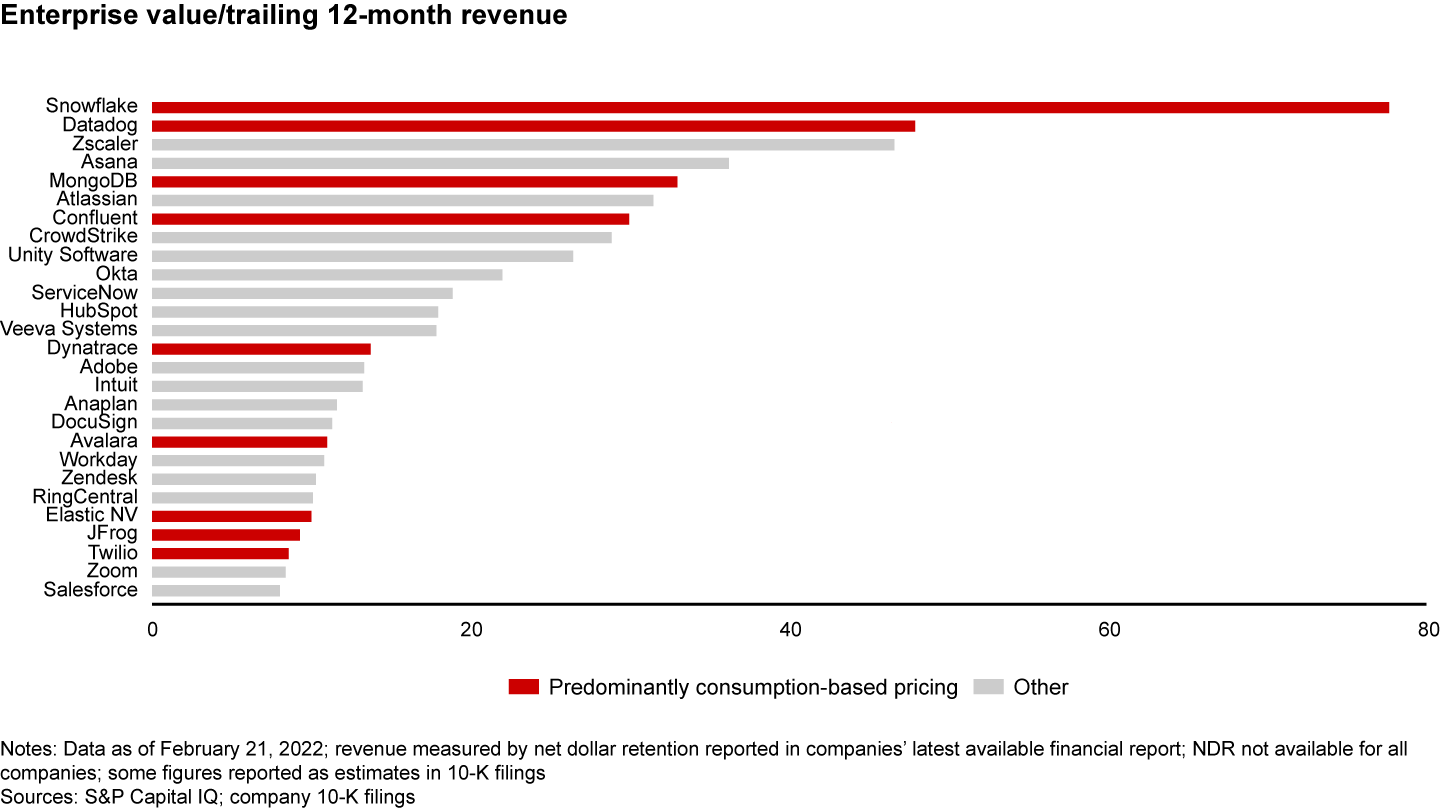
      Consumption-based pricing models are associated with some of the most highly valued software companies

      In 2021, companies with primarily consumption-based models, including Snowflake, JFrog, Elastic NV, Datadog, and Confluent, increased revenue approximately 8 percentage points higher on average than companies that mainly license or sell subscriptions to their software. Among the software companies with the highest valuation multiples, those offering consumption-based pricing on average earned 10 points higher revenue retention from existing customers, as measured by net dollar retention (NDR).

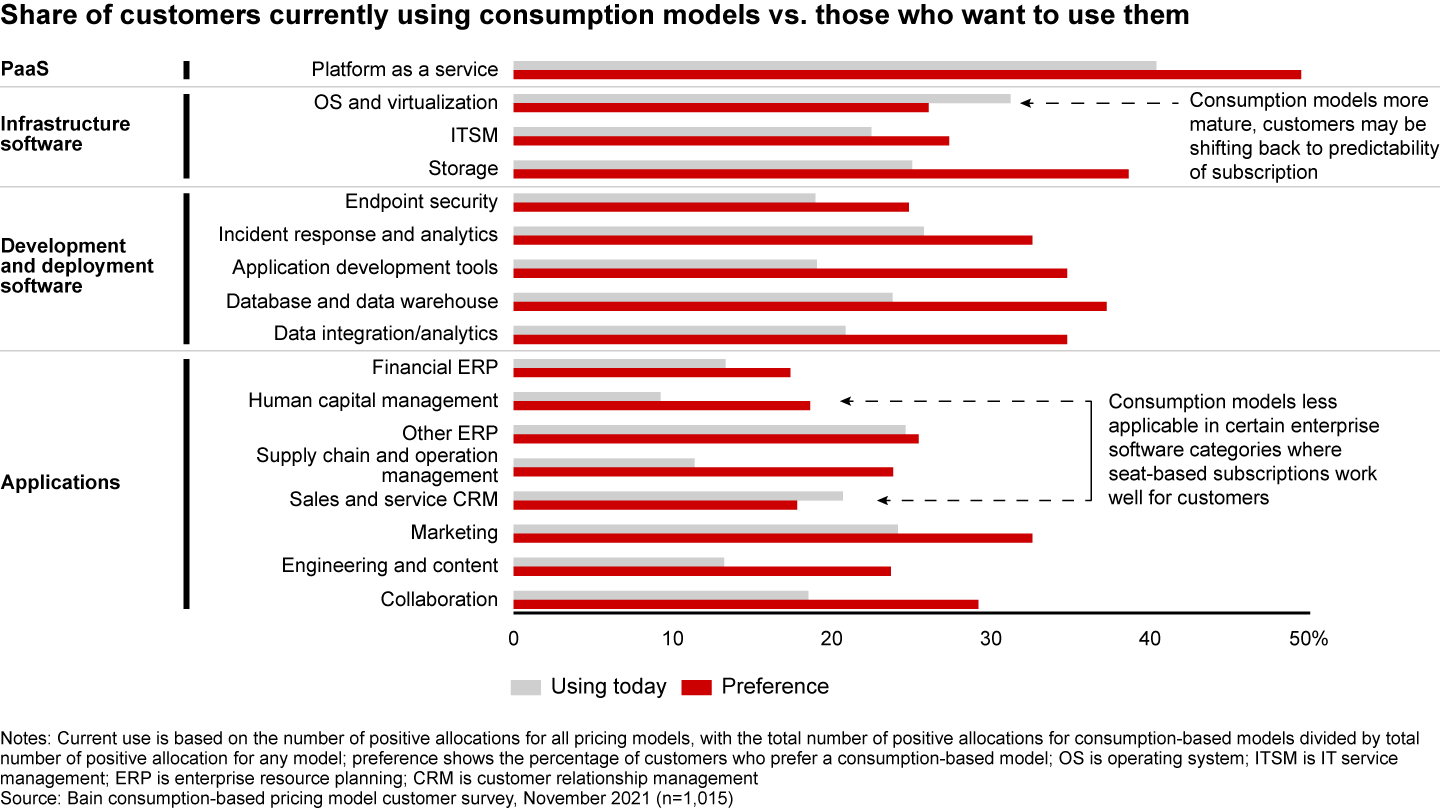
      Our research finds that customers expect to more than double their use of this model in the next one to three years, with most of that growth in the next 12 months. But even with this momentum, consumption-based pricing isn’t suited to every situation (see Figure 2). Three-quarters of software is still sold as a subscription or perpetual license, models that work well when customers know exactly how much they need. Consumption pricing has really taken off with platforms-as-a-service; cloud service providers like Amazon Web Services, Microsoft Azure, and Google Cloud; and infrastructure software and software tools serving developers.

      Figure 2
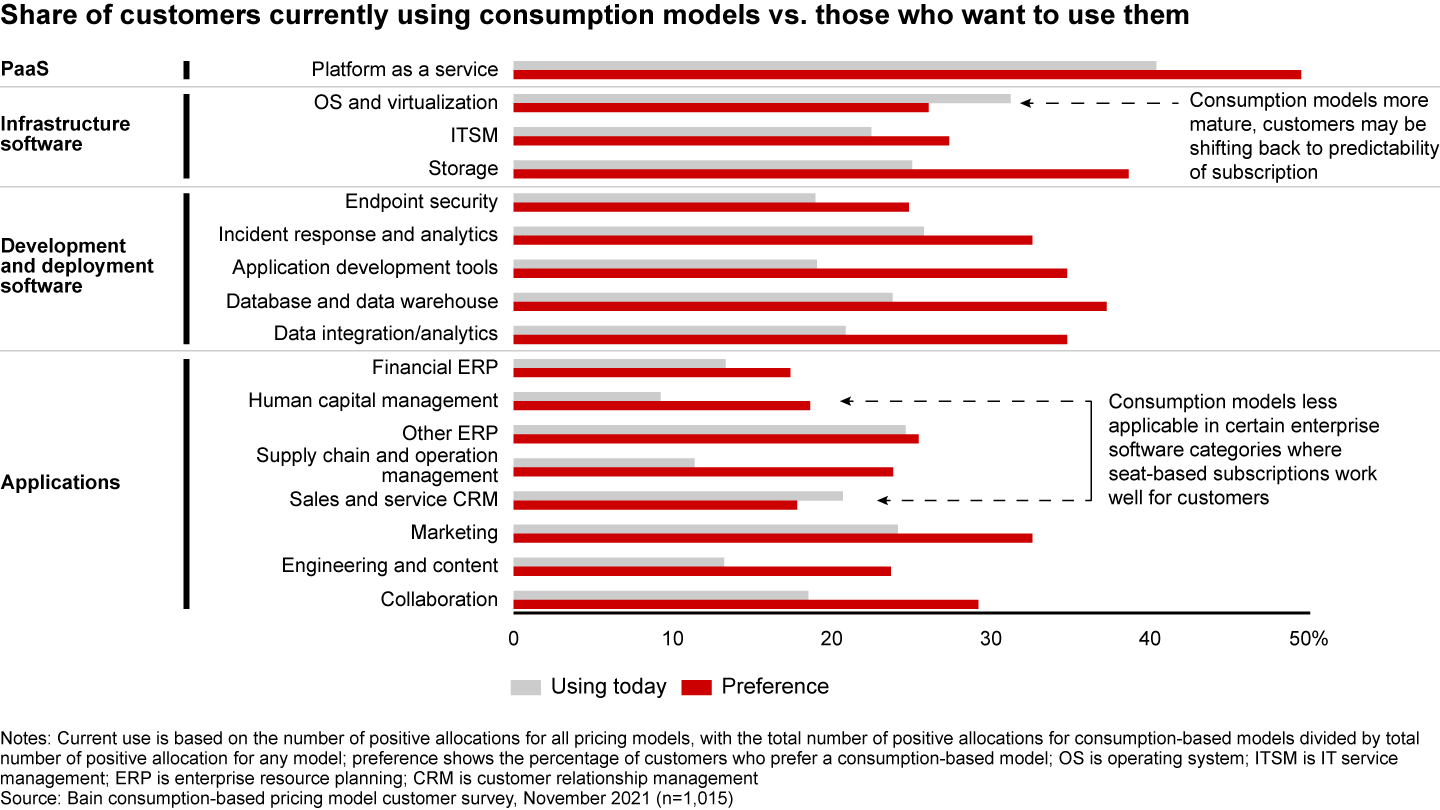
      Customer preference for consumption models outpaces current use for almost all software types

      Choosing the right pricing model

      Consumption models offer potential new growth, but before adopting one, a vendor must think through important strategic, operational, and investment considerations, and realize that this transition can take multiple years. Software companies can begin by asking themselves three guiding questions.

      1. Can we directly tie the value of our offering to a clear, transparent consumption metric that makes sense for both customers and vendors?

      Cloud software company Snowflake offers a usage-based pricing model with two metrics. For data storage, the company charges a certain dollar amount per terabyte per month after compression. For querying data, the metric is a dollar amount per second per warehouse, a flexible figure that enables customers to purchase any size and number of data warehouses. Because these metrics measure the use and value of the product’s two primary functions, they clearly align with the value delivered to customers. Defined and quantitative, they allow for granular tracking, and customers have embraced them. Today, 93% of Snowflake’s revenue is consumption-based.

      A successful meter has several characteristics.

      • Value-based. It aligns with the value customers receive.
      • Flexible. Customers can control how much they use and pay only for that. Snowflake, for example, offers automatic suspension of warehousing charges when no query is running.
      • Scalable. Value moves with consumption instead of being “worth it” only after or before a certain amount of use, and it feels fair to both small and large users.
      • Predictable. Usage can be estimated and used to inform budgeting. This is difficult to achieve. More than 90% of users who prefer subscription models cite a lack of predictability as the main downside of consumption models.
      • Feasible. The meter should be easy to monitor.

      2. Are customers in our industry interested in paying based on consumption, and are competitors offering it?

      In some applications like enterprise software for enterprise resource planning (ERP), human capital management (HCM), and customer relationship management (CRM), subscriptions based on seat count work well, and few customers are interested in changing models. For them, the value of the software lies in each user’s ability to create a unique workspace and workflow for managing customer and prospect pipelines. Start-ups in these categories aren’t using consumption models to disrupt. Operating system and virtualization software customers appreciate how the predictability of subscriptions aligns with corporate budgeting.

      3. Do we have or can we see a path to developing the capabilities to operate the business in a consumption model?

      The selection of the pricing meters and packaged offerings was just the start of a much larger journey for an infrastructure software company that recently shifted to consumption pricing. Each function in the organization has adapted:

      • product development, by engineering telemetry into the product, creating dashboards to inform users of real-time usage, and featuring predictive models for forecasting;
      • sales, by creating “land and expand” sales plays and enablement, and adjusting sales staff incentives to support ongoing consumption instead of Day 1 booking;
      • services, by creating quick-start services that support starting small and then expanding;
      • customer success, by finding ways to support incremental usage;
      • sales operations and finance, by creating a plan to migrate to the new model and a business plan that balances new growth with the short-term drop in revenue expected from current customers who pay less in a consumption model; and
      • systems, by building tools to estimate the cost of using the product and systems that route usage data to billing, customer reporting, financial systems, and sales and customer success dashboards.

      The answers to these three questions will help determine if consumption pricing is right for your company. If it is, there will certainly be work ahead to develop the capabilities and offerings needed to make the transition a success, but it will give your company a shot at growth and valuation rivaling that of some of the best businesses in software.

      Read the Next Chapter

      Product Management: The Key to Unlocking Return on Your Software R&D Investment

      Value Evolution

      • The Rise of Growth Equity Investors

      • A Multicloud World

      • Welcome to Web3

      • The US-China Decoupling

      Competitive Battlegrounds

      • Defending against Disruption

      • The Engine 2 Imperative

      • AI’s Next Frontier

      • The Industrial IoT

      Operational Advantage

      • Beyond the Rule of 40

      • Sales Productivity

      • Consumption-Based Pricing

      • Software R&D Efficiencies

      • The Chip Shortage

      • The Circular Economy

      Read our 2022 Technology Report

      Explore the report Download PDF
      著者
      • Headshot of Simon Heap
        Simon Heap
        Advisory Partner, Silicon Valley
      • Sukh Brar
        アソシエイト パートナー, Seattle
      関連業種
      • Cloud Computing
      • IoT
      • IT Services
      • Semiconductors
      • Software
      • テクノロジー
      Technology Report
      Product Management: The Key to Unlocking Return on Your Software R&D Investment

      Product management is instrumental to boosting returns on software development investments, but few companies do it well.

      詳細
      Technology Report
      Quantum Computing Moves from Theoretical to Inevitable

      Quantum will likely become part of a mosaic, working with classical computing to solve big problems.

      詳細
      CIO Insights
      Despite Tech Layoffs, Competition for Talent Remains Fierce

      Tech workers increasingly value career development opportunities and remote or hybrid work options, while compensation has soared.

      詳細
      Technology Report
      How Can We Meet AI’s Insatiable Demand for Compute Power?

      Technological innovation, new revenue, and public support may be needed to fund and supply enough electricity.

      詳細
      テクノロジー
      Using Hardware to Scale the Industrial Internet of Things

      Bain partners discuss the opportunity for hardware vendors to help companies develop their IoT pilots.

      詳細
      First published in 9月 2022
      Tags
      • CIO Insights
      • Cloud Computing
      • IoT
      • IT Services
      • Semiconductors
      • Software
      • Technology Report
      • テクノロジー

      クライアント支援事例

      Helping a Midsize ERP Player Compete against the Giants

      ケーススタディを見る

      業績改善 Aggressively growing an IT service provider with a high-performance culture

      ケーススタディを見る

      顧客戦略、マーケティング Sales blueprint puts IT Services Co.'s growth back on track

      ケーススタディを見る

      お気軽にご連絡下さい

      私達は、グローバルに活躍する経営者が抱える最重要経営課題に対して、厳しい競争環境の中でも成長し続け、「結果」を出すために支援しています。

      ベインの知見。競争が激化するグローバルビジネス環境で、日々直面するであろう問題について論じている知見を毎月お届けします。

      *プライバシーポリシーの内容を確認し、合意しました。

      プライバシーポリシーをご確認頂き、合意頂けますようお願い致します。
      Bain & Company
      お問い合わせ Sustainability Accessibility Terms of use Privacy Cookie Policy Sitemap Log In

      © 1996-2026 Bain & Company, Inc.

      お問い合わせ

      How can we help you?

      • ビジネスについて
      • プレス報道について
      • 採用について
      全てのオフィス