

論説

At a Glance
- Companies often struggle with managing multiple external marketing agencies, which can lead to ballooning costs, inefficiencies, and a lack of innovation.
- To regain control, marketers should determine which capabilities to build in-house and which to outsource, focusing on areas where proximity to the brand and data matter most.
- While many companies are combining in-house teams with external agencies, these setups can fall short without a well-defined strategy and clear alignment of roles.
- Generative AI will transform marketing by automating tasks, enhancing content creation, and improving ROI, but marketers must reimagine workflow and renegotiate agency contracts to reflect new realities.
Inside the marketing group at a major beverage company, years of frustration with external agency performance finally boiled over. Despite promises from agency management and staffing changes, the agency of record was not meeting the company’s needs and was falling short in delivery and accurate revisions. Accountability, quality, and timing all suffered. In response, the beverage company conducted an analysis to decide which capabilities to keep sourcing externally and which to bring in-house. The capabilities it ultimately decided to bring in-house included media strategy, insights, and analytics, making it necessary to hire and train new staff.
The company centralized its data and marketing technology teams and, rather than have one central team, dedicated internal media teams to business units so as to increase accountability and embed brand capabilities. In parallel, the company replaced its agency of record with a more suitable partner.
Vexing situations such as this one commonly crop up in companies that have become overly dependent on external agencies for core marketing activities. Marketing organizations often find themselves saddled with vendors that fail to provide consistently high-caliber performance yet come with high costs and added administrative burden due to rigid processes and frequent rework.
Many marketers lack the governance to hold their agencies accountable. In these instances, brand marketers end up steps removed from important data, impeding their ability to make confident decisions quickly.
Some 92% of companies that belong to the Association of National Advertisers worked with one or more external agencies in 2023, the ANA reports in its latest survey. At the same time, 82% had an in-house agency as well—up from 78% in 2018—meaning most marketers have a hybrid approach rather than the extreme approach of either outsourcing everything or keeping all work in-house.
Complicated agency configurations, hybrid or not, often fall short of full potential. Marketing executives may find they spend too much time coordinating in-house and agency experts rather than running the business and owning key decisions. By contrast, effective marketers create a deliberate, well-defined agency ecosystem where the in-house/outsource equation is balanced with a consolidated set of agencies and in-house talent in close collaboration, with clear decision rights.
Questions to structure the ins and outs
To determine the right balance of marketing talent, companies will need to answer three questions.
What specialized capabilities should we build in-house? Taking more control of the brand’s marketing services entails first understanding what capabilities will help accelerate competitive advantage. The best marketing organizations rarely outsource everything or retain all functions in-house. They prioritize those capabilities that will best advance the most important objectives, and hand off work that requires external expertise.
Leaders focus on building in-house talent in areas where proximity to the brand or line of business has the greatest effect, and where fewer handoffs increase efficiency with no trade-off in expertise. Such areas typically include media strategy, insights, data, analytics, and performance metrics.
Where do we gain an advantage by using outside talent? External agencies are well positioned to address certain needs. These areas of focus often include:
- Creative development and production for building brand equity;
- National video buying and media operations;
- Flexible pools of people to execute the strategy; and
- Clout when negotiating contracts and price.
Redesigning the in-house/outsource equation can produce big dividends, as an effective agency ecosystem provides expertise and resources that would be too expensive or time-consuming to develop in-house.
Of course, in any of these areas, marketing executives need to ensure that agency partners have a solid commitment to the strategy. Marketers will want to identify opportunities to pare back the volume of agencies and thus reduce inefficient costs wherever possible. And they should regularly validate quality and price standards with benchmarks in the marketplace.
What is the best way to integrate internal and external activities? It’s one thing to determine the mix of internal and external activities, but it’s quite another to divide and conquer the work as a single unit.
For instance, some activities must move quickly, such as measuring how a campaign is performing against expectations. Other goals, such as improving consumer engagement, involve adjusting multiple activities. Effective integration between teams requires a well-documented workflow, governance, and the right talent for the job.
Marketers must decide between a consolidated model with a single agency team for all work; a mixed model that bundles work for one main function (such as creative or media) and uses a series of point solutions for the other functions; or a model that divides work across many agencies, each handling a point solution (see Figure 1). Each model comes with trade-offs along dimensions such as cost efficiency and operational friction.
Figure 1
As marketers take control of more activities, they will have to deal with a corresponding effect on personnel and productivity. Certain agency roles will switch to in-house, which means new technical staff will need to be hired and trained. The transition will involve periods of overlap between agency and internal teams, requiring extra management to maintain performance. In a multi-brand or multi-business-unit company, marketers will have to determine which capabilities to centralize and which to embed within the brands or business units.
Agencies also need to evolve as new ways of working are established. New commercial models and incentives may need to be negotiated. And both parties will benefit from clearly defined accountability and governance, with explicit guidelines on service-level agreements and escalation. To manage agency performance, it would be a mistake to rely solely on procurement and sourcing teams. Marketers, both internal and external, should be the ones to agree on interdependent and independent motions.
How generative AI changes the game
The advent of generative artificial intelligence (AI), which focuses on analyzing and creating content, brings a new wrinkle to the challenges of managing an agency ecosystem. The technology will yield benefits such as more content at a lower cost, increased personalization, and faster testing.
We estimate that generative AI has the potential to affect 47% of marketing activities, which is relatively high compared to other corporate functions. And companies could save 24% in marketing labor time using generative AI, translating to a roughly 30% gain in productivity for marketing. The areas most affected by the technology rely heavily on data analysis: digital marketing and consumer insights and experience (see Figure 2). For example, the technology is automating data analysis used to optimize campaigns and user experience, and it’s helping to create and visualize customer insights. This causes some marketers to wonder how to keep pace with the latest technology—should they build expertise in-house or leverage some of their agency partners?
Figure 2
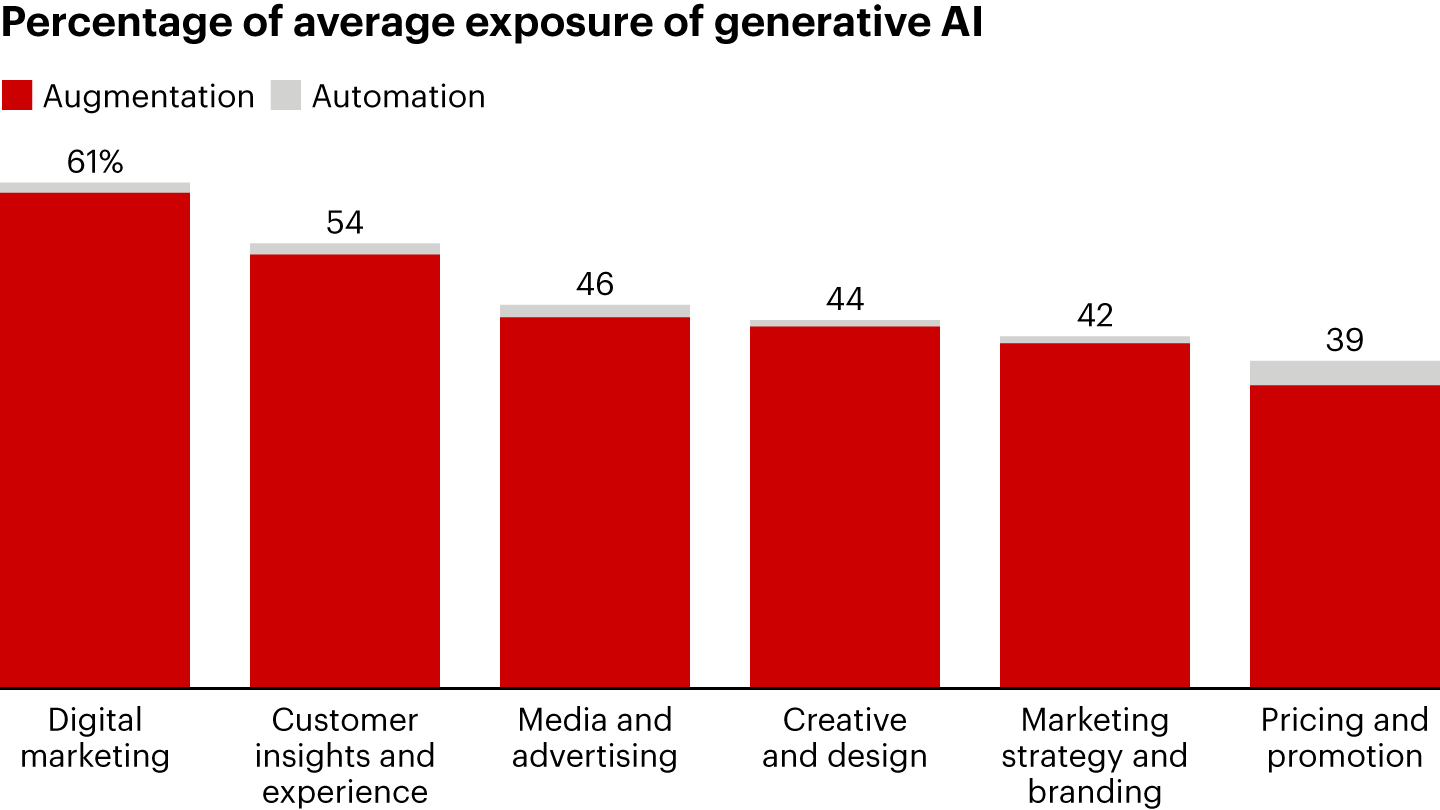

Generative AI thus will reshape the corporate/agency relationship on several fronts, each with its own issues to resolve. Most obviously, the technology easily creates content, but there are diminishing returns to abundance. So, marketers must understand when and how more content yields returns, then structure contracts to avoid paying for abundance past its marginal value.
Beyond content, generative AI enables more creative output of all types, but the technology can only be deployed if it’s complemented with greater capabilities in rigorous experimentation, analytics to measure value, and personalization.
Operations economics will change by substituting automation and its fixed costs for manual labor with variable costs. Agencies will likely capture those returns to scale—and spend more on customizing to accommodate variation among consumers. Therefore, marketers should insist that agencies automate activities such as administrative and reporting processes, and that agency fees should drop by, say, 20%. Agencies that can meet the lower cost with automation-enabled quality and reliability stand to benefit the most.
Generative AI also looks set to accelerate ROI within launched campaigns, creating opportunities for agencies to earn some value—for instance, through capturing programmatic buying arbitrages. But this capability will become commoditized as agencies compete to provide the capability. Here, marketers should insist on optimization during the campaign and price any optimization with value-based or at-risk contracting.
Time for a frank self-assessment
For marketers considering whether to redesign their agency partnership model, it’s useful to work through a set of high-gain questions:
- Do we have a clear talent strategy for the next few years on what skills we need to grow demand?
- Is our agency—paid media or creative—running multiple experiments each quarter (across content, channel, audience, etc.)?
- Can our agency turn around our requests in under 12 hours?
- Do we and our agencies feel like one team?
- Do we have performance-based compensation?
Depending on the answers, a review of the agency operating model may be overdue. And with the spread of generative AI, it’s well worth assessing how the new technology will change marketers’ and agencies’ approaches to modern marketing.
First published in 10月 2024