
Skip to Content
  • オフィス

    オフィス

    北米・南米
    • Atlanta
    • Austin
    • Bogota
    • Boston
    • Buenos Aires
    • Chicago
    • Dallas
    • Denver
    • Houston
    • Los Angeles
    • Mexico City
    • Minneapolis
    • Monterrey
    • Montreal
    • New York
    • Rio de Janeiro
    • San Francisco
    • Santiago
    • São Paulo
    • Seattle
    • Silicon Valley
    • Toronto
    • Washington, DC
    ヨーロッパ・中東・アフリカ
    • Amsterdam
    • Athens
    • Berlin
    • Brussels
    • Copenhagen
    • Doha
    • Dubai
    • Dusseldorf
    • Frankfurt
    • Helsinki
    • Istanbul
    • Johannesburg
    • Kyiv
    • Lisbon
    • London
    • Madrid
    • Milan
    • Munich
    • Oslo
    • Paris
    • Riyadh
    • Rome
    • Stockholm
    • Vienna
    • Warsaw
    • Zurich
    アジア・オーストラリア
    • Bangkok
    • Beijing
    • Bengaluru
    • Brisbane
    • Ho Chi Minh City
    • Hong Kong
    • Jakarta
    • Kuala Lumpur
    • Manila
    • Melbourne
    • Mumbai
    • New Delhi
    • Perth
    • Shanghai
    • Singapore
    • Sydney
    • Tokyo
    全てのオフィス
  • アルムナイ
  • メディア
  • お問い合わせ
  • 東京オフィス
  • Japan | 日本語

    地域と言語を選択

    グローバル
    • Global (English)
    北米・南米
    • Brazil (Português)
    • Argentina (Español)
    • Canada (Français)
    • Chile (Español)
    • Colombia (Español)
    ヨーロッパ・中東・アフリカ
    • France (Français)
    • DACH Region (Deutsch)
    • Italy (Italiano)
    • Spain (Español)
    • Greece (Elliniká)
    アジア・オーストラリア
    • China (中文版)
    • Korea (한국어)
    • Japan (日本語)
  • Saved items (0)
    Saved items (0)

    You have no saved items.

    後で閲読、共有できるようにするためにブックマークしてください

    Explore Bain Insights
  • 業界別プラクティス
    メインメニュー

    業界別プラクティス

    • 航空宇宙、防衛、政府関連
    • 農業
    • 化学製品
    • インフラ、建設
    • 消費財
    • 金融サービス
    • ヘルスケア
    • 産業機械、設備
    • メディア、エンターテインメント
    • 金属
    • 採掘・鉱業
    • 石油、ガス
    • 紙、パッケージ
    • プライベートエクイティ
    • 公共、社会セクター
    • 小売
    • テクノロジー
    • 通信
    • 交通
    • 観光産業
    • 公益事業、再生可能エネルギー
  • 機能別プラクティス
    メインメニュー

    機能別プラクティス

    • カスタマー・エクスペリエンス
    • サステイナビリティ、 社会貢献
    • Innovation
    • 企業買収、合併 (M&A)
    • オペレーション
    • 組織
    • プライベートエクイティ
    • マーケティング・営業
    • 戦略
    • アドバンスド・アナリティクス
    • Technology
    • フルポテンシャル・トランスフォーメーション
  • Digital
  • 知見/レポート
  • ベイン・アンド・カンパニーについて
    メインメニュー

    ベイン・アンド・カンパニーについて

    • ベインの信条
    • 活動内容
    • 社員とリーダーシップ
    • プレス・メディア情報
    • クライアントの結果
    • 受賞歴
    • パートナーシップを結んでいる団体
    Further: Our global responsibility
    • ダイバーシティ
    • 社会貢献
    • サステイナビリティへの取り組み
    • 世界経済フォーラム(WEF)
    Learn more about Further
  • キャリア
    メインメニュー

    キャリア

    • ベインで働く
      キャリア
      ベインで働く
      • Find Your Place
      • ベインで活躍する機会
      • ベインのチーム体制
      • 学生向けページ
      • インターンシップ
      • 採用イベント
    • ベインでの体験
      キャリア
      ベインでの体験
      • Blog: Inside Bain
      • キャリアストーリー
      • 社員紹介
      • Where We Work
      • 成長を後押しするサポート体制
      • アフィニティ・グループ
      • 福利厚生
    • Impact Stories
    • 採用情報
      キャリア
      採用情報
      • 採用プロセス
      • 面接内容
    FIND JOBS
  • オフィス
    メインメニュー

    オフィス

    • 北米・南米
      オフィス
      北米・南米
      • Atlanta
      • Austin
      • Bogota
      • Boston
      • Buenos Aires
      • Chicago
      • Dallas
      • Denver
      • Houston
      • Los Angeles
      • Mexico City
      • Minneapolis
      • Monterrey
      • Montreal
      • New York
      • Rio de Janeiro
      • San Francisco
      • Santiago
      • São Paulo
      • Seattle
      • Silicon Valley
      • Toronto
      • Washington, DC
    • ヨーロッパ・中東・アフリカ
      オフィス
      ヨーロッパ・中東・アフリカ
      • Amsterdam
      • Athens
      • Berlin
      • Brussels
      • Copenhagen
      • Doha
      • Dubai
      • Dusseldorf
      • Frankfurt
      • Helsinki
      • Istanbul
      • Johannesburg
      • Kyiv
      • Lisbon
      • London
      • Madrid
      • Milan
      • Munich
      • Oslo
      • Paris
      • Riyadh
      • Rome
      • Stockholm
      • Vienna
      • Warsaw
      • Zurich
    • アジア・オーストラリア
      オフィス
      アジア・オーストラリア
      • Bangkok
      • Beijing
      • Bengaluru
      • Brisbane
      • Ho Chi Minh City
      • Hong Kong
      • Jakarta
      • Kuala Lumpur
      • Manila
      • Melbourne
      • Mumbai
      • New Delhi
      • Perth
      • Shanghai
      • Singapore
      • Sydney
      • Tokyo
    全てのオフィス
  • アルムナイ
  • メディア
  • お問い合わせ
  • 東京オフィス
  • Japan | 日本語
    メインメニュー

    地域と言語を選択

    • グローバル
      地域と言語を選択
      グローバル
      • Global (English)
    • 北米・南米
      地域と言語を選択
      北米・南米
      • Brazil (Português)
      • Argentina (Español)
      • Canada (Français)
      • Chile (Español)
      • Colombia (Español)
    • ヨーロッパ・中東・アフリカ
      地域と言語を選択
      ヨーロッパ・中東・アフリカ
      • France (Français)
      • DACH Region (Deutsch)
      • Italy (Italiano)
      • Spain (Español)
      • Greece (Elliniká)
    • アジア・オーストラリア
      地域と言語を選択
      アジア・オーストラリア
      • China (中文版)
      • Korea (한국어)
      • Japan (日本語)
  • Saved items  (0)
    メインメニュー
    Saved items (0)

    You have no saved items.

    後で閲読、共有できるようにするためにブックマークしてください

    Explore Bain Insights
  • 業界別プラクティス
    • 業界別プラクティス

      • 航空宇宙、防衛、政府関連
      • 農業
      • 化学製品
      • インフラ、建設
      • 消費財
      • 金融サービス
      • ヘルスケア
      • 産業機械、設備
      • メディア、エンターテインメント
      • 金属
      • 採掘・鉱業
      • 石油、ガス
      • 紙、パッケージ
      • プライベートエクイティ
      • 公共、社会セクター
      • 小売
      • テクノロジー
      • 通信
      • 交通
      • 観光産業
      • 公益事業、再生可能エネルギー
  • 機能別プラクティス
    • 機能別プラクティス

      • カスタマー・エクスペリエンス
      • サステイナビリティ、 社会貢献
      • Innovation
      • 企業買収、合併 (M&A)
      • オペレーション
      • 組織
      • プライベートエクイティ
      • マーケティング・営業
      • 戦略
      • アドバンスド・アナリティクス
      • Technology
      • フルポテンシャル・トランスフォーメーション
  • Digital
  • 知見/レポート
  • ベイン・アンド・カンパニーについて
    • ベイン・アンド・カンパニーについて

      • ベインの信条
      • 活動内容
      • 社員とリーダーシップ
      • プレス・メディア情報
      • クライアントの結果
      • 受賞歴
      • パートナーシップを結んでいる団体
      Further: Our global responsibility
      • ダイバーシティ
      • 社会貢献
      • サステイナビリティへの取り組み
      • 世界経済フォーラム(WEF)
      Learn more about Further
  • キャリア
    人気検索キーワード
    • デジタル
    • 戦略
    前回の検索
      最近訪れたページ

      Content added to saved items

      Saved items (0)

      Removed from saved items

      Saved items (0)

      論説

      Measuring decision effectiveness

      Measuring decision effectiveness

      Good, fast decision making and execution produce good financial results.

      著者:Marcia W. Blenko and Michael C. Mankins

      • min read

      論説

      Measuring decision effectiveness
      en

      Good, fast decision making and execution produce good financial results.  

      The research we conducted for our recent book firmly established this connection, but really, it’s only common sense.1 Companies that make high-quality decisions, make them quickly, and implement them effectively win more contracts, get to market faster and otherwise beat out rivals. Google launched Gmail, Google+, the Android operating system, and Google Apps, all while Yahoo! was struggling to decide on its priorities in these areas. Such dramas play out on a smaller scale in every company every day. Organizations that decide and execute better and faster than their competitors win the race. 

      And yet many companies do not even measure their decision effectiveness. They don’t know how they stack up against the competition, and they can’t tell whether they are getting better or worse over time. People may gripe in the hallways about this or that decision process, but there’s no burning platform to stimulate improvement.

      Measurement changes all that. As Peter Drucker famously observed, “What gets measured gets managed.” And if the measurement shows that your decision skills are way behind where they should be, suddenly you have a big incentive to get better.

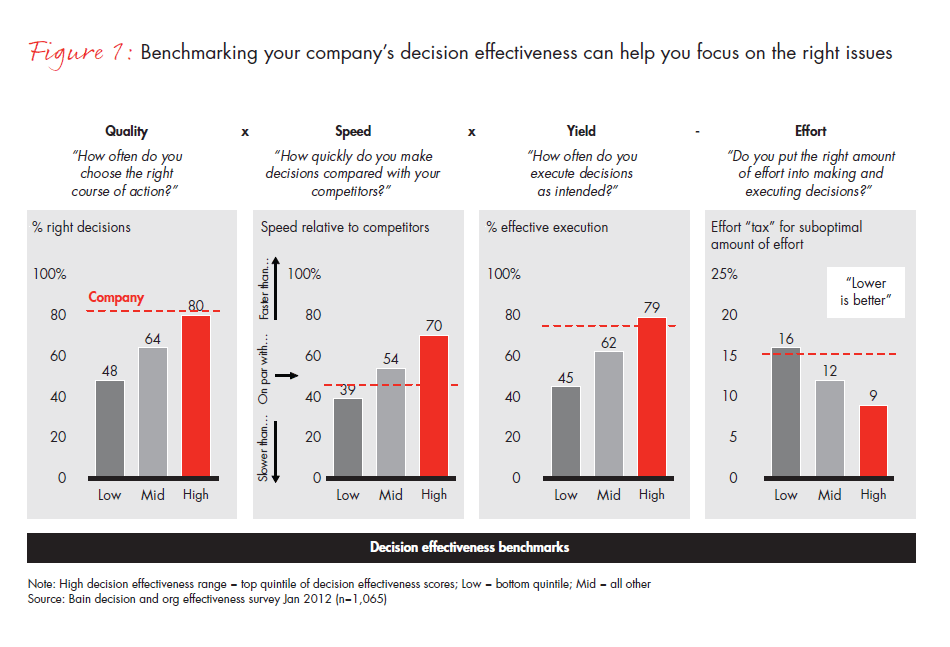
      Decision effectiveness involves four different dimensions. High-performing organizations, of course, make high-quality decisions. But they also make those decisions faster than their competitors, translate them into action more effectively and devote an appropriate amount of effort to the process. People need to know how well (or poorly) they perform on all of these elements—decision quality, speed, yield and effort.

      Employee surveys are the best gauge of performance on each dimension, since no one knows better than the people involved how good the organization really is. Ask respondents to rate your company’s abilities on quality, speed, yield and effort using a 1-to-4 point scale; this will allow you to compare scores with our benchmark database of high, average, and low performers (see Figure 1). The results will show you where your decision strengths and weaknesses lie, and what you need to do to improve performance. A pharmaceutical company, for instance, learned from a survey that its decisions were generally of high quality compared with its competitors, but its speed was below average, and nearly 80% of respondents said that decisions required too much effort. The priorities for improvement were clear. Once a company launches efforts to improve its decision effectiveness, moreover, regular surveys can provide critical feedback to show you what’s working and what isn’t.

      diV4-measuring-decision-effectiveness-fig-01_embed

      While survey results provide a high-level overview of a company’s decision effectiveness, it helps to supplement this data with metrics that relate to specific trouble spots. Among them are the following.

      Performance on certain kinds of decisions. Some organizations repeatedly stumble over particular types of critical decisions. Another pharmaceutical company, for example, found that sluggish decision procedures slowed its stage-gate process for product development, creating unnecessary iterations along the way. The data helped the company spot and unclog decision bottlenecks and thus get its products to market faster. A utility company learned that its forecasts of daily demand were often off the mark. So it began tracking the percentage of forecasting decisions that, with hindsight, turned out to be right. The process helped the executives responsible for forecasting to see where their procedures were strong and what actions could help improve them.

      What happens in meetings. Meetings should be effective forums for discussing or making decisions, but often they are not. So top-performing companies make a point of setting decision-focused agendas, beginning meetings by specifying the decisions to be made and who is accountable for them, ensuring that committees have clear decision charters, and so on. Then they measure performance on these dimensions. A semiconductor company, for instance, tracked its R&D forums—groups charged with developing new products—to determine the number of decisions each forum made, the number of decisions it delayed, and the number it revisited over a given time period. The company also tracked the frequency of escalation to a decision maker higher up in the organization. The data helped people learn to increase decision speed, cut back on reconsiderations, and reduce escalations.

      Decision competencies and behaviors. Companies can assess individuals’ decision-making skills in their regular performance evaluations. They can also track the behaviors that are central to effective decision making and execution, such as people’s willingness to engage in open and constructive debate or their willingness to commit to a decision even when they disagree with it. For example, a tech company established a list of such behaviors and began measuring them through its annual upward feedback system. A financial services company tracked adoption of its desired decision behaviors through quarterly “pulse” surveys. Several companies link executives’ bonuses to a range of decision metrics, including overall quality, speed, yield and effort; specific behaviors measured through employee surveys; and performance against established leadership standards. Both the measurements and the incentives encourage individuals to develop their own decision skills and to build organizations that make and execute decisions well.

      Drucker’s dictum about measurement and management is by now an accepted part of management lore. The challenge it presents is to measure “soft” but critical aspects of a business’s operation, such as decision effectiveness. Some companies have met this challenge head-on and are reaping the rewards. They not only invest to improve their decision effectiveness, but they also measure how well those efforts generate better, faster decisions and thus better performance.

      Marcia W. Blenko is a partner with Bain & Company and a senior member of the firm’s Global Organization practice. Michael C. Mankins leads Bain’s Organization practice in the Americas and is a senior member of Bain’s Strategy practice. He is a partner in the firm’s San Francisco office.


      1See Marcia W. Blenko, Michael C. Mankins, and Paul Rogers, Decide and Deliver: 5 Steps to Breakthrough Performance in Your Organization (Harvard Business Review Press, 2010). Copyright © 2012 Bain & Company, Inc. All rights reserved.


      diV4-measuring-decision-effectiveness-fig-01_full
      Bain Book

      Decide & Deliver

      Learn more about the five steps that leading organizations use to make great decisions quickly and execute them effectively.

      著者
      • Headshot of Marcia Blenko
        Marcia Blenko
        Advisory Partner, Boston
      • Headshot of Michael Mankins
        Michael Mankins
        パートナー, Austin
      関連するコンサルティングサービス
      • 組織
      コンサルティングサービス
      • Decision Effectiveness
      組織
      Refresh, refocus and remind: Nine practical tips to keep meetings centered on decisions and action

      Meetings. No company can live without them, but it sure is hard to live with them.

      詳細
      Decision Effectiveness
      RAPID® Decision Making

      When the roles involved in decisions are clearly delineated, teams and organizations make the right choices.

      詳細
      ベイン・クラシック
      Is Your Sales Organization Ready for a Recession?

      A winning plan will help companies prosper when the economy turns down.

      詳細
      組織
      Want More Out of Your AI Investments? Think People First

      To unlock AI’s exponential productivity potential, companies must modernize workflow and workforce in tandem.

      詳細
      ベイン・クラシック
      Three Ways Companies Make Work Purposeful

      Retaining employees starts with keeping them engaged.

      詳細
      First published in 6月 2012
      Tags
      • Decision Effectiveness
      • ベイン・クラシック
      • 組織

      クライアント支援事例

      戦略 A Bold New Strategy Restores a Bank to a Leadership Position

      ケーススタディを見る

      組織 Centralization boosts performance for an energy giant

      ケーススタディを見る

      組織 A Regional Operating Model Lifts European Sales for a Medical Device Maker

      ケーススタディを見る

      お気軽にご連絡下さい

      私達は、グローバルに活躍する経営者が抱える最重要経営課題に対して、厳しい競争環境の中でも成長し続け、「結果」を出すために支援しています。

      ベインの知見。競争が激化するグローバルビジネス環境で、日々直面するであろう問題について論じている知見を毎月お届けします。

      *プライバシーポリシーの内容を確認し、合意しました。

      プライバシーポリシーをご確認頂き、合意頂けますようお願い致します。
      Bain & Company
      お問い合わせ Sustainability Accessibility Terms of use Privacy Cookie Policy Sitemap Log In

      © 1996-2026 Bain & Company, Inc.

      お問い合わせ

      How can we help you?

      • ビジネスについて
      • プレス報道について
      • 採用について
      全てのオフィス