

論説

One of the most disruptive forces in business is rapidly coming into focus—namely, the application of advanced data and analytics embedded into the core of business. Incumbents struggle to compete against it; smart companies take advantage of it.
The signs that an industry is ripe for advanced analytics disruption are becoming clearer. So are the disruptive patterns that commonly follow.
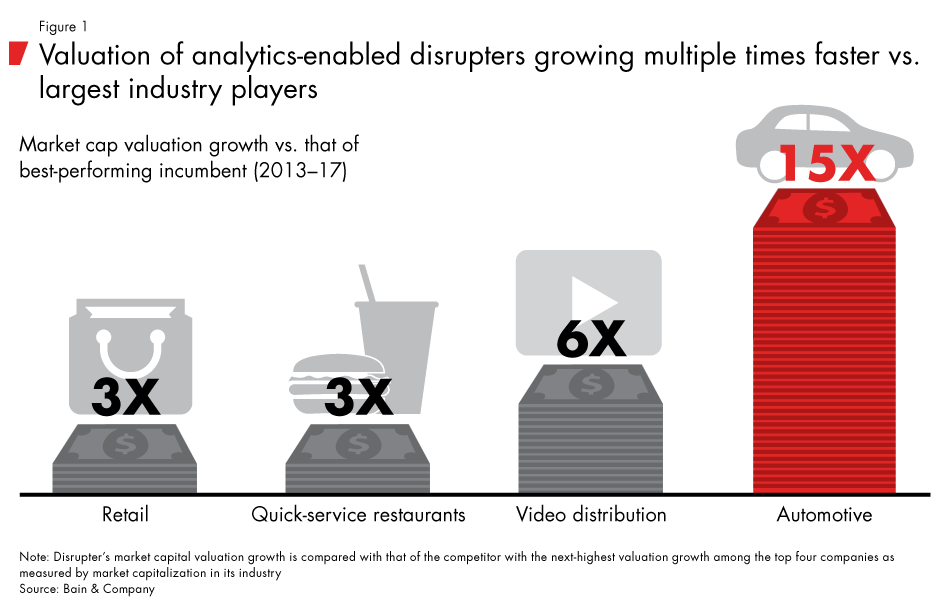
New challengers and a select few incumbents are increasingly adopting advanced analytics to innovate and to disrupt their industries. While analytics is not the only source of advantage, investors have rewarded the disrupters with much higher valuation growth than even the best-performing stock among the large incumbents (see Figure 1), according to a recent study by Bain & Company. Still, many companies and executive teams have yet to embrace analytics. Thirty percent of companies surveyed by Bain reported that advanced analytics has not been a priority for investment and progress so far, while only 5% suggested that it is a top priority.
Rasmus Wegener, a partner with Bain’s Advanced Analytics practice, shares three patterns that can signal when an industry is ripe for disruption driven by advanced analytics.
Three patterns of disruption powered by advanced analytics
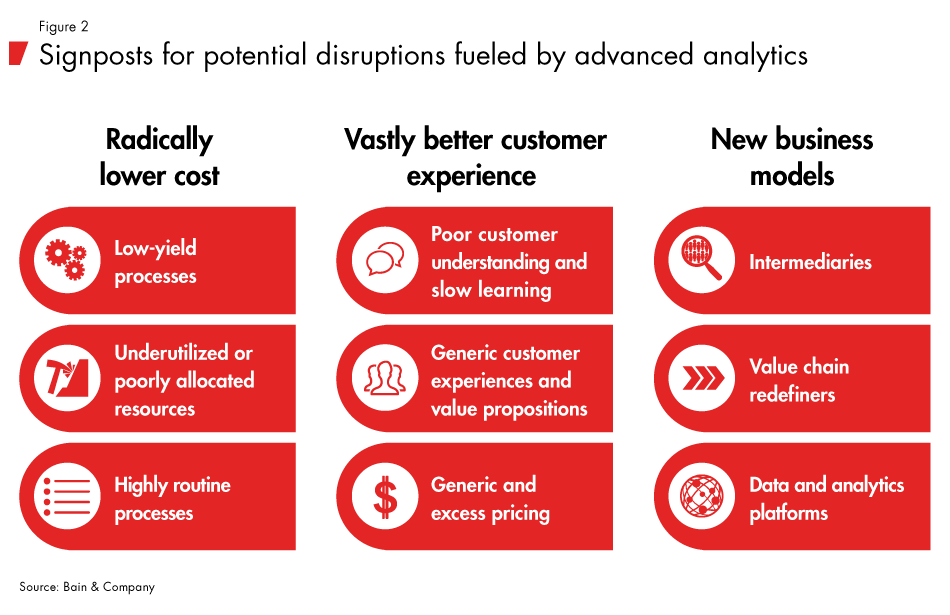
Sometimes disruption is at your doorstep and obvious—the analytically enabled new business model threatening your own. More often, however, you have to look for the signposts heralding analytic disruption. While predictions of this sort are never certain, three common patterns of disruption have emerged: radically lower cost; a step-change improvement in customer experience; and new business models combining services, technologies and data in unexpected ways.

Signs of potential disruption involving cost and customer experience often have at their root serious product, service or process deficiencies. Analytic disrupters turn these shortcomings into major opportunities by addressing and solving them with advanced analytics.
New business models go a step further. They disrupt competitive dynamics and shift profit pools by combining services, technologies and data sources that may not even seem to be related, and in doing so, create a significant and discontinuous change in customer and business value—all powered by advanced analytics and new ways to collect and deploy data (see Figure 2).
Radically lower cost
Data and analytics help provide existing products or services at a radically lower cost.
Signs your industry may be ripe for cost disruption enabled by advanced analytics:
- Low-yield or low-quality processes that advanced analytics can improve. Examples include optimized routing of delivery services based on real-time traffic and forecasts, improved salesforce effectiveness using advanced analytics to qualify leads and steer and monitor sales approaches, and better identification of malignant tumors using machine learning for identification.
- Underutilized or poorly allocated resources. Examples include expert networks and car- or workspace-sharing networks that use advanced analytics to enable economies of sharing and connecting.
- Highly routine processes, unnecessary activities or resources that can be made obsolete by the systematic use of advanced analytics. Examples include automated restocking of coffee pods using a virtual pantry instead of grocery runs as coffee machines track and learn from their owners’ coffee consumption patterns, and preventative maintenance or preventative healthcare in place of costly fixes or cures deployed after the fact. Each of these threatens large profit sources of traditional services businesses.
Chris Brahm, who leads Bain's Advanced Analytics practice, discusses how to spot signposts of disruption across three areas: customer, cost and business model.
A step-change improvement in customer experience
Data and analytics can significantly improve customer experience and in turn customers’ advocacy of an existing product or service. This often involves enhancing products or services with a high degree of personalization, making them easier to use, improving their quality, and increasing responsiveness to and resolution of customer issues.
Signs your industry may be ripe for customer experience disruption enabled by advanced analytics:
- Limited customer understanding often exacerbated by poor learning and feedback loops. Advanced analytics can draw insights from data on customer interactions, product usage and social media, and flag changing customer behavior, using methods such as the predictive Net Promoter Score® for customer interactions or social listening. Examples include data on home appliance usage that is rarely collected or used to improve products and industrial distributors’ practice of maintaining large safety stocks of occasionally ordered products, reflecting a lack of understanding of the factors driving demand.
- A generic, impersonal or poor customer experience, such as using very similar customer service processes to serve your most and least valuable customers. Most customer service interactions require users to share information that companies already know about them or force all users down similar customer service paths. Based on advanced analytics, personalization and robotic process automation can solve such shortcomings.
- Generic and untargeted pricing, including a lack of transparency. Advanced analytics can enable targeted or dynamic pricing that reflects real-time demand and supply. For instance, with the exception of car insurance, most insurance products are still priced based on a few simple demographic data points.
New business models combining services, technologies and data in unexpected combinations to disrupt
By taking a hard look at the signposts of inefficiency and ineffectiveness described above, business leaders can foresee the types of disruption in which analytics enables radically lower cost or a step-change improvement in customer experience. Much harder to predict are the specifics of the third pattern—namely, analytics-fueled disruptive business models. Yet, of the three patterns of disruption, these new business models bring about the largest change. They redefine the rules of competition and can completely alter the profit pools of entire industries.
In order to generate new value for the business and in the eyes of the customer, the new models typically address existing customer needs in a novel way by combining services, technologies and data sources that may not even seem to be related.
Familiar examples include free smartphone apps combining up-to-date mapping data, traffic flows and real-time routing capabilities that disrupted the established ways by which navigation companies Garmin and TomTom were competing. Monsanto is shifting to models based on outcomes and new analytics services to avoid disruption by precision agriculture firms that might dramatically reduce demand for its seeds and pesticides. LinkedIn builds on its social media data assets to support new recruiting services and executive search, challenging traditional players in those fields.
So, what early warning signs can leadership teams heed to detect that their business model is vulnerable to disruption through analytics?
The best way to gauge the threat from business model disruption is to understand the activity of digitally native attackers, data intermediaries, and new information platforms that work with data broadly related to your business and your customers.
Telltale indicators that a business model disruption enabled by advanced analytics may just be around the corner include the presence of:
- Value chain redefiners that build on digital and analytics business models to redefine the value proposition or cost of a certain business or service—examples include Google search ads disrupting Yellow Pages and Avant’s analytics- and machine-learning-enabled consumer lending vs. legacy lenders.
- Intermediaries that bring transparency to a market and enable new entrants—examples include online travel site TripAdvisor, hospitality platform Airbnb and Chinese online shopping site Taobao.
- New information platforms that use their data advantage to drain profits from adjacent markets, such as LinkedIn challenging traditional recruiting services, or that change the nature of competitive rivalry in an industry, such as Westlaw and other data sets in the legal profession.
Creating a new operating model requires truly embedding advanced analytics at the core of the business. This can be particularly difficult for incumbents that often struggle to overcome the inertia of well-established processes, poor IT and data infrastructure, and misaligned incentives.

How to Respond to Disruption in the Era of Advanced Analytics
Disrupters in advanced analytics upend ill-prepared companies or industries. Here's how to spot the warning signs.
Harnessing disruption
No organization is immune from advanced analytics disruption. The disruptive force of advanced analytics even affects the data-savvy set.
For example, companies such as CloudHealth claim that they can reduce an Amazon Web Services (AWS) bill by 10%–20% by uncovering overprovisioning and mismatched infrastructure, slowing some of the torrid growth in Amazon’s profitable AWS cloud services. Amazon, meanwhile, is challenging Google as the logical starting point for e-commerce searches. Having used analytics to massively improve its targeting and selection of both product and retailers, Amazon has now become the starting point for more than half of US consumers’ e-commerce searches, according to some estimates.
Leadership teams can start to assess their own risk and opportunity by asking some fundamental questions: Do any of the signposts above fit your industry? What competitive moves are you seeing?
Advanced analytics disruption leaves very little time to adapt. Bold strategies and determined leadership are the only ways to cope. How ready are you to transform and run a business to benefit from the disruptive opportunities of advanced analytics?
Will you be predator or prey?
Rasmus Wegener is a partner with Bain & Company’s Advanced Analytics practice; he is based in the firm’s Atlanta office. Chris Brahm is a Bain partner based in the San Francisco office; he leads the firm’s Global Advanced Analytics practice. Sanjin Bicanic is the practice manager of the firm’s Global Advanced Analytics practice; he is based in the San Francisco office.
Net Promoter®, Net Promoter System®, Net Promoter Score® and NPS® are registered trademarks of Bain & Company, Inc., Fred Reichheld and Satmetrix Systems, Inc.
First published in 11月 2017