

論説

Product managers at many incumbent technology companies have effectively been encouraged to think small. They typically focus on just one product line, whose boundaries are often narrowly defined by industry analysts. They are measured on their ability to ship products on time and on budget. Those are worthy business goals, of course, but meeting them doesn’t mean a product will succeed in the marketplace or that customers will be delighted.
Some leading-edge tech companies, by contrast, take a more fluid and nimble approach to product management, one that puts the customer first. Rather than viewing the market from the inside out, they start by understanding customer needs, then figuring out how to serve them. They recognize that commonly used product categories and classifications are often out of sync with what customers actually want.
The cloud, artificial intelligence, the Internet of Things and other forces have disrupted technology markets. Increasingly, customers want more than standalone products; they want solutions. They want speed, value and ease of use. They expect friction-free, end-to-end experiences.
Conventional product management isn’t set up to deliver comprehensive solutions or seamless customer experiences. Consider the example of an airline that’s in the market for technology that will help it understand the purchasing patterns of its passengers. A vendor following a standard product management approach might offer the carrier a series of components: perhaps a database management system, a data warehousing program and storage hardware.
Once it has all these pieces, the airline may then have to install a business-intelligence package and call on a service provider for help pulling everything together. Instead of getting the solution it wants—customer insights—the airline ends up with a collection of disconnected products and an unsatisfying experience.
This fragmented approach to product management can put incumbent tech companies at a disadvantage—making them vulnerable to declining sales and a shrinking market share. Many leadership teams know they have a problem, but how do they fix it? Forward-looking tech firms are adopting a broad-based, customer-centric approach known as offering management (OM).
The key to offering management is reimagining what it means to be a product manager. An offering manager is accountable for the full life cycle of an offering, including validating the need in the marketplace; determining the business model; and assessing the implications for engineering, marketing, sales, support, and, of course, budgeting. Offering managers have a mandate to work across business units and disciplines to harness the company’s full arsenal of talent and intellectual property.
The upside is significant: If offering managers are carefully selected, trained and empowered, they can emerge as visionaries in an organization, with keen insights into what customers want and how to deliver it to them. No longer mere functionaries whose primary task is to meet timetables and budgets, offering managers become leaders, advocates and agents of change.
Offering managers are responsible for crafting a detailed business plan. They move quickly, using Agile development, design thinking and test-and-learn approaches, and they are prepared to adapt rapidly when a disruptive competitor challenges their strategy for differentiation.
Offering managers define a market not as a group of customers that buys a specific product, but as a segment of customers that has a common need. What matters isn’t only deciding which features go on the product, but also ensuring that customers have a positive end-to-end experience while using it.
Mark Brinda, a partner in Bain’s Telecommunications, Media and Technology practice, describes how the two approaches differ and how giving more power to product managers can help companies drive growth.
In our experience, companies that successfully make the transition from product management to offering management share three practices. First, they completely rethink the way they define markets and the methods they use to develop and deliver offerings. Next, they elevate and broaden the role of the product manager. Finally, they develop a rigorous feedback loop to continually gather and analyze customer sentiments and competitor developments, which they use to inform the next generation of products.
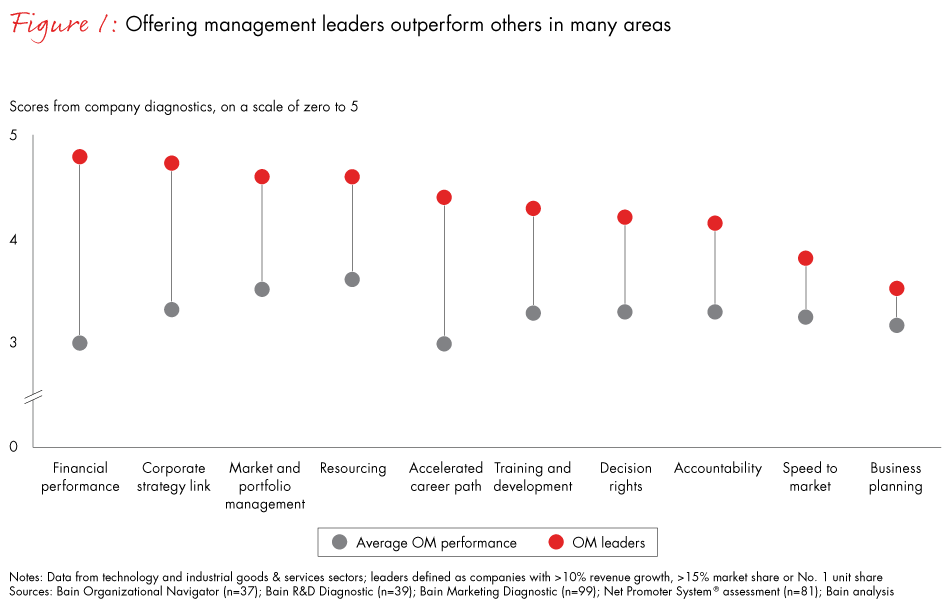
Transforming product management into offering management takes time and energy, but the approach can pay dividends both inside the company and in the marketplace. Bain surveys show that companies that lead in OM outpace average performers in such areas as speed to market, training and development, and business planning (see Figure 1).
Define the market and deliver unique offerings
In an age of constant disruption, when distinctions are blurring between products and services, product categories and entire industries, it has become increasingly challenging for companies to accurately define markets and assess the needs of customers.
The firms that excel at identifying market opportunities develop a unique point of view—one that’s based not on a synthesis of third-party market research reports and analysts’ perspectives, but on proprietary insights gathered through regular engagement with customers and sellers. Product managers at these companies test the market frequently with new offerings. If they don’t succeed, they “fail fast,” learn lessons and move quickly to the next iteration.
Before moving ahead with an offering, managers face two critical decision points. First, is the design compelling and differentiated enough? Is there evidence that the differentiation resonates with customers? Second, what is the business case? What levels of investment and resources will generate what economic impact over time?
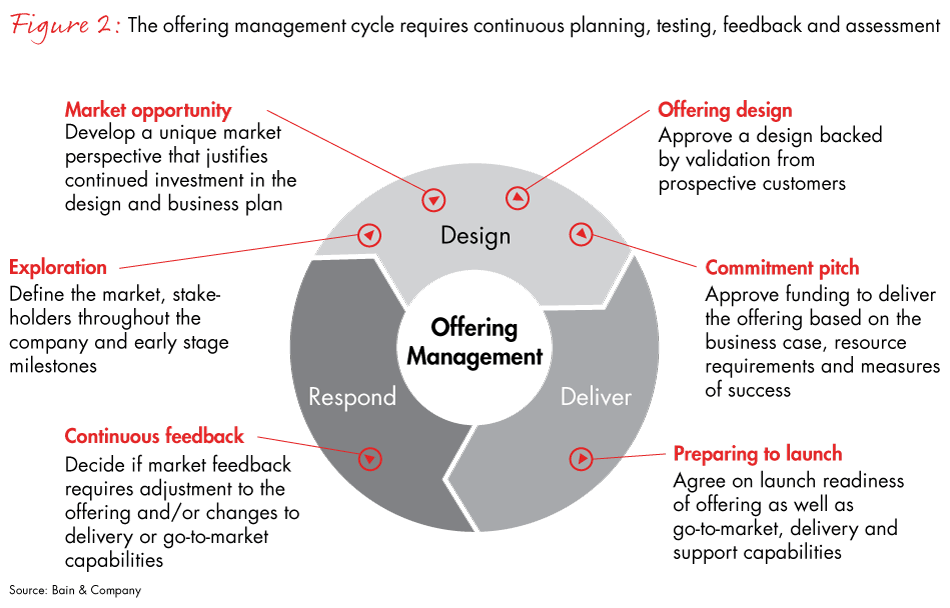
Once these questions are answered, the offering—either an entirely new product or an enhancement of an existing one—can be made real. Traditional product managers spend a majority of their time shepherding the engineers who build the product, but offering managers understand that this task represents only a portion of the work that needs to be done. Offering managers must prepare marketing, sales, digital channel, support and partner ecosystems before the offering comes to market (see Figure 2).
Offering managers aren’t managers in the conventional sense. They don’t have armies of people reporting to them. Their job is to set priorities, spell out resource requirements and delineate the support they’ll need from other parts of the organization. This means they must lead through influence, not directives.
At Google, for example, product managers can find their authority—and budgetary allocations—vulnerable at any time if others in the organization no longer buy into their vision. It’s up to product managers to continuously drive alignment with designers, engineers, designers, marketers and salespeople through the power of their ideas and the completeness of their plans. If engineers or marketers feel their time is better spent elsewhere, they can withhold their support, and the offering will fall apart.
When product managers are empowered, and when they are called upon to rigorously defend their positions, they can come up with singular insights. At Adobe, product managers spotted a trend that rivals and industry analysts were slow to recognize. They saw that the market for digital marketing software was undergoing a sea change. Looked at through a conventional lens, the market consisted of discrete segments, including web analytics, campaign management, audience management and social media marketing.
But Adobe discerned that customers no longer wanted piecemeal products; they wanted comprehensive solutions. Beginning in 2009, Adobe made a series of targeted acquisitions in digital marketing segments then melded those products into a suite of integrated offerings. Just eight years after entering the business, Adobe is now a market leader in digital marketing software.
Find and elevate the right talent
In Bain’s experience, the companies that lead in offering management understand the centrality of talent. They know they must develop, nurture and reward offering managers. The first step is to redesign the job. A new kind of product manager requires a new set of skills, including deep experience in specific markets, along with such intangibles as perseverance, creativity and the ability to inspire others.
Once the prerequisites of the role are spelled out, companies can conduct a disciplined assessment of their existing cadre of product managers. Some will be standout candidates for the new positions; others will be promising but in need of development; and a third group may not have what it takes to thrive as an offering manager. Once companies have sorted out their internal candidates, they can begin recruiting aggressively to fill open positions.
While there is no one-size-fits-all approach to offering management, companies typically find that an offering manager ideally has only a few formal direct reports, who assist with planning and outreach to customers and help run scrum teams. Each offering manager works closely with a group of designers, developers and engineers to build the offering, along with help from marketing, sales and support. The structure is neither a hierarchical pyramid nor a diamond-shaped construct that’s weighed down with middle managers. It’s flat, lean and fluid.
At analytics company Teradata, managers who used to have a narrower scope of authority now have a broad remit over the entire life cycle of a product and the customer experience. Teradata offering managers now map out needs and priorities across functions, assuming decision-making rights that were previously held by the heads of individual departments. With this new power comes new accountability—metrics have been refreshed and focused more on market results—and with accountability comes opportunity. The offering manager post is becoming a sought-after role and a primary pathway to general manager positions.
In the year or so since Teradata began its transition to OM, the company has already begun seeing results in the marketplace, notably with the launch of Intelli-Cloud, a cloud-based software-as-a-service offering introduced in the first quarter of 2017.
Build a robust customer feedback loop
Offering managers are responsible not just for getting a product to the market, but also for what happens to that product once it’s in the market.
To track what’s happening to products in the market, product managers need to set up robust customer feedback loops. In the Big Data era, companies are often inundated with information about their customers from a variety of sources: through direct purchases, resellers and support centers, as well as via the web, mobile apps and social media. In a well-constructed feedback loop, companies collect essential information from all of these touchpoints, distill it, sometimes with the help of artificial intelligence, and then route it back to the owner of the product—the offering manager. The offering manager is responsible for identifying and prioritizing any systemic problems with the product and acting quickly to fix them.
One major enterprise software services company embarking on an offering management transformation discovered significant “leakage” in its customer feed-back processes. Data was coming in from various touchpoints, but the offering managers weren’t systematically reviewing the information. The company is now creating a system that will collect and analyze customer feedback from its 10,000-plus sales representatives, as well as from its delivery and support organizations, and then funnel that information to the relevant offering managers.
Companies considering whether they need to change their product management organization can start by asking themselves a simple question: Are they gaining or losing market share? If they’re losing share, the chances are good that something is broken in product management. When product managers are empowered and invigorated under offering management, they become product leaders, not merely product caretakers. They assume responsibility for the offering’s entire journey from the lab to the customer. For these offering managers, market share becomes the metric that matters most. When their offering succeeds in the marketplace, they reap the rewards—and so do their customers.
Mark Brinda and David Mortlock are partners with Bain & Company’s Telecommunications, Media and Technology practice in New York. James Dixon is a partner with the Telecommunications, Media and Technology practice in Silicon Valley.
First published in 9月 2017