
Skip to Content
  • オフィス

    オフィス

    北米・南米
    • Atlanta
    • Austin
    • Bogota
    • Boston
    • Buenos Aires
    • Chicago
    • Dallas
    • Denver
    • Houston
    • Los Angeles
    • Mexico City
    • Minneapolis
    • Monterrey
    • Montreal
    • New York
    • Rio de Janeiro
    • San Francisco
    • Santiago
    • São Paulo
    • Seattle
    • Silicon Valley
    • Toronto
    • Washington, DC
    ヨーロッパ・中東・アフリカ
    • Amsterdam
    • Athens
    • Berlin
    • Brussels
    • Copenhagen
    • Doha
    • Dubai
    • Dusseldorf
    • Frankfurt
    • Helsinki
    • Istanbul
    • Johannesburg
    • Kyiv
    • Lisbon
    • London
    • Madrid
    • Milan
    • Munich
    • Oslo
    • Paris
    • Riyadh
    • Rome
    • Stockholm
    • Vienna
    • Warsaw
    • Zurich
    アジア・オーストラリア
    • Bangkok
    • Beijing
    • Bengaluru
    • Brisbane
    • Ho Chi Minh City
    • Hong Kong
    • Jakarta
    • Kuala Lumpur
    • Manila
    • Melbourne
    • Mumbai
    • New Delhi
    • Perth
    • Shanghai
    • Singapore
    • Sydney
    • Tokyo
    全てのオフィス
  • アルムナイ
  • メディア
  • お問い合わせ
  • 東京オフィス
  • Japan | 日本語

    地域と言語を選択

    グローバル
    • Global (English)
    北米・南米
    • Brazil (Português)
    • Argentina (Español)
    • Canada (Français)
    • Chile (Español)
    • Colombia (Español)
    ヨーロッパ・中東・アフリカ
    • France (Français)
    • DACH Region (Deutsch)
    • Italy (Italiano)
    • Spain (Español)
    • Greece (Elliniká)
    アジア・オーストラリア
    • China (中文版)
    • Korea (한국어)
    • Japan (日本語)
  • Saved items (0)
    Saved items (0)

    You have no saved items.

    後で閲読、共有できるようにするためにブックマークしてください

    Explore Bain Insights
  • 業界別プラクティス
    メインメニュー

    業界別プラクティス

    • 航空宇宙、防衛、政府関連
    • 農業
    • 自動車
    • 化学製品
    • インフラ、建設
    • 消費財
    • 金融サービス
    • ヘルスケア
    • 産業機械、設備
    • メディア、エンターテインメント
    • 金属
    • 採掘・鉱業
    • 石油、ガス
    • 紙、パッケージ
    • プライベートエクイティ
    • 公共、社会セクター
    • 小売
    • テクノロジー
    • 通信
    • 交通
    • 観光産業
    • 公益事業、再生可能エネルギー
  • 機能別プラクティス
    メインメニュー

    機能別プラクティス

    • カスタマー・エクスペリエンス
    • サステイナビリティ、 社会貢献
    • Innovation
    • 企業買収、合併 (M&A)
    • オペレーション
    • 組織
    • プライベートエクイティ
    • マーケティング・営業
    • 戦略
    • アドバンスド・アナリティクス
    • Technology
    • フルポテンシャル・トランスフォーメーション
  • Digital
  • 知見/レポート
  • ベイン・アンド・カンパニーについて
    メインメニュー

    ベイン・アンド・カンパニーについて

    • ベインの信条
    • 活動内容
    • 社員とリーダーシップ
    • プレス・メディア情報
    • クライアントの結果
    • 受賞歴
    • パートナーシップを結んでいる団体
    Further: Our global responsibility
    • ダイバーシティ
    • 社会貢献
    • サステイナビリティへの取り組み
    • 世界経済フォーラム(WEF)
    Learn more about Further
  • キャリア
    メインメニュー

    キャリア

    • ベインで働く
      キャリア
      ベインで働く
      • Find Your Place
      • ベインで活躍する機会
      • ベインのチーム体制
      • 学生向けページ
      • インターンシップ
      • 採用イベント
    • ベインでの体験
      キャリア
      ベインでの体験
      • Blog: Inside Bain
      • キャリアストーリー
      • 社員紹介
      • Where We Work
      • 成長を後押しするサポート体制
      • アフィニティ・グループ
      • 福利厚生
    • Impact Stories
    • 採用情報
      キャリア
      採用情報
      • 採用プロセス
      • 面接内容
    FIND JOBS
  • オフィス
    メインメニュー

    オフィス

    • 北米・南米
      オフィス
      北米・南米
      • Atlanta
      • Austin
      • Bogota
      • Boston
      • Buenos Aires
      • Chicago
      • Dallas
      • Denver
      • Houston
      • Los Angeles
      • Mexico City
      • Minneapolis
      • Monterrey
      • Montreal
      • New York
      • Rio de Janeiro
      • San Francisco
      • Santiago
      • São Paulo
      • Seattle
      • Silicon Valley
      • Toronto
      • Washington, DC
    • ヨーロッパ・中東・アフリカ
      オフィス
      ヨーロッパ・中東・アフリカ
      • Amsterdam
      • Athens
      • Berlin
      • Brussels
      • Copenhagen
      • Doha
      • Dubai
      • Dusseldorf
      • Frankfurt
      • Helsinki
      • Istanbul
      • Johannesburg
      • Kyiv
      • Lisbon
      • London
      • Madrid
      • Milan
      • Munich
      • Oslo
      • Paris
      • Riyadh
      • Rome
      • Stockholm
      • Vienna
      • Warsaw
      • Zurich
    • アジア・オーストラリア
      オフィス
      アジア・オーストラリア
      • Bangkok
      • Beijing
      • Bengaluru
      • Brisbane
      • Ho Chi Minh City
      • Hong Kong
      • Jakarta
      • Kuala Lumpur
      • Manila
      • Melbourne
      • Mumbai
      • New Delhi
      • Perth
      • Shanghai
      • Singapore
      • Sydney
      • Tokyo
    全てのオフィス
  • アルムナイ
  • メディア
  • お問い合わせ
  • 東京オフィス
  • Japan | 日本語
    メインメニュー

    地域と言語を選択

    • グローバル
      地域と言語を選択
      グローバル
      • Global (English)
    • 北米・南米
      地域と言語を選択
      北米・南米
      • Brazil (Português)
      • Argentina (Español)
      • Canada (Français)
      • Chile (Español)
      • Colombia (Español)
    • ヨーロッパ・中東・アフリカ
      地域と言語を選択
      ヨーロッパ・中東・アフリカ
      • France (Français)
      • DACH Region (Deutsch)
      • Italy (Italiano)
      • Spain (Español)
      • Greece (Elliniká)
    • アジア・オーストラリア
      地域と言語を選択
      アジア・オーストラリア
      • China (中文版)
      • Korea (한국어)
      • Japan (日本語)
  • Saved items  (0)
    メインメニュー
    Saved items (0)

    You have no saved items.

    後で閲読、共有できるようにするためにブックマークしてください

    Explore Bain Insights
  • 業界別プラクティス
    • 業界別プラクティス

      • 航空宇宙、防衛、政府関連
      • 農業
      • 自動車
      • 化学製品
      • インフラ、建設
      • 消費財
      • 金融サービス
      • ヘルスケア
      • 産業機械、設備
      • メディア、エンターテインメント
      • 金属
      • 採掘・鉱業
      • 石油、ガス
      • 紙、パッケージ
      • プライベートエクイティ
      • 公共、社会セクター
      • 小売
      • テクノロジー
      • 通信
      • 交通
      • 観光産業
      • 公益事業、再生可能エネルギー
  • 機能別プラクティス
    • 機能別プラクティス

      • カスタマー・エクスペリエンス
      • サステイナビリティ、 社会貢献
      • Innovation
      • 企業買収、合併 (M&A)
      • オペレーション
      • 組織
      • プライベートエクイティ
      • マーケティング・営業
      • 戦略
      • アドバンスド・アナリティクス
      • Technology
      • フルポテンシャル・トランスフォーメーション
  • Digital
  • 知見/レポート
  • ベイン・アンド・カンパニーについて
    • ベイン・アンド・カンパニーについて

      • ベインの信条
      • 活動内容
      • 社員とリーダーシップ
      • プレス・メディア情報
      • クライアントの結果
      • 受賞歴
      • パートナーシップを結んでいる団体
      Further: Our global responsibility
      • ダイバーシティ
      • 社会貢献
      • サステイナビリティへの取り組み
      • 世界経済フォーラム(WEF)
      Learn more about Further
  • キャリア
    人気検索キーワード
    • デジタル
    • 戦略
    前回の検索
      最近訪れたページ

      Content added to saved items

      Saved items (0)

      Removed from saved items

      Saved items (0)

      Expert Commentary

      Rolling Out Multiarmed Bandits for Fast, Adaptive Experimentation

      Rolling Out Multiarmed Bandits for Fast, Adaptive Experimentation

      How to outperform conventional A/B testing when scaling up personalized messages and services.

      著者:Joshua Mabry, Janani Sriram, and Richard Lichtenstein

      • min read
      }

      記事

      Rolling Out Multiarmed Bandits for Fast, Adaptive Experimentation
      en
      概要
      • Marketing teams often lack the ability to quickly run in-market tests and scale them up.
      • Traditional A/B testing and even multivariate testing fall short for marketing that has frequent customer touches.
      • Multiarmed bandits, by contrast, dynamically steer traffic toward winning marketing messages, decreasing the cost of testing due to lost conversions.
      • Pricing experiments are a particularly useful application since retailers must balance the need for a demand model that informs long-term profits without compromising immediate profits.

      With third-party cookies on the wane, marketers rely increasingly on first-party data. Most retailers are investing heavily in platforms to capture and unify their customer data. Across the board, they have been reaping value from triggered campaigns, with simple purposes such as reminding customers to return to their abandoned carts or to consider relevant product assortments.

      Now, there’s a broader opportunity—namely, to use artificial intelligence (AI) to segment customers and automatically orchestrate aspects of their customer experience, ranging from marketing messages to retention interventions. Yet while many companies talk about creating a deeply personalized experience, few have made good use of AI.

      Worse, many have invested in advanced marketing technology stacks, but they cannot take advantage of the personalization capabilities advertised by platform providers. The main constraint: Marketing teams often lack the ability to quickly run in-market tests and scale up these systems through automation.

      Enter the multiarmed bandit

      We attribute the testing bottleneck to a reliance on traditional A/B testing approaches. These tend to be highly manual to set up, implement, and interpret. Moreover, the insights generated may be ephemeral because of shifting consumer preferences and underlying seasonality in many markets. Companies that send daily messages to customers see steep decay curves as even the highest-performing messages lose effectiveness by the third time someone sees them.

      Moreover, multivariate testing (MVT), which is a more powerful approach that can test many variables at once, also suffers from this flaw as the huge lift that it generates erodes with frequent customer touches. MVT can, however, work well for marketing touches that occur infrequently for an individual consumer, such as a subscription.

      Marketers can gain greater value by adopting adaptive experimentation approaches that more efficiently optimize customer engagement or financial metrics. These highly automated and always-on tools dynamically steer traffic toward winning marketing messages, decreasing the cost of testing caused by lost conversions. We have seen retailers realize double-digit sales increases by setting their ambitions higher and by automating the testing process using these advanced approaches. One of the most effective algorithms is the multiarmed bandit (MAB), which can be applied to use cases ranging from offer optimization to dynamic pricing. Because the MAB is always optimizing, we see persistent lift even for daily customer contacts (see Figure 1).

      Figure 1
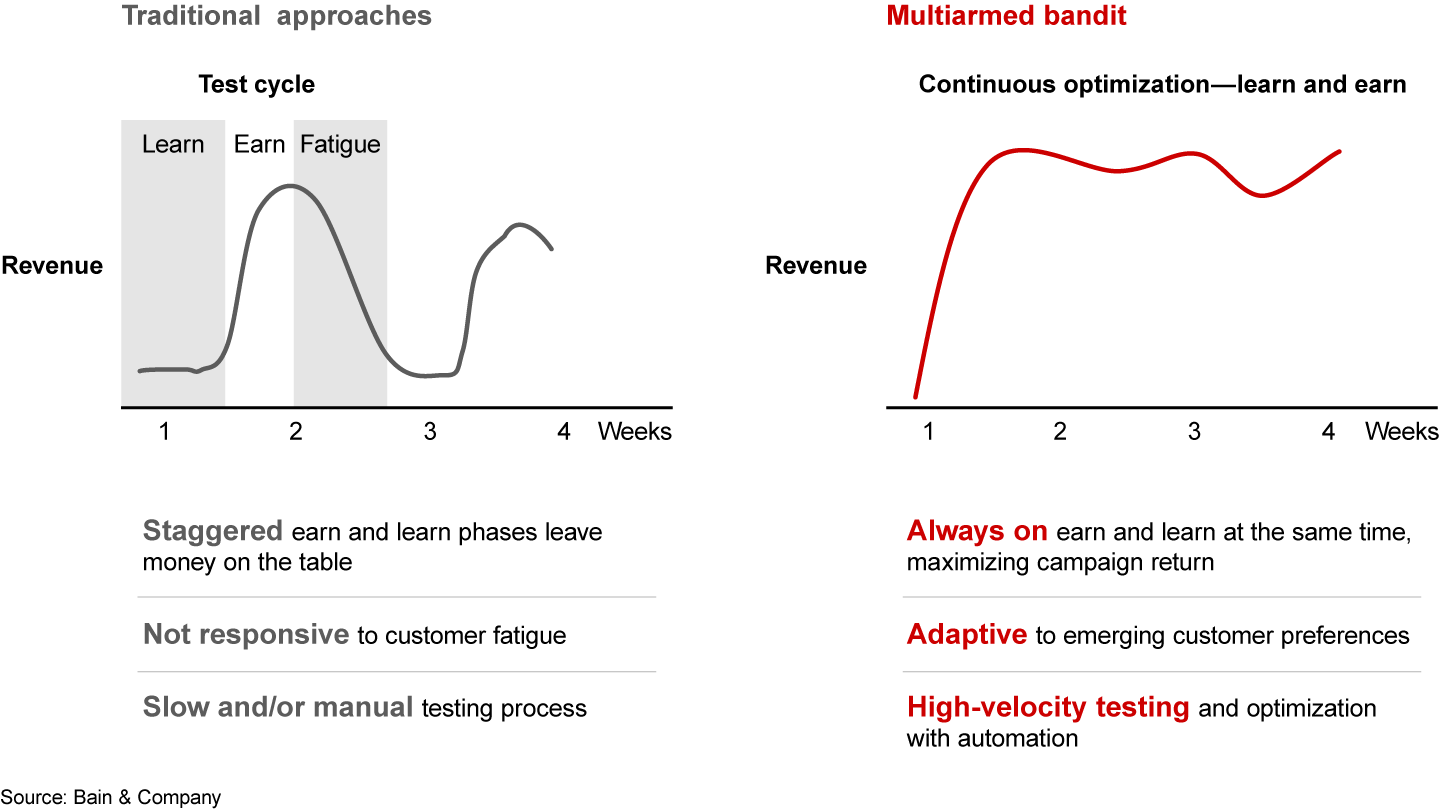
      Multiarmed bandit has several benefits over traditional A/B or multivariate testing
      Multiarmed bandit has several benefits over traditional A/B or multivariate testing
      Multiarmed bandit has several benefits over traditional A/B or multivariate testing

      MABs provide a simple, robust solution for sequential decision making during periods of uncertainty. To build an intelligent and automated campaign, a marketer begins with a set of actions (such as which coupons to deliver) and then selects an objective (such as maximizing clickthrough rates or EBITDA for email marketing). The algorithm balances exploration (gathering more data on new actions) with exploitation (selecting actions that perform well). The goal here is to select actions that maximize the payoff and quickly converge on the best set of actions. As market conditions change, the campaigns can easily be reset to discover new winners, or in more sophisticated designs, they can be configured to continue the testing cycle indefinitely.

      Pricing experiments are a particularly useful application since retailers must balance the need for a demand model that informs long-term profits without compromising immediate profits. They thus “earn while learning” through in-market tests rather than “learn then earn.” As with any learning algorithm, it is important to be thoughtful about objective functions. For instance, an objective tied to revenue rather than profit may lead the MAB to converge on a solution with excessive discounting if the algorithm decides that deep discounts are a great way to increase revenue.

      Online service applications

      Companies often use bandit solutions to speed up experimentation and personalize the experience for users of online services. Such solutions share a few characteristics:

      • They make several actions, such as unique ads or email messages, available for different users.
      • Marketers can quickly track user response to the action.
      • Marketers can easily adapt the online system, such as when recommending a different product, at a low cost.

      In their most basic form, MABs serve as a more efficient alternative to A/B testing, adaptively allocating traffic to find a winning version of a website, email, advertisement, or other marketing action. In most digital systems, each user interaction also gathers some side information about the user and the action, known as the context. This might be information about the user’s current circumstance (cohort, location, time of day) or historically computed information (past spending, age, gender, shopping history). Contextual bandits extend the MAB framework and learn how to use this additional information to make decisions that optimize a target metric, such as profits or clickthrough rate.

      Personalization with contextual bandits

      Leading digital organizations implement contextual bandits for core services, such as promotional offer selection, in which it’s important to personalize the experience and adjust to fast-changing market conditions. The leaders also generate a steady stream of innovative content to test: new creative, imagery, promotions, and products. Constantly feeding the bandit with new ideas to test helps to avoid getting stuck with less-than-optimal results and generates new insights into customer behavior. Also, because bad ideas fail fast while winners rise to the top, companies can take bigger risks with their marketing ideas than they could in a slower-moving test cycle.

      There are a few signals that a company is ready for more advanced approaches such as a contextual bandit:

      • a robust and fast-moving experimentation program;
      • customer data that can be accurately matched to historical marketing and transactional records; and
      • product-focused teams that can optimize high-value customer touchpoints.

      Taking on the complexity of a bandit makes sense for an organization already running tests at scale, and the traditional testing generates valuable digital exhaust that can be fed into the bandit algorithm. One typically trains a contextual bandit on logged data stored in a data warehouse or other analytical data storage. Here, a company needs records of marketing actions served (such as which coupon was sent) and the resulting reward metric at the individual customer level, as well as metadata describing both the action and the user history at the time of campaign execution.

      With data in hand, a bandit model can be trained on any modern machine learning (ML) platform with model training, versioning, and serving capabilities. Usually, the value is established by building a minimum viable product algorithm operating on batches of data at a cadence that allows for careful validation by data science teams before being put into production. Personalized marketing messages can be served through web, email, or application-specific channels, and often there is some application programming interface (API) development work required to integrate the ML models with these channels. Luckily, most of the channel-specific tools include personalization APIs, which populate the personalized content within a message template, so these integration tasks are relatively straightforward.

      As with any ML/AI system, continuous monitoring and ongoing maintenance remain important, so these systems are most effective in the hands of stable, product-focused marketing teams. Looking ahead, we expect to see broader adoption of AI and adaptive experimentation techniques, from which marketers can more effectively learn and activate first-party customer data.

      著者
      • Headshot of Joshua Mabry
        Joshua Mabry
        Alumni, Silicon Valley
      • Janani Sriram
        Alumni, Bengaluru
      • Headshot of Richard Lichtenstein
        Richard Lichtenstein
        Alumni, New York
      関連するコンサルティングサービス
      • Digital
      • アドバンスド・アナリティクス
      アドバンスド・アナリティクスエキスパートのコメント
      Defining the Intelligent Enterprise

      A recap from DeepLearning.AI’s AI Dev 25 × NYC.

      詳細
      アドバンスド・アナリティクス
      Agentic AI Commerce: The Next Retail Revolution Is Here

      Retailers need to place their bets as AI commerce shakes up retail economics.

      詳細
      アドバンスド・アナリティクスエキスパートのコメント
      Making Friends with Collinearity: How Driver Interactions Can Inform Targeted Interventions

      Driver analysis helps inform decisions on which drivers deserve the greatest effort.

      詳細
      アドバンスド・アナリティクス
      The AI Enterprise: Code Red

      Four questions every executive must answer now.

      詳細
      アドバンスド・アナリティクスエキスパートのコメント
      Mission Possible: Driver Analysis with Collinear Variables

      Many commonly used methods have serious limitations when assessing the variable importance of collinear drivers.

      詳細
      First published in 9月 2021
      Tags
      • Digital
      • アドバンスド・アナリティクス
      • アドバンスド・アナリティクスエキスパートのコメント

      クライアント支援事例

      アドバンスド・アナリティクス A New Demand Forecasting Approach Signals a Bottom-Line Boost

      ケーススタディを見る

      アドバンスド・アナリティクス Blockchain-enabled Payment Flows: A Payments Company Reviews its Strategy

      ケーススタディを見る

      Digital Better Forecasts, Less Waste Boost Grupo Bimbo’s Profitability

      ケーススタディを見る

      お気軽にご連絡下さい

      私達は、グローバルに活躍する経営者が抱える最重要経営課題に対して、厳しい競争環境の中でも成長し続け、「結果」を出すために支援しています。

      Digital is a service mark of Bain & Company, Inc.

      ベインの知見。競争が激化するグローバルビジネス環境で、日々直面するであろう問題について論じている知見を毎月お届けします。

      *プライバシーポリシーの内容を確認し、合意しました。

      プライバシーポリシーをご確認頂き、合意頂けますようお願い致します。
      Bain & Company
      お問い合わせ Sustainability Accessibility Terms of use Privacy Cookie Policy Sitemap Log In

      © 1996-2026 Bain & Company, Inc.

      お問い合わせ

      How can we help you?

      • ビジネスについて
      • プレス報道について
      • 採用について
      全てのオフィス