

論説
Home to the next billion consumers, the developing world is viewed by consumer goods companies as the world’s last great prize. It’s where the growth is and, increasingly, it’s also contributing to worldwide margins for global brands. But even as companies make greater investments there, they are still coming to grips with its unique challenges and struggling to understand how to sell to the rising middle class in places like Brazil, Nigeria and Indonesia.
We’ve worked with hundreds of consumer goods brands entering or growing a presence in developing markets and analyzed the behavior of more than 100,000 shoppers around the world across categories, based on data collected by Kantar Worldpanel. We’ve identified significant changes that are emerging everywhere, as consumer behavior evolves, and how those changes can help brands plot the smartest path forward as they pursue developing market growth.
Some of those changes represent a sharp departure from traditional thinking. Foremost among the important trends: Around the world, shoppers are disloyal in most categories. Consumer goods companies have long tried to capture growth by targeting a well-segmented group of shoppers, getting them to try the brand and progressively converting them into avid consumers who buy larger and larger quantities over time. Our research shows that this approach simply doesn’t work (see the Bain Brief: “The biggest contributor to brand growth”). Consumers are likely to buy the top brands only a couple of times a year, and the more they buy in a category, the more brands they buy. We call this repertoire behavior, and it’s as popular in Cambridge as it is in Chongqing.
In addition to coming to terms with disloyal shoppers, consumer goods companies are acknowledging the importance of household penetration (defined as the percentage of households in a market buying a particular brand in a given year). Across categories and countries, increasing penetration is the primary way to build big brands. This is a key insight from the research of the Ehrenberg-Bass Institute for Marketing Science, summarized by Professor Byron Sharp, director of the Institute, in his book How Brands Grow, based on decades of observations of buying behavior. The one thing all leading brands have in common is that they also lead their categories in penetration. The message is clear: The best way to grow is to increase the number of households buying your brand, not to sell more to existing consumers.
The challenge is that penetration is a leaky bucket. Analyze shoppers who bought a brand in any given year and it’s likely that a majority of them will not be buying it the following year. The implication: Companies need to invest to re-earn penetration over and over again by acquiring more new consumers than they lose.
Brand disloyalty and the significance of household penetration are two key trends that have the same broad impact in developing markets as in the developed world. But companies can use these trends as the launching point for a winning growth strategy, succeeding to grow in markets with a limited history of brand consumption, a domination of traditional trade, tough distribution roadblocks and all the other challenges of the developing world.
The winners are making themselves known. Look at Havaianas, which are to flip-flops what Kleenex is to tissue and Coke is to sodas. The footwear is so common in Brazil that the company has a penetration rate of 900 pairs sold per 1,000 inhabitants per year. Look at Maggi’s penetration of India’s instant noodle market in 2013—40%, according to Kantar—and its 72% market share, seven times greater than that of its closest competitor. And Danone’s Aqua bottled water, which saw 16% annual growth from 2007 to 2012, has a penetration rate that’s 24 times the average of the top 20 brands in the category in Indonesia.2
While each of these companies took a different path to success, there’s one thing they have in common: They’ve consistently applied components of a successful approach to growth in developing markets. We’ll look at those components one by one.
Memory structures. Building memory structures means anchoring a brand in consumers’ long-term memories, which may take generations. Think of the world’s great brands and the consistent messaging behind them. A single example: Over the decades, Nutella hasn’t significantly altered the hazelnut chocolate spread’s formulation and taste, and rarely modifies its message. But there’s a fundamental difference when companies ponder memory structures in the developing world. Many of these developing markets have a relatively short history of brand consumerism, with some brands just starting out while others have been around too briefly to establish and reinforce the kinds of memory structures that have worked so well for brands like Nivea in the developed world.
For both domestic and multinational companies, the answer is to be focused and unwavering in your efforts to connect to existing memory structures, even if your place in those structures is new. Success requires consistent investment in above-the-line media, not just periodic bursts of advertising around holidays. The same consistent messaging in above-the-line media must also be applied to packaging and in-store promotions. Another important factor: linking your product in consumers’ minds to the rituals in which it will be used. In India, since the mid-1990s, Cadbury has built its Dairy Milk brand on its “the taste of life” platform, using powerful, award-winning creative executions to establish a strong connection between its positioning and an existing memory structure. For example, a successful campaign linked it to the Indian tradition of giving sweets to mark auspicious beginnings and special occasions. In one television ad, a young husband, overhearing his wife struggle with how to break the news of her pregnancy to him, offers her a Cadbury Dairy Milk bar.
Scratch a winning brand and you’ll find a distinct method of connecting to memory structures. Among the best-known examples is Brazil’s Havaianas. Originally known as chinelos de pobre (poor man’s flip-flops), Havaianas were first sold at convenience stores in the 1960s, hanging in plastic bags next to cleaning supplies. The brand quickly became wildly popular with low-income Brazilians, but in 1994, after sales had declined, the company made a move designed to significantly boost penetration: It positioned the flip-flops as a fashion accessory for Brazil’s middle and upper classes. It added more colors, launched an advertising campaign showing celebrities wearing the shoes—including opinion leaders and stars such as Jennifer Aniston and surfing champion Kelly Slater—and built on Brazil’s positive image overseas by portraying Havaianas as a colorful, joyful, simple product. Today, the brand is sold in more than 80 countries. Havaianas’s success makes it a poster child as a “Brander” Category Creator (see the Bain Brief “Taking a new consumer goods category from zero to 100 in no time flat”).
Another big winner is Chivita, the leading juice brand in Nigeria. The brand strongly and consistently positions itself as a proudly Nigerian brand (with the tagline “My Country, My Chivita”), building its popularity by emphasizing the health benefits and quality of its products. It’s a clear message delivered across all of CHI, Ltd. brands. Many companies limit their media investment, either for budgetary reasons or because they’re trying to support too many brands. As a result, they never gain the share of attention necessary to boost consideration, the important precursor to penetration. That’s not the case with CHI. It outspends rivals on advertising, with approximately 60% share of voice, and with a mix of TV advertising and in-store activation across priority channels to encourage shoppers to try its products. The investment helped CHI grow its share of the fruit beverage category from 40% to more than 60% in just a few years.
Product portfolios. Even as modern trade rapidly gains ground in developing markets, traditional trade— with its extremely limited shelf space—still dominates. The numbers say it all. Mom-and-pop store penetration is 98% in India, 94% in Nigeria, 84% in Indonesia and 68% in Turkey (see Figure 1). Traditional trade isn’t going away any time soon. It’s still going to be an important channel for any packaged goods firm and critical for those operating in high-impulse categories like confectionery or ready-to-drink juices.
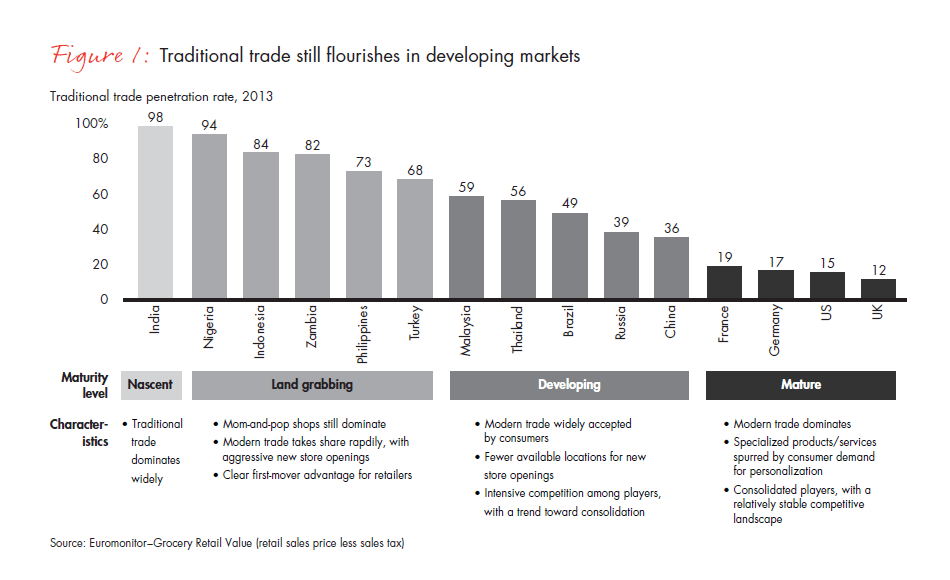
Successful brands accommodate traditional trade’s limited shelf space by focusing only on the critical “hero” SKUs that have the highest potential to win with shoppers and avoid the temptation to which most companies succumb: SKU proliferation to get loyalists to buy more. Hero SKUs generate higher volumes that increase scale, leading to bigger margins that enable investment to fuel growth. Winning companies find that focusing on fewer brands and SKUs makes them more efficient and effective in everything from operations to sales to distribution. Retailers love the hero SKUs, too, because they have high rates of sale that bring shoppers into the stores.
The less-is-more approach is working throughout the developing world. In China, Yunnan Baiyao toothpaste built a strong market position with a focus on a limited number of flavors. In India, Maggi, the leading instant noodle brand, concentrates on a couple of hero SKUs with two main flavors (Masala and Veg Atta, for whole wheat) and two main package options (pack and cup).
Distribution. In developing markets, more than anywhere else, if you don’t have a viable distribution strategy, you have no hope of increasing penetration. Companies must deal with infrastructure issues—consider that 40% of Indonesia’s roads are unpaved. And multinationals must grapple with domestic competitors’ long-entrenched distribution networks, which are difficult to penetrate. The distribution challenge is so thorny for multinationals that it’s one of the reasons for buying local companies: to gain access to local distribution.
Danone’s Aqua bottled-water brand has set the standard for overcoming the challenges of distribution in an infrastructure-poor country like Indonesia. Among the winning moves: establishing centralized water stations in rural areas where consumers can refill their own bottles. Aqua makes use of an extensive distribution network covering more than 1.5 million off-premises outlets. About 30% of its total volume is distributed directly to consumers, either to homes or commercial offices and stores through a network of distributors and wholesalers. Its penetration is the highest in the category, with 67% of Indonesian shoppers claiming to have bought the brand in 2012, according to Kantar. For its part, Trade Kings maintains wide coverage in Zambia through the company’s access to a network of traders across the country, for its highly successful Boom laundry detergent. It also has its own fleet of trucks for distribution, although some buyers supply their own transport or rely on third parties.
The extreme diversity of urban, suburban and rural populations demands completely different approaches to distribution—everything from a wholly owned and directly managed sales force to wholesale markets.
Companies must weigh the costs and time required to build relationships with distributors in rural areas— where volume requirements are very different from those of cities—and find the optimal point between cost and reach. For example, companies in China face the challenge of distributing in roughly 350 city clusters (a large city surrounded by a few tier-four cities and towns) of different sizes, income level and channel mix. This means they can find themselves managing several hundred or more distributors in the country. Liby detergent became the category leader in China by taking a unique approach to distribution. Among the elements of that model: Liby recruited army veterans to help it distribute in rural China. Also, its special cooperation model with distributors, with full payment in advance and requiring an exclusive-agent relationship, contributed to a more stable distribution team. The strategy helped Liby grow to become a leader in its category; however, the brand has recently lost penetration to competitors.
In-store assets. Having invested in memory structures, tightened their product portfolios and solved the distribution puzzle, companies then need to focus on the stores themselves, activating the most important SKUs at the point of sale to ensure they’re always available at the right place on the shelf. As a final stage of The Bain Brand Accelerator, we counsel companies in all markets to identify which store assets—everything from the actual category shelf and secondary placements to promo slots and signage—are critical to own in their category to boost shopper consideration. China’s Jia Duo Bao is a winner in targeting and owning the right in-store assets. It showcases its distinctive red cans of ready-to-drink tea in vivid end-cap displays in key traffic zones in large, modern trade stores, while it deploys a different, equally well-devised strategy for traditional trade.
Winners also ensure that their organizations are in sync—from brand planning to trade marketing and sales—to keep the right products on the right shelves all the time. Flawless execution contributes directly to sales uplift and market share gains by maximizing consideration at the point of purchase. That often requires a true transformation in sales capabilities and activities (see the Bain Brief “Perfecting sales execution”). Forward-thinking companies establish prescriptive steps for sales reps to follow before, during and after each store visit to ensure compliance. Scorecards measure how well each sales rep performs in each outlet, focusing on the few specific, measurable key performance indicators that truly matter and on which they can act.
Nigeria’s CHI is moving steadily in this direction. Because not all of its outlets are served directly, controlling the store remains challenging. The company is progressively transitioning from a volume-focused model to a more sophisticated in-store activation approach. With thousands of sales reps on the ground, planograms tailored to the different types of outlets and clear key performance indicators, CHI is getting more visibility for its products. In India, Hindustan Unilever understood that for several of its core categories, a large percentage of purchase decisions are made in the stores. Implementing a program to boost in-store execution has helped participating stores outperform other stores on average.
As consumer goods companies prepare to gain ground in developing markets, they know the journey is likely to be tough. The brands that will rise above rivals will be those that rigorously prepare and maintain unwavering focus, emphasizing the four components of The Bain Brand Accelerator. They’ll build memory structures to get into consumers’ heads and stay there, limit their portfolios to products with the highest potential to win, find innovative ways to tackle the unique distribution challenges and invest to win in the store. These are the rules that take the mystery out of the world’s last—and biggest—prize.
James Root is a Bain & Company partner based in Hong Kong. Giovanni Fiorentino is a Bain & Company partner based in São Paulo. Johanne Dessard is a Bain & Company manager based in Singapore.
1 Penetration and market share data is from Euromonitor and Kantar Worldpanel.
The Bain Brand Accelerator® is a registered trademark of Bain & Company.
First published in 11月 2014