

論説

Decisions are the coin of the realm in business. No company can reach its full potential unless it makes good decisions quickly and consistently and then implements them effectively. Good companies can’t become great. Troubled companies can’t escape mediocrity. Our 10-year research program involving more than 1,000 companies shows a clear correlation (at a minimum 95% confidence level) between decision effectiveness and business performance.
And it isn't just financial results that suffer. Organizations that can’t decide and deliver are dispiriting to their employees. From the C-suite to the front line, people feel as if they’re stuck in molasses or trapped inside a depressing Dilbert comic strip.
The European division of an American automaker, for example, repeatedly lagged behind competitors in bringing out new features on its cars. The reason? Marketing thought it was in charge of deciding on new features. Product Development thought it was in charge. The two functions had different incentives and so could never agree. Every proposal had to be thrashed out in long, contentious meetings. It isn't hard to imagine how the people in these functions felt about coming to work in the morning.
But things don’t have to be that way.
For more than 25 years, the three of us have consulted to organizations of all sorts. Our clients have included large multinational corporations, entrepreneurial ventures, research universities and nonprofit institutions. We have worked with leaders at every level. Despite their differences, we noticed all these organizations share one consistent trait: when they focus explicitly on decisions, they improve their performance. As their decision making and execution gets better, so do their results. They create great working environments, which in turn attract the kind of people who get things done. They build the organizational capabilities to decide and deliver time and time again, in every part of the business.
Over time, we began to see how to systematize this approach to decisions and performance, how to map it out and capture it in a sequence of steps. Eventually we published a book about it, called Decide & Deliver: 5 Steps to Breakthrough Performance in Your Organization, from Harvard Business Review Press. We hoped the book would help companies kick-start the process of improving their decision making and execution and thus their performance. To judge from readers’ reactions, it has achieved that goal to a degree well beyond our expectations.
Since then, many people have asked us for the short version: Couldn’t we boil our five points down to their basics? So that’s what we have done in this article. We can't fit in all the nuances and stories, of course—we hope you'll still buy the book—but we can help you see at a glance where your own organization’s decision muscles are strong or weak so that you can begin to take action. The business world is moving fast these days. The only companies that can keep up—that can ultimately realize their full potential—are those with the ability to decide and deliver. We hope yours will be one of them.
- Score your organization
- Focus on key decisions
- Make decisions work
- Build an organization
- Embed decision capabilities
Step 1: Score your organization
How good is your organization at making and executing decisions? What are the strengths you can build on to improve your effectiveness? Where are the hang-ups that prevent you from doing better?
Step 1 in our five-step process will help you answer these questions. It's a rigorous, fact-based technique for benchmarking both decision abilities and the organizational elements that either help or get in the way.
Rating decision abilities. Let's look at decisions first. One thing that sets great companies apart is the ability to make high-quality decisions. But it isn't just decision quality—the top performers also make those decisions quickly and execute them effectively. And they don't spend too much or too little effort in the process.
So it's important to assess your performance on all these factors—decision quality, speed, yield (or execution), and effort (see Figure 1). A good way to begin is to survey a cross-section of people throughout the organization. You can then add rigor with face-to-face interviews and focused data gathering, using the decision X-ray described in Step 2. The goal is to answer some key questions: What percentage of the time does the organization make the right decisions? Are decisions made faster or slower than competitors? Is there too much (or too little) effort involved?
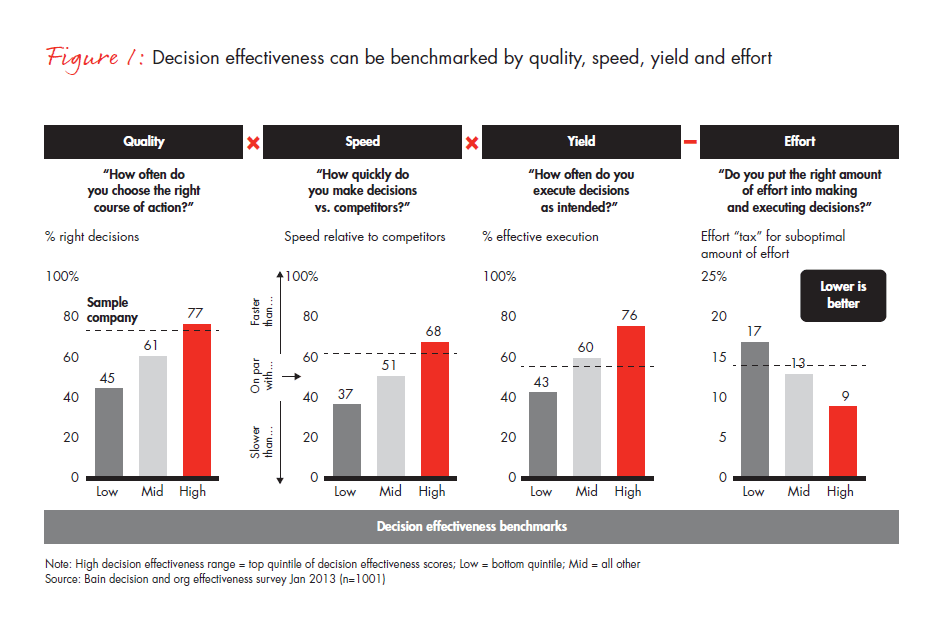
What you find may surprise you. Hospira, a $3.6 billion specialty medical device and pharmaceutical company, learned that its decision abilities were only in the 40th percentile overall, compared to the hundreds of companies in our database. That was far from the top-quartile performance that Hospira's CEO at the time was seeking.
Identifying the obstacles. So Hospira's executive team took the next step: pinpointing the organizational trouble spots. Here, too, you can use surveys and interviews, this time focused on the elements that can help or hinder good decision making and execution. Sample questions might include:
- Are individuals clear on the roles they should play in critical decisions?
- Do people with decision authority have the skills and experience they need?
- Do our goals and incentives encourage good, fast decision making and execution?
Hospira's research turned up important strengths, such as strong leadership and a healthy pipeline of management talent. But executives and employees alike felt that some decisions weren't made at the right level of the organization. They believed that meetings didn't always work well, and that the company's culture didn't encourage people to make decisions with the customer in mind.
Insights like these allow you to understand not just where your decision abilities are weak but why, and then create an effective plan of attack. At Hospira, the research conclusions helped managers redesign a wide variety of key decisions. The company also began a series of organizational initiatives, such as training workshops, to support good decision making and execution. Better decision abilities contributed to the company's improved financial performance in recent years. Total shareholder return was in the upper quartile—right where Hospira's executive team believed it should beStep 2: Focus on key decisions
Large organizations make and execute thousands, perhaps millions of decisions every day. No leadership team can work on every decision at once. So Step 2 in our process is to identify the decisions that matter most—your critical decisions. We'll outline how to go about it and how to analyze those specific decisions to determine what's working well and what isn't.
Two categories of critical decisions. Some decisions clearly stand out as important. They're the big, high-value, strategic choices made in every part of the organization. Senior leaders decide whether to make a big acquisition. IT decides whether to invest in a major systems upgrade. But many organizations overlook a second category that can be equally significant: operating decisions that seem small but that are made and remade frequently and generate a lot of value over time.
A key reason for Amazon.com's success, for instance, is its ability to make savvy merchandising decisions, including decisions about special prices and discounts, suggestions for complementary purchases, and so on. Most companies have a similar set of decisions made day in and day out by people close to the front lines of the business.
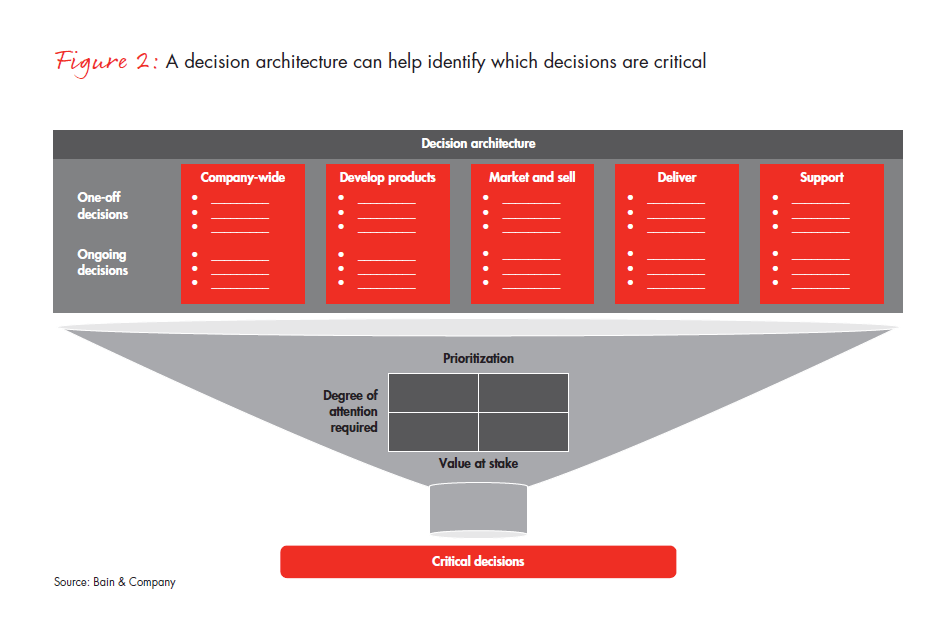
Decision architecture. To identify the key decisions in these two categories, you can use a tool we call decision architecture (see Figure 2). You begin with a long list of decisions for every major business process of a company or unit and then narrow it down using two different screens:
- Value-at-stake. Estimate the value involved in each decision, and focus on those with the highest value. To be sure you don't miss the everyday decisions that add up over time, consider the value of a single decision multiplied by its frequency.
- Degree of management attention required. Some decisions inevitably need more attention than others. They might be more complex. Or they might have greater scope for improvement.
The result from applying these two screens is a list of your critical decisions—the top 20 or 30 decisions that absolutely must work well for the business to succeed.
Using the decision X-ray. When one of these critical decisions runs into trouble, the first impulse is usually to jump in and fix it. Understandable, but a long-term fix requires analyzing the decision in greater depth. What works? Where is the decision breaking down—in quality, speed, execution, or effort? What elements of the organization are holding things back? Teams can use a decision X-ray to pinpoint these issues. With interviews and other analyses, team members probe each factor to determine the trouble spots.
When Nike was changing its management structure, for instance, team members identified 33 critical decisions, such as determining retail strategy for a particular country. The team then gathered detailed input on how each decision had worked in the past and how it should work in the future. Thanks to the data, the company was able to resolve—and help everyone understand—how the key decisions would be made and executed under the new approach.
Step 3: Make decisions work
Step 3 in our process helps you reset a specific decision. It's like a surgical intervention: you go in and repair the trouble in order to restore the patient to health. We think of the four parts of this operation as fixing the What, Who, How, and When of the decision.
1. Clarify the What. The group involved in the decision first needs to know exactly what the decision is. It has to be spelled out clearly and framed correctly. When Ford Motor Co. was contemplating taking taxpayer bailout money, CEO Alan Mulally didn't frame the decision as 'yes or no'. Rather, he asked his team to decide what strategy would best maximize the long-term value of the company. That forced people to consider alternatives such as fixing the operations, merging with a competitor, seeking Chapter 11 bankruptcy protection, and others, in addition to the bailout.
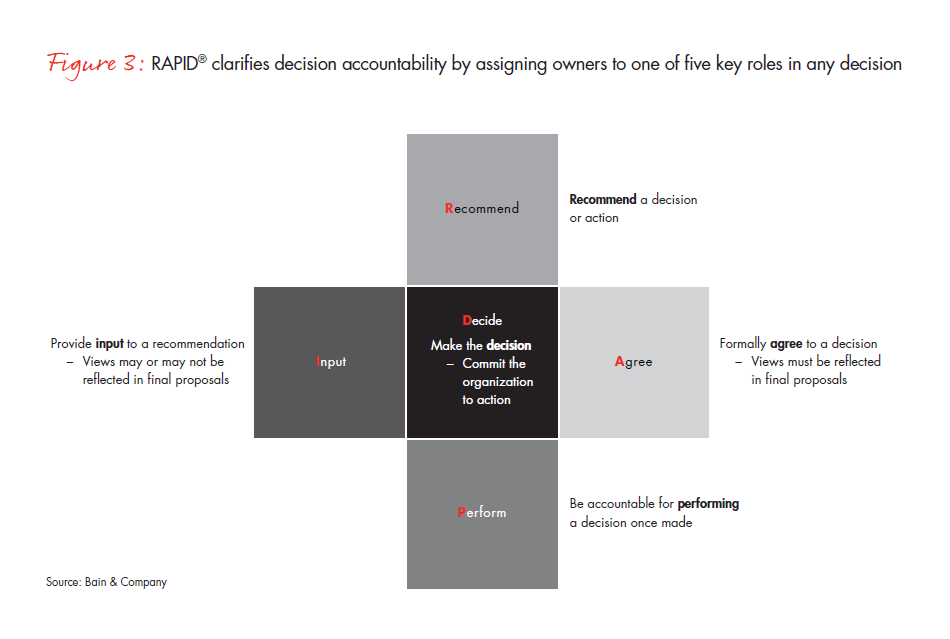
2. Determine the Who. The roles involved in the decision need to be equally clear. We use a decision-rights tool we call RAPID®, which includes all the key roles (see Figure 3). One person or group makes the Recommendation. Others provide Input. Still others must Agree, or sign off on the recommendation. One person or group then has the D—they make the final Decision. Others are assigned to Perform or execute it. If you spell out these roles clearly, everyone will know who's accountable for what.
3. Understand the How. Will the decision be made by consensus, by vote, or by one person? How will the necessary information be provided? Can the group agree on criteria for the decision in advance? Will there be more than one real alternative presented? Answering questions like these beforehand enables a decision to proceed much more smoothly than it otherwise would.
4. Make the When explicit. Every major decision needs timetables and deadlines. A schedule ensures that decisions are quickly followed by action, so that things happen rapidly and the hurdle to reopen the decision is high.
Intel's Embedded and Communications Group (ECG) put many of these tools to work in deciding which products to add to its "roadmap" for development. ECG's process specifies how people will play their roles, at what stage they will provide input, when a recommendation will be developed, how approval will be sought when necessary, and how the final decision will be reached. ECG also makes sure to communicate these decisions and the process that led to them to all concerned. "We developed a regular cadence of 'Here's what we've done, here's why we've done it,' to help people understand what's being added to the roadmap and why," says Doug Davis, who leads the group. "This has reduced the amount of revisiting we do by a lot."
Step 4: Build an organization
The ultimate goal is an organization in which people make good decisions, make them quickly, and execute them effectively, all as a matter of course. But some of the most important decisions are the seemingly small operating choices made every day by people throughout the business. Getting those decisions right requires an environment that equips people at every level to decide and deliver. All the elements of the broader organizational system have to support good decision making and execution.
That's why Step 4 of our process involves scrutinizing, and improving where necessary, every one of these elements—both the "hard" elements of the organization, such as structure and processes, and the "soft" ones, such as people and culture.
The power of this approach is the way it focuses the organizational investments that most large companies make every year. Instead of a series of disconnected initiatives, which often confuse people and dilute the investment, the single objective for any improvement is whether it will lead to better decision making and execution.
To take one example, consider the difference between the traditional view of talent development and deployment—which people to assign to which jobs—and a decision-centered approach (see Figure 4).
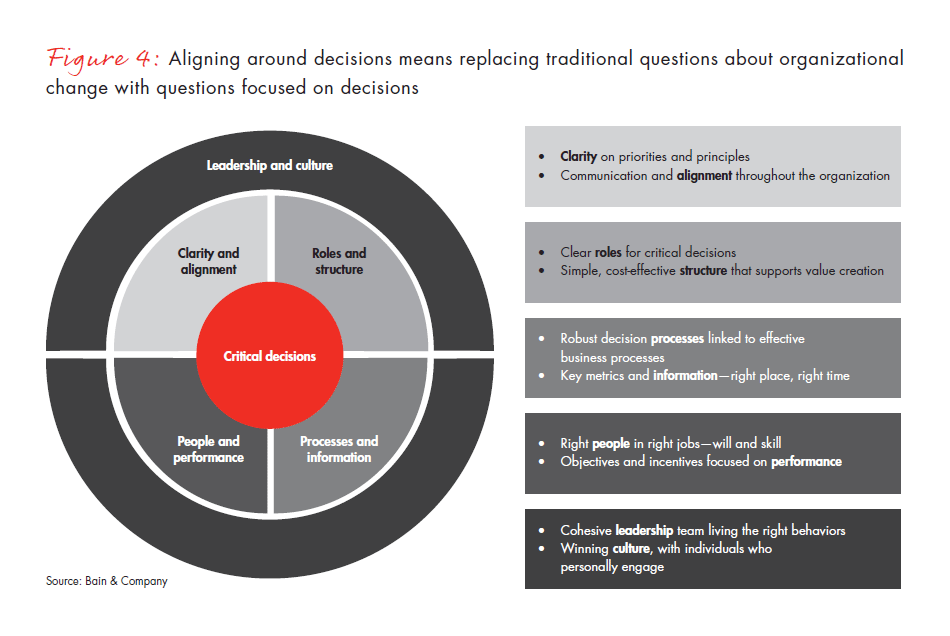
Most companies ask the traditional question: Are we winning the war for talent? Companies have invested massively to get the answer they are looking for.
The decision-centered question, by contrast, is: Do we put our best people in the jobs where they can have the biggest impact on decisions?
To answer the decision-centered question, you need to know the key positions in your organization. These are the jobs that have the biggest impact on critical decisions—and since some of those are everyday operating decisions, the key positions can be almost anywhere in the organization. Many will be on or close to the front line. The next step is to identify the individuals who can best fill those positions, which means singling out the people who have the skills to make and execute decisions well and quickly.
Looking at your organization from that vantage point is likely to change how you think about talent. One technology company, for instance, identified its mission-critical positions and assessed how many of these positions were filled by top performers. The answer was less than 30%. When the company then asked how many of its top performers were in mission-critical positions, the answer was only 40%. Thinking about deployment from a decision perspective helped this company make the most of its talent pool and improve its decision effectiveness.
Of course, talent management is just one part of an organization. But you can ask decision-centered questions of every major element. Evaluating your organization on these lines will give you a more accurate assessment of what needs to be improved and how to go about improving it.
Step 5: Embed decision capabilities
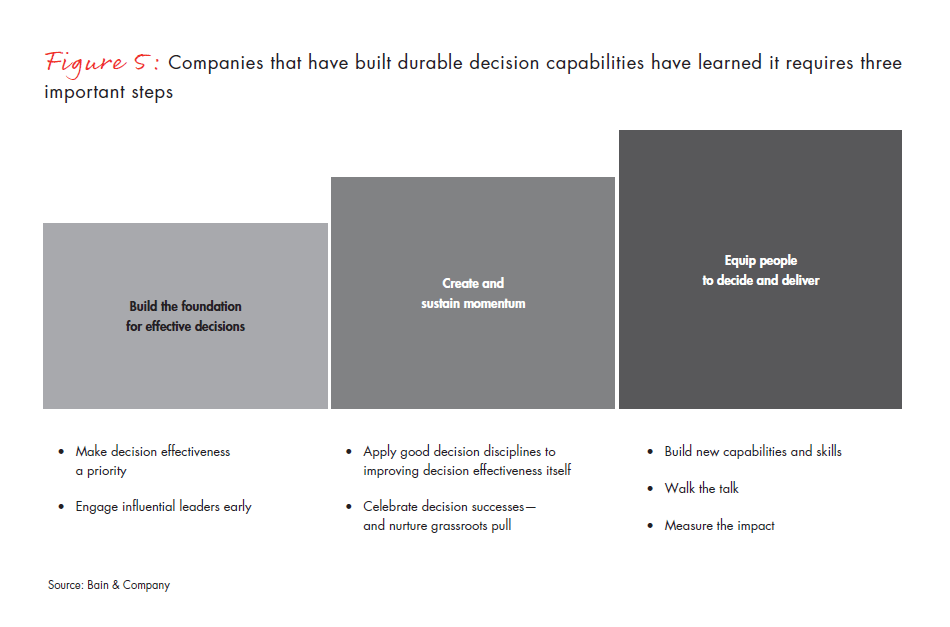
Step 5 in our process is a little different. It's last in the list, but since it's about making change stick you really have to think about it from the beginning, in parallel with the other steps. Even before undertaking Step 1, for example, it's important to determine which leaders will spearhead the decision effort and how you plan to engage the broader organization (see Figure 5).
We've found that successful companies build a foundation for effective decisions by mapping out ambitious goals and involving influential leaders early on. They create and maintain momentum by celebrating early wins and nurturing the kind of viral takeup that builds enthusiasm for decision effectiveness throughout the organization—a step that's often aided by people who feel liberated from decision paralysis and spread the word. And they embed decision behaviors by helping people at all levels learn new decision capabilities, by sharing best practices, and by keeping close track of progress.
In MetLife's effort to improve its decision-effectiveness, for instance, key leaders such as the head of the company's Auto and Home business led the charge. These leaders established a step-by-step approach which made it easier for each business and function to apply best practices in its own part of the business. The Technology & Operations unit, for one, laid out a plan, appointed a rollout leader, and began redesigning its key decisions. As the new approach gained traction, people throughout the unit learned to make better decisions and make them faster, day in and day out.
Watch out for potholes! Of course, the road isn't always smooth. But the top performers manage to avoid the worst obstacles. Some of their hard-won lessons:
- Don't start anything you're not prepared to finish. One tech company undertook a six-month project to improve the decisions involving headquarters and its European team. The project's conclusion? Move more decision authority to Europe to speed up response times. HQ promptly nixed the whole thing, and many of the European leaders left the business within a year.
- Apply the tools to difficult decisions, not just the easy ones. Quick wins are great. But the real proof of the pudding is when a company applies these tools to contentious decisions, such as product tailoring or allocation of resources across markets.
- Don't fudge the people issues. Some folks may not adapt to the new ways of making and executing decisions. "You push gently at first, then less gently" says one executive. "You set targets that they can't achieve without changing."
- Cut bureaucracy—don't add to it. Remember it's the big decisions that matter. Don't assign RAPID roles for a decision, for instance, unless the value of the decision justifies that kind of formality.
In a large company, the change process can take several months to hit its stride. But once an organization begins to hum, once it learns to decide and deliver, the effect is dramatic. Things get done. Financial performance improves. People are motivated to come to work, because they know their energy will translate to prompt decisive action.
Your organization can be like this. It can be the one that stands out, the one that people want to be a part of. It can accomplish great things—starting with its next decision.
Marcia W. Blenko is a partner with Bain & Company and a senior member of the firm’s Global Organization practice. Michael C. Mankins is a partner and a senior member of the firm’s Global Organization practice. Paul Rogers is the managing partner of Bain’s London office and leads Bain’s Global Organization practice.

Decide & Deliver
Learn more about the five steps that leading organizations use to make great decisions quickly and execute them effectively.
First published in 8月 2013