

論説
The world of healthcare delivery in the US is changing rapidly, and organizations are radically transforming their business strategies to keep up with the new environment. Identifying a strategy, however, is not just the first step, it’s also often the easiest step. Whether you choose to focus on a specific set of services, integrate episodes of care or manage an entire population, the hard work begins when you try to make the strategy come to life in your organization. Setting up your organization to successfully implement your chosen strategy usually requires three major efforts: realigning your operating model, eliminating outdated and unnecessary complexity and deploying a comprehensive and systematic change program.
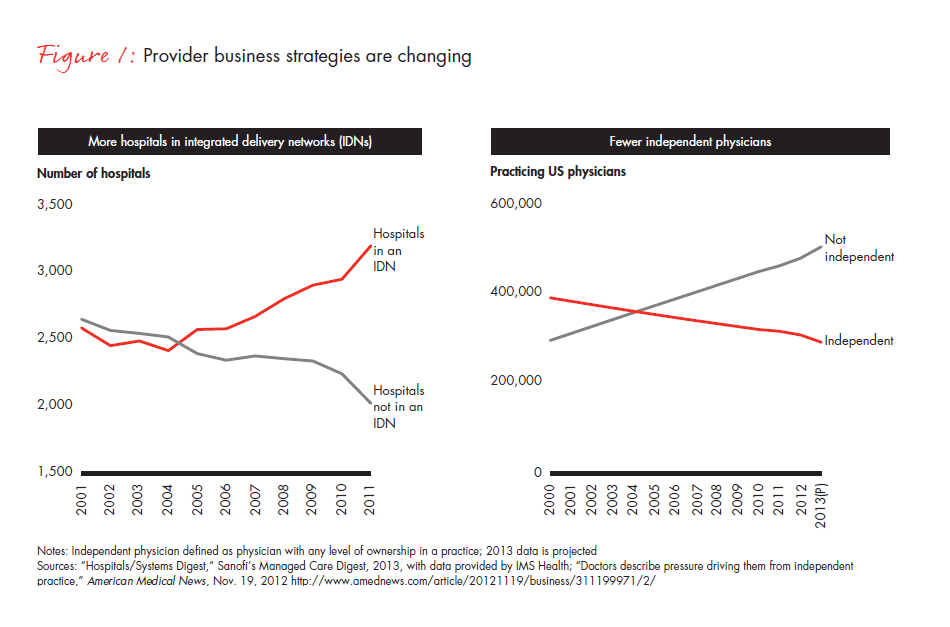
After 40 years of a healthcare cost crisis without much change, significant new rate and cost pressures have begun forcing the fragmented US healthcare market to organize differently (see Figure 1). The transparency induced by the Affordable Care Act, government rate cuts in Medicare and Medicaid, and employers’ intolerance for rising costs have finally led to new payment models, such as bundled payments and outcome-based contracts, which in turn are providing incentives for vertical and horizontal integration. Layered on these changes are information technology improvements and better data, which facilitate new insights into population health management and the ability to reduce cost variation in clinical practice. Last but not at all least, physician attitudes are changing, particularly among younger physicians, as they face new payment systems and the need to become more accountable for patient outcomes.
To respond to these new pressures, three sustainable business strategies have emerged. While a traditional fee-for-service model still dominates many markets, the markets that are moving faster toward new payment models are lending themselves to more innovative approaches to care (see Figure 2).
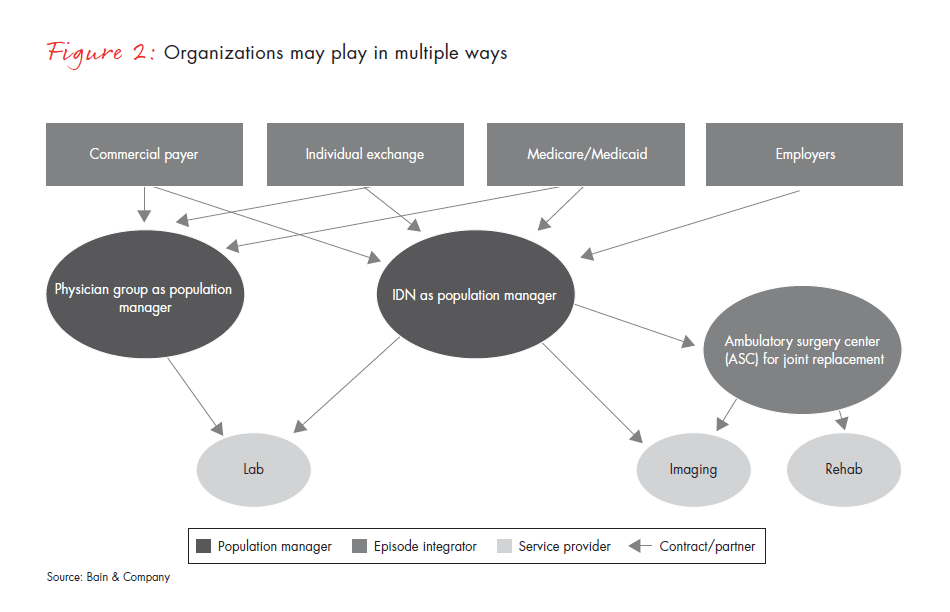
A Service Provider strategy focuses on a narrow set of services in support of patient care in a specific area—imaging, labs, urgent care, specialized centers for colonoscopy. This strategy does not involve direct coordination of care or financial risk at the system level, but relies on contracts with physicians and groups. It is best suited for niche services where payment is primarily based on fee-for-service reimbursement or where there are significant numbers of patients whose medical conditions have few comorbidities. Quest Diagnostics, the largest independent clinical laboratory company in the US, is an example of a Service Provider approach. Quest’s clinical testing services deliver the vast majority (92%) of its revenues, but less than 5% of those revenues are generated via capitated contracts. Independent labs like Quest offer lower-cost alternatives to hospital-based labs due to economies of scale (such as fostering higher utilization and spreading the cost of their call centers over a larger base). Being best in class on cost for the same or better outcomes is the way to win with this strategic approach.
An Episode Integrator strategy manages patient care for specific episodes to help coordinate all care across the service continuum for a given illness. It is well suited for conditions with common comorbidities, such as heart, kidney or joint replacement. An Episode Integrator may contract with a specialty physician group, such as oncology or orthopedics, or simply work to integrate the various specialties within the hospital setting.
This integrated approach to payment and delivery is not new. Consider the UCLA Kidney Transplant program: In 1986, UCLA began bundling its services and pricing with a contract for transplantation with Kaiser Permanente. While it was not easy to figure out how to track reimbursements, UCLA believes its strategy at least kept costs equivalent to fee-for-service by integrating care within the episode while improving outcomes. This and other similar integration efforts have succeeded via the ability to build networks and partnerships with all participants on the continuum.
A third strategy involves becoming a Population Manager, an approach that manages total healthcare for an entire population of individuals. The managed care provider HealthCare Partners (an operating division of DaVita HealthCare Partners) uses this approach in California and several other states for the 65-and-older Medicare Advantage population. HealthCare Partners contracts for the full spectrum of care for its patients and is paid a capitated per-member, per-month fee, which covers members’ physician and facility costs. Cost reductions from population health management come from integrating and managing care across an episode and reducing overall utilization for all members, including the highest-cost chronically ill members. This approach only wins if the organization can effectively manage risk within a closed or semi-closed network.
Because different markets are evolving at different speeds, providers that span multiple markets typically wrestle with different competitive starting points. Many providers will need to simultaneously pursue multiple strategies tailored to their local markets.
Selecting the appropriate strategy, however, is just the first step. An organization’s executive team may feel it has the best strategy and understands what is truly required to be successful, but actually mobilizing the organization to focus effectively on what matters most is critical for success. Do leaders know which specific organizational assets will be most important? Can the organization truly take on and manage partial or full financial risk? Coordinate handoffs among participants? Build true consumer-centric programs? What talent will be needed to build and shape the capability? Answering these questions before implementing a new approach is critical.
Making things even more challenging, the new strategy may just be a set of initiatives layered on top of what the organization is already doing. Organizations have a finite capacity to change, and prioritization is crucial. A workable strategy should define not only what a provider will do, but also what it will not do. It may be enticing to expand to new geographies or acquire ancillary expertise, but will that really help operationalize the selected business strategies? Is there the will to say no to the construction of new bed towers or the opportunity to acquire a specific specialty provider?
The hard work begins when you actually start making the changes you need to survive. In subsequent briefs, we will describe in greater detail how to achieve success, but the following is a high-level description of three of the most important elements:
- Realigning your operating model to fully enable your chosen strategy
- Eliminating unnecessary complexity
- Deploying a systematic change program
Realigning your operating model
Historically, Integrated Delivery Networks (IDNs) have been very decentralized, focusing mainly on hospital-based acute care. Many of the newer strategies require integration across units that have traditionally operated more independently. Transformative strategies require rethinking profit and loss flows, clarifying shared accountabilities, streamlining decision-making processes and aligning incentive systems. In our experience with most organizations, more than 80% of their value is tied to less than 20% of the decisions they make and execute. So it becomes critically important to concentrate on the decisions that are most important. Does everyone in the organization understand exactly what the decision is? Are all employees’ roles clear? Is the necessary information available? Are the procedures for execution well defined? And are the right people in the right jobs, with the skill sets and capabilities required for success?
Eliminating unnecessary complexity
Just as rates are coming under additional pressure, organizations begin to realize that new business strategies will require additional investment—and additional sources of revenue are not easy to find. Most organizations have done “classic” cost management: looking at unit cost, contract compliance and frontline labor productivity, as well as reducing organizational layers. But in many cases, these traditional sources of savings have reached their limit. Merely asking each functional area to find 10% to 15% cost savings is not enough. IDNs need to identify the big buckets of expense and then change behaviors to facilitate cost reduction. Reducing clinical variability across procedures/diagnosis-related groups (DRGs) has enormous potential, as does standardizing structures across hospitals, utilizing a more streamlined and centralized support function infrastructure and reducing complexity by consolidating service lines in areas where it makes sense. Reducing this type of complexity is critical, but it often takes a multiyear systematic change process to pull it off.
Deploying a systematic change program
It is absolutely essential for management to put sufficient time, attention and resources into developing and deploying a systematic change process. This type of change requires political will, sustained discipline and the ability to reimagine how to do business.
Delivering sustainable results—what we call Results Delivery®—has three parts: installation, realization and repeatability. Most organizations focus on installation— how to get the program started—without considering what is truly required to realize or adopt change. Producing real behavioral change across a healthcare organization, including employed clinicians, clinical staff and affiliated providers, is an enormous challenge, and it requires substantial time and effort to reach the intended outcome. Although there are risks to any change process, a complete failure—less than 10% of the cases—is not what is at stake so much as a dilution of results: not achieving full performance from your strategy.
You have come this far by identifying your market requirements, selecting your strategy and moving to implementation. Repeating your successes, even the smallest ones, by moving from strength to strength will build the confidence and expertise to deliver better and faster results the next time.
Julie Coffman and Jim Rechtin are partners in Bain & Company’s Global Healthcare practice. Both are based in Chicago.
First published in 12月 2013