
Skip to Content
  • オフィス

    オフィス

    北米・南米
    • Atlanta
    • Austin
    • Bogota
    • Boston
    • Buenos Aires
    • Chicago
    • Dallas
    • Denver
    • Houston
    • Los Angeles
    • Mexico City
    • Minneapolis
    • Monterrey
    • Montreal
    • New York
    • Rio de Janeiro
    • San Francisco
    • Santiago
    • São Paulo
    • Seattle
    • Silicon Valley
    • Toronto
    • Washington, DC
    ヨーロッパ・中東・アフリカ
    • Amsterdam
    • Athens
    • Berlin
    • Brussels
    • Copenhagen
    • Doha
    • Dubai
    • Dusseldorf
    • Frankfurt
    • Helsinki
    • Istanbul
    • Johannesburg
    • Kyiv
    • Lisbon
    • London
    • Madrid
    • Milan
    • Munich
    • Oslo
    • Paris
    • Riyadh
    • Rome
    • Stockholm
    • Vienna
    • Warsaw
    • Zurich
    アジア・オーストラリア
    • Bangkok
    • Beijing
    • Bengaluru
    • Brisbane
    • Ho Chi Minh City
    • Hong Kong
    • Jakarta
    • Kuala Lumpur
    • Manila
    • Melbourne
    • Mumbai
    • New Delhi
    • Perth
    • Shanghai
    • Singapore
    • Sydney
    • Tokyo
    全てのオフィス
  • アルムナイ
  • メディア
  • お問い合わせ
  • 東京オフィス
  • Japan | 日本語

    地域と言語を選択

    グローバル
    • Global (English)
    北米・南米
    • Brazil (Português)
    • Argentina (Español)
    • Canada (Français)
    • Chile (Español)
    • Colombia (Español)
    ヨーロッパ・中東・アフリカ
    • France (Français)
    • DACH Region (Deutsch)
    • Italy (Italiano)
    • Spain (Español)
    • Greece (Elliniká)
    アジア・オーストラリア
    • China (中文版)
    • Korea (한국어)
    • Japan (日本語)
  • Saved items (0)
    Saved items (0)

    You have no saved items.

    後で閲読、共有できるようにするためにブックマークしてください

    Explore Bain Insights
  • 業界別プラクティス
    メインメニュー

    業界別プラクティス

    • 航空宇宙、防衛、政府関連
    • 農業
    • 自動車
    • 化学製品
    • インフラ、建設
    • 消費財
    • 金融サービス
    • ヘルスケア
    • 産業機械、設備
    • メディア、エンターテインメント
    • 金属
    • 採掘・鉱業
    • 石油、ガス
    • 紙、パッケージ
    • プライベートエクイティ
    • 公共、社会セクター
    • 小売
    • テクノロジー
    • 通信
    • 交通
    • 観光産業
    • 公益事業、再生可能エネルギー
  • 機能別プラクティス
    メインメニュー

    機能別プラクティス

    • カスタマー・エクスペリエンス
    • サステイナビリティ、 社会貢献
    • Innovation
    • 企業買収、合併 (M&A)
    • オペレーション
    • 組織
    • プライベートエクイティ
    • マーケティング・営業
    • 戦略
    • アドバンスド・アナリティクス
    • Technology
    • フルポテンシャル・トランスフォーメーション
  • デジタル
  • 知見/レポート
  • ベイン・アンド・カンパニーについて
    メインメニュー

    ベイン・アンド・カンパニーについて

    • ベインの信条
    • 活動内容
    • 社員とリーダーシップ
    • プレス・メディア情報
    • クライアントの結果
    • 受賞歴
    • パートナーシップを結んでいる団体
    Further: Our global responsibility
    • ダイバーシティ
    • 社会貢献
    • サステイナビリティへの取り組み
    • 世界経済フォーラム(WEF)
    Learn more about Further
  • キャリア
    メインメニュー

    キャリア

    • ベインで働く
      キャリア
      ベインで働く
      • Find Your Place
      • ベインで活躍する機会
      • ベインのチーム体制
      • 学生向けページ
      • インターンシップ
      • 採用イベント
    • ベインでの体験
      キャリア
      ベインでの体験
      • Blog: Inside Bain
      • キャリアストーリー
      • 社員紹介
      • Where We Work
      • 成長を後押しするサポート体制
      • アフィニティ・グループ
      • 福利厚生
    • Impact Stories
    • 採用情報
      キャリア
      採用情報
      • 採用プロセス
      • 面接内容
    FIND JOBS
  • オフィス
    メインメニュー

    オフィス

    • 北米・南米
      オフィス
      北米・南米
      • Atlanta
      • Austin
      • Bogota
      • Boston
      • Buenos Aires
      • Chicago
      • Dallas
      • Denver
      • Houston
      • Los Angeles
      • Mexico City
      • Minneapolis
      • Monterrey
      • Montreal
      • New York
      • Rio de Janeiro
      • San Francisco
      • Santiago
      • São Paulo
      • Seattle
      • Silicon Valley
      • Toronto
      • Washington, DC
    • ヨーロッパ・中東・アフリカ
      オフィス
      ヨーロッパ・中東・アフリカ
      • Amsterdam
      • Athens
      • Berlin
      • Brussels
      • Copenhagen
      • Doha
      • Dubai
      • Dusseldorf
      • Frankfurt
      • Helsinki
      • Istanbul
      • Johannesburg
      • Kyiv
      • Lisbon
      • London
      • Madrid
      • Milan
      • Munich
      • Oslo
      • Paris
      • Riyadh
      • Rome
      • Stockholm
      • Vienna
      • Warsaw
      • Zurich
    • アジア・オーストラリア
      オフィス
      アジア・オーストラリア
      • Bangkok
      • Beijing
      • Bengaluru
      • Brisbane
      • Ho Chi Minh City
      • Hong Kong
      • Jakarta
      • Kuala Lumpur
      • Manila
      • Melbourne
      • Mumbai
      • New Delhi
      • Perth
      • Shanghai
      • Singapore
      • Sydney
      • Tokyo
    全てのオフィス
  • アルムナイ
  • メディア
  • お問い合わせ
  • 東京オフィス
  • Japan | 日本語
    メインメニュー

    地域と言語を選択

    • グローバル
      地域と言語を選択
      グローバル
      • Global (English)
    • 北米・南米
      地域と言語を選択
      北米・南米
      • Brazil (Português)
      • Argentina (Español)
      • Canada (Français)
      • Chile (Español)
      • Colombia (Español)
    • ヨーロッパ・中東・アフリカ
      地域と言語を選択
      ヨーロッパ・中東・アフリカ
      • France (Français)
      • DACH Region (Deutsch)
      • Italy (Italiano)
      • Spain (Español)
      • Greece (Elliniká)
    • アジア・オーストラリア
      地域と言語を選択
      アジア・オーストラリア
      • China (中文版)
      • Korea (한국어)
      • Japan (日本語)
  • Saved items  (0)
    メインメニュー
    Saved items (0)

    You have no saved items.

    後で閲読、共有できるようにするためにブックマークしてください

    Explore Bain Insights
  • 業界別プラクティス
    • 業界別プラクティス

      • 航空宇宙、防衛、政府関連
      • 農業
      • 自動車
      • 化学製品
      • インフラ、建設
      • 消費財
      • 金融サービス
      • ヘルスケア
      • 産業機械、設備
      • メディア、エンターテインメント
      • 金属
      • 採掘・鉱業
      • 石油、ガス
      • 紙、パッケージ
      • プライベートエクイティ
      • 公共、社会セクター
      • 小売
      • テクノロジー
      • 通信
      • 交通
      • 観光産業
      • 公益事業、再生可能エネルギー
  • 機能別プラクティス
    • 機能別プラクティス

      • カスタマー・エクスペリエンス
      • サステイナビリティ、 社会貢献
      • Innovation
      • 企業買収、合併 (M&A)
      • オペレーション
      • 組織
      • プライベートエクイティ
      • マーケティング・営業
      • 戦略
      • アドバンスド・アナリティクス
      • Technology
      • フルポテンシャル・トランスフォーメーション
  • デジタル
  • 知見/レポート
  • ベイン・アンド・カンパニーについて
    • ベイン・アンド・カンパニーについて

      • ベインの信条
      • 活動内容
      • 社員とリーダーシップ
      • プレス・メディア情報
      • クライアントの結果
      • 受賞歴
      • パートナーシップを結んでいる団体
      Further: Our global responsibility
      • ダイバーシティ
      • 社会貢献
      • サステイナビリティへの取り組み
      • 世界経済フォーラム(WEF)
      Learn more about Further
  • キャリア
    人気検索キーワード
    • デジタル
    • 戦略
    前回の検索
      最近訪れたページ

      Content added to saved items

      Saved items (0)

      Removed from saved items

      Saved items (0)

      An Architecture for Agentic AI

      The Three Layers of an Agentic AI Platform

      The Three Layers of an Agentic AI Platform

      Modern AI platforms are converging around a shared architecture built for orchestration, visibility, and governed data access.

      著者:Eric Sheng, Roger Zhu, Brendan O'Rourke, Dale Pedzinski, and Kevin Zhang

      • min read
      }

      論説

      The Three Layers of an Agentic AI Platform
      en
      概要
      • Legacy enterprise AI platforms are structurally mismatched for agentic systems.
      • Modern agentic AI demands a three-layer architecture centered on orchestration, observability, and governed data access.
      • Security and governance must be embedded by design, not bolted on after deployment.

      This is part two of a four-part series on architecting for agentic AI.

      In the first post in this series, we made the case that agentic AI demands a fundamentally new architecture built for connected, nondeterministic systems rather than isolated models. Here, we discuss what that architecture looks like.

      Agentic architecture converges around orchestration and governance

      Most enterprise AI platforms were built for simpler systems: single models serving narrow use cases behind static application programming interface (API) endpoints. Data flowed into specific applications through fixed extract, transform, load (ETL) pipelines; orchestration logic lived within individual systems; and governance was typically tacked on after deployment.

      Identity and access controls assume that users are humans operating within role-based sessions—not autonomous agents that require contextual, least-privilege permissions for every tool. This approach worked when AI was contained and deterministic, but now it’s breaking down.

      Today, AI agents discover tools dynamically via Model Context Protocol (MCP) servers and tool catalogs, share session state and persistent memory, and invoke other agents via standardized protocols such as MCP and agent-to-agent (A2A) interfaces. The result is a structural mismatch between architectures designed for human-driven workflows and the demands of autonomous, multi-agent systems.

      Agentic AI raises the complexity bar well beyond what existing enterprise platforms were designed to handle. These systems involve multiple models and agents that share persistent memory, coordinate via multistep orchestration workflows, and communicate directly with other agents rather than operating in isolation. Each agent may invoke APIs, execute generated code in sandboxed environments, query knowledge bases through vector and graph indexes, and pass context to downstream agents—all within a single user request. This requires an orchestration layer that can manage the workflow end to end, including tool calls, context handoffs, and execution controls across agents within an application. It also calls for a centralized registry and policy layer to govern agent access, runtime guardrails such as prompt-injection filtering and content safety controls, and end-to-end traceability across the full execution graph.

      Memory management must be treated as a first-class infrastructure concern rather than an application afterthought. Agent behaviors evolve rapidly and nondeterministically, so the underlying infrastructure must support faster deployment cycles, canary rollouts, automated rollback on service level objective (SLO) regression, and continuous evaluation. To meet these new requirements, organizations are modernizing their existing platforms, converging around three architectural layers—each with direct implications for delivery, risk, and scale.

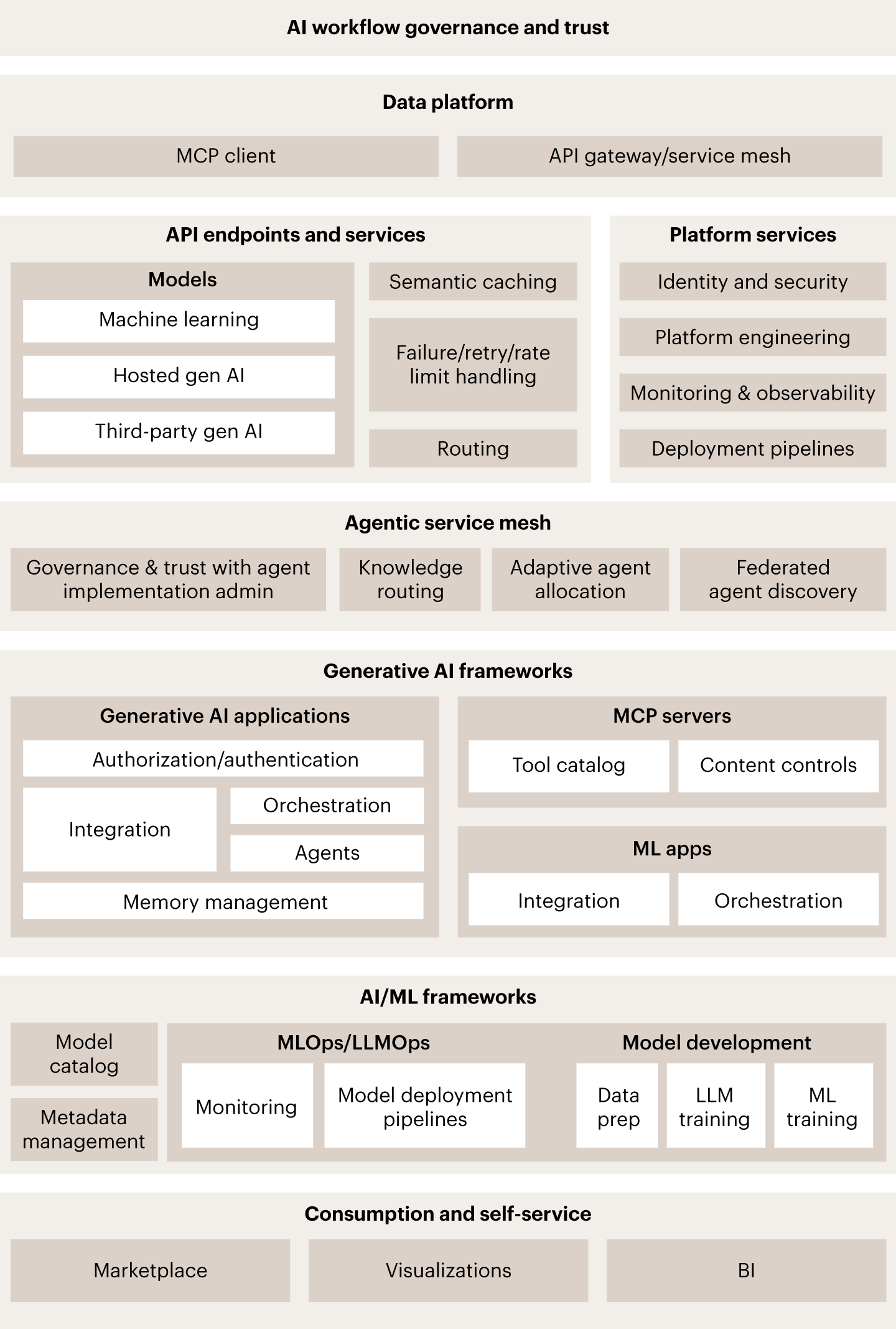
      Application and orchestration layer

      This is the command center of the agent-based system. It directs multistep workflows through orchestration engines that manage control flow, retries, time-outs, and parallel execution.
      出所 Bain & Company

      At the platform level, orchestration and runtime services should be shared, along with identity and policy enforcement, observability and audit tooling, and centralized registries and catalogs for agents, tools, and entitlements. Every request is routed to a specialized agent through an orchestration layer that manages workflow control and context handoffs. This layer also coordinates A2A communication through standardized protocols (such as MCP and A2A), maintaining shared context, session memory, and state (e.g., variables, task progress, decisions made) across interactions.

      Agents are deployed as separate yet connected versioned services that can be scaled, updated, and rolled back independently. Each is logged in an agent registry and policy layer with defined capabilities, tool entitlements, and policy constraints. Tool and API abstractions normalize external capabilities as MCP servers with consistent schemas and invocation semantics, while a tool catalog with life cycle management governs what is available and to whom.

      Agent skills are managed the same way: with a governed library of approved capabilities that can be reused across use cases. Built-in access controls, identity propagation for nonhuman principals, and audit tooling reinforce accountability across every interaction. On top of this foundation, applications implement the use case logic, including task-specific agents and workflows, domain tool adapters, user experience and approval patterns, and evaluation and success criteria that define what “good” looks like in production. A mature platform should provide reusable components for these patterns so teams can deliver faster without rebuilding the wheel each time.

      Analytics and insight layer

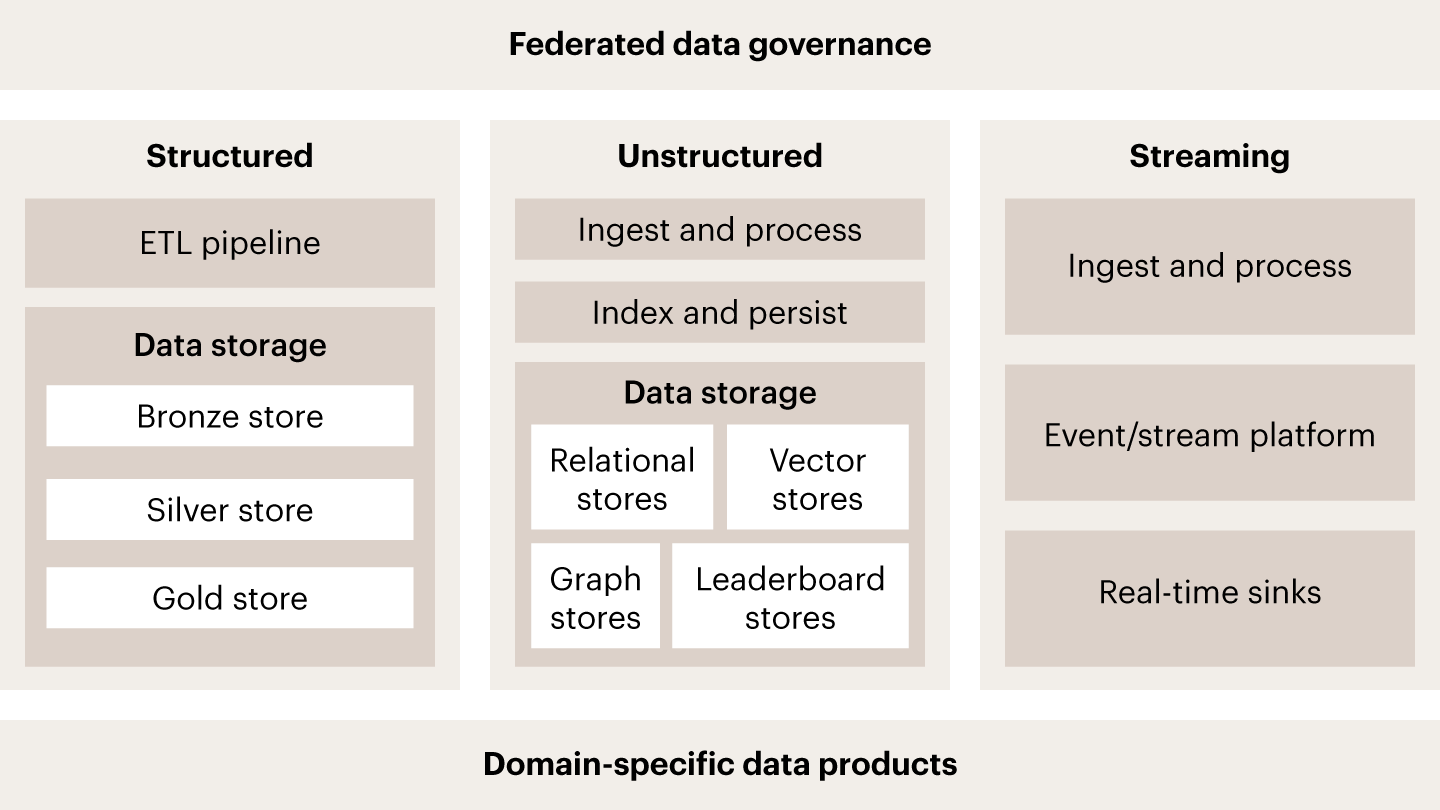
      This layer provides real-time visibility into agent execution via metrics, logs, and traces collected across agents, workflows, and infrastructure. Full reasoning-path traceability captures every step—from prompt to tool invocation to final output—enabling teams to audit and explain agent decisions. Integrated monitoring, token management, and alignment monitoring (i.e., detecting behavioral drift, hallucination patterns, and bias signals) make it easier to manage compliance. Live dashboards and anomaly detection help teams maintain visibility as A2A interactions and behaviors evolve in production, ensuring everything stays transparent and aligned with policy.
      出所 Bain & Company

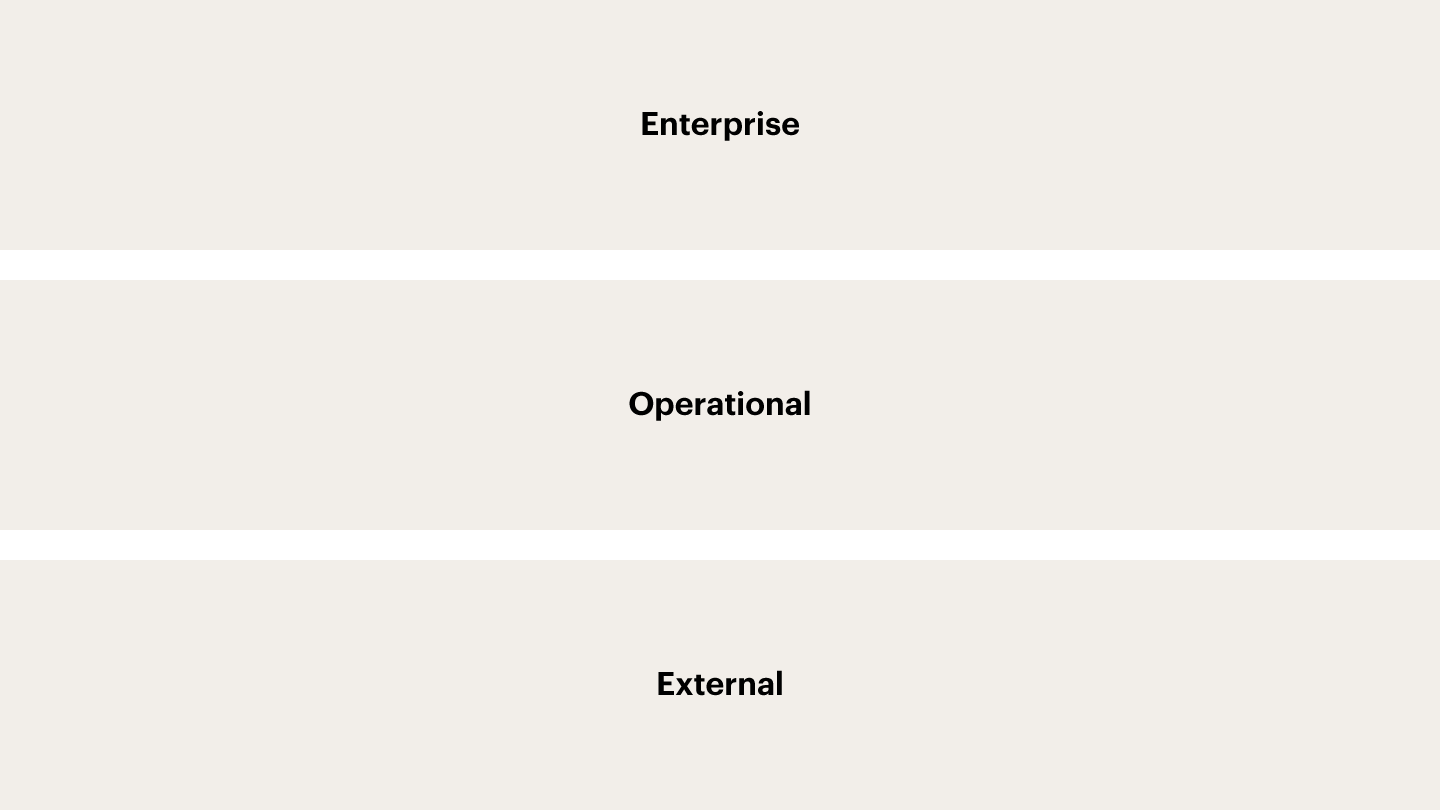
      Data and knowledge layer

      This layer serves as the data foundation for agentic systems, integrating structured and unstructured data via standardized interfaces. It unifies data across domains (spanning relational, vector, and graph stores) and gives agents consistent, governed access they can rely on. Schema and data contract governance enforce compatibility across producers and consumers, while a federated data catalog provides discoverability and lineage.

      Real-time streaming pipelines complement batch processing to ensure agents operate on current data, not stale snapshots. Metadata is automatically captured, and key data governance controls (e.g., classification, masking, retention, cross-domain access) are built into the pipelines to help ensure everything is used responsibly.

      Together, these layers transform AI architecture from a collection of independent components into a shared enterprise capability. Security and governance are embedded across layers rather than applied after deployment. Control points, auditability, and oversight become part of normal operations.
      出所 Bain & Company

      But architecture alone isn’t enough. In the next post, we’ll explore why governance and trust are the true foundation for scaling agentic AI—and why data quality is the make-or-break factor.

      著者
      • Headshot of Eric Sheng
        Eric Sheng
        パートナー, Silicon Valley
      • Headshot of Roger Zhu
        Roger Zhu
        パートナー, Boston
      • Headshot of Brendan O'Rourke
        Brendan O'Rourke
        パートナー, London
      • Headshot of Dale Pedzinski
        Dale Pedzinski
        Expert Associate Partner, Dallas
      • Headshot of Kevin Zhang
        Kevin Zhang
        Data Engineering Lead
      関連するコンサルティングサービス
      • Digital
      • IT
      • アドバンスド・アナリティクス
      コンサルティングサービス
      • Artificial Intelligence
      Artificial Intelligence Insights
      Beyond AI Efficiency: A Conversation with Intuit’s Ivan Lazarov

      “Ultimately, we must be audacious enough to envision the impossible and bold enough to build it.”

      詳細
      Artificial Intelligence Insights
      Global Venture Capital Outlook: The Latest Trends

      With AI infrastructure fueling the surge, 2025 closed strong.

      詳細
      Artificial Intelligence Insights
      The AI Upskilling Boom Has a Problem

      Companies are spending billions on AI training at the wrong moment. There’s a better order of operations—and it starts with people who are being ignored.

      詳細
      Artificial Intelligence
      Nvidia GTC 2026: AI Becomes the Operating Layer

      The companies leading in AI aren’t just deploying it. They’re rebuilding around it.

      詳細
      Artificial Intelligence Insights
      AI Talent Lab: Underwriters

      How generative AI is transforming the job of insurance underwriters and what companies can do to harness this moment.

      詳細
      First published in 4月 2026
      Tags
      • Artificial Intelligence
      • Artificial Intelligence Insights
      • CIO Insights
      • Digital
      • IT
      • アドバンスド・アナリティクス

      クライアント支援事例

      A Beauty Company Enables Always-On Brand Acceleration

      ケーススタディを見る

      Digital Reimagining Insurance for the AI Era

      ケーススタディを見る

      Digital A European Banking Giant Rises to the Fintech Challenge

      ケーススタディを見る

      お気軽にご連絡下さい

      私達は、グローバルに活躍する経営者が抱える最重要経営課題に対して、厳しい競争環境の中でも成長し続け、「結果」を出すために支援しています。

      Digital is a service mark of Bain & Company, Inc.

      ベインの知見。競争が激化するグローバルビジネス環境で、日々直面するであろう問題について論じている知見を毎月お届けします。

      *プライバシーポリシーの内容を確認し、合意しました。

      プライバシーポリシーをご確認頂き、合意頂けますようお願い致します。
      Bain & Company
      お問い合わせ Sustainability Accessibility Terms of use Privacy Cookie Policy Sitemap Log In

      © 1996-2026 Bain & Company, Inc.

      お問い合わせ

      How can we help you?

      • ビジネスについて
      • プレス報道について
      • 採用について
      全てのオフィス