

論説
A year after the failure of India’s power grid in the summer of 2012, which left hundreds of millions of people without electricity for a day or two, the event remains a dramatic demonstration of the vulnerabilities of the country’s electrical generation and distribution system. The outage focused international attention on India’s fragile energy infrastructure as a weak point that could hinder future growth. It also revealed the scale and range of opportunities for international utilities, some of which had already been scouting for projects in power generation.
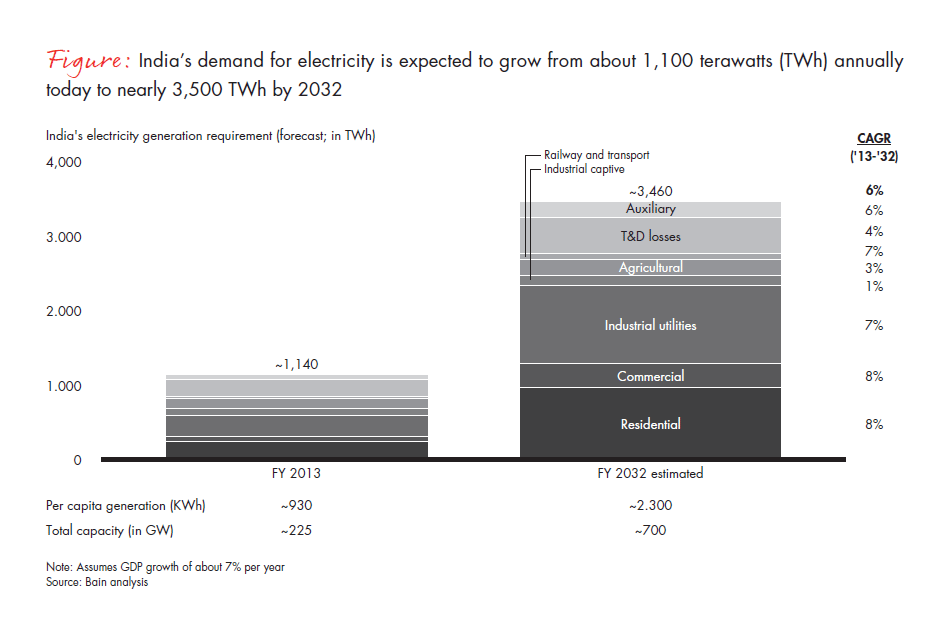
India’s power market is fundamentally attractive for investment, given the country’s growing demand for electricity (see figure). Indians use far less electricity per capita than their counterparts in more developed countries—only about 900 kilowatt hours (kWh) per capita, compared with 7,000 kWh per capita in Europe and 14,000 kWh in the US. We project that electricity generation capacity will grow from about 225 gigawatts (GW) in 2013—to 700 GW by 2032—to meet rising demand. That will require more than $500 billion of investment in power generation over the next 20 years, plus up to another $300 billion to $500 billion to upgrade the transmission and distribution grid. Thermal generation is profitable in India, delivering 15% to 17% margins with fixed power purchase agreements. That compares favorably with countries like Germany, where margins are under pressure (due to the transition away from nuclear) and significantly below the 15% to 20% level seen three years ago.
In spite of these opportunities, international utility executives remain wary about the market’s viability for several reasons. The biggest of these is the financial viability of the state distribution companies, which suffer large losses across the distribution system, for both technical and commercial reasons. Electricity grids in developed markets expect losses below 15%, but the losses by India’s state utilities over the past five years were as high as 30%—equal to about 1.5% of the country’s GDP. About one-third of that loss is technical, but the rest is either given away for free or with high subsidies to farmers, or lost to pilferage. Utility generation companies have little control over that; the loss happens under the nose of distribution companies, which are generally state-owned enterprises. These distribution companies also conduct regular load shedding and intentional blackouts in certain areas to manage demand, as collections don’t always cover the bills to power generators.
Many states are aware that the weak position of their state electricity boards (SEBs) hinders the investment climate and they have begun to take action. Over the past few years, most of the states, including Andhra Pradesh, Bihar, Gujarat, Madhya Pradesh, Punjab, Rajasthan and Tamil Nadu, have raised electricity tariffs by 3.6%, to 37%, to compensate for losses. Some states are working to control electricity loss from the grid, implementing electronic monitoring and control systems, enacting anti-theft laws and even setting up special police stations. What’s more, some farmers in India are increasingly willing to pay for a reliable supply of electricity rather than receive an unreliable supply for free or at the highly subsidized rates. Most promising of all, in September 2012, the central government agreed to restructure the short-term liabilities of the SEBs—$35 billion in accumulated losses—provided they increase their tariffs and reduce their losses. At least eight states, accounting for about 70% of the debt, have taken up the offer, which should help create more favorable economics for upstream players.
Fuel supply is another major concern. The world’s largest coal-mining company, Coal India—which is 90% owned by the central government and 10% by investors—has failed to meet its production targets, resulting in domestic shortages. In 2012, in an effort to spur Coal India to meet its fuel service agreements, the government introduced new minimum targets and fines for failing to meet those targets. Imports are feasible but expensive, and they challenge the existing structure of power purchase agreements and tariffs that were designed around cheaper, domestic coal. They also add pressure to the already constrained port and railroad infrastructures. Similar issues affect gas availability, and imported gas continues to be quite expensive despite the surplus in North America.
Opportunities in thermal generation
Taking all that into account, we believe that coal generation represents the greatest opportunity for international utilities in India. We expect that 55% of the growth in the country’s electrical installed capacity will come from coal-powered thermal generation and that, even as late as 2032, 56% of the country’s power will continue to come from coal. The investment required to meet that demand cannot be supplied by the government or domestic independent power producers alone, making the role of international producers critical.
To meet India’s vast energy needs, the central government has envisioned a series of ambitious ultra mega power projects (UMPP), each delivering 4,000 megawatts (MW). Four UMPPs have been awarded (three to Reliance Power and one to Tata Power), and there are others in the pipeline. Additional options to enter the market include Case 2 bidding, where the state government calls for bids on projects for which it has determined the location and technical specifications (including fuel source). Both UMPP and Case 2 are large opportunities, but they must be carefully evaluated by international utilities given the risk-reward trade-offs.
The sweet spot for international players could be mid-scale (50 MW to 300 MW) coal-based generation plants, both captive (dedicated to a company or site) and non-captive. These midsize plants deliver electricity to commercial and industrial customers, bypassing the state distribution companies’ grids, and thus avoiding distribution losses. They are more successful at collecting tariffs and can absorb the cost of imported coal since they don’t have to pay for expensive diesel back-up generators for customers.
Gas is another attractive opportunity. Small and midsize gas-fired power-generation plants could be profitable if utilities can buy fuel at the right price. But while the global supply is expanding and gas is cheap in North America, it’s still comparatively expensive to deliver to generators in India, primarily due to infrastructure constraints. For example, in June 2013, the Henry Hub price was about $3.50 per million BTU, but the delivered price in India was $15 or more. The national government is pushing to expand and create new liquefied natural gas (LNG) terminals to import gas and also exploring long-term supply contracts with US companies—assuming regulators there allow LNG exports. Also, a state-owned natural gas company is investing $4 billion to develop gas reserves in the Arabian Sea. But in the short term, domestic supply has remained limited, and production has stagnated because of regulations that have kept prices below those on the international market. That should change soon: In June 2013, the Indian government decided to let producers raise natural gas prices (beginning in April 2014) to spur investment and increase production.
All these potential power-generation options come with their share of risks and rewards for potential new entrants. For many independent power producers, the memory of the struggles around the Dabhol Power Station—which sat idle for years because the power it generated was too expensive for Maharashtra state to buy—is still fresh in their minds. Even so, some international utilities are looking to enter India’s power-generation market independently, relying on their expertise and assets, and even exporting used or underutilized equipment from developed markets, where growth and returns are under severe downward pressure. Others are looking to partner with an Indian company, trading investment and expertise for access and the opportunity to learn about the market while building local teams. Partnering can mitigate risks around land acquisition, environmental rehabilitation and resettlement of the affected population, although it may also introduce complexities around managing a joint venture. Finally, the market in India is ripe for M&A: There are several coal and gas assets in advanced stages of construction with owners who want to exit, either because they lack the expertise to manage the project or due to related fuel or capital issues in a slower economy.
A key challenge for international utilities will be securing a reliable and affordable supply of coal, given the domestic shortage and high costs of importing. New entrants will find it difficult to get their supply from Coal India, given its existing commitments to Indian companies. Because of that, international utilities setting up thermal generation plants in India will need to source much of their coal through imports—primarily from Indonesia, South Africa and Australia. Long-term contracts are the preferred way to secure supply, but if those are not available, utilities may need to consider passive investments in coal-mining operations, as Reliance and other Indian companies have done. The government’s July 2013 decision to award 14 new mines to the private sector, after a lag of five years, is likely to encourage investment and production.
Investing in renewables
Among renewable power sources, we believe that solar offers the greatest potential for international players, although the window of opportunity for entering may already be closing, since the best locations are being developed first. India represents one of the fastest-growing markets for solar power, with more than 1.7 GW installed in the last two years, up from zero. The industry is on track to meet or surpass its target of 22 GW by 2022 (20 GW on the grid and 2 GW off). Indeed, the installed capacity targets for 2013 were reached a year early. As the country relies more and more on imported oil and gas, solar emerges as a significant way to limit coal imports over the next 5 to 10 years. Competition among plant developers is intense, but the market remains fragmented, so now is the time for international players to enter. Developers can still make 15% internal rate of return (IRR) with the lowest tariffs (around 13 or 14 US cents), or even a bit more if they can find cheaper sources of foreign capital.
International utility players can participate in many ways: through thoughtful bidding for new capacity allocations as more states develop their solar policies, or through joint ventures or partnerships with credible local players for new projects. M&A activity is picking up in solar, including acquisitions of distressed assets from players that could not manage the challenges of the sector. Even with partnerships, international players face a steep learning curve managing development and the issues related to land acquisition.
India’s wind sector is also moderately attractive with significant potential of up to about 100 GW, but much of it (about 19 GW) is already installed in the best locations. Profitability is substantial, although proposed regulations that would require wind producers to issue day-ahead forecasts (and pay penalties if they are off) could erode margins. Existing wind farms deliver up to 20% IRR because they benefit from the old subsidy scheme. New projects are more likely to see 15% IRR based on the current incentives, which are likely to be phased out soon. Renewable energy certificates offer some support, but their trading value has been trending lower as supply has outstripped demand. The health of the state electricity board also matters: In Tamil Nadu, for example, payments can take up to six months due to the state’s poor financial health.
With that in mind, international utilities should consider investing in existing wind facilities rather than greenfield opportunities. The industry is still highly fragmented, with more than 180 players with wind-generation capacity of more than 10 MW each, providing a wide choice of potential sellers. One path of entry is to acquire an existing site with old, inefficient turbines and either retool or repower to increase output. Building a portfolio of wind farms can help an operator gain scale, further improving the economics by reducing the operations and maintenance for each site by 10% to 20%. Better maintenance can also improve output from inefficient turbines by up to 15%. Building a new site is more difficult, even with Indian partners. Most of the best sites—those close to industrial belts, for example— have already been developed, and there is substantial execution risk that needs to be managed carefully.
We strongly believe that given the demand potential and the positive news that the Indian power sector has seen recently, the sector is turning a corner in its attractiveness. The government’s recent decisions on loan restructuring, fast-tracking stuck projects due to land and fuel issues, domestic gas price increases and coal blocks for the private sector signal its intent to move quickly to revive the sector. International utilities have a critical role to play in India’s power sector, one that offers growth potential to utilities whose home markets are less dynamic, while delivering much needed capital, talent and resources to India’s stretched power grid. The key for utility executives will be to identify the most promising opportunities for their organizations in a rapidly changing environment and ensure thoughtful on-the-ground execution, with or without a local partner.
Amit Sinha is a partner with Bain & Company in New Delhi, where he leads the firm’s Industrial Goods & Services practice in India. Julian Critchlow is a Bain partner based in London, where he leads the firm’s Global Utilities practice.
The authors would like to acknowledge the contributions of Arunava Saha Dalal, a consultant with Bain & Company in New Delhi, and Christoph Henseleit, a Bain consultant in Frankfurt.
First published in 9月 2013