

論説
“Excellence is an art won by training and habituation. We do not act rightly because we have virtue or excellence, but we rather have those because we have acted rightly. We are what we repeatedly do. Excellence, then, is not an act but a habit.”
–Aristotle
Though he was probably speaking to artists, craftsmen and students, Aristotle could have been talking to today’s oil and gas industry executives when he wrote those words 2,300 years ago. We know from our conversations with industry executives that they aspire to the same ambitious goals as Aristotle’s listeners. They want their businesses to run safely and more efficiently: to demonstrate operational excellence. But aspirations are not enough; excellence is a habit that results from millions of small acts, performed every day by tens of thousands of employees.
Unlike Aristotle’s audience, however, a company cannot simply decide to get better. Because they are large, complex organizations, companies demand a systemic approach to improvement: an operational excellence management system (OEMS).
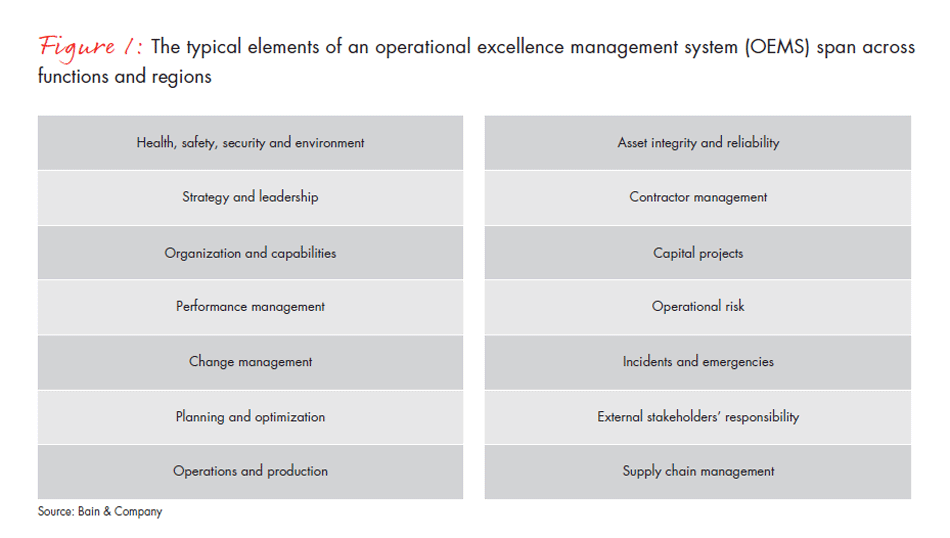
Two decades ago, Exxon deployed the first and best known OEMS in response to the Valdez oil spill. The company has since gone on to refine and improve the approach over the years, and it has become a model for others in the industry. Today, most international oil companies (IOCs), national oil companies (NOCs) and many other energy companies have management systems in place that reflect their aspirations for excellence. These systems describe the expectations for performance by all of the company’s operations (see Figure 1).
Because they are so widespread, putting an OEMS in place no longer differentiates a company or ensures superior performance; it’s merely a first step. Breakthrough performance depends on how well you embed the system, from the front line to the back office, and how employees act on it day after day. In other words, this isn’t just about designing new systems, it’s about teaching people a new way of working and then continuously getting better at it.
What is an OEMS?
An operational excellence management system isn’t just a manual. It’s a set of rules that describe how a company is going to operate in order to achieve operational excellence. The best examples are focused, simple and relentlessly applied. A solid system:
- sets global expectations for operations
- defines common language that everyone in the organization can use to talk about operations and their aspirations
- shares successful practices and behaviors across the organization
- maps accountabilities from the top to the front line
- promotes continuous improvement
Many companies spend too much time preparing the manual and not enough implementing it with accountability measures that ensure compliance. Successful companies focus more on implementation and compliance to get the most out of the effort.
Oil and gas companies typically don't become more efficient overnight. However, an operational management system can help set the rules that ultimately help a company run more effectively in the long term, says Pedro Caruso, a partner in Bain's Oil and Gas practice.
Putting an OEMS in place
The most successful implementations start with insightful design and system principles that relate directly to strategic goals. The best designed systems are focused, simple and carefully crafted to make them easy to apply across the business.
- Focused. Avoid trying to make the system everything to everyone. The most effective systems bear down on operational integrity. Casting the net too wide can raise complexity and make the system difficult to apply—and less useful.
- Simple. Group the system’s requirements into natural bundles (sub-systems) that are roughly equal in importance. Ideally, the OEMS should cover all the relevant areas without any overlap—a mutually exclusive, collectively exhaustive structure. Otherwise, overlaps can reduce the clarity of responsibilities and lead to duplication of work.
- Designed for relentless application. Define how conformance to the OEMS will be measured in a clear and succinct way. Measure conformance at the subsystem level with two metrics, one to assess the quality of the subsystem developed to meet the system requirements, and another to assess the adherence to it. Measuring below sub-system level promotes fragmented solutions. Unclear conformance definitions create confusion and make it difficult to measure compliance.
Base the implementation approach on business objectives, and integrate the system into the way the business operates. For example, if the primary aim is to reduce operational risks, then prioritize development and deployment of subsystems linked to risk control and management. If, on the other hand, the goal is to improve operational efficiency, then prioritize the sub-systems related to maintenance and turnarounds. In any case, focus on the geographic areas or operations that have the largest opportunity for improvement. Management tools, including planning and performance management, should be updated to reinforce the OEMS.
The most effective way to roll out a major transformational effort like this is with a sponsorship spine, in which direct managers introduce it to their reports at every level of the organization. It starts at the top, where a steering committee sponsors and directs the project. Committee members work with project leaders who design the OEMS elements. These leaders talk with others across the organization, called change agents, who in turn communicate the details to the front line or back-office personnel in their area.
Ideally, most employees will learn the details of the OEMS from their own manager or someone in their group. Even so, senior leadership must continue to speak passionately and confidently about the importance of the OEMS. They should be clear about the connection between the OEMS and the way the organization creates value. In their own work, they should explicitly link their priorities to the delivery of OEMS requirements.
Throughout the rollout and beyond, err on the side of over-communicating the goals of the OEMS, and make sure there are enough resources behind the effort to give it a good shot at success. Keep communications as simple as possible, and describe what is changing and what isn’t.
Leaders should communicate continuously, from the start of design through the implementation and beyond. Some may need coaching to ensure the message is delivered consistently, to reduce confusion.
As soon as the OEMS is up and running, team leaders should disband the deployment team and transfer their responsibilities to the relevant functions and the front line. They should create incentives to embed the OEMS into daily operations and reward those achieving their goals quickly and prominently. The system’s goals should be measurable, with metrics linked to the performance scorecards of those accountable.
What to watch out for
As we have worked with companies putting operational excellence into place, we see five common pitfalls that threaten the success of an implementation.
- Vague definitions. Without good definitions, there’s little chance that everyone in the company will get a clear understanding of the program’s goals and how they’re going to go after them. For example, goals that are overly lofty (“world class”) are not as helpful as more specific ones (“99.6% reliability”).
- Unclear accountability. When people are not held accountable for implementing the rules described in the system, they have less incentive to change their behavior. It cannot succeed if people don’t face consequences for failing to follow its guidelines.
- A front line that doesn’t grasp the reasons for the program. Changing behaviors is hard. A common reaction is for frontline teams to claim their situation is different so that they don’t have to apply the OEMS in the prescribed way. If a company really wants thousands of frontline workers to change the way they work every day, it requires lots of communication, ongoing support and assessment, and a culture of consequences.
- Executives feel like they don’t own the OEMS. If senior executives or middle managers feel like the program has been foisted on them from high above or outside the company, they may lose enthusiasm and let the program trail off after the initial burst of enthusiasm.
- An implementation effort that runs as a parallel organization, not integrated into the business. A dedicated team has to be set up to design and deploy an OEMS, but that team cannot continue to run as a separate organization within the company. Its task is to implement the new way of working into the organization, down to the task level. Ideally, the OEMS team should be able to disband after the program’s planned development time, allowing it to become a normal part of management.
Falling into any one of these traps can reduce compliance levels, hindering the company’s progress toward operational excellence.
How one company got started
A large energy company’s legacy management system had served it well, but it had not kept pace with its growth. As the organization grew to world-class size, the CEO aspired for it to become the best at what they do. Senior executives decided they needed to redefine their way of operating, and they began a three-month trial to see what impact an OEMS would have.
The OEMS project leaders looked at several areas, one of which was the execution of engineering studies. In this and other areas marked for improvement, they mapped out the current situation and then applied the framework of an OEMS, asking “Is it performing up to expectations, and if not, what is the gap?”
As the team looked closely at the way it approved engineering studies, it realized its approval process was overwhelmed by the number of studies under review. Many of the studies working through the approval process had not been challenged early in their development, to see if they were necessary.
As part of its new OEMS, the company put in place a cross-functional team that posed early challenges to the studies, to ensure they were necessary. They also compared studies in the approval queue with those already completed and found that the scope of about 10% of the studies was redundant, having been covered by a previous study or project. The impact reduced the backlog of projects by around 20% and the inflow of new studies and projects by 25%.
The team then began to rank studies by criticality and risk, and elevated the most critical studies to senior engineers. That streamlined and balanced the load of the people doing the approving. All told, executives estimate that improving just this part of the way they do things could save them approximately $20 million annually.
Keep long-term goals in mind
As organizations embark on the journey to build operational excellence into their processes, occasionally the initial enthusiasm generates such an all-encompassing project that is too overwhelming to tackle. Don’t get bogged down in building the manual. A three- to fourmonth survey of any particular area is enough to get a clear picture of where the operations stand and how big the gap is between reality and the ideal.
We recommend that companies start in a few focused areas. If you begin writing manuals for every part of the business it could be many months or years before you actually begin implementing and measuring success.
Design a framework, and choose a few places to implement it—places where you can show a big impact in just a few months, in order to get buy-in. Remember, you probably have a short honeymoon period in which to demonstrate success or risk losing others’ interest in the effort.
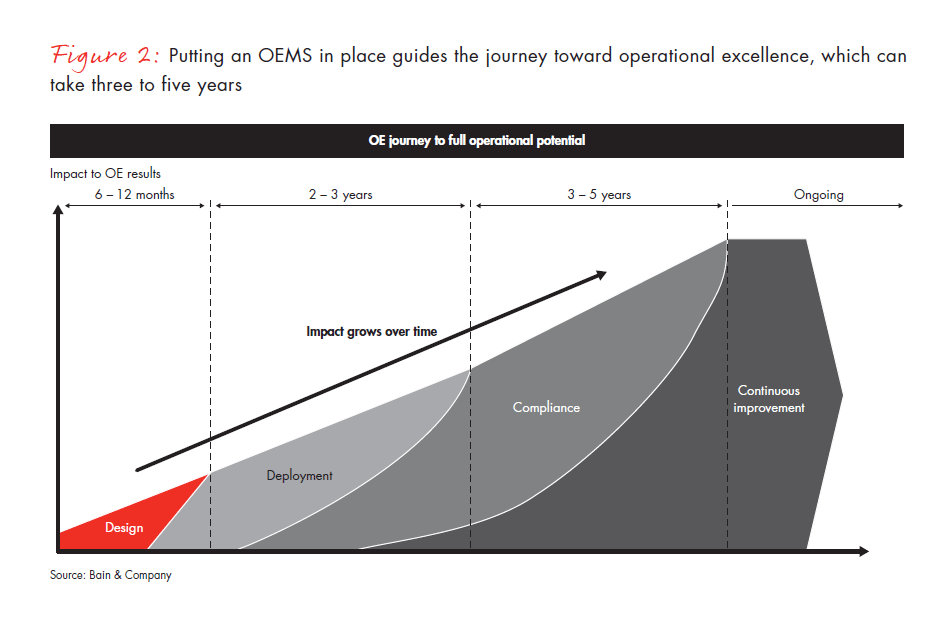
And while it’s important to find those quick wins, don’t declare victory too soon. Implementing an OEMS is a three- to five-year process (see Figure 2). After that, change can be self-propelling as guidelines continue to shape behavior.
But the rewards of operational excellence are worth the journey. As oil and gas executives know, companies are under unprecedented pressure to improve their environmental, safety and financial performance amid rising costs, operations in more challenging environments and heightened competition. Operational excellence is no longer just a lofty aspiration; it’s becoming a necessity in this increasingly demanding market. An operational excellence management system, which guides employees toward repeatable, optimized behavior, is the tool executives can use to reach their goals.
Pedro Caruso is a partner with Bain & Company in Houston. Francesco Cigala is a Bain partner in Kuala Lumpur. Juan Carlos Gay is a Bain partner in London.
All three are members of the firm’s Global Oil & Gas practice.
First published in 10月 2013