

Article

概要
- In polling, a solid majority of customers say they’re willing to provide more personal data if doing so results in a better customer experience.
- Personalization can improve sales and loyalty, but only with the right blend of organizational readiness, technology, and content.
- Delivering exceptional customer experiences requires seamless communication, clear decision rights, and disciplined data privacy policies.
Even before the Covid-19 pandemic upended most aspects of daily life, the simple act of shopping was undergoing a profound shift. The rise of online entrants across every sector of retail gave customers scores of new options, and raised expectations about convenience, cost, and selection. In parallel, customers were arming themselves with ever more knowledge about product pricing, quality, and other attributes, thanks to a seemingly limitless stream of reviews, opinions, and tips on what to buy, and where.
The pandemic accelerated those changing behaviors and expectations, to the point where shopping has become far less about what consumers buy, and more about how. The quality of the customer experience—not just during the research and purchase phases, but across all touchpoints, including shipping, returns, and post-sales service—has become the true differentiating factor. That means that brands will need to make quick and significant adjustments to many long-established practices and beliefs.
An essential component of this improvement is to move from the customer experience and focus on each customer experience. Customers vary enormously in terms of product preferences, browsing behaviors, price sensitivities, and dozens of other factors. A one-size-fits-all approach has demonstrable limitations and has proved to be ineffective. Instead, personalization, connectedness, effective engagement, and a deep understanding of each customer’s needs and desires are the factors that will separate the winners from the also-rans.
Catching up with customers
Customers don’t need to be persuaded about the value of personalization and other aspects of the customer experience. If anything, brands may need to catch up with customer expectations. For example, while it may come as no surprise that 83% of customers say they would prefer to be treated like a unique individual rather than a number, brands may be surprised to learn that a solid majority—76%, according to data from Salesforce—say they are willing to provide more personal data if doing so results in a better customer experience. And 62% say they prefer personalized offers or services.
Brands have plenty of incentive to comply: Shoppers who click on a personalized product recommendation average a 26% higher order value compared with those who don’t, and a majority (52%) now expect offers to always be personalized.
Their expectations don’t stop there: Three-quarters of shoppers surveyed now expect consistent interactions across all departments. For example, they don’t want to see a brand push a promotion to them for an item they’ve already purchased from that brand.
Customers say they are willing to provide more personal data.
In short, they want to feel a true sense of connection with the companies they do business with. That requires brands to make their own connections, literally: The people, processes, and technologies that support the customer experience need to be tightly integrated and digitally enabled, to provide the seamless, personalized interactions customers want. Many brands have made great strides in digitalization. However, customers still expect more: Eighty-eight percent say they expect companies to accelerate their digital initiatives. That requires companies to make critical improvements to various facets of their operating model, including migrating to a more agile, cross-functional way of working (e.g., a product model).
Start with the organization
Digital capabilities are important, but brands will need to think beyond technology. They’ll need to focus on the organizational issues that inhibit the sense of connectedness customers crave. Customers view a brand as a single company, not as a collection of departments. Yet, within most companies, sales, marketing, customer service, and other functions often don’t share information nearly as well as they should. Or could. As a result, personalization remains a missed opportunity for most brands (see Figure 1).
Figure 1
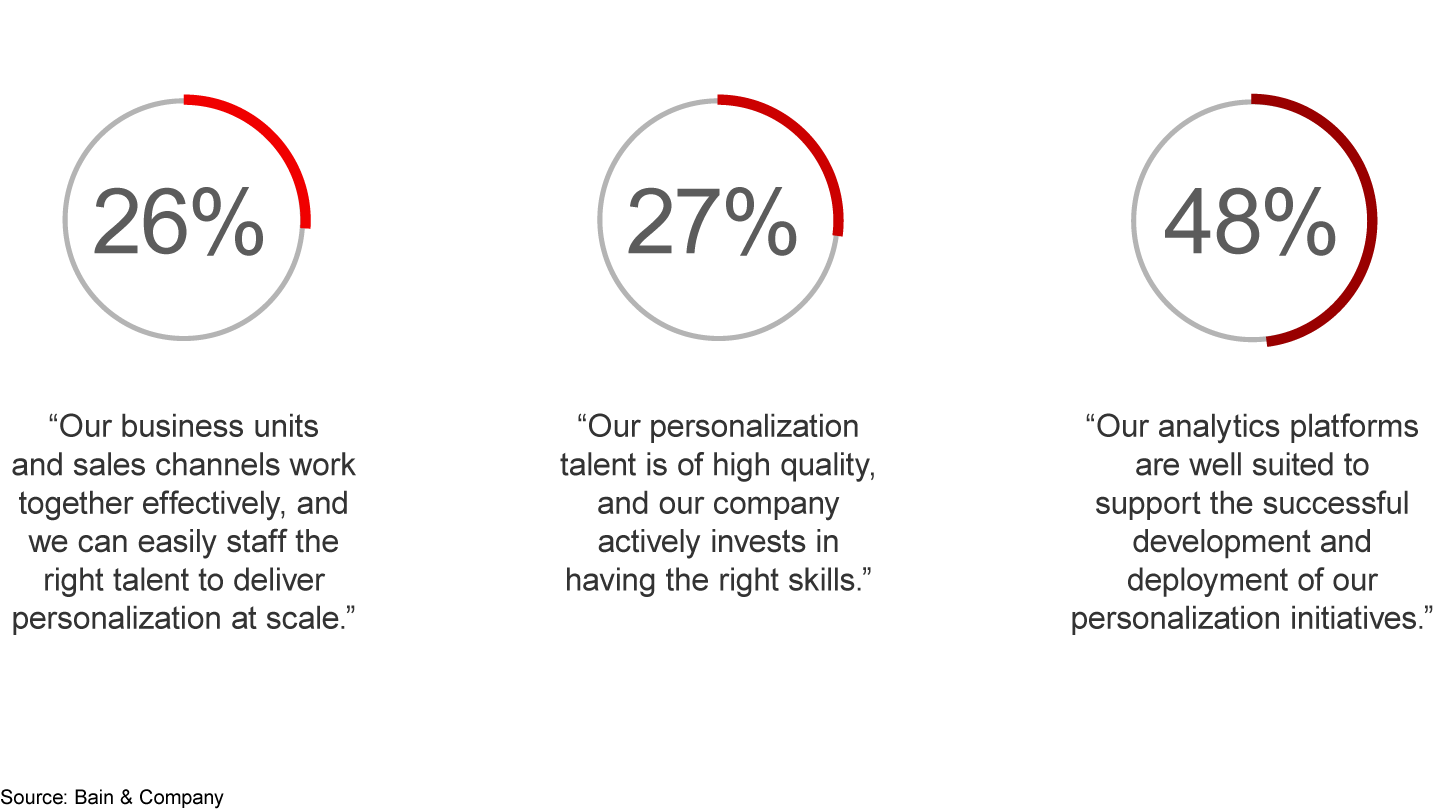

That means that before brands can improve the customer experience they’ll have to improve the employee collaboration model and related ways of working. That requires critical organizational improvements to various facets of their operating model, to ensure they have created the right channels of communication, clarified decision rights, implemented proper data privacy policies, and made other adjustments that enable team members to operate with maximum efficiency. That paves the way for another critical element of success: providing employees with the resources they need—primarily in the form of accurate, detailed, and timely data—to support the personalized interactions customers want.
Personalization success: Getting there from here
Overcoming legacy systems and processes is never easy, but a proven four-step plan can help brands provide the personalization and connectedness so critical to winning today’s consumers.
To start, it’s imperative that you have a clearly defined vision, supported by executive sponsorship, that establishes design principles, defines the breadth and depth of the desired personalization, determines where and how AI and machine learning can be applied, sets parameters for the necessary data collection, and prioritizes desired business outcomes.
Next, identify the most relevant types of personalization, and build a catalog of use cases based on a high-level assessment of financial opportunity and viability. The optimal use cases will vary by type of company: A grocer, for example, is likely to focus on personalized promotions and offers, while a fashion brand is more likely to personalize the creative and product selection.
As a third step, gain a better understanding of customer needs and behaviors, which often starts with segmentation: Which ones are frequent buyers, vs. infrequent? Which ones shop cross-category? Which ones are primarily sale shoppers? High-value vs. low-value? You can also gain a deeper understanding of your customer segments by analyzing what the sale of certain products says about future buying habits. Some products may correlate strongly to one-and-done customers, while others may signal the start of a (potentially) beautiful relationship. A home products retailer, for example, may discover that the purchase of drapes often precedes the purchase of multiple pieces of furniture. These and related analyses will help you gauge future customer lifetime value opportunities.
When determining which digital channels to personalize, focus first on channels where you currently have the best customer engagement (e.g., email, your app), but aim for a consistent and relevant experience across all channels.
Finally, create agile teams with clearly defined roles and decision makers; iterate with small groups from the tech team, then the business team, and finally a larger group, including finance. Design a flexible roadmap that uses hypotheses to posit the ideal customer experience, and then determine which tests will accurately prove or disprove those hypotheses. (Data from NPS Prism℠ can be hugely helpful in deciding where to focus your initial tests.) And, start with scaling in mind, to avoid the common trap of launching a series of small tests that have no clear path to wide deployment.
Harnessing the right data in the right way
It’s also important to address the technology and data needs at the heart of the customer experience, to not only provide effective personalization at the start of a transaction but to ensure that customers are satisfied across the entire journey, including returns. Data can provide useful signals that, even when a customer has been disappointed with a product, they remain happy with the retailer.
Important actions include:
- Mapping behaviors across the customer experience, and identifying the technology enablers that support each moment.
- Assigning key performance indicators (KPIs) to high-value tasks and signals. These will vary across the customer journey.
- Assessing your priority use cases, and determining the business, technical, and other requirements to be addressed, as well as trade-offs, such as how much (or little) personal information to request, and at what stage of the journey.
- Reviewing existing content and identifying gaps: Does your image library, for example, have enough variety to create tailored banners for each defined segment?
Testing, testing …
With those issues addressed, a rapid test-and-learn approach will enable you to launch pilots and then quickly scale to an automated approach. Set rules guided by baseline information, such as open rates on emails and other KPIs, so you can measure the relative success of your tests.
Initial results from pilots can be fed into your roadmap, to guide development. A stage-gate process enables you to make progress in waves, beginning with a minimally viable product (MVP) and expanding across channels and categories, adding additional use cases as you progress toward your target state.
Once designs are set up, AI can create variation. For example, rather than manually creating sets of predefined audiences and landing pages across a product category, AI can create predictive website journeys and personalized experiences, using website and CRM data to deliver real-time one-to-one experiences. You can test those AI-powered experiences against your previous approach to measure improvements in engagement.
Once you’ve used that test-and-learn approach on no-risk pilots, and then for select channels and categories, you’re ideally positioned to scale your new personalization and related capabilities across the entire customer experience.

NPS Prism®
Our cloud-based customer experience benchmarking service provides actionable insights and analysis that guide your creation of game-changing customer experiences.
Putting personalization into practice
To see how personalization can produce impressive results, consider the experience of a global quick-service restaurant. Same-store sales at this multibillion dollar company were stagnant, and its email outreach program was having little impact, in part because the company sent the same offer to every customer.
We applied the framework described above to create eight distinct customer segments, based on purchase history and many other variables. Our testing program used a mix of different subject lines, creative layouts, send times, and other factors to create personalized messages. We carefully tracked relevant KPIs to determine which kinds of offers got what kind of results for which segments, then used machine learning to amplify the reach of the most successful messaging. This data-driven, multivariant, carefully segmented approach was the equivalent of running 13,000 A/B tests a week.
The result: a 15% lift in sales after just four pilot iterations, and a 9% boost in profits compared with control. We also created a playbook of repeatable actions for specific use cases, an initial rollout plan, and a resourcing and hiring plan that could sustain this initial personalization effort.
Are You Making It Personal?
Learn more about our maturity assessment to see how your company compares on strategy, enablers and results.
The future is now
As that example demonstrates, customers respond when the messages, offers, and even images they’re exposed to speak to their specific needs and desires. Making that happen requires a blend of organizational readiness, analytics, content creation, testing sophistication, and supporting tools. The end result—carefully tailored personalization and a customer experience characterized by a sense of genuine connection—improves sales, boosts loyalty, and demonstrates to customers that they are at the heart of everything you do.