

論説

When a fast-moving consumer goods executive was asked why he was so intent on pursuing future growth in a region with unsteady GDP, he quickly replied, “GDP doesn’t drink beer and use hair conditioner. People do.” Indeed, the smartest consumer goods companies are looking beyond the current headwinds that are buffeting many of Asia’s developing markets to two overwhelmingly positive signs: First, the region is home to nearly 50% of the world’s population; second, by any indication, most companies’ moves to capture this vast market are still in their infancy.
There’s no question that the fundamentals for growth exist and that things are only going to get better throughout developing Asia. Growth rates have slowed from their dramatic recent highs, but they remain significantly above what even the best companies are yielding in developed markets, with profits that can meet or exceed global averages. Consider Indonesia, where penetration for baby diapers is less than 30%, according to Euromonitor, and poised to take off, and where Tier 2 cities are accounting for much of the growth. In India, where GDP is growing steadily, much of the market growth in toys is moving toward educational toys even as sales of traditional toys constitute the base. As consumer behavior and the retail landscape evolve throughout the region, winning will mean understanding the nuances of a new era for growth and playing by a quickly shifting set of rules.
Let’s look at recent developments and the important changes they’ve delivered.
Category consolidation continues to raise the barriers to entry and leadership. Low-cost positions and knowledge of local tastes have enabled the best Asian companies to narrow the gap on Western multinationals and win in key categories. Think of the gains that Godrej has made in household insecticides and that Rohit Surfactants has made in detergents in India over Western multinationals. Or that China’s Yili and Mengniu have achieved over global dairy giants in the category of ultra-high-temperature milk. As domestic companies boom, they’ve given rise to a phenomenon: the new Asian multinational corporation (MNC). This growing group of companies includes names such as Universal Robina Corporation from the Philippines and Thai Union Frozen—regionally expanding brands that have introduced a new level of competition. No longer is the battle between local champions and MNCs. Today it’s among local champions, Western MNCs and Asian MNCs.
Now that consumers can pay more, they are becoming more discerning and demanding more choice. This shift has opened the door for new categories and subcategories and changed the dynamics of existing categories. Shoppers’ increasing sophistication has expanded the premium segments across a range of products. For example, fully 38% of the volume in China’s yogurt sales last year came from premium SKUs. And our research has found that consumers in developing Asia will pay more in categories devoted to health or to improving their quality of life. China’s YNBY toothpaste, for one, built its success on a core product with a host of functional benefits, including minimizing bleeding gums, toothaches and oral mucosa lesions. But even as shoppers buy more premium products in health and other categories, they remain less loyal to any particular brand. This poses a threat for incumbents and creates an opportunity for followers and new entrants.

Asia's emerging digital consumers
New technologies are changing the way consumer product companies do business. Nowhere is the shift happening more quickly than in Asia.
Geographic markets within the region have evolved differently from one another. In fact, differences among markets are now more prominent than similarities. For example, 48% of all milk products purchased in Indonesia are in the form of powdered milk, a format barely consumed in China and India. Modern trade accounts for the majority of grocery retail sales in China but is miniscule in India. And each market has its own preferred e-commerce platform—such as China’s Alibaba, Southeast Asia’s Lazada and India’s Flipkart. Given the fragmentation, each market requires a highly tailored approach.
The channel landscape is also evolving differently across markets in the region. Throughout the region, modern trade’s emergence has been uneven, spreading faster in recent years in Vietnam and Indonesia than in Thailand and Malaysia. The formats that proliferate reflect the differences among markets—everything from the rate of car ownership to national protectionist measures to local consumer tastes. In Indonesia, for instance, smaller formats such as mini-marts and convenience stores are preferred; their ranks have grown 21% annually over the past decade. In China, where the majority of business passes through modern trade, mother-and-baby-store formats have gained traction, with annual growth of 13% since 2010, representing 61,000 outlets. Players need to be aware of and target these fast-growing channels.
Similarly, the online world is taking on varying shapes in different markets throughout developing Asia. Overall, there is unprecedented growth in connectivity, particularly in mobile commerce, across Asia, with China leading the digital charge. There, e-commerce sales have jumped 60% each year since 2010. Online penetration has reached 15% in Tier 1 cities, with shoppers now routinely going online to browse, buy and offer feedback on products. By comparison, digital sales in India, Malaysia and the Philippines are on a slower trajectory, with each growing by 10% per year across the same period and with penetration in the 0.5% to 2% range. Different categories shift to online sales at different speeds. For example, online penetration for the diaper category is way ahead of impulse products and fresh produce. Even within categories, different products, such as coffee capsules and instant coffee, move at different speeds. Regardless of variations in adoption by market, category and product, new technologies are changing the way that consumer goods companies develop their products, engage with consumers, sell and deliver.
As these dissimilarities come into clear view, some companies are gaining an edge over rivals by following a few basic rules.
Focus, focus, focus. In such a diverse environment, we counsel companies to maintain an unwavering focus on just a few products and brands in a core set of markets, with the goal of building up leadership positions (either organically or inorganically). Focus allows companies to provide the scale support required to help ensure success. For example, spending at scale on above-the-line advertising is necessary to achieve threshold share of voice. Focused growth was critical to the success earned by Vietnam’s Masan. The company targeted the undeveloped but high-growth market for branded fish sauces, entered with a premium offering, built up leadership in that sector and then expanded into the mass market. It ultimately locked out competitors with a full range of economy to super premium offerings.
Tailor strategy to markets, categories, channels and, most important, market positions. Winning with a more focused portfolio requires strategies that are tailored to the nature of the category and country, using market position as a guide (see Figure 1). For example, market share leaders extend their leadership and close followers strive to become leaders by growing the core and carefully expanding the category. Over the past decades, Indonesia’s Petra established itself as the chocolate category leader in part by hitting the right price points for occasions such as after-school snacks and by making the most of its low-cost position. Then, among the moves that helped it stay on top, it targeted a few key brands to maximize its advertising budget. Ferrero has maintained its leadership in chocolate confectionery in Singapore by introducing products such as Ferrero Rondnoir in the fast-growing premium dark chocolate segment.
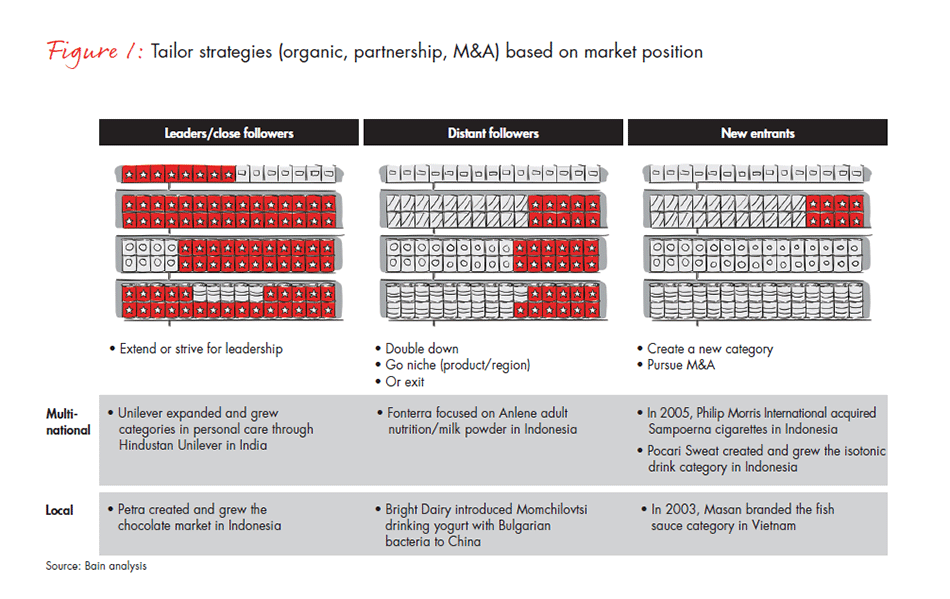
Distant followers are best served by doubling down, pursuing a niche or, if the prospects for growth seem unfavorable, exiting the market. Wings took advantage of its route-to-market capabilities in detergents to grow its position in noodles in Indonesia, gaining share from leader Indofoods. It then expanded to Malaysia, where its Mi Sedaap brand noodles took the market by storm. In both cases, Wings established itself as a strong follower.
New entrants can find an underserved category and introduce it to the market, as L’Oréal did when it brought hair coloring kits to India, where powder dyes predominated. For China’s Bright Dairy, entering the ambient yogurt category meant partnering with a European company to introduce recipes and ingredients from Momchilovtsi, a Bulgarian village. By emphasizing that foreign connection in advertising, communicating the digestive benefits and offering its product in packs designed for convenience and gifting, Bright Dairy’s ambient yogurt flourished. Only six years on the market, Momchilovtsi-branded yogurt now contributes about one-third of Bright Dairy’s total revenue. The brand’s revenue grew by 85% in 2014, making the yogurt a billion-dollar business.
Brands can gain access to an existing category through partnerships with local brands or by turning to mergers and acquisitions, as Mondelez International did with its purchase of Kinh Do’s snacks business in Vietnam. Companies should look for acquisition targets that are closest to the core and that can reinforce organic growth.
Remember: Penetration is king. Across categories and countries, increasing penetration is the primary way to build big brands. (Penetration is defined as the percentage of households in a market buying a particular brand in a given year.) This is a key insight from the research of the Ehrenberg-Bass Institute for Marketing Science, summarized by Professor Byron Sharp, director of the Institute, in his book How Brands Grow, based on decades of observations of buying behavior.
An important step toward boosting penetration is winning at the point of sale in both the physical and online worlds. (Winning at the point of sale is one of three imperatives in Bain’s approach to building penetration; the other two imperatives are focusing on product assortment and brand memorability.) Establishing a leading point-of-sale presence requires building out a route to market that will provide maximum reach, taking a highly disciplined approach to sales execution in both traditional and modern trade alike and delivering an online shopping experience that complements the physical store experience.
Chinese consumers are focusing less on price and more on value and experience, which is spurring continued growth of e-commerce penetration in China and giving rise to a branded Internet, says Jason Ding of Bain's Consumer Products practice.
From our work with clients, we see three critical challenges to master for in-store success in the offline world. First, consumer goods companies need to hone their capabilities in key account management, category management, joint business planning and trading terms, working with retailers to enable success in hypermarkets and supermarkets. Second, they need to understand what it takes to win with traditional trade, establishing the right route-to-market capabilities to ensure high weighted distribution and product availability and visibility. Finally, they must form partnerships with leaders in the fast-growing convenience store channel to ensure winning in physical stores.
We find that too many consumer goods companies focus the bulk of their online efforts on marketing activities such as brand building and awareness generation, allocating only a fraction of their time and investment in sales. However, the best companies prioritize both areas. Winners also balance their above-the-line and below-the-line advertising to reach and repeat, improving their odds of getting into consumers’ consideration set. In a digital world where consumers often won’t go beyond the first page of results, where they often won’t click on a link without an image and where e-retailers delete out-of-stock products from search results, anything less than a perfect online experience risks losing sales to a competitor—potentially forever.
Obsess about costs. Developing Asia is home to the low-cost model; companies can’t succeed without keeping their costs below those of competitors, even as those costs rise in some Asian markets. A low-cost model (with lean structures and overhead) helps a company keep prices down, maintain margins and fuel growth. It also provides protection from opportunistic new entrants and activist investors, a big influence and a looming threat. Winning means constantly looking for opportunities to generate savings. In a major cost transformation effort, India’s Godrej saved millions of dollars by reducing its manufacturing footprint in a single product category and by reducing inventory by six days. For Godrej, keeping its costs lower than competitors means revisiting everything from ingredients to the type of print used for packaging. One such design-to-value initiative allowed the company to see how it could trim 13% off the cost of each unit of liquid mosquito repellant it produced. For its part, a dedicated cost reduction effort enabled Hindustan Unilever to trim 7% off the cost of goods, general and administrative expenses, and employee costs; it invested half of the savings into advertising and spend promotion and flowed the other half into earnings.
This is a defining moment in developing Asia. While growth rates vary among the countries—some dropping dramatically in recent years, some dropping temporarily and some not dropping at all—these markets still hold great promise for consumer goods companies. However, as the dynamics of each market and product category take shape, brands will need to act before it’s too late. How companies respond in the next five years will determine which brands will thrive in the region for decades and which brands will need to look elsewhere, to possibly less-promising markets, for their future.
Mike Booker is a Bain & Company partner based in Singapore; he leads the firm’s Consumer Products and Retail practices for the Asia-Pacific region. Sebastien Lamy is a partner based in Singapore, Bruno Lannes is a partner based in Shanghai, and Nikhil Ojha is a partner based in New Delhi. All are members of Bain’s Consumer Products practice.
First published in 11月 2015