

論説

OKRs are in the management spotlight. Pioneered by Intel’s Andy Grove and credited with helping Google rapidly scale from a few dozen employees to over 150,000, objectives and key results are now used by companies in many industries to dynamically focus resources on their most important ambitions. Fans prize their flexibility when circumstances change and appreciate how they make progress transparent. But there is no single, standard way to use OKRs. Companies must consider their own circumstances and objectives as they decide how to deploy and manage them.
As they make these choices, new questions arise for many executives. Here are answers to five of the most common ones, including insights from leading companies.
1. How are OKRs different from the planning and target setting we already do?
Leading companies seek to build a management system that will help them achieve results, one that is both integrated and dynamic (see Figure 1). Integrated in that it connects all the steps from setting strategy and determining the activities required to operationalize that strategy, to allocating resources to those activities and reviewing overall progress. Dynamic in that priorities and performance are reviewed regularly and resources adjusted based on those reviews.
Figure 1
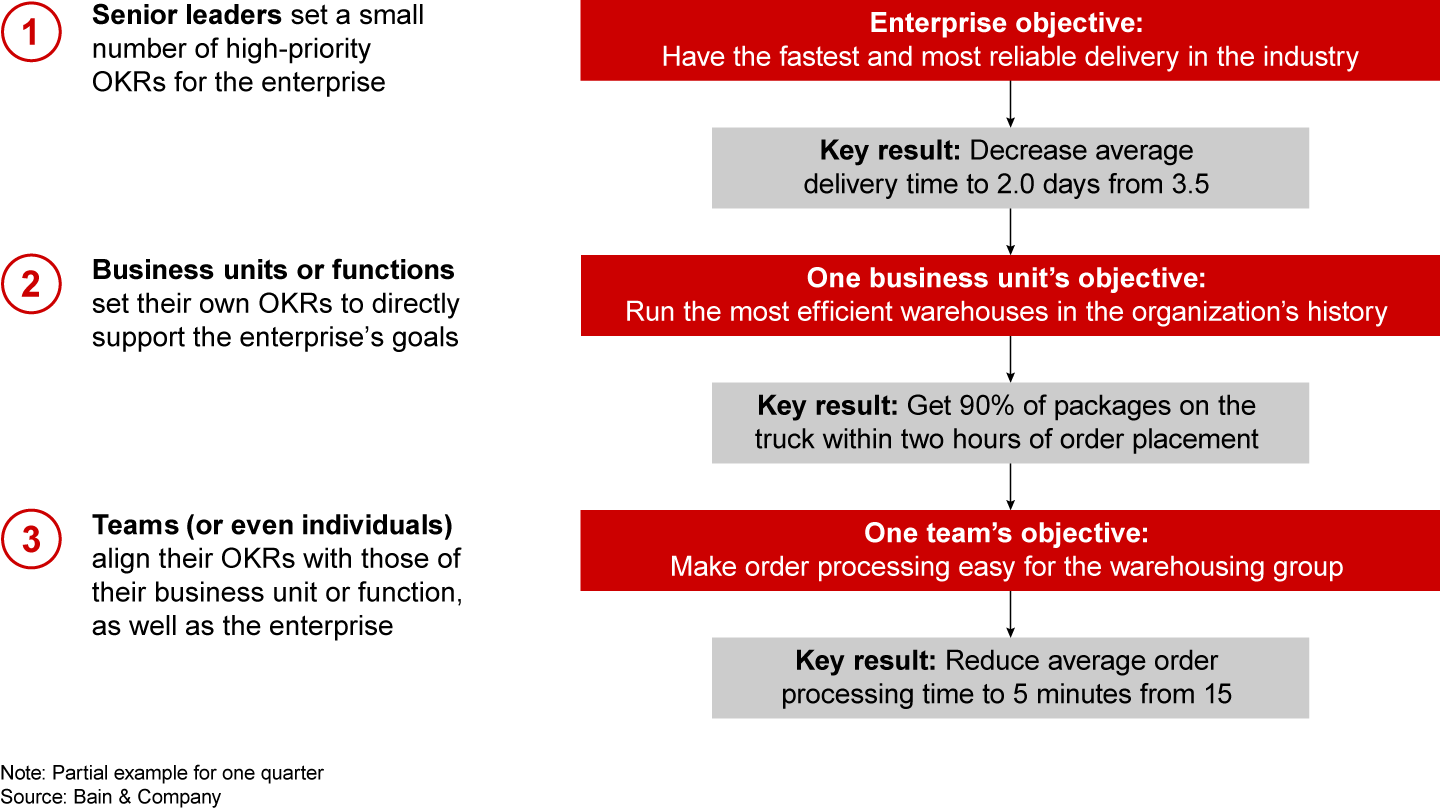

OKRs help to create such a management system. A company’s most senior executives define a small number of objectives that articulate the overall strategic goals for the company. They allocate funds not as one lump sum to a corporate function or a large project of fixed scope, but based on achieving the next quarter’s key results. Business reviews, whether done quarterly or on a different cadence, focus on quantitative key results that clearly measure business value delivered, helping executives make the right decisions faster. By contrast, traditional status reports and work plans often have little connection to broader corporate strategy.
OKRs are part of the approach being taken by Telia Company, a telecommunications and media enterprise operating in the Nordics and Baltics, as it rolls out an end-to-end integrated management system. The system builds on the Scaled Agile Framework for managing Agile teams at scale. Telia’s group strategy is broken down into strategic themes, with each theme tied to OKRs. Those OKRs are then executed through a portfolio of initiatives that are fully integrated into the financial and operational plans for all markets and functions.
2. How are OKRs set and measured?
As the operational owners of the process, OKR champions get feedback from relevant team members on which OKRs should be put in place, and they later facilitate and participate in reviews, including collecting input from team members on progress made on those OKRs. That feedback in turn informs discussions with relevant leaders on the implications for their teams’ work, and which future OKRs to put in place.
When setting and measuring OKRs, there are a few things any organization needs to decide:
- How often OKRs will be set and reviewed. This depends on the pace of change in the business. Google, for example, sets and reviews its key results quarterly, but objectives can remain stable for much longer. When setting OKRs, Google ensures that the key results together cover every element necessary to achieve an objective and that key results are reasonably similar in importance and value, to incentivize the right behavior.
- How deep to go. Another question is whether to focus on strategic themes at the enterprise, unit/function, team, or individual level. This depends on the size of your business and the trade-off with administrative effort you would need to make. Google’s original OKRs applied all the way down to individual employees and were visible on each person’s intranet profile. But in many parts of the company, managers have since stepped back from this practice, stopping at the team level or higher, as most companies do.
- How ambitious to be. Companies must decide whether to set OKRs based on what they expect to achieve or to incentivize exceeding expectations. This depends on the type of activity underlying the OKR and how certain its outcome is. Like most companies, Google uses both “committed OKRs” and “aspirational OKRs.” At Google, it’s expected that committed OKRs will be fully achieved, while aspirational OKRs have a higher variance and meet their goals closer to 70% of the time.
- What the implications of an OKR review should be. Organizations also need to consider whether resourcing and budgeting, or even employee compensation, will be affected. This depends on your comfort with the trade-offs involved: staying dynamic vs. giving ownership to individual functions, and, in the case of compensation, strengthening incentives vs. increasing the risk of skewed OKR setting or reporting. Google is one of the many companies that adjust funding and human resource allocation based on OKR progress and changing priorities. Tying compensation directly to OKRs generally is not recommended, however, as it could incentivize the wrong behavior and imperil the original intention: to align on the right activities and level of ambition and provide an accurate, transparent view of progress to act on and learn from.
3. What’s the difference between OKRs and KPIs?
OKRs and KPIs (key performance indicators) are important tools that complement one another with notable differences. KPIs change infrequently and measure static performance outcomes, whereas OKRs are more dynamic and can change each quarter. Although both KPIs and OKRs flow from top management, OKRs also incorporate significant frontline input. And while KPIs tend to be about keeping the business on track, OKRs are more often used for innovation, growth, and true transformation.
For airlines, departure punctuality and passenger load factor are two common KPIs. When the pandemic struck, American Airlines set a new OKR with the objective of providing a completely touchless check-in experience that would encourage customers to travel. Two of the key results the airline pursued were a 25% increase in self-check-ins begun with a boarding pass scan in the terminal and a 25% increase in prepaid luggage bookings via its mobile app. Results far exceeded these goals, with boarding pass scans rising 145% and prepaid luggage bookings up 57%.
Note that KPIs can, in certain circumstances, influence or even become OKRs—and vice versa. For example, if an airline suffered a drop in its departure punctuality KPI, it could set an OKR with the objective of being the carrier with the best record of timely takeoffs. The corresponding key results for the next quarter might be cabin cleaning in under 10 minutes or 95% of passengers scanning their own boarding pass. Conversely, the boarding-pass-scanning key results could become such an important predictor of overall customer satisfaction that executives would choose to make it a standing KPI going forward.
4. Will adopting OKRs require new tools?
Excel is often used for a first OKR deployment when technical requirements are comparatively low. More specialized tools list the OKRs, track progress scores and verbatims, and calculate averages of these scores, offering a visual indication of progress. Any tool should be accessible and editable by many people and serve as a single, reliable source of truth for the organization.
For large-scale adoption, more advanced software solutions are important. Some companies build their own, but a number of vendors have launched products with a much better user experience than Excel and native integrations with other software—for example, allowing a window-in-window view of OKR status in Microsoft Teams conversations for day-to-day transparency. WorkBoard, Betterworks, Gtmhub, and Ally.io all make OKR software, and companies that sell task management software, including Jira Align and Asana, have also begun to add OKR functionality.
Enterprise software provider VMware considered building its own solution but ultimately chose WorkBoard over nine others based on three strengths: its ability to be a consultative, strategic partner in designing VMware’s future; its strong platform features, capabilities, integration, and automation; and its information security and accessibility, which would promote transparency across the broader organization.
Though it’s still early in the implementation, managers report that their team members have a high level of clarity, greater focus on what’s important this quarter, and a strong understanding of how their day-to-day work contributes to the company’s broader priorities, strategy, and vision. One team, for example, has reduced the number of tools it uses by 50%, instead tapping WorkBoard to help complete projects with a measurable impact on the business, while becoming more proactive and working better as a global, distributed team.
While it’s important to choose a good OKR tool that fits your situation, in the end, successfully implementing it depends on sufficient leadership commitment and a culture focused on outcomes over process.
5. How do we get started?
OKRs can be created for any part of an organization, but they tend to be most valuable to dynamic work focused on change, improvement, and innovation. Chances are, somebody at your company is already using OKRs. A good place to start is by asking where they’ve seen the most value, what challenges they anticipate ahead, and the next steps they would recommend.
Then, consider which deployment approach is the best fit for you. Should it be staged or a big bang?
Staged starts in one function—often technology or product management—and gradually extends into other areas of the business. This approach is most appropriate when an organization is receptive to the idea of OKRs but unclear on how to use them, or if certain areas will benefit more than others. It is the sensible choice for most large companies. For smaller organizations in which leadership knows exactly how OKRs should be applied and the culture is receptive to them, a big-bang rollout to the entire company may be more appropriate.
A staged approach can come as a push from top management or as a pull requested by certain parts of the business. Pulls work best when resistance is anticipated, and early success stories and a clear OKR playbook will be critical to broader adoption.
With notably fewer than 10,000 employees, Middle Eastern online marketplace Noon is a smaller company that has taken an “almost big-bang” push approach, following one quick pilot with selected top-level leaders. Setting this up took about eight weeks, during which the guiding principles and governance were defined, the tool selected, communication and training arranged, and the first set of OKRs drafted.
***
From Noon to Google, OKRs have proven their worth and become commonplace in many companies. Others are only beginning to apply them. When OKR introductions fall short, it’s most often because they were tried here or there in an organization without the full commitment of the management team or suitable coaching. Done right, OKRs are a powerful way to help organizations focus on their most important goals and quickly adapt when circumstances change.
First published in 5月 2022