

論説

At a Glance
- There’s a correlation between businesses that outperform and highly effective executive teams, Bain research has found.
- Yet only one in five executive teams is high-performing.
- The most effective teams develop and demonstrate five key behaviors: direction, discipline, collaboration, dynamism, and drive.
Effective leadership teams outperform even the most effective individual leaders. Every time. In almost every context. A Bain study of 1,250 companies found a correlation between business performance leaders—companies that beat their competition in revenue growth, profitability, and total shareholder return—and highly effective top teams.
What do these high-performing top teams have in common? Not the things companies have traditionally focused on like cultivating highly talented individuals with deep expertise and all the right experiences. It’s not even the individual leader’s ability to lead others. What makes the biggest difference is a top team’s ability to act—to behave—as a collective.

Leadership Team Effectiveness
An organization is only as successful as the team leading it. Backed by behavioral science, our Top Team Journey solution helps executive teams diagnose and develop their effectiveness and improve their ability to meet strategic goals.
Insights from data gathered by Bain from hundreds of top teams across 11 industries and three global regions show that the most effective leadership teams demonstrate five observable behaviors: direction— they align on strategy; discipline—they make and execute decisions consistently and have productive meetings; collaboration—they build trust, intentionally solve problems and brainstorm together, and hold each other accountable; dynamism—they prepare for and lead change; and drive—they’re industrious and resilient. The adverse conditions of Covid‒19 particularly called on drive, demonstrating new levels of hard work and perseverance. These behaviors are here to stay.
Top teams that prioritize learning and practice these collective behaviors are the most effective, but a surprising percentage of top teams struggle to work together well. Sixty-five percent of senior executives surveyed by the Center for Creative Leadership in 2020 described their leadership team as ineffective, and only roughly one in five find their executive teams to be high-performing.
The root causes of this underperformance are typically the ways the teams behave as a group, including common shortcomings on the five key collective behaviors (see Figure 1).
Figure 1
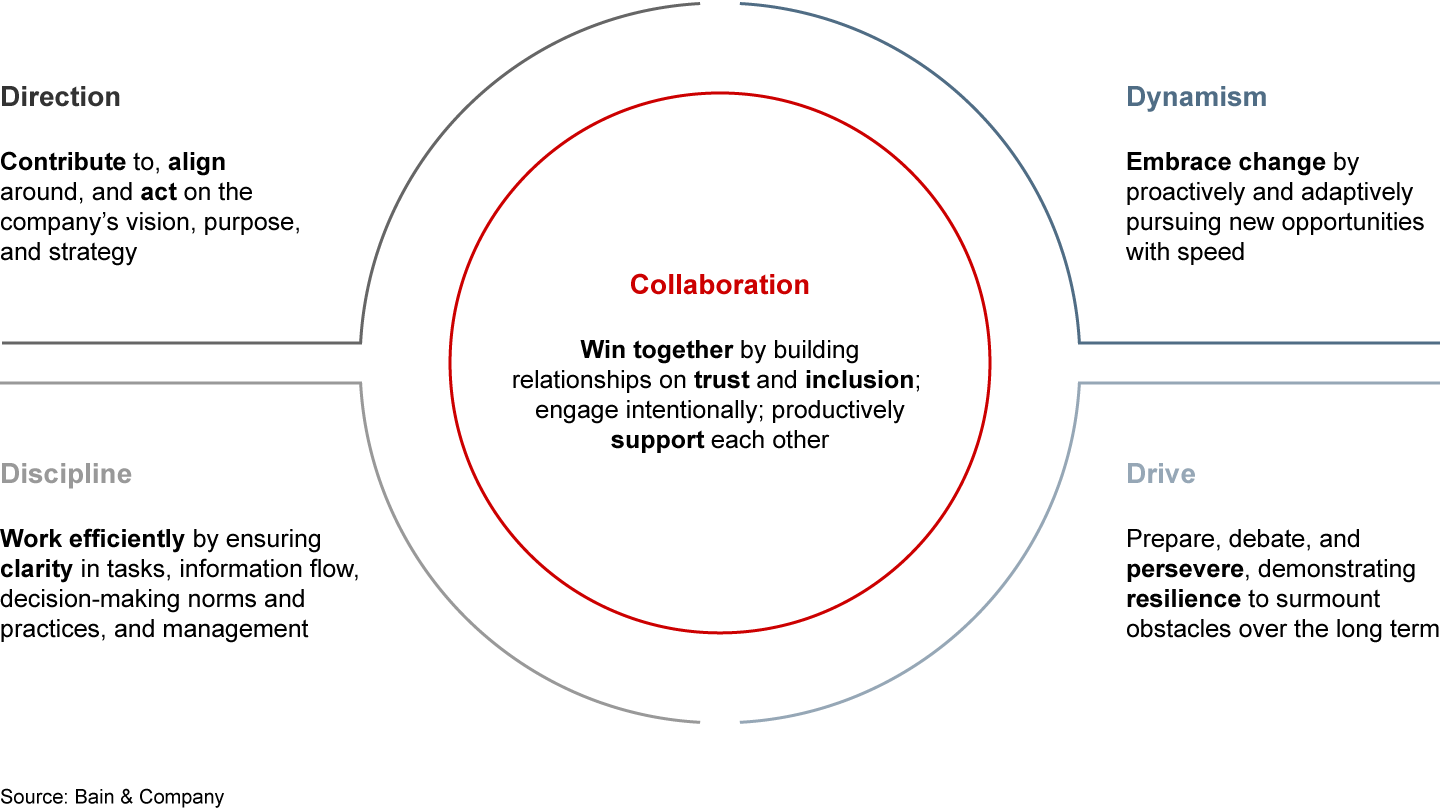
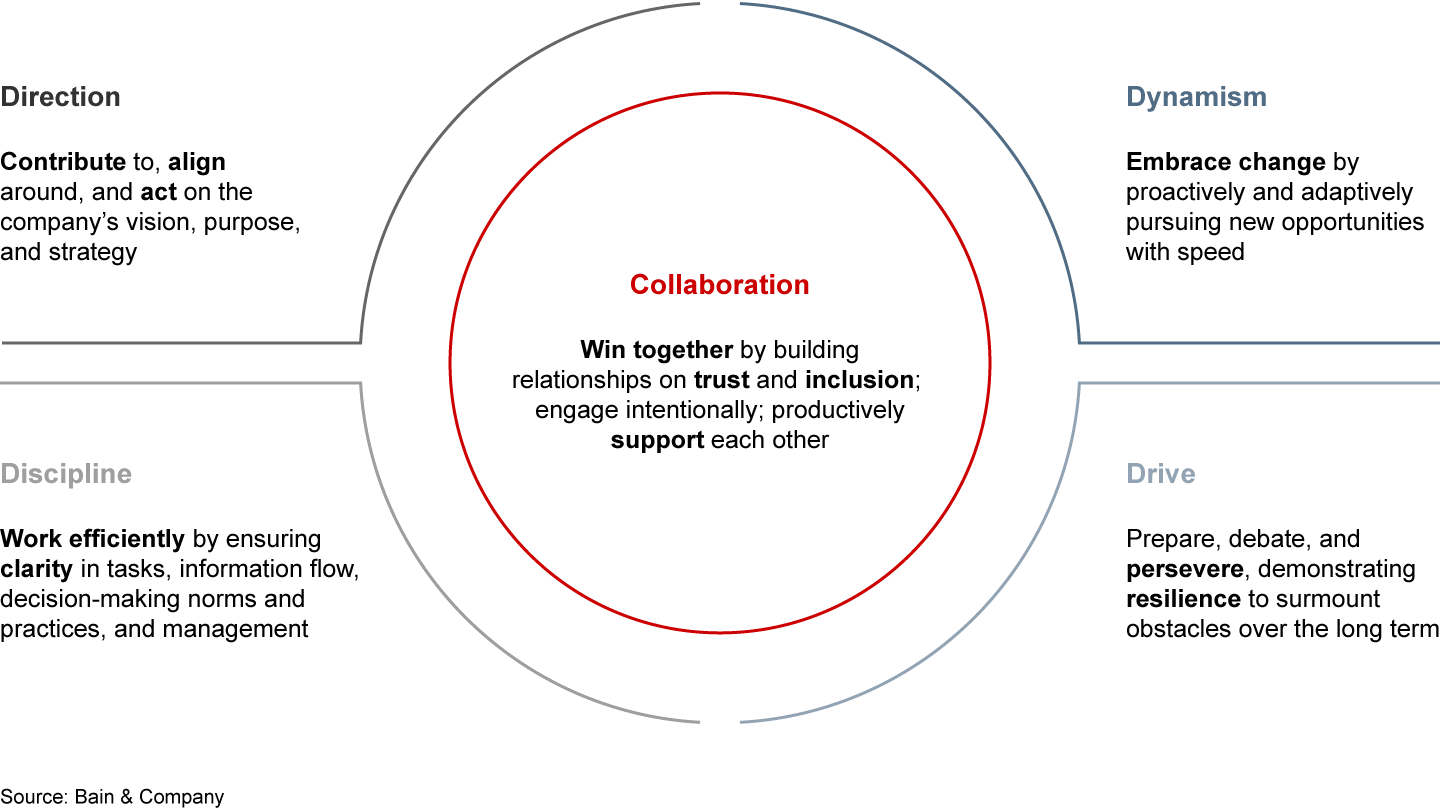
Teams generally are the locus of performance and culture in all organizations, and top teams are uniquely positioned to be a role model for how teams can work well together. Without team effectiveness, companies won’t achieve their full potential results.
Collaboration
Collaborative behaviors are the essence of teaming. A lack of collaboration leads to ineffective interaction and teams that may resemble a cage match or a morgue. But a highly collaborative team is a crucible of effective focus, energy, execution, and accountability. Teams that value collaboration share a “win-together, lose-together” attitude. They’re grounded in personal and working relationships that help trust take root. They practice inclusion. As a result, they establish the psychological safety necessary to innovate, fail, and give and receive feedback along the way. A global restaurant chain’s leadership helped build its collaboration and overcome a lack of personal relationships by organizing quarterly market visits in which leaders traveled as a group, met with franchisees, and had planned one-on-one time together.
Direction
A top team shares and holds to a common direction by contributing to and aligning around its organization’s vision, purpose, and strategy. Together, team members author the company’s vision, purpose, and strategy, then share with one another how they’ve translated them into short- and long-term priorities for their respective parts of the business. They demonstrate commitment: team members unite around and stand by the strategy when under pressure from outside the team. They prioritize and defend the greater good inherent in it over individual or other interests, something that can help prevent silos from forming.
Breakdowns in direction can take different forms. The top team leading a multibillion multinational publishing company, for example, understood the company’s strategy and, when in group settings, gave the appearance of agreeing with it. But the CEO felt something was awry. Deeper investigation revealed that a number of team members actually did not concur with the strategic direction, and some resented that the CEO, CFO, and COO created the strategy and simply informed the remaining members after the fact. In response, the CEO called an emergency offsite to invite everyone to contribute, building not only strategic alignment, but true buy-in and a new sense of cohesion.
By contrast, the members of the executive team of the global restaurant chain did agree with the company’s high-level strategy but struggled to understand how to execute it outside their own silos. They formed a sprint team designed to help members better understand their peers’ respective strategies and objectives. They interviewed each leader, translated each one’s specific strategies and objectives into a common template, and shared it in a team session. This deepened their mutual understanding and immediately illuminated opportunities to help one another.
Discipline
Efficient meetings and good decision-making practices are important aspects of the discipline many teams need to better develop. Without them, decisions are made inconsistently, meetings are unproductive, and efforts that require attention to detail—like planning, monitoring, and execution—are shortchanged.
Teams must create and organize the space, time, and flexibility to be productive. Meetings should be the locus of productivity, but teams often don’t give them the rigor of preparation, conduct, and follow-through they are due. The behaviors that lead to well-structured and well-run meetings also support other valuable behaviors, including collaboration. By contrast, poorly run meetings can have a negative domino effect, like lack of participation, disengagement, and retreat to silos.
When the executive team leading a $10 billion heavy equipment company needed to strategically move away from selling internal combustion trucks and buses to electric vehicles and associated services such as leasing, charging, and maintenance contracts, a new level of cross-organization collaboration was critical—and simply not happening. One cause was the nature and frequency of the top team’s meetings. After increasing the frequency of their regular meetings, shifting the agenda to more forward-looking “change-the-business” strategic topics, and creating a smaller operating committee to get the right people discussing “run the business” topics, the team found the right rhythm and started making decisions more efficiently and effectively. Months later, the CEO and team drew a clear correlation between the improved alignment, focus, and energy they all unlocked during their meetings and the business’s subsequent progress toward its financial expectations.
Too often, the purpose and role of the top team is unclear. Members may not understand one another’s roles either—what they do, how they get it done, and the unrealized interdependencies between them. This was the issue faced by the members of the leadership team running a global practice in a large professional services firm. So, its leader called a four-hour session on “role clarity” that uncovered both fault lines and opportunities for cross-pollination among regions, products, and clients.
Dynamism
Teams that treat change as a constant and understand how to behave together are dynamic in the face of both opportunities and challenges. They continuously seek and engage with information from channels outside and inside their organization. They also create the conditions for innovation by investing in it, securing resources, and setting expectations, compensation, and incentives that allow for failure. The top team of the global restaurant chain had struggled so much with innovation, it had resorted to outsourcing the topic to others. However, after studying the behaviors that support team innovation, such as allocating time and resources to design thinking and explicitly permitting failing fast, it introduced a mandatory “Innovation Hour” into the monthly half-day meeting. In its first session, the team identified a product innovation previously confined to one market that could be adapted and offered to restaurant customers around the world.
A bias for action enables a team to respond with speed and deliberation to new scenarios by modifying plans and executing accordingly. Another overlooked behavior is intentional learning from both success and mistakes. Most teams avoid practicing that, but the leadership team of a talent center of excellence serving a workforce of 80,000 embraces it, spending 15 minutes of its monthly meeting agenda studying the “Failure of the Month.”
Drive
Covid-19 showed that teams that sustain their drive over the long term help their organizations not only to survive, but to thrive. They prepare for potential setbacks and are industrious—focused, diligent, detail-oriented. They embrace the creative friction that comes from constructive debate, especially when under pressure, and follow a process to resolve conflict. By reiterating and recommitting to their goals, members help one another maintain focus and persevere. A focus on problem solving and innovation helps them face difficulties head-on with confidence and optimism.
Conclusion
By virtue of their unique characteristics and apex position, top teams are force multipliers. When they address their behavior gaps, these teams don’t just build their own effectiveness, they set an example that, when emulated throughout their organization, can be revolutionary.
Every top team comprises individuals who are oriented differently in how they think, feel, and behave, so building an effective team requires intentional, targeted, collective development over time. Teams can accomplish this only by habitually carving out developmental periods during which they can build specific behaviors and skills, setting times and locations (virtual and physical) when all members convene to learn, like the Innovation Hour or Failure of the Month.
In these settings, teams develop strong collective behaviors by simulating real situations and practicing skills, such as constructive debate or problem solving, and providing feedback to one another. Once teams have developed these kinds of strong collective behaviors, they can build the kind of role clarity, division of duties, delegation, and strong decision making that are the hallmarks of well-functioning teams. Without them, teamwork at the top feels—and is—hard.
Too many teams make the mistake of participating in one working session, generating insights and energy for more work together, only to lose momentum. The teams that get good results faster prioritize specific behaviors they want to develop and concentrate on incrementally changing them over an extended period of time. Sometimes it’s months; sometimes it’s years, but they commit to taking the journey together.
First published in 7月 2023