

論説

概要
- Companies in the energy and natural resource sectors face unique challenges attracting and retaining top talent. Working toward gender parity can help them meet their workforce goals.
- One way to increase gender diversity is to increase the hiring pool by looking beyond disciplines such as engineering, and considering candidates from other industries.
- These companies should also rethink their traditional paths to promotion, which typically place a premium on hardship and international rotations—which can be difficult for employees in dual-income families.
- Most important, building a more inclusive organization creates an environment where women can thrive and succeed, one in which they would actively encourage and nurture participation by other women.
(While this brief focuses on gender parity for energy and natural resource (ENR) companies, we discuss measures that can improve diversity in many ways. For more, see the Bain Brief “10 Proven Actions to Advance Diversity, Equity, and Inclusion.”)
For companies in the energy and natural resource sectors, finding and retaining more talented women is more than a matter of social responsibility. These companies face existential talent challenges that could impair their ability to manage through the critical changes affecting their industries today, such as the energy transition and the shift toward more circular and sustainable systems. Failing to attract and retain women inhibits their ability to benefit from more diverse ideas and thinking. Gender-diverse teams have been shown to be more effective in solving complex problems and improving overall business performance—both of which are becoming increasingly important as companies adapt to new demands.
Building a diverse and capable workforce may be particularly difficult for companies in the energy and natural resource sectors because of a few structural challenges.
- The Great Retirement. These industries are midway through a massive retirement that will clear the ranks of many experienced professionals who have guided their success over the past three decades. In power generation, for example, nearly a quarter of utilities employees are set to retire over the next five years.
- Declining appeal of the sector. Many talented young people expect to have a personal impact on the environmental and sustainability issues facing our world today, which can appear at odds with some career paths in the sector. This shrinks the talent pool that ENR companies can draw upon to replace those leaving in the Great Retirement.
- A less diverse starting point. These industries have historically struggled to increase gender diversity in their frontline and executive ranks, and often lack the visible senior representation, sponsorship, and mentorship motions and inclusive culture needed to attract and retain women.
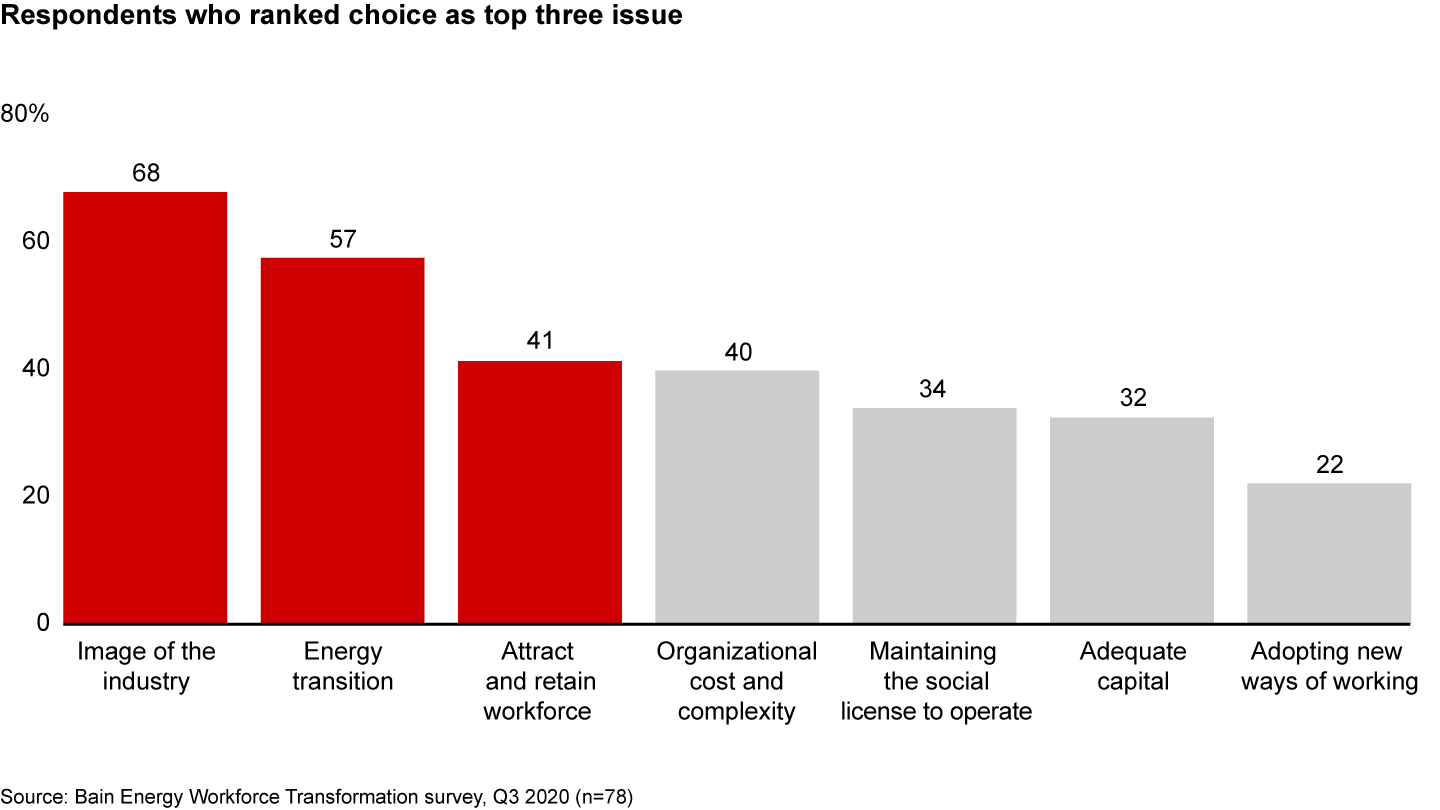
The difficulty isn’t lost on executive teams who, in a 2020 survey, recognized that the ability to attract and retain their workforce is one of the top challenges they face over the next decade (see Figure 1).
Figure 1

Increasing gender diversity, in particular, won’t be easy. Structural factors perpetuate systems that limit the number of women promoted onto senior executive teams, especially in critical profit-and-loss ownership roles. For example, oil and gas companies typically place greater value on experience in operational and engineering roles, areas that tend to have lower female representation and have less inclusive working environments. Achieving gender parity in these sectors will require questioning long-held beliefs and ways of working, although some things can be put into action quickly to start making a difference.
And while the energy and natural resource sector may lag others in gender diversity, its talent record inspires confidence in its ability to adapt quickly to new conditions and major shifts, many of which have required extensive overhauls of the workforce. Companies that are ready and able to make meaningful changes are more likely to succeed in their efforts to increase workforce diversity.
ENR’s unique gender diversity challenges
The challenges faced by energy and natural resource companies begin with recruitment and are then reinforced in retention and promotion processes that lead many women to switch to other industries or languish in lower and midlevel positions. For example, a 2018 report found that only 15% of the total oil and gas workforce were women, and only half that many were in more senior technical or leadership roles.
Challenges in recruiting new talent. The traditional approach to hiring new talent in energy and natural resource companies is to target engineers for many roles, including entry level and more senior positions. Here’s where the math gets tricky: Women account for less than 30% of the science, technology, engineering, and math (STEM) labor force in the US and about 15% of engineers. At the same time, many energy and natural resource companies want to recruit more women, indicating greater demand for female engineers—but with no new talent pipeline. Reaching gender parity, if continuing to pull from that same talent pool, would require growing the percentage of women in engineering by three times, which is orders of magnitude above what has been accomplished over the past few decades.
Given this, companies will need to do more, including looking at talent pools beyond engineering and finding ways to encourage more women to enter STEM fields. While some roles need specific STEM backgrounds, the gender diversity challenge is exacerbated by the tendency to fill even nonengineering roles, such as sales, marketing, and managerial positions, with engineers.
Challenges in retention and promotion. Recruitment alone will not achieve gender parity without addressing retention and promotion. People leave their jobs for many reasons, but two of the top three—not seeing opportunities for promotion or growth, and being offered a better, higher-paying role—relate to promotion and recognition. So how can companies increase promotion rates for women?
First, it’s important to note that talent pipeline issues tend to get reinforced through promotion processes. Traditional paths to leadership often place a premium on roles where women are underrepresented or where it’s difficult to participate as a member of a dual-income family. (While not a rule, women who work outside the home are more likely to be part of a dual-income family than men, and the career demands of male partners in heterosexual couples are more likely to be put ahead of those of the woman.) Notably, energy and natural resource companies often require operations roles as a path to senior positions—even those that may not require it. These senior management roles are filled only from the same small portion of women already in engineering and similar roles.
Some companies, especially in mining and oil and gas, have required a hardship rotation—that is, working several years in a challenging environment—to achieve leadership positions. Others have expected work experience across regions, something that requires uprooting and moving families, which is usually harder for dual-income families, and therefore disproportionately limiting for women’s career progressions.
Other hurdles to promotion can include demands for working long hours on call or overnight shifts to monitor plant operations, both of which tend to impede women more than men. Research continues to show that women remain responsible for more tasks at home than men, even when they earn more than their spouses. This makes these types of demands much more difficult for women, leading some to step away from promotion tracks or from the workforce altogether.
Despite this history of structural barriers, some energy and natural resource companies are finding ways to remove barriers and get women into senior roles. Newer functions like sustainability, new ventures, and specific strategic initiatives—areas that lack existing talent pipelines—are becoming important areas for increasing diversity among senior management. The evolving nature of these roles allows more critical thinking about the role, the capabilities required, and the definition of success. The rise of women executives in these roles shows that women are interested in solving a company’s emerging issues and that when companies release their historical constraints about who gets senior roles, they can successfully recruit and retain senior executive women.
Promoting meaningful change, starting now
While ENR companies are starting from behind, some bright spots and early wins are emerging. One theme common to companies seeing success: Gender diversity cannot be improved as a side project or something relegated to human resources alone. Companies can’t mentor or coffee chat their way to success. Business executives and frontline leaders must see this as a critical part of running the business—arguably, talent strategy is the essence of how a company performs—and take ownership beyond a figurehead sponsor role. The good news: Bain research finds that while only about one in five men say they are engaged in gender parity efforts at their organization, nearly three-quarters of men say they would like to be more involved. Successful companies make this a critical part of every leader’s role (see the Bain Brief “Racial Equity Begins with C-Suite Accountability.”)
Recruiting: Expand the talent pipeline. Successful companies take some form of these three actions to increase their chances for successful recruitment.
- Diversify the hiring pool. Look beyond the STEM talent pool to other business functions, such as marketing and sales, along with other liberal arts disciplines. For midlevel and executive hiring, consider generalists—high-performing executive candidates, sometimes from other industries. These new hires can always receive industry-focused training in their new roles.
Many of these roles are hired through external recruiters who look for candidates like those that have succeeded in the past—mostly men with industry experience. In general, be open to more external hiring, but make sure recruiters broaden their horizons. When a strategy role opens up, consider hiring a great strategist from another company or industry rather than pulling someone into that role from a technical field. - Take a skills-first approach. Hire based on capabilities, not the résumé. When given diversity targets and a wider aperture for success, recruiters can rise to the challenge. Rewrite job descriptions, start demanding more gender-diverse candidate slates, and ask recruiters to track and report their progress. A large international energy company has worked to increase diversity, reevaluating job descriptions to remove requirements that weren’t actually critical—for example, considering skills developed in other industries, recruiting at more schools, and considering a wider set of degree majors (see the Bain Brief “Focus on Skills to Hire the Best—and Most Diverse—Talent”).
- Develop the talent pipeline. Establishing STEM educational or internship programs is more of a long game, but it has succeeded in some cases. Wipro and Tata Consultancy Services, for example, have each found ways to develop STEM pipelines to address talent shortages in the business services industry in India. While most ENR companies won’t go as far as setting up their own engineering schools, the initiatives show the lengths that some firms will go to in order to expand the talent pool.
Business executives and frontline leaders must see this as a critical part of running the business and take ownership beyond a figurehead sponsor role.
Retention and promotion: Extend diversity into and across the organization. First, support the women you have with sponsorship. Women often have mentors, but sponsors can be more valuable and harder to find. Where mentors might coach on how to navigate an organization’s structural challenges, sponsors are senior leaders who advocate for women to their peers and superiors to ensure they have the right opportunities to get a promotion. Does every woman of a certain tenure in your organization have a sponsor? Does that sponsor routinely identify ways she can get new skills or experience that position her better for promotion? Do they speak up when bias arises in talent and promotion conversations when no women are present—or even when they are? While some system-wide solutions do work (some of these are below), individualized support to guide and drive progression is critical (see the Bain Brief “10 Proven Actions to Advance Diversity, Equity, and Inclusion”).
When doing this, it’s also important to ensure leaders are not making assumptions about women that could harm their opportunities for advancement—for example, assuming a woman wouldn’t relocate to take a senior international role. While these roles won’t work for every woman, they also don’t work for every man. Women should have the same opportunity and access as men with similar qualifications.
Some companies are going further, mandating balanced candidate slates for every senior-level position, with an equal number of qualified men and women interviewed for every role. By showcasing talented women within and outside of the company, this has led to more women in leadership. Some companies have also moved to an opt-out system for consideration in promotions, rather than opting in, since women tend to be less likely to nominate themselves. This simple change also helps create more balanced candidate slates.
Once you have an equal slate, it’s critical to have checks and balances in the debriefing and decision conversations that follow interviews. One way to do this is to ensure there’s a neutral party present for these discussions, someone whose task is to call out any potential bias they hear. Tracking talent pipeline data at every stage of decisions also helps. Investing in unconscious bias training for leadership can also be an important step to help everyone identify biases and develop the skills to mitigate them.
Build an inclusive organization. Employees need to feel included to thrive in the workplace and bring their best to work each and every day. An inclusive organization is one that creates connections within and across lines of difference, engages and recognizes people for their contributions and for who they are at and outside of work, and prioritizes transparency and trust in talent management practices. In addition to organization-wide inclusion training, some companies have experimented with ways to bring inclusion into their daily interactions, such as expanding the safety moment at the start of each meeting to include diversity, equity, and inclusion.
Measurement: Track progress and ensure accountability. As with everything in business, you can’t expect what you don’t inspect. That goes for diversity, too. Companies that track, measure, and report publicly are the ones with the greatest incentive to make progress. Measurement and transparency are key, even if the initial findings aren’t what you aspire to. In addition to the obvious outcome metrics around female representation across functions and levels of seniority, consider leading indicators like employee advocacy, supported by tools like employee Net Promoter Score℠ (eNPS), which measures how willing one would be to recommend a job at the company to a friend of the same gender. These tools can also help dig into root causes.
Improving gender diversity is about pointing proven operational skills at a stubborn problem, coupled with a cultural shift starting at the top. Companies in energy and natural resource industries are adept at training people, building and enforcing good processes, and driving operational initiatives, such as safety, into day-to-day culture. Their record of success and their disciplined approach to challenges bodes well for their ability to solve big problems and address gender equity head on.
But gender diversity has been on the agenda of energy and natural resource companies for over a decade, and the industry is still far from achieving parity. Creating real change will require making choices that buck traditional approaches to hiring, talent development, and promotion, and reexamining assumptions.
For those willing to try bold approaches, the payoff could be enormous: a renewed ability to find, hire, and hold onto the right talented people who can provide the diverse thinking that will help their companies survive and thrive through the Energy Transition.
First published in 2月 2022