
Skip to Content
  • オフィス

    オフィス

    北米・南米
    • Atlanta
    • Austin
    • Bogota
    • Boston
    • Buenos Aires
    • Chicago
    • Dallas
    • Denver
    • Houston
    • Los Angeles
    • Mexico City
    • Minneapolis
    • Monterrey
    • Montreal
    • New York
    • Rio de Janeiro
    • San Francisco
    • Santiago
    • São Paulo
    • Seattle
    • Silicon Valley
    • Toronto
    • Washington, DC
    ヨーロッパ・中東・アフリカ
    • Amsterdam
    • Athens
    • Berlin
    • Brussels
    • Copenhagen
    • Doha
    • Dubai
    • Dusseldorf
    • Frankfurt
    • Helsinki
    • Istanbul
    • Johannesburg
    • Kyiv
    • Lisbon
    • London
    • Madrid
    • Milan
    • Munich
    • Oslo
    • Paris
    • Riyadh
    • Rome
    • Stockholm
    • Vienna
    • Warsaw
    • Zurich
    アジア・オーストラリア
    • Bangkok
    • Beijing
    • Bengaluru
    • Brisbane
    • Ho Chi Minh City
    • Hong Kong
    • Jakarta
    • Kuala Lumpur
    • Manila
    • Melbourne
    • Mumbai
    • New Delhi
    • Perth
    • Shanghai
    • Singapore
    • Sydney
    • Tokyo
    全てのオフィス
  • アルムナイ
  • メディア
  • お問い合わせ
  • 東京オフィス
  • Japan | 日本語

    地域と言語を選択

    グローバル
    • Global (English)
    北米・南米
    • Brazil (Português)
    • Argentina (Español)
    • Canada (Français)
    • Chile (Español)
    • Colombia (Español)
    ヨーロッパ・中東・アフリカ
    • France (Français)
    • DACH Region (Deutsch)
    • Italy (Italiano)
    • Spain (Español)
    • Greece (Elliniká)
    アジア・オーストラリア
    • China (中文版)
    • Korea (한국어)
    • Japan (日本語)
  • Saved items (0)
    Saved items (0)

    You have no saved items.

    後で閲読、共有できるようにするためにブックマークしてください

    Explore Bain Insights
  • 業界別プラクティス
    メインメニュー

    業界別プラクティス

    • 航空宇宙、防衛、政府関連
    • 農業
    • 化学製品
    • インフラ、建設
    • 消費財
    • 金融サービス
    • ヘルスケア
    • 産業機械、設備
    • メディア、エンターテインメント
    • 金属
    • 採掘・鉱業
    • 石油、ガス
    • 紙、パッケージ
    • プライベートエクイティ
    • 公共、社会セクター
    • 小売
    • テクノロジー
    • 通信
    • 交通
    • 観光産業
    • 公益事業、再生可能エネルギー
  • 機能別プラクティス
    メインメニュー

    機能別プラクティス

    • カスタマー・エクスペリエンス
    • サステイナビリティ、 社会貢献
    • Innovation
    • 企業買収、合併 (M&A)
    • オペレーション
    • 組織
    • プライベートエクイティ
    • マーケティング・営業
    • 戦略
    • アドバンスド・アナリティクス
    • Technology
    • フルポテンシャル・トランスフォーメーション
  • Digital
  • 知見/レポート
  • ベイン・アンド・カンパニーについて
    メインメニュー

    ベイン・アンド・カンパニーについて

    • ベインの信条
    • 活動内容
    • 社員とリーダーシップ
    • プレス・メディア情報
    • クライアントの結果
    • 受賞歴
    • パートナーシップを結んでいる団体
    Further: Our global responsibility
    • ダイバーシティ
    • 社会貢献
    • サステイナビリティへの取り組み
    • 世界経済フォーラム(WEF)
    Learn more about Further
  • キャリア
    メインメニュー

    キャリア

    • ベインで働く
      キャリア
      ベインで働く
      • Find Your Place
      • ベインで活躍する機会
      • ベインのチーム体制
      • 学生向けページ
      • インターンシップ
      • 採用イベント
    • ベインでの体験
      キャリア
      ベインでの体験
      • キャリアストーリー
      • 社員紹介
      • Where We Work
      • 成長を後押しするサポート体制
      • アフィニティ・グループ
      • 福利厚生
    • Impact Stories
    • 採用情報
      キャリア
      採用情報
      • 採用プロセス
      • 面接内容
    FIND JOBS
  • オフィス
    メインメニュー

    オフィス

    • 北米・南米
      オフィス
      北米・南米
      • Atlanta
      • Austin
      • Bogota
      • Boston
      • Buenos Aires
      • Chicago
      • Dallas
      • Denver
      • Houston
      • Los Angeles
      • Mexico City
      • Minneapolis
      • Monterrey
      • Montreal
      • New York
      • Rio de Janeiro
      • San Francisco
      • Santiago
      • São Paulo
      • Seattle
      • Silicon Valley
      • Toronto
      • Washington, DC
    • ヨーロッパ・中東・アフリカ
      オフィス
      ヨーロッパ・中東・アフリカ
      • Amsterdam
      • Athens
      • Berlin
      • Brussels
      • Copenhagen
      • Doha
      • Dubai
      • Dusseldorf
      • Frankfurt
      • Helsinki
      • Istanbul
      • Johannesburg
      • Kyiv
      • Lisbon
      • London
      • Madrid
      • Milan
      • Munich
      • Oslo
      • Paris
      • Riyadh
      • Rome
      • Stockholm
      • Vienna
      • Warsaw
      • Zurich
    • アジア・オーストラリア
      オフィス
      アジア・オーストラリア
      • Bangkok
      • Beijing
      • Bengaluru
      • Brisbane
      • Ho Chi Minh City
      • Hong Kong
      • Jakarta
      • Kuala Lumpur
      • Manila
      • Melbourne
      • Mumbai
      • New Delhi
      • Perth
      • Shanghai
      • Singapore
      • Sydney
      • Tokyo
    全てのオフィス
  • アルムナイ
  • メディア
  • お問い合わせ
  • 東京オフィス
  • Japan | 日本語
    メインメニュー

    地域と言語を選択

    • グローバル
      地域と言語を選択
      グローバル
      • Global (English)
    • 北米・南米
      地域と言語を選択
      北米・南米
      • Brazil (Português)
      • Argentina (Español)
      • Canada (Français)
      • Chile (Español)
      • Colombia (Español)
    • ヨーロッパ・中東・アフリカ
      地域と言語を選択
      ヨーロッパ・中東・アフリカ
      • France (Français)
      • DACH Region (Deutsch)
      • Italy (Italiano)
      • Spain (Español)
      • Greece (Elliniká)
    • アジア・オーストラリア
      地域と言語を選択
      アジア・オーストラリア
      • China (中文版)
      • Korea (한국어)
      • Japan (日本語)
  • Saved items  (0)
    メインメニュー
    Saved items (0)

    You have no saved items.

    後で閲読、共有できるようにするためにブックマークしてください

    Explore Bain Insights
  • 業界別プラクティス
    • 業界別プラクティス

      • 航空宇宙、防衛、政府関連
      • 農業
      • 化学製品
      • インフラ、建設
      • 消費財
      • 金融サービス
      • ヘルスケア
      • 産業機械、設備
      • メディア、エンターテインメント
      • 金属
      • 採掘・鉱業
      • 石油、ガス
      • 紙、パッケージ
      • プライベートエクイティ
      • 公共、社会セクター
      • 小売
      • テクノロジー
      • 通信
      • 交通
      • 観光産業
      • 公益事業、再生可能エネルギー
  • 機能別プラクティス
    • 機能別プラクティス

      • カスタマー・エクスペリエンス
      • サステイナビリティ、 社会貢献
      • Innovation
      • 企業買収、合併 (M&A)
      • オペレーション
      • 組織
      • プライベートエクイティ
      • マーケティング・営業
      • 戦略
      • アドバンスド・アナリティクス
      • Technology
      • フルポテンシャル・トランスフォーメーション
  • Digital
  • 知見/レポート
  • ベイン・アンド・カンパニーについて
    • ベイン・アンド・カンパニーについて

      • ベインの信条
      • 活動内容
      • 社員とリーダーシップ
      • プレス・メディア情報
      • クライアントの結果
      • 受賞歴
      • パートナーシップを結んでいる団体
      Further: Our global responsibility
      • ダイバーシティ
      • 社会貢献
      • サステイナビリティへの取り組み
      • 世界経済フォーラム(WEF)
      Learn more about Further
  • キャリア
    人気検索キーワード
    • デジタル
    • 戦略
    前回の検索
      最近訪れたページ

      Content added to saved items

      Saved items (0)

      Removed from saved items

      Saved items (0)

      Expert Commentary

      Classify Demand Series to Improve the Forecast

      Classify Demand Series to Improve the Forecast

      Each class has different demand signal patterns that can help with model selection.

      著者:Yue Li

      • min read
      }

      記事

      Classify Demand Series to Improve the Forecast
      en

      Companies often group their demand series according to a business or organizational structure, such as a planning hierarchy or reporting hierarchy. Although this type of grouping is easy to organize and report, it is poorly suited for modeling purposes. Instead, companies should think about demand series from the perspective of demand signals and classify them accordingly to better understand them and guide the forecasting process.

      Special demand signals

      There are three special demand signals. Depending on the application, these might require a modeler to handle each in a special manner or ignore them by applying a simple method that improves the computational performance.

      • Retired product series. Sometimes demand series for discontinued products remain in the system. The expected forecast behavior should either filter out these series or generate zero or missing forecast values. The decision on whether to include these series in the modeling process depends on the case. For an important product or when this series can provide useful information to substitute products, the series should be included in the modeling process after adjustment.
      • New product series. Examples include a new product in an existing store, an existing product in a new store or a new product in a new store. The series usually has limited historical observations for modeling, and its use will depend on the application. For example, an assortment planning or pricing project might require new product forecast methods such as attribute-based models or life cycle analysis.
      • Extremely low-demand series. For demand with small values at relatively low frequency, such as demand for special machinery or some luxury products, the historical pattern alone will be hard to model. A critical series—say, products with high margins—might require modeling with additional explanatory variables to capture demand occurrence signals or borrowing information from other series. Otherwise, values from complicated models cannot exceed those from the simple average.

      Regular demand signals

      Regular demand signals can be classified in two ways.

      First, using a business- and project-planning perspective. By classifying demand based on volume, which indicates importance, and volatility, which indicates forecastability, we can classify the demand series into four categories and prioritize the forecasting efforts (see Figure 1).

      Figure 1
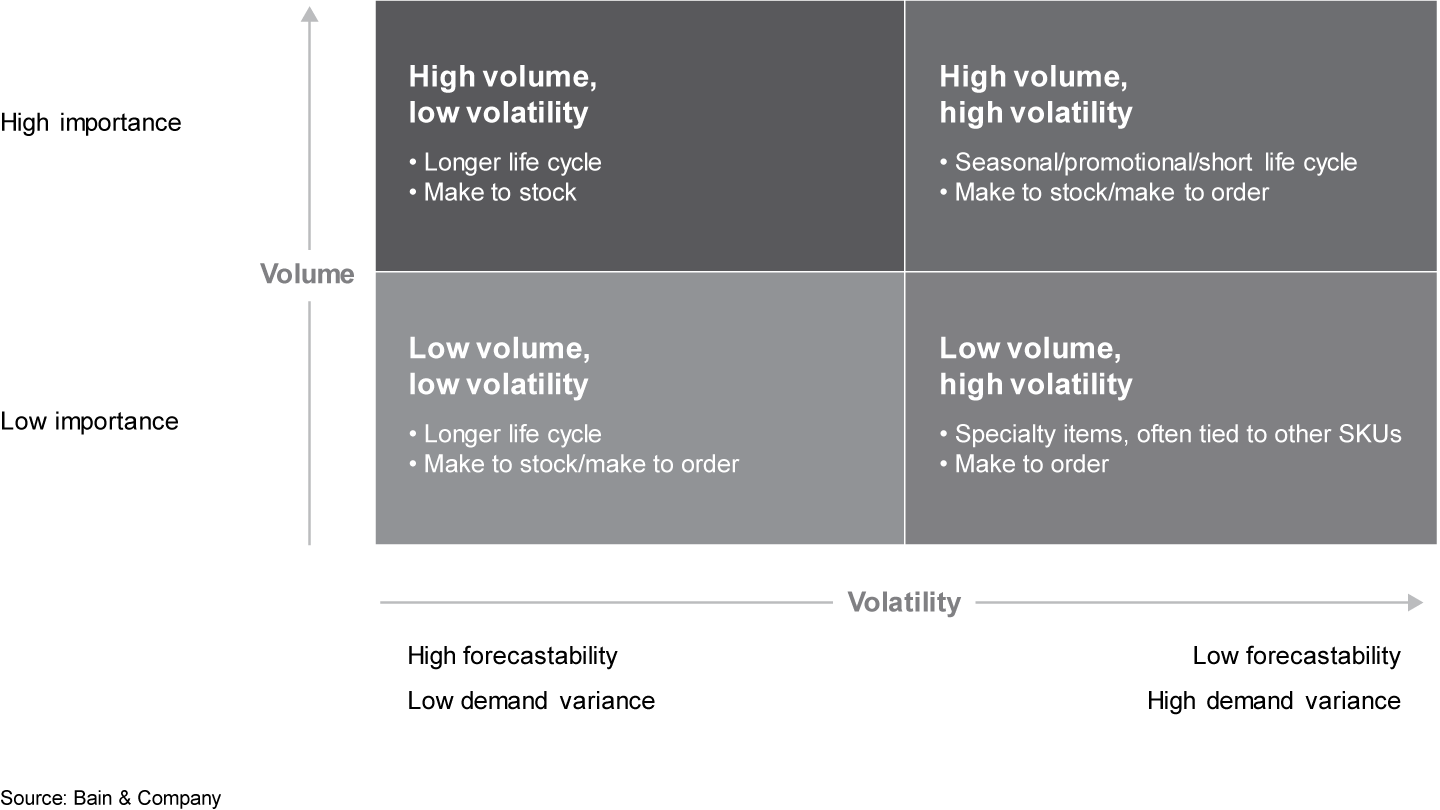
      Four demand classes help to prioritize forecasting efforts
      Four demand classes help to prioritize forecasting efforts
      Four demand classes help to prioritize forecasting efforts

      Usually, high volatility indicates low forecastability. Sometimes, the volatility of the original demand series does not directly serve to measure the forecastability, however, because highly seasonal series, such as one with a sine curve, are highly volatile but not hard to forecast. A more reasonable gauge of volatility in forecasting should be the volatility of the residuals from the benchmark model.

      The advantage of this classification is that it helps to prioritize the forecasting tasks. For an operational level forecast, there are usually thousands of demand series, too many to monitor. It’s more effective to focus on the high-volume, high-volatility class first, since improving forecast accuracy for this category yields the most value. Then we can focus on the high-volume, low-volatility category next, with the low-volume, low-volatility category after that and the low-volume, high-volatility category last.

      Using Pareto’s 80/20 principle, the four classes should be easy to manage and interpret. You can also split each dimension into three categories instead of two so that it has nine classes, similar to ABC/XYZ classification, with a slightly different measurement of volatility. Companies often use ABC/XYZ classification in supply chain management.

      Six categories for demand series

      Depending on the demand cycle pattern, seasonality and volume, we can classify demand series into six categories (see Figure 2).

      Figure 2
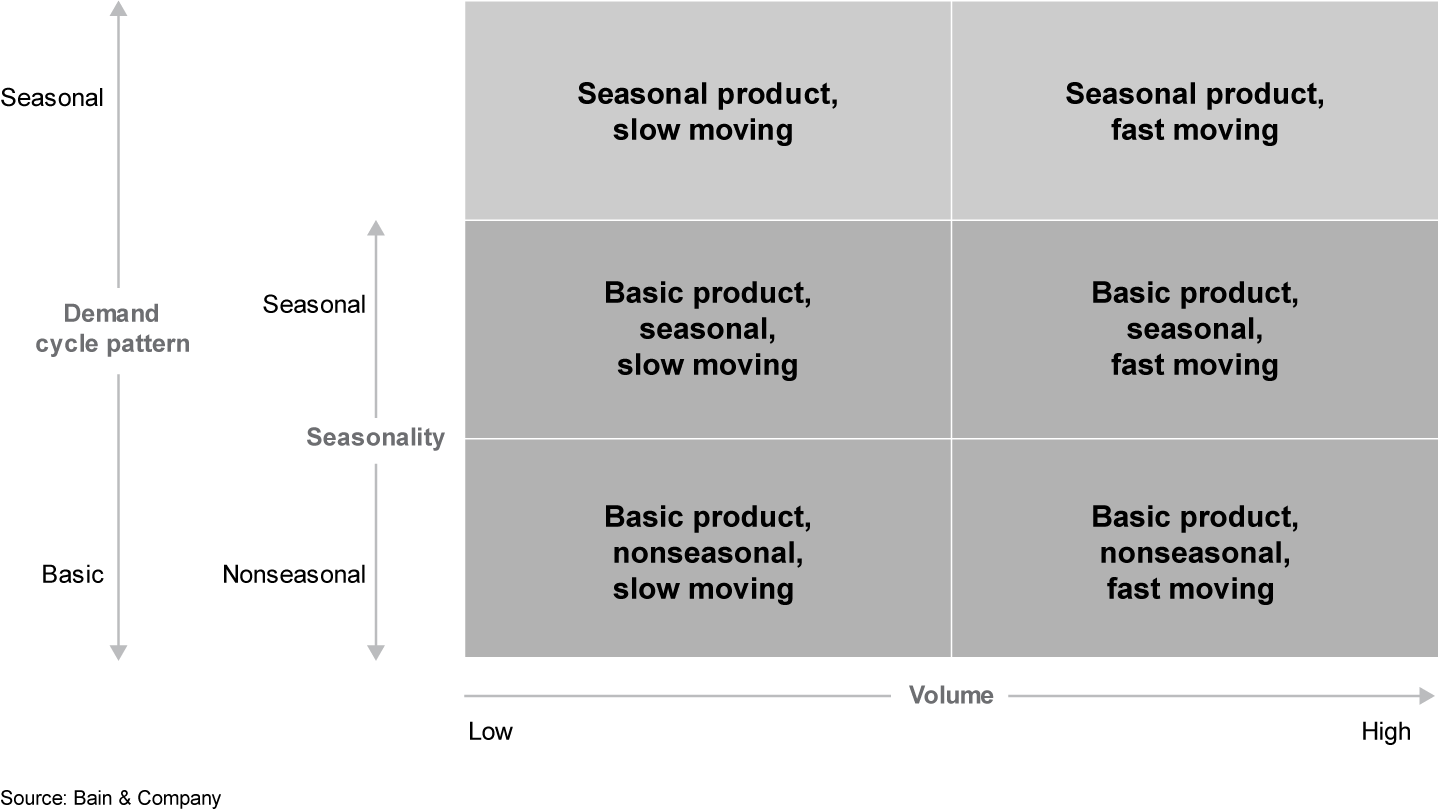
      Each class has different demand signal patterns that can help with model selection
      Each class has different demand signal patterns that can help with model selection
      Each class has different demand signal patterns that can help with model selection

      Each class has different demand signal patterns that can help with model selection. For example, slow-moving series, also called intermittent demand series, might require intermittent demand models or a probabilistic forecast model in order to understand the special distribution of the demand. Seasonal product series, which have big demand gaps during the off-season periods, require models that can handle that pattern, so we might model with a customized time interval or a regression-based model with interval indicators.

      We can use the six categories to diagnose problems with existing forecast results. For example, we might find that a forecasting team encounters issues with some of the products or regions. This classification method can help identify the common characteristics of such series and improve upon them.

      The classification method serves to improve business insights and build trust in the forecast. For example, when working with seasonal product series, such as demand for wood stove accessories, many forecasting models will generate some small, nonzero forecast values for the off-season part of the series. Although the forecast accuracy for these models might be good, it does not make sense from a business perspective because one might not trust a forecast that predicts demand for wood stove accessories during the summer. With the demand pattern in mind, we can avoid such mistakes and build trust in the forecast.

      The classification method can also guide consideration of the downstream decision process. For example, extremely low-demand series, slow-moving series and fast-moving series imply different demand distributions and models for inventory optimization. Therefore, it makes sense to consider them separately during the forecasting process.

      In summary, classifying demand series can help facilitate forecasting tasks by focusing time on high-value cases, understanding the data, identifying forecasting problems, selecting forecasting models, building trust in the forecast and guiding the forecast process.

      Yue Li is an expert with Bain & Company’s Advanced Analytics practice. She is based in Los Angeles.

      Read More

      Advanced Analytics Expert Commentary

      Success with advanced analytics requires both technical know-how and a thoughtful approach. In this series, Bain's experts offer practical advice on some of the most common data issues.

      著者
      • Headshot of Yue Li
        Yue Li
        Expert Associate Partner, Los Angeles
      関連するコンサルティングサービス
      • アドバンスド・アナリティクス
      コンサルティングサービス
      • Demand Forecasting
      アドバンスド・アナリティクスエキスパートのコメント
      How to Choose among Three Forecasting Models: Machine Learning, Statistical and Expert

      Get to know their strengths and weaknesses.

      詳細
      アドバンスド・アナリティクスエキスパートのコメント
      Defining the Intelligent Enterprise

      A recap from DeepLearning.AI’s AI Dev 25 × NYC.

      詳細
      Demand Forecasting
      Predicting Consumer Demand in an Unpredictable World

      While it's more complicated than ever in the Covid-19 pandemic, don’t abandon forecast modeling. Just change how you do it.

      詳細
      アドバンスド・アナリティクス
      Retailers Have a Secret Weapon in AI-Powered Shopping: Trust

      US consumers would be more comfortable with AI buying on their behalf if a familiar retailer were involved.

      詳細
      アドバンスド・アナリティクスエキスパートのコメント
      Making Friends with Collinearity: How Driver Interactions Can Inform Targeted Interventions

      Driver analysis helps inform decisions on which drivers deserve the greatest effort.

      詳細
      First published in 8月 2019
      Tags
      • Demand Forecasting
      • アドバンスド・アナリティクス
      • アドバンスド・アナリティクスエキスパートのコメント

      クライアント支援事例

      アドバンスド・アナリティクス A New Demand Forecasting Approach Signals a Bottom-Line Boost

      ケーススタディを見る

      アドバンスド・アナリティクス Advanced Analytics Breakthrough Lets Metals Company Optimize Yield Cost

      ケーススタディを見る

      アドバンスド・アナリティクス Advanced Analytics powers up UtilityCo’s reliability, and customers notice

      ケーススタディを見る

      お気軽にご連絡下さい

      私達は、グローバルに活躍する経営者が抱える最重要経営課題に対して、厳しい競争環境の中でも成長し続け、「結果」を出すために支援しています。

      ベインの知見。競争が激化するグローバルビジネス環境で、日々直面するであろう問題について論じている知見を毎月お届けします。

      *プライバシーポリシーの内容を確認し、合意しました。

      プライバシーポリシーをご確認頂き、合意頂けますようお願い致します。
      Bain & Company
      お問い合わせ Sustainability Accessibility Terms of use Privacy Cookie Policy Sitemap Log In

      © 1996-2026 Bain & Company, Inc.

      お問い合わせ

      How can we help you?

      • ビジネスについて
      • プレス報道について
      • 採用について
      全てのオフィス