

論説

概要
- The damaging effects of climate change are here and are accelerating.
- Traditional corporate approaches to climate resilience are insufficient—overly focused on near-term risks to the physical plant, with limited understanding of potential impacts in the organization and limited use of advanced predictive tools.
- Leading companies are experimenting with new approaches, thinking broadly about their value chain and focusing on practical actions they can take now to stay ahead of inevitable climate challenges.
Despite decarbonization efforts, the effects of climate change are here now and will grow through this decade and beyond.
Extreme weather events have become a distressingly regular occurrence. In 2022, we’ve seen everything from unprecedented floods in Pakistan to generational droughts in Europe to severe drought in China. While it is challenging to tie specific weather events to long-term climate trends, it’s clear that weather-related disasters have increased five-fold in the past 50 years and that the number of 1-in-500-year weather events is growing. With the world well off track of the goal to limit warming to 1.5 degrees Celsius, and with potential climate tipping points approaching, such events are likely to intensify over the coming decade.
Looking ahead, corporate leaders are seeing more risk than ever before and are asking how to be ready to survive and thrive in a changing climate. On the horizon, they see that natural resource availability may be constrained, and critical facilities—whether their company’s own or those of key suppliers—may be severely damaged or out of operation for extended periods. Customers are impacted by climate change as well.
Leaders are also finding that many corporate planning processes, such as those covering engineering standards and insurance availability, are premised on “normal” weather patterns and have not been adjusted for a different climate in the future.
Adaptive companies take an end-to-end view of climate impacts across the value chain, not just within their four walls but also upstream and downstream of the business. They systematically integrate new predictive analytics tools into corporate planning processes. And they think broadly and strategically about resilience and adaptation—treating this work not purely as a risk management exercise but as a chance to assess how climate change will impact their growth, operations, and engagement with stakeholders over the long term. As climate challenges mount, adaptation will be an increasingly important source of competitive advantage for every company.
The business impacts of extreme natural events are here now, and growing
Companies are already experiencing the effects of climate change across their end-to-end value chains. This summer, global giants Apple, Intel, and CATL suffered a weeklong shutdown of most of their production facilities in Sichuan, China, where a generational drought stalled multiple hydropower plants. Constellation Brands had to halt construction of a nearly completed, $1.4 billion brewery in Northern Mexico in early 2020, in response to increasing drought and water availability concerns in the region. Insurers will incur $50 billion to $75 billion in losses due to Hurricane Ian, a 1-in-1,000-year rain event, and yet just the most recent in a series of catastrophes pressuring the insurance market.
Many businesses have underestimated the likelihood of such events and their exposure to them, relying on a narrow set of risk-transfer tools (e.g., insurance or financial hedges) rather than a broader set of strategic and operational levers for building resilience. Meanwhile, the frequency and severity of these perils are growing with each year.
Climate change is also taking a toll on the communities where businesses operate, affecting their employees and customers. Earlier this year, for example, the Metropolitan Water District of Southern California imposed mandatory water cutbacks on 6 million people amid extreme high temperatures, urging the public to conserve water and reduce electricity use. Similar restrictions have been mandated in Europe, and the US government has already warned Western states to expect reduced access to Colorado River water next year.
For companies addressing their resilience to climate change, the sources of value are both increasingly important and multifaceted:
- Minimizing losses and damage (physical and economic), moving beyond risk mitigation to more proactive risk minimization and avoidance
- Ensuring access to critical resources (e.g., water)
- Protecting critical supply chain inputs from disruption
- Ensuring continued operational reliability and service to customers
- Adjusting offerings for customers and communities as they respond to a changing climate, including the creation of new offerings
Common pitfalls
In our experience, executives looking to build climate resilience face several challenges. First, they often start with an uneven understanding of the potential effects of climate change across the organization. While most leaders are aware of more frequent, more extreme natural events, they may not fully understand how such events impact different elements of their business, in which geographies or over what time horizon.
Part of the challenge is that, traditionally, climate resilience work has been the remit of the risk function, focused on loss and damage at a physical plant. What’s missed is the broader value chain—capturing key inputs the company relies on as well as impacts on customer groups—and the fully loaded economics of ensuring resiliency, as opposed to the limited loss-and-damage view.
A too-narrow view of the risks, combined with a lack of high-quality forecasting data reflecting future (rather than past) weather patterns, means that a company cannot fully identify the true risk it is facing nor begin to mitigate it in a systematic fashion. As catastrophic perils grow in frequency and severity, a more expansive view of total economic exposure highlights the inadequacy of traditional risk mitigation levers (e.g., physical insurance coverage alone).
A different approach
Leading companies take a different approach that follows three practical steps.
First, they adopt best-in-class analytical tools to model a granular view of climate risk for key geographies today and 10 or more years from now. In our own work with clients, for example, Bain has partnered with Jupiter, a market leader in climate risk analytics, to perform risk assessments. Every critical site (upstream, downstream, and within the company) should be assessed to identify which are at risk, and from which climate-related impacts.
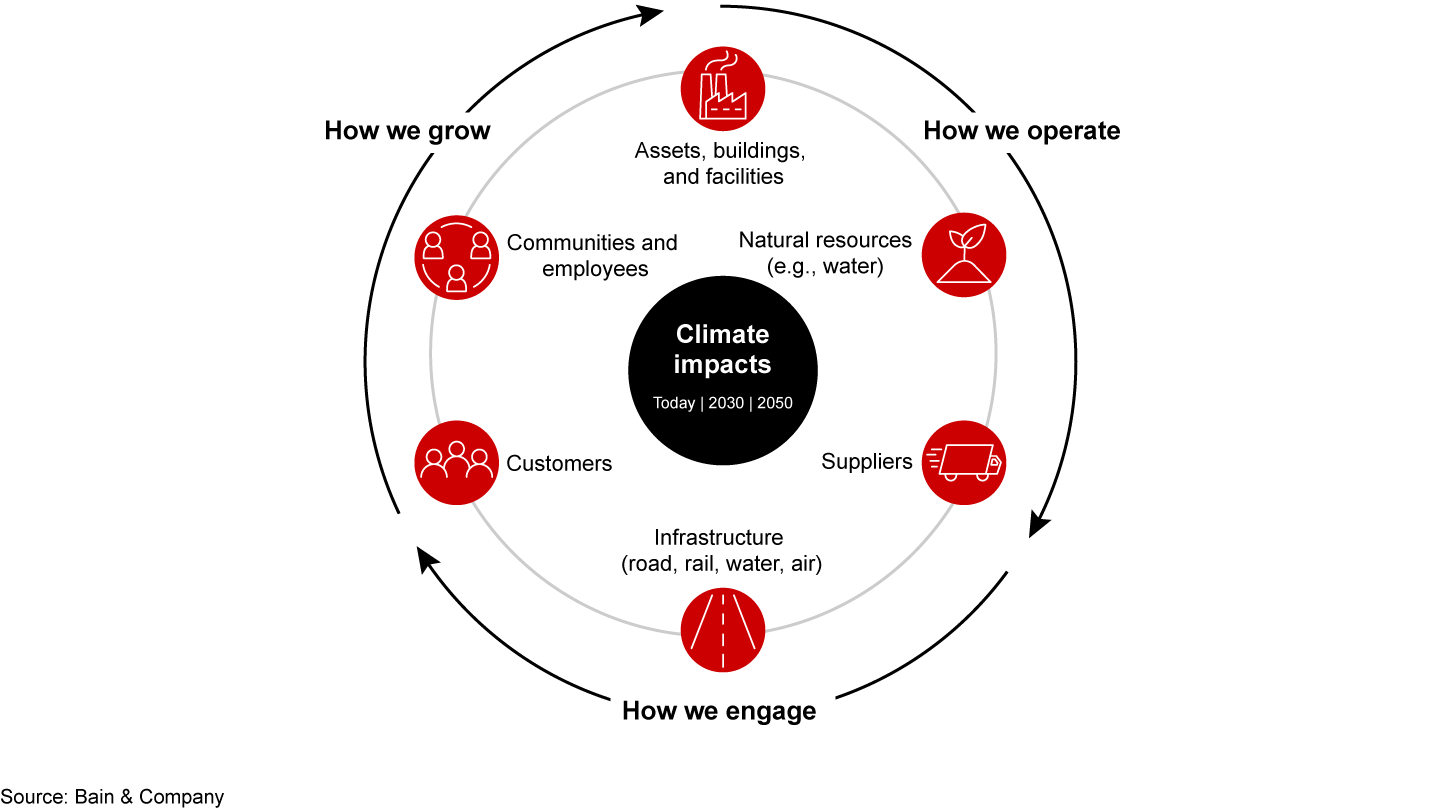
Second, leaders take a systematic look across all aspects of their value chain: assets, suppliers, infrastructure (road, rail, water, air), access to critical resources, customers, communities, and employees (see Figure 1). They combine more traditional business assessment approaches with technical studies (e.g., hydrology assessments) and the latest data science to develop an enterprise view of the value at stake.
Figure 1

Finally, they focus on practical actions they can take now to adapt and stay ahead of inevitable climate challenges. They decide not just which facilities to protect, but which strategic changes are necessary to survive and thrive, such as revising capital planning processes, restructuring or nearshoring the supply chain, or advocating for new policy solutions.
Southern California Edison is an excellent example. SCE recently completed a detailed climate adaptation vulnerability assessment of assets, operations, and services throughout its 50,000-square-mile service area, as part of its Pathway 2045 plan. Among other strategic considerations, the results of the assessment helped SCE reprioritize capital investments toward no-regrets foundational measures and new infrastructure that can withstand more intense flooding and storms, extreme temperatures, and more severe wildfires.
As a leader in this space, SCE has been investing for years to adapt to climate change, dedicating over $5 billion annually to maintain and improve the grid. The results are impressive: By the end of 2021, SCE had reduced wildfire risk by 65% to 70% compared with pre-2018 expectations.
Business leaders who wish to follow SCE’s example should recognize that a new approach may be met with natural resistance to change, amplified by the complex nature of climate science. As with any significant shift, it is critically important to educate employees, articulate a compelling case for change, and launch a parallel change management effort to help the organization embed these new tools and methodologies into day-to-day operations.
Crucially, the financial sector has a central role to play. Insurers will need to move beyond risk transfer to risk engineering—helping commercial clients better understand the size and nature of their exposures and identify opportunities for ex ante risk avoidance and mitigation. Banks and other capital providers will find that funding these investments can significantly lower credit risk.
Adapting now
As the effects of climate change accelerate, investing in climate resilience and adaptation becomes even more valuable for businesses across industries and geographies. Adapting now is a prudent and financially sound decision that will prepare your business to survive and thrive in a changing climate.
Start with a few critical questions:
- What is our current and future exposure to energy transition and physical risks?
- What are the likely impacts of climate change on our business, inside and outside our four walls?
- What is the fully loaded economic and financial cost to our business, our customers, our people, and our communities?
- Which strategic or mitigation actions are likely to be most valuable to our business, customers, communities, and employees?
First published in 11月 2022