
Skip to Content
  • オフィス

    オフィス

    北米・南米
    • Atlanta
    • Austin
    • Bogota
    • Boston
    • Buenos Aires
    • Chicago
    • Dallas
    • Denver
    • Houston
    • Los Angeles
    • Mexico City
    • Minneapolis
    • Monterrey
    • Montreal
    • New York
    • Rio de Janeiro
    • San Francisco
    • Santiago
    • São Paulo
    • Seattle
    • Silicon Valley
    • Toronto
    • Washington, DC
    ヨーロッパ・中東・アフリカ
    • Amsterdam
    • Athens
    • Berlin
    • Brussels
    • Copenhagen
    • Doha
    • Dubai
    • Dusseldorf
    • Frankfurt
    • Helsinki
    • Istanbul
    • Johannesburg
    • Kyiv
    • Lisbon
    • London
    • Madrid
    • Milan
    • Munich
    • Oslo
    • Paris
    • Riyadh
    • Rome
    • Stockholm
    • Vienna
    • Warsaw
    • Zurich
    アジア・オーストラリア
    • Bangkok
    • Beijing
    • Bengaluru
    • Brisbane
    • Ho Chi Minh City
    • Hong Kong
    • Jakarta
    • Kuala Lumpur
    • Manila
    • Melbourne
    • Mumbai
    • New Delhi
    • Perth
    • Shanghai
    • Singapore
    • Sydney
    • Tokyo
    全てのオフィス
  • アルムナイ
  • メディア
  • お問い合わせ
  • 東京オフィス
  • Japan | 日本語

    地域と言語を選択

    グローバル
    • Global (English)
    北米・南米
    • Brazil (Português)
    • Argentina (Español)
    • Canada (Français)
    • Chile (Español)
    • Colombia (Español)
    ヨーロッパ・中東・アフリカ
    • France (Français)
    • DACH Region (Deutsch)
    • Italy (Italiano)
    • Spain (Español)
    • Greece (Elliniká)
    アジア・オーストラリア
    • China (中文版)
    • Korea (한국어)
    • Japan (日本語)
  • Saved items (0)
    Saved items (0)

    You have no saved items.

    後で閲読、共有できるようにするためにブックマークしてください

    Explore Bain Insights
  • 業界別プラクティス
    メインメニュー

    業界別プラクティス

    • 航空宇宙、防衛、政府関連
    • 農業
    • 化学製品
    • インフラ、建設
    • 消費財
    • 金融サービス
    • ヘルスケア
    • 産業機械、設備
    • メディア、エンターテインメント
    • 金属
    • 採掘・鉱業
    • 石油、ガス
    • 紙、パッケージ
    • プライベートエクイティ
    • 公共、社会セクター
    • 小売
    • テクノロジー
    • 通信
    • 交通
    • 観光産業
    • 公益事業、再生可能エネルギー
  • 機能別プラクティス
    メインメニュー

    機能別プラクティス

    • カスタマー・エクスペリエンス
    • サステイナビリティ、 社会貢献
    • Innovation
    • 企業買収、合併 (M&A)
    • オペレーション
    • 組織
    • プライベートエクイティ
    • マーケティング・営業
    • 戦略
    • アドバンスド・アナリティクス
    • Technology
    • フルポテンシャル・トランスフォーメーション
  • Digital
  • 知見/レポート
  • ベイン・アンド・カンパニーについて
    メインメニュー

    ベイン・アンド・カンパニーについて

    • ベインの信条
    • 活動内容
    • 社員とリーダーシップ
    • プレス・メディア情報
    • クライアントの結果
    • 受賞歴
    • パートナーシップを結んでいる団体
    Further: Our global responsibility
    • ダイバーシティ
    • 社会貢献
    • サステイナビリティへの取り組み
    • 世界経済フォーラム(WEF)
    Learn more about Further
  • キャリア
    メインメニュー

    キャリア

    • ベインで働く
      キャリア
      ベインで働く
      • Find Your Place
      • ベインで活躍する機会
      • ベインのチーム体制
      • 学生向けページ
      • インターンシップ
      • 採用イベント
    • ベインでの体験
      キャリア
      ベインでの体験
      • Blog: Inside Bain
      • キャリアストーリー
      • 社員紹介
      • Where We Work
      • 成長を後押しするサポート体制
      • アフィニティ・グループ
      • 福利厚生
    • Impact Stories
    • 採用情報
      キャリア
      採用情報
      • 採用プロセス
      • 面接内容
    FIND JOBS
  • オフィス
    メインメニュー

    オフィス

    • 北米・南米
      オフィス
      北米・南米
      • Atlanta
      • Austin
      • Bogota
      • Boston
      • Buenos Aires
      • Chicago
      • Dallas
      • Denver
      • Houston
      • Los Angeles
      • Mexico City
      • Minneapolis
      • Monterrey
      • Montreal
      • New York
      • Rio de Janeiro
      • San Francisco
      • Santiago
      • São Paulo
      • Seattle
      • Silicon Valley
      • Toronto
      • Washington, DC
    • ヨーロッパ・中東・アフリカ
      オフィス
      ヨーロッパ・中東・アフリカ
      • Amsterdam
      • Athens
      • Berlin
      • Brussels
      • Copenhagen
      • Doha
      • Dubai
      • Dusseldorf
      • Frankfurt
      • Helsinki
      • Istanbul
      • Johannesburg
      • Kyiv
      • Lisbon
      • London
      • Madrid
      • Milan
      • Munich
      • Oslo
      • Paris
      • Riyadh
      • Rome
      • Stockholm
      • Vienna
      • Warsaw
      • Zurich
    • アジア・オーストラリア
      オフィス
      アジア・オーストラリア
      • Bangkok
      • Beijing
      • Bengaluru
      • Brisbane
      • Ho Chi Minh City
      • Hong Kong
      • Jakarta
      • Kuala Lumpur
      • Manila
      • Melbourne
      • Mumbai
      • New Delhi
      • Perth
      • Shanghai
      • Singapore
      • Sydney
      • Tokyo
    全てのオフィス
  • アルムナイ
  • メディア
  • お問い合わせ
  • 東京オフィス
  • Japan | 日本語
    メインメニュー

    地域と言語を選択

    • グローバル
      地域と言語を選択
      グローバル
      • Global (English)
    • 北米・南米
      地域と言語を選択
      北米・南米
      • Brazil (Português)
      • Argentina (Español)
      • Canada (Français)
      • Chile (Español)
      • Colombia (Español)
    • ヨーロッパ・中東・アフリカ
      地域と言語を選択
      ヨーロッパ・中東・アフリカ
      • France (Français)
      • DACH Region (Deutsch)
      • Italy (Italiano)
      • Spain (Español)
      • Greece (Elliniká)
    • アジア・オーストラリア
      地域と言語を選択
      アジア・オーストラリア
      • China (中文版)
      • Korea (한국어)
      • Japan (日本語)
  • Saved items  (0)
    メインメニュー
    Saved items (0)

    You have no saved items.

    後で閲読、共有できるようにするためにブックマークしてください

    Explore Bain Insights
  • 業界別プラクティス
    • 業界別プラクティス

      • 航空宇宙、防衛、政府関連
      • 農業
      • 化学製品
      • インフラ、建設
      • 消費財
      • 金融サービス
      • ヘルスケア
      • 産業機械、設備
      • メディア、エンターテインメント
      • 金属
      • 採掘・鉱業
      • 石油、ガス
      • 紙、パッケージ
      • プライベートエクイティ
      • 公共、社会セクター
      • 小売
      • テクノロジー
      • 通信
      • 交通
      • 観光産業
      • 公益事業、再生可能エネルギー
  • 機能別プラクティス
    • 機能別プラクティス

      • カスタマー・エクスペリエンス
      • サステイナビリティ、 社会貢献
      • Innovation
      • 企業買収、合併 (M&A)
      • オペレーション
      • 組織
      • プライベートエクイティ
      • マーケティング・営業
      • 戦略
      • アドバンスド・アナリティクス
      • Technology
      • フルポテンシャル・トランスフォーメーション
  • Digital
  • 知見/レポート
  • ベイン・アンド・カンパニーについて
    • ベイン・アンド・カンパニーについて

      • ベインの信条
      • 活動内容
      • 社員とリーダーシップ
      • プレス・メディア情報
      • クライアントの結果
      • 受賞歴
      • パートナーシップを結んでいる団体
      Further: Our global responsibility
      • ダイバーシティ
      • 社会貢献
      • サステイナビリティへの取り組み
      • 世界経済フォーラム(WEF)
      Learn more about Further
  • キャリア
    人気検索キーワード
    • デジタル
    • 戦略
    前回の検索
      最近訪れたページ

      Content added to saved items

      Saved items (0)

      Removed from saved items

      Saved items (0)

      Forbes.com

      Competing in China with "good enough" products

      Competing in China with "good enough" products

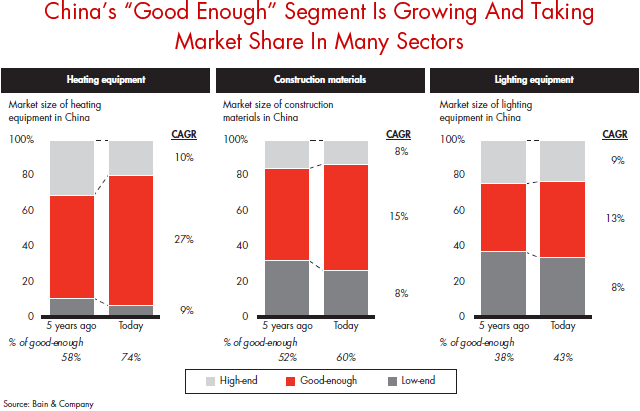
      China's "good enough" segment is growing and taking market share in many sectors.

      著者:Raymond Tsang and Kevin Chong

      • min read

      記事

      Competing in China with "good enough" products
      en

      This article originally appeared on Forbes.com.

      In the two decades since Grundfos first opened an office in China, the world’s largest producer of industrial and residential pumps has built an enviable position. The Danish company dominates the market’s high end with a share approaching 50%. Its high-quality, feature-rich pumps command prices sometimes twice as high as the local competition’s.

      But if this perch atop one of the world’s most dynamic markets appears comfortable, it isn’t. Like so many foreign multinationals seeking to establish, sustain or expand their presence in China, Grundfos has found that the game has changed dramatically in recent years, forcing it to rethink old notions about how to compete.

      Though Grundfos continues to flourish in the market’s premium segment, it has encountered significant pressure from below as insurgent local competitors make their way up the learning curve. Having substantially closed the quality gap with well-designed, low-cost products that are “good enough” to appeal to a growing number of customers in China’s burgeoning middle market, these local rivals are scooping up market share and enticing even high-end customers to trade down for what they see as better value (see figure below).

      forbes-pi

      As this pattern repeats itself in almost every market sector from construction equipment to financial information, local companies are not only posing a stiff challenge to foreign incumbents in China today but they are also conditioning themselves to compete on a global scale tomorrow. Increasingly, this twin threat demands a decisive response: For many foreign companies the question is no longer whether to take on local rivals in the “good enough” market, but where to play and how to win.

      Large companies already thriving in China’s premium space have long been timid about moving down-market. Introducing lower-priced products poses the real risk of cannibalization, and many large companies lack confidence in their ability to profit in a lower-cost, fast-moving environment. But the past five years have seen a clear shift in many companies’ willingness to take on the challenge. More and more, companies like Grundfos view China’s good-enough market as a historic opportunity and are thinking creatively about how they can exploit it profitably without threatening their high-end franchises.

      The most successful good-enough strategies begin with a clearly differentiated product offering that steers clear of the premium business. Companies then have to ask themselves two crucial questions: How wide is the price and feature gap between that product and our premium offerings? And how quickly can we close it with the resources at hand? The answers will vary widely depending on each company’s structure, product complexity and culture. But in most cases, this analysis will suggest three broad approaches to building a more flexible, low-cost value chain—an organic approach, which relies primarily on internal capabilities; an inorganic approach, which leans heavily on M&A; and a hybrid approach, which blends internal capabilities with external partnerships or acquisitions.

      Historically, a strategic acquisition has offered the quickest, most straightforward entrée to the good-enough market. AB Volvo came to that conclusion in 2007 when it invested $80 million to buy a 70% stake in Lingong, a leading construction-equipment maker in northern China. Because Volvo’s complex global production process was highly calibrated to deliver top-end equipment at a premium price, creating a new platform to serve China posed a steep challenge. Lingong, on the other hand, provided ready access to low-cost production, a complementary line-up of popular good-enough products and a strong set of existing customer relationships.

      Grundfos might have resorted to buying or partnering with a Chinese rival as well. Like Volvo, it was loath to threaten its own franchise by simply “de-specing” its premium products, and it knew that closing the price gap would require a separate, low-cost operation. But the Danish company also had a key asset that allowed it to craft a hybrid solution—a middle-market Italian pump maker, DAB, it had acquired in the 1990s.

      DAB had no market presence in China but had been exporting products to other markets from a plant in Qingdao since 2006. That gave Grundfos a platform it could retrofit to create an entirely new, low-cost brand for China’s residential market called Emerco. By finding key low-cost sources for almost all its inputs and bypassing distributors to ship directly to residential installers and retail customers, Emerco products could be priced 20% to 30% lower than the premium Grundfos brand, but still 10% higher than local offerings. And Grundfos has been careful to avoid cannibalization or market confusion by maintaining a strict separation between the brands. Emerco’s website, for instance, features no links or references to the parent company.

      What companies like Grundfos and Volvo are finding is that investments in China’s good-enough segment are well worth the risk. A carefully crafted strategy opens access to the vast demand being created by China’s exploding population of middle-class consumers. But they are also recognizing that the implications of the good-enough challenge stretch well beyond China. As global powerhouses like Haier and Lenovo have amply demonstrated, the skills and scale local Chinese companies develop at home eventually make them formidable competitors abroad. Winning on the good-enough battlefield is crucial to succeeding in China. But for many multinationals it may also represent the table stakes for staying competitive globally.

      Read the full report: How to win on China's "good enough" battlefield

      Raymond Tsang is a partner in Bain & Company’s Shanghai office and a leader in the firm’s Performance Improvement practice. Kevin Chong is a partner in Bain’s Shanghai office and leader of the firm’s Strategy practice in Greater China.

      著者
      • Headshot of Raymond Tsang
        Raymond Tsang
        パートナー, Hong Kong
      関連するコンサルティングサービス
      • 戦略
      戦略
      中国「ミドル市場」で勝利するには
      詳細
      小売
      アジア新興国で食品小売業者が勝利するための9つのルール
      詳細
      戦略
      Six Threats Demand a New Playbook for Banks in Wealth and Asset Management

      AI, direct-to-consumer models, and the return of local priorities are redrawing industry lines.

      詳細
      戦略
      Compete, Evolve, Compete Again

      What does it really take to stay relevant when the world refuses to stand still?

      詳細
      戦略
      The Magic of Founder-led Companies

      Companies with their founder present performed twice as well as their peers in the S&P 500 over the past decade.

      詳細
      First published in 4月 2014
      Tags
      • 戦略

      クライアント支援事例

      戦略 Jump-starting innovation for a telecom solutions provider

      ケーススタディを見る

      戦略 New products propel profitability for metals manufacturer

      ケーススタディを見る

      戦略 An auctioneer makes a winning online bid

      ケーススタディを見る

      お気軽にご連絡下さい

      私達は、グローバルに活躍する経営者が抱える最重要経営課題に対して、厳しい競争環境の中でも成長し続け、「結果」を出すために支援しています。

      ベインの知見。競争が激化するグローバルビジネス環境で、日々直面するであろう問題について論じている知見を毎月お届けします。

      *プライバシーポリシーの内容を確認し、合意しました。

      プライバシーポリシーをご確認頂き、合意頂けますようお願い致します。
      Bain & Company
      お問い合わせ Sustainability Accessibility Terms of use Privacy Cookie Policy Sitemap Log In

      © 1996-2026 Bain & Company, Inc.

      お問い合わせ

      How can we help you?

      • ビジネスについて
      • プレス報道について
      • 採用について
      全てのオフィス