

論説

For an entire generation of business leaders, the actions they take now and in the weeks ahead will define them and their companies. And while the impact of this crisis varies across industries and regions, it’s no exaggeration to recognize that this time around, the burden of destiny is real.
CEOs working urgently to balance dozens of critical priorities each day are starting to focus on two leading questions: “How can we ride out the crisis to emerge stronger than others in our industry?” and “How can the organization learn through this experience to win in a new world?” To guide the decisions and actions that will answer those questions—through the welter of competing demands, the sometimes chaotic conditions and the paramount importance of doing the right thing—some leadership teams have committed themselves to two guiding principles: act now to protect and run the business today, and plan now to retool the business for the future (Figure 1).
Figure 1
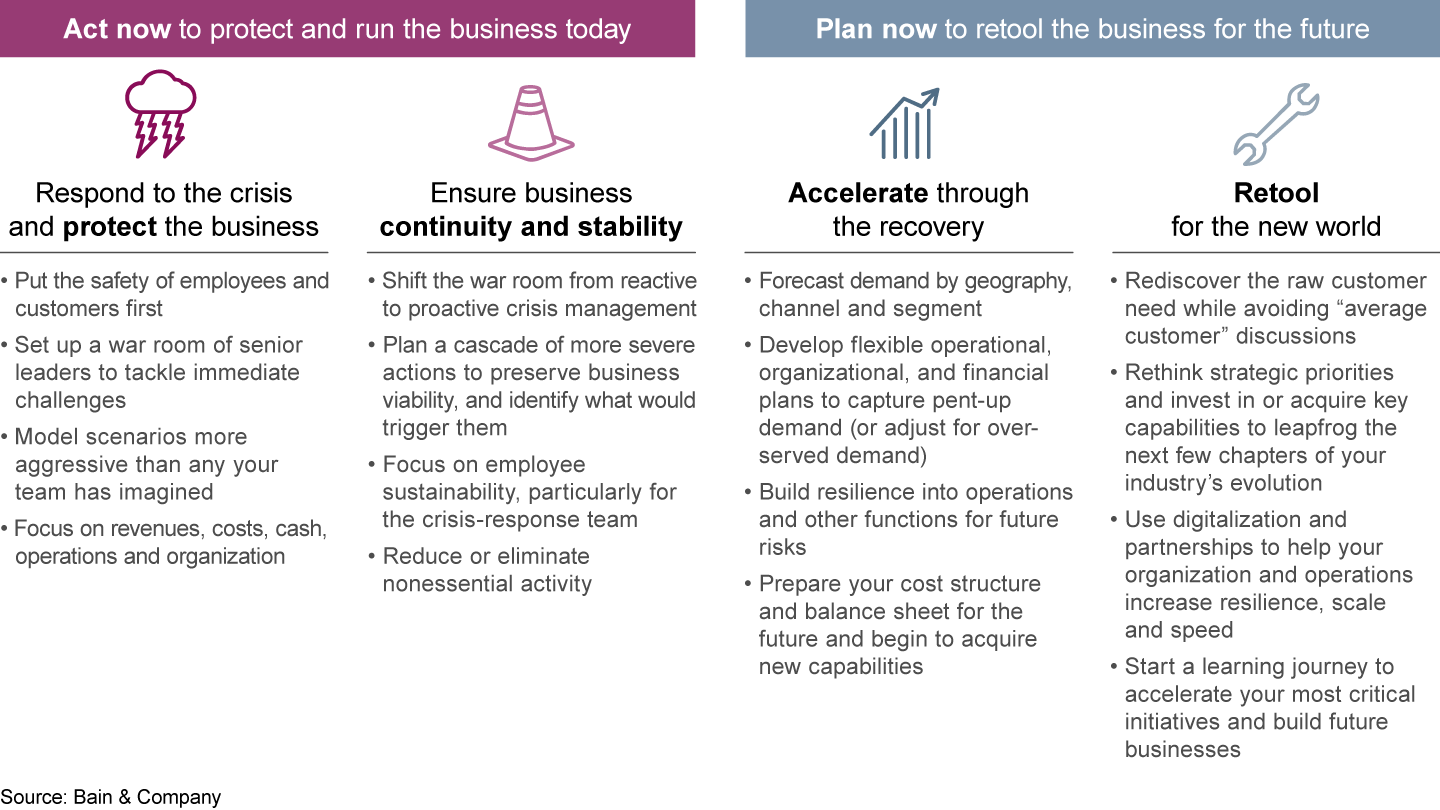

It helps to understand the different phases of the journey, but CEOs and their teams won’t follow a straight line. During the journey, some phases will overlap and even circle back again, requiring simultaneous action.

Macro Surveillance Platform
For more detail on the business implications of coronavirus from Bain’s Macro Trends Group, log on to the Macro Surveillance Platform. Learn more about the platform >
Respond to the crisis and protect the business
As external shocks hit the business, the nature of this crisis means that many employees and customers are grappling with a basic human emotion: fear. Businesses in some sectors are seeing revenues decline, and some are confronting the prospect of a liquidity squeeze. Daily heroics have kept operations intact at many companies, but of course, the time horizons remain uncertain.
Most CEOs have already taken the most important first step: Make the safety of employees and customers the top priority. Beyond travel limitations, in-person meeting restrictions, temporary closures of facilities and rigorous protocols to protect essential operational teams, the Covid-19 outbreak called for a reexamining of policies and practices on employee benefits, remote working and employee engagement. Leading companies have been communicating steadily with employees and customers to be fully transparent about the situation. And some quickly found ways to support their communities with their assets and capabilities. British fast-food chain Leon, for example, pivoted its business in a matter of days to provide groceries and ready-made meals to customers under lockdown. Silo, a Vermont-based maker of vodka and other spirits, rapidly converted its distilling operations to produce hand sanitizer for first responders and communities.
For many leading companies, the next urgent priority was setting up a fully dedicated Covid-19 war-room team, consisting of senior leaders from disciplines ranging from sales and operations to HR and finance. The team’s mission is to deliver critical business action plans with clearly defined work streams, including initiative owners and designated subteams of experts. The team is action-oriented and Agile, operating in sprints with daily virtual huddles and using a real-time digital platform to track the status of different initiatives. Its members break all normal reporting cycles to overcommunicate consistently and transparently with all key stakeholders across the organization.
Surviving this downturn also requires immediate action planning for scenarios more aggressive than anything teams could have imagined. Winning businesses in every industry, beyond the consumer-facing companies most obviously affected by the coronavirus, started with a clear, quantitative set of possible revenue and cash scenarios, including extreme downside scenarios. Leaders translated the scenarios into revenue declines and stress tested the P&L and balance sheet. In a matter of days, not weeks, they planned their initial moves.
Ensure business continuity and stability
As they respond to the early fallout from the crisis, senior leaders are navigating a cascade of operating challenges every day, including supply chain disruptions, call-center closures, network bandwidth issues and more. Revenues have declined even for businesses that aren’t directly affected by lockdowns.
Most of the organization’s energy is concentrated on riding out the storm. CEOs are clearing the decks of nonessential activity by asking the war room to label all initiatives launched before the crisis as “stop,” “start” and “continue.” Once the war-room team has time to look past the flood of urgent crises, it can plan a cascade of more severe actions as needed regarding revenue, cost and operations to preserve business viability. Leading companies are reallocating resources to pockets of current and future growth, such as e-commerce, to protect against revenue loss. They’re launching immediate spending “hand brakes,” from halting nonessential IT purchases to freezing hiring to delaying nonessential accounts-payable payments.
As the team maps scenarios and readies scenario-based action plans, CEOs are shifting the war-room focus from reactive to proactive crisis management. War-room team members are making small adjustments to the operating model and technology for new ways of working. They’re determining how to improve the company’s cost position for the medium to long term. Leaders are conducting virtual training sessions on managing teams during a crisis and executing an external communications plan, among other activities.
CEOs can expect the crisis to last months, not weeks. The anxiety of uncertainty is taking its toll on all employees, creating the need for support more than ever before. That’s especially prevalent in the war room, where teams are stressed, stretched and at risk of burning out. Many CEOs set this cultural norm as early as possible: Raising flags is a best practice, not a sign of failure. Beyond frequent pulse checks, they’ve instituted policies to ensure the team can sustain its efforts. For example, at some companies, senior leaders alternate being “on duty” in the war room in two-week rotations.
Accelerate through the recovery
As new cases of Covid-19 start to drop off and economic life appears to stabilize, firms need to be ready with strong, working hypotheses about the dynamics in their industry and the right strategy to outperform. The companies that adapt faster to the initial upswing—and eventually, the new environment—will emerge stronger. But this recovery will be different. Companies will scramble to capture pent-up demand or adjust for weeks of overserved demand. The picture is further complicated by wide variations in when and how the widely different markets come back online or whether people are forced back into confinement with subsequent outbreaks of Covid-19. A heterogeneous business environment will pose new challenges to rebuilding supply chains, manufacturing networks and shared service centers. Cash flow and revenues won’t immediately balance out or return to normal levels, leaving companies on uncertain footing in the early recovery.
To manage the bursts of demand, leadership teams can take an “insights to action” approach to their business systems. Starting with anticipated customer behaviors, they can use a combination of predictive and prescriptive analytics, scenario simulation and early-warning detection to forecast demand changes almost in real time. They’ll glean, analyze and merge data from their online channels, stores, social media, weather, news and other third parties.
Some companies successfully adopted these techniques before the crisis. Take Starbucks, which relies on AI-enabled coffee machines to predict and manage inventory. But AI isn’t the only answer. Companies that empower their front line will also be able to deftly maneuver demand swings. Consider how Zara, a global retailer, has decentralized decision making, allowing store managers to place product orders twice a week.
Leading firms will not only protect supply chains from coronavirus-related disruptions and define flexible plans to serve customers during the recovery. They will also mitigate future risks and turn supply chain resilience into a source of competitive advantage. They’ll become nimbler, with a flexible network of suppliers and partners. For example, after Hurricane Katrina in 2005, Cisco struggled to cope with a surge in orders to replace damaged telecommunications infrastructure. But the experience prompted the company to build a network of flexible manufacturers ready to produce any of its optical service routers at short notice.
Leaders will also transform their operations with secure, cloud-based interfaces. The most resilient companies will use a “control tower,” or a decision-making platform that governs a real-time, integrated and omniscient supply chain through end-to-end visibility and analytics. Using the control tower model, Procter & Gamble quelled the devastating effects of Hurricane Sandy in 2012. Its damaged facility in New Jersey, which supplied more than 90% of the company’s perfume, was back up and running after only 2½ days. With a control tower, organizations will be better prepared for the shorter-term turbulence of Covid-19—and the longer-term turbulence of our increasingly uncertain world.
Retool for the new world
Even before the pandemic passes, CEOs will face perhaps their most significant moment of truth: Can they take what they’ve learned through the crisis and retool the company for a new world? Boards and executive teams recognize that, in some respects, markets and societies may revert back to how they were before the spread of Covid-19. But this crisis is different, and it’s vitally important to think through the new normal each business will face.
Some parts of this evolution are clear. Trends like digital and automation that were evident before we entered the crisis have accelerated and will accelerate further. But important new questions need to be answered. For example, will the elements that customers value shift irrevocably? In many industries, leaders will have to determine how to serve their customers’ raw needs in a changed world. All companies need to seek out signals of changing customer expectations. They may adjust their go-to-market and distribution models based on new behaviors, including the possibility of an accelerated move to digital channels. Winning companies will also avoid any considerations of the “average customer.” When seeking new customer insights, they’ll prioritize direct conversations with their most valuable customers.
To deliver, companies need the same clear-eyed perspective around business definition in the new world. As governments reflect on the crisis, enacting new policies to protect citizens and ensure preparedness, how might private-sector regulations change? If the priority of resilient supply chains leads to more local operations, how will business boundaries evolve? As the crisis reshuffles the industry landscape, what are the risks and opportunities?
To fortify the firm for a more disruptive reality, leaders will embed the best of their crisis response into the organization. What’s become clear in the crucible of this crisis is the critical need to improve three related but distinct capabilities: prediction, adaptability and resilience. Companies are rapidly deploying tools and systems to improve prediction, with some good outcomes. Raising our ability to adapt—as organizations, but also collectively—is proving to be more challenging. Equally clear is the need to elevate resilience in decision-making and operations, beyond a focus on efficiency.
CEOs now are using the war room to cut through hierarchical layers and silos. Leaders are delegating decision making to those who—regardless of their rank—are best informed and able to deliver better outcomes to customers and employees. Leading CEOs won’t replace those layers, but instead embrace this Agile way of working for the long term. They’ll complement the Agile teams working on “change the business” questions with flawless and repeatable “run the business” processes to build a fully Agile enterprise.
While this crisis poses challenging questions, it also presents some unique opportunities to learn. In many industries, business shifted to 100% digital overnight. What can we learn about being a digital business? While markets are locked down, marketing budgets have been slashed. How do we reengage in ways that allow us to more clearly understand where these marketing dollars are most effective? We’ve discovered new ways to partner with governments and other stakeholders to support our communities through this crisis. How might this shape new constructive partnerships? We’ve found a new operating cadence. Can we preserve the speed as we go forward? In an effort to accelerate learning, some leadership teams are embracing micro-battles. These fast-moving initiatives systematically take customer-oriented lessons from the front line and scale them across the organization.
Bold leadership teams are beginning to imagine this new world now and already adjusting their strategies and operating models. At this moment, teams want to hear four messages: our people are safe, our business is protected, we will recover stronger, and we will redefine the new world for our industry.
How CEOs can move from respond to retool
Uncertainty this far-reaching makes it hard to control the challenges at hand, let alone think years ahead. But CEOs who balance urgent actions for today with planning for the future can better guide what happens next. Here are some valuable questions that can help executives and boards focus their efforts:
- What’s the “big idea” that could shape our industry and firm for the next decade? What multiyear trends have been irrevocably pulled forward? What are the new trends we need to confront?
- How will customer behavior shift? How will the next generation of customers that fuel our growth be different than our core customers prior to the pandemic?
- How might business boundaries be redrawn, as supply chains and operating models are reconfigured and the public sector resets its role?
- How do we build adaptability and resilience into our strategy and operations?
- Which ways of working that we discovered during this crisis should we preserve and build upon?
- How do we increase the intensity and speed of our learning as we navigate the uncertainty ahead?

Coronavirus
The global Covid-19 pandemic has extracted a terrible human toll and spurred sweeping changes in the world economy. Across industries, executives have begun reassessing their strategies and repositioning their companies to thrive now and in the world beyond coronavirus.
Hernan Saenz is a Bain & Company partner in Dallas and leads the firm’s Global Performance Improvement practice. Dunigan O’Keeffe is the leader of Bain’s Global Strategy practice and is based in San Francisco.
First published in 4月 2020