
Skip to Content
  • オフィス

    オフィス

    北米・南米
    • Atlanta
    • Austin
    • Bogota
    • Boston
    • Buenos Aires
    • Chicago
    • Dallas
    • Denver
    • Houston
    • Los Angeles
    • Mexico City
    • Minneapolis
    • Monterrey
    • Montreal
    • New York
    • Rio de Janeiro
    • San Francisco
    • Santiago
    • São Paulo
    • Seattle
    • Silicon Valley
    • Toronto
    • Washington, DC
    ヨーロッパ・中東・アフリカ
    • Amsterdam
    • Athens
    • Berlin
    • Brussels
    • Copenhagen
    • Doha
    • Dubai
    • Dusseldorf
    • Frankfurt
    • Helsinki
    • Istanbul
    • Johannesburg
    • Kyiv
    • Lisbon
    • London
    • Madrid
    • Milan
    • Munich
    • Oslo
    • Paris
    • Riyadh
    • Rome
    • Stockholm
    • Vienna
    • Warsaw
    • Zurich
    アジア・オーストラリア
    • Bangkok
    • Beijing
    • Bengaluru
    • Brisbane
    • Ho Chi Minh City
    • Hong Kong
    • Jakarta
    • Kuala Lumpur
    • Manila
    • Melbourne
    • Mumbai
    • New Delhi
    • Perth
    • Shanghai
    • Singapore
    • Sydney
    • Tokyo
    全てのオフィス
  • アルムナイ
  • メディア
  • お問い合わせ
  • 東京オフィス
  • Japan | 日本語

    地域と言語を選択

    グローバル
    • Global (English)
    北米・南米
    • Brazil (Português)
    • Argentina (Español)
    • Canada (Français)
    • Chile (Español)
    • Colombia (Español)
    ヨーロッパ・中東・アフリカ
    • France (Français)
    • DACH Region (Deutsch)
    • Italy (Italiano)
    • Spain (Español)
    • Greece (Elliniká)
    アジア・オーストラリア
    • China (中文版)
    • Korea (한국어)
    • Japan (日本語)
  • Saved items (0)
    Saved items (0)

    You have no saved items.

    後で閲読、共有できるようにするためにブックマークしてください

    Explore Bain Insights
  • 業界別プラクティス
    メインメニュー

    業界別プラクティス

    • 航空宇宙、防衛、政府関連
    • 農業
    • 化学製品
    • インフラ、建設
    • 消費財
    • 金融サービス
    • ヘルスケア
    • 産業機械、設備
    • メディア、エンターテインメント
    • 金属
    • 採掘・鉱業
    • 石油、ガス
    • 紙、パッケージ
    • プライベートエクイティ
    • 公共、社会セクター
    • 小売
    • テクノロジー
    • 通信
    • 交通
    • 観光産業
    • 公益事業、再生可能エネルギー
  • 機能別プラクティス
    メインメニュー

    機能別プラクティス

    • カスタマー・エクスペリエンス
    • サステイナビリティ、 社会貢献
    • Innovation
    • 企業買収、合併 (M&A)
    • オペレーション
    • 組織
    • プライベートエクイティ
    • マーケティング・営業
    • 戦略
    • アドバンスド・アナリティクス
    • Technology
    • フルポテンシャル・トランスフォーメーション
  • Digital
  • 知見/レポート
  • ベイン・アンド・カンパニーについて
    メインメニュー

    ベイン・アンド・カンパニーについて

    • ベインの信条
    • 活動内容
    • 社員とリーダーシップ
    • プレス・メディア情報
    • クライアントの結果
    • 受賞歴
    • パートナーシップを結んでいる団体
    Further: Our global responsibility
    • ダイバーシティ
    • 社会貢献
    • サステイナビリティへの取り組み
    • 世界経済フォーラム(WEF)
    Learn more about Further
  • キャリア
    メインメニュー

    キャリア

    • ベインで働く
      キャリア
      ベインで働く
      • Find Your Place
      • ベインで活躍する機会
      • ベインのチーム体制
      • 学生向けページ
      • インターンシップ
      • 採用イベント
    • ベインでの体験
      キャリア
      ベインでの体験
      • Blog: Inside Bain
      • キャリアストーリー
      • 社員紹介
      • Where We Work
      • 成長を後押しするサポート体制
      • アフィニティ・グループ
      • 福利厚生
    • Impact Stories
    • 採用情報
      キャリア
      採用情報
      • 採用プロセス
      • 面接内容
    FIND JOBS
  • オフィス
    メインメニュー

    オフィス

    • 北米・南米
      オフィス
      北米・南米
      • Atlanta
      • Austin
      • Bogota
      • Boston
      • Buenos Aires
      • Chicago
      • Dallas
      • Denver
      • Houston
      • Los Angeles
      • Mexico City
      • Minneapolis
      • Monterrey
      • Montreal
      • New York
      • Rio de Janeiro
      • San Francisco
      • Santiago
      • São Paulo
      • Seattle
      • Silicon Valley
      • Toronto
      • Washington, DC
    • ヨーロッパ・中東・アフリカ
      オフィス
      ヨーロッパ・中東・アフリカ
      • Amsterdam
      • Athens
      • Berlin
      • Brussels
      • Copenhagen
      • Doha
      • Dubai
      • Dusseldorf
      • Frankfurt
      • Helsinki
      • Istanbul
      • Johannesburg
      • Kyiv
      • Lisbon
      • London
      • Madrid
      • Milan
      • Munich
      • Oslo
      • Paris
      • Riyadh
      • Rome
      • Stockholm
      • Vienna
      • Warsaw
      • Zurich
    • アジア・オーストラリア
      オフィス
      アジア・オーストラリア
      • Bangkok
      • Beijing
      • Bengaluru
      • Brisbane
      • Ho Chi Minh City
      • Hong Kong
      • Jakarta
      • Kuala Lumpur
      • Manila
      • Melbourne
      • Mumbai
      • New Delhi
      • Perth
      • Shanghai
      • Singapore
      • Sydney
      • Tokyo
    全てのオフィス
  • アルムナイ
  • メディア
  • お問い合わせ
  • 東京オフィス
  • Japan | 日本語
    メインメニュー

    地域と言語を選択

    • グローバル
      地域と言語を選択
      グローバル
      • Global (English)
    • 北米・南米
      地域と言語を選択
      北米・南米
      • Brazil (Português)
      • Argentina (Español)
      • Canada (Français)
      • Chile (Español)
      • Colombia (Español)
    • ヨーロッパ・中東・アフリカ
      地域と言語を選択
      ヨーロッパ・中東・アフリカ
      • France (Français)
      • DACH Region (Deutsch)
      • Italy (Italiano)
      • Spain (Español)
      • Greece (Elliniká)
    • アジア・オーストラリア
      地域と言語を選択
      アジア・オーストラリア
      • China (中文版)
      • Korea (한국어)
      • Japan (日本語)
  • Saved items  (0)
    メインメニュー
    Saved items (0)

    You have no saved items.

    後で閲読、共有できるようにするためにブックマークしてください

    Explore Bain Insights
  • 業界別プラクティス
    • 業界別プラクティス

      • 航空宇宙、防衛、政府関連
      • 農業
      • 化学製品
      • インフラ、建設
      • 消費財
      • 金融サービス
      • ヘルスケア
      • 産業機械、設備
      • メディア、エンターテインメント
      • 金属
      • 採掘・鉱業
      • 石油、ガス
      • 紙、パッケージ
      • プライベートエクイティ
      • 公共、社会セクター
      • 小売
      • テクノロジー
      • 通信
      • 交通
      • 観光産業
      • 公益事業、再生可能エネルギー
  • 機能別プラクティス
    • 機能別プラクティス

      • カスタマー・エクスペリエンス
      • サステイナビリティ、 社会貢献
      • Innovation
      • 企業買収、合併 (M&A)
      • オペレーション
      • 組織
      • プライベートエクイティ
      • マーケティング・営業
      • 戦略
      • アドバンスド・アナリティクス
      • Technology
      • フルポテンシャル・トランスフォーメーション
  • Digital
  • 知見/レポート
  • ベイン・アンド・カンパニーについて
    • ベイン・アンド・カンパニーについて

      • ベインの信条
      • 活動内容
      • 社員とリーダーシップ
      • プレス・メディア情報
      • クライアントの結果
      • 受賞歴
      • パートナーシップを結んでいる団体
      Further: Our global responsibility
      • ダイバーシティ
      • 社会貢献
      • サステイナビリティへの取り組み
      • 世界経済フォーラム(WEF)
      Learn more about Further
  • キャリア
    人気検索キーワード
    • デジタル
    • 戦略
    前回の検索
      最近訪れたページ

      Content added to saved items

      Saved items (0)

      Removed from saved items

      Saved items (0)

      Technology Report

      Decarbonizing Technology Supply Chains

      Decarbonizing Technology Supply Chains

      Most tech companies have set ambitious targets, but only half are on track to meet them.

      著者:Peter Guarraia, Joshua Hinkel, Velu Sinha, and James Baird

      • min read
      }

      レポート

      Decarbonizing Technology Supply Chains
      en
      概要
      • In technology, most emissions are Scope 3, resulting from upstream supply chains or downstream use of products, which are harder for companies to control than Scope 1 (operations) or Scope 2 (energy use) emissions that are under their direct control.
      • Using more renewable energy in data centers helps many software companies reduce their Scope 2 emissions.
      • Bringing supply lines closer to customers can reduce upstream Scope 3 emissions, while redesigning products to use less energy helps reduce downstream Scope 3 emissions.
      • Companies should adopt a holistic perspective so that they can take a long-term strategic approach to emissions and other sustainability issues.

      This article is part of Bain's 2023 Technology Report.

      Explore the report

      Sustainability and decarbonization efforts increasingly are top priorities for technology companies as customers, shareholders, and regulators all push for more sustainable products and services. In response, most tech companies are setting ambitious goals to reduce emissions, but only half report being on track to reach their goals (see Figure 1). Most emission reduction goals focus on Scope 1 (direct emissions from a company’s activity) and Scope 2 (emissions from purchased electricity, heat, and steam), which companies have more control over. Scope 3 emissions come from the upstream supply chain and flow downstream to customer use.

      Figure 1
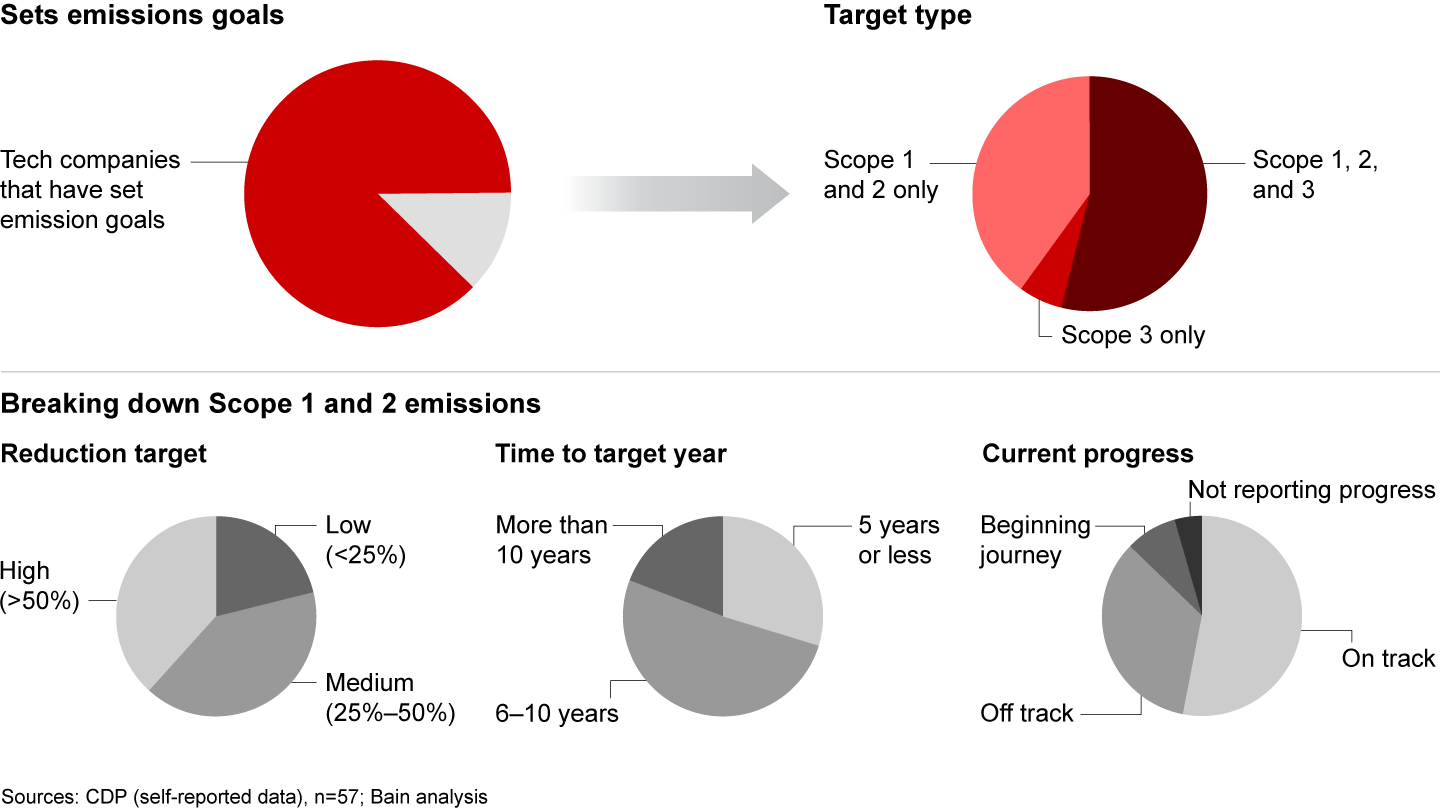
      90% of tech companies have set decarbonization targets, but results are mixed
      90% of tech companies have set decarbonization targets, but results are mixed
      90% of tech companies have set decarbonization targets, but results are mixed

      Why is reducing emissions so hard? First, most emissions are Scope 3, which are more difficult to control. Also, reductions compete with other strategic priorities. For example, PC makers need to find sustainable solutions to extend the life of their products without jeopardizing long-term sales.

      The ambitions may be clear, but the devil is in the execution. Improvement initiatives require complex coordination across manufacturing, operations, engineering, and R&D teams, as well as customers. Regulations differ across locations. Even with offset purchases as part of the strategy, companies might find it hard to source enough renewable power in some markets. Launching, tracking, and following through on implementation requires senior sponsorship and commitment—and a willingness to tackle cross-organizational and cross-regional challenges.

      Successful measures

      The causes of carbon emissions vary by subsector (see Figure 2). Emissions in semiconductors derive mostly from Scope 3 downstream usage, but the sector also has the largest Scope 1 and Scope 2 emissions. Hardware manufacturers’ emissions result from Scope 3 downstream electricity usage and the upstream supply chain for materials and minerals. The software industry’s emissions come from customers using their products (Scope 3 downstream) as well as the goods and services that software companies buy to make their products (Scope 3 upstream).

      Figure 2
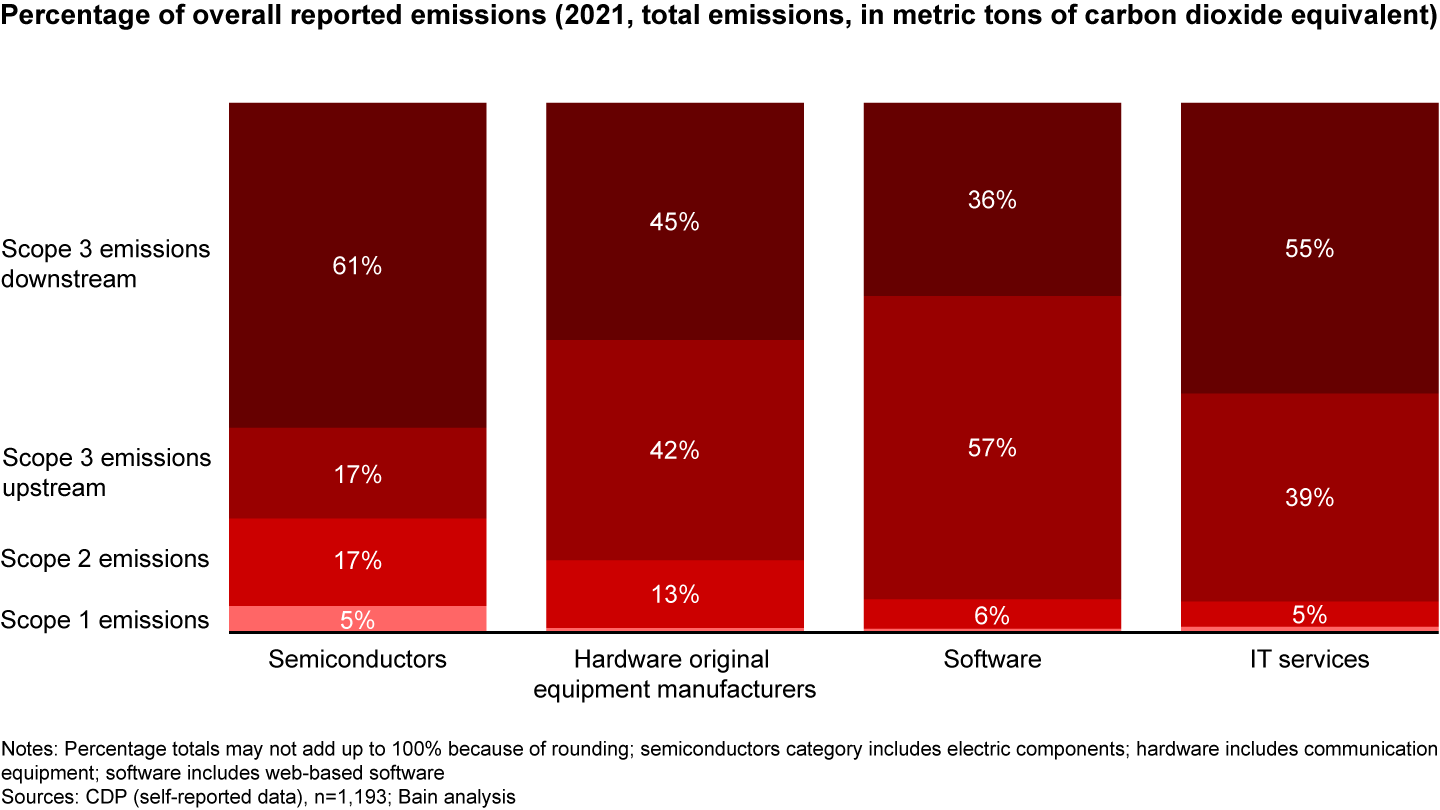
      Most emissions are Scope 3, which are difficult to track and abate
      Most emissions are Scope 3, which are difficult to track and abate
      Most emissions are Scope 3, which are difficult to track and abate

      While specific solutions may look different for hardware and software companies, all tech companies are embedding the impact of carbon into decision making around supply chain footprint, day-to-day operations, and product life cycles. Across subsectors, tech companies are finding ways to reduce carbon emissions.

      • Data centers: Many companies are using more renewable energy in their daily operations. For example, Microsoft committed to using 100% renewable energy by 2025 for electricity in its data centers and buildings, and it says it reduced Scope 2 emissions by 30% to 35% from 2021 to 2022. Some are reducing emissions by developing new, more energy-efficient ways to cool servers. Intel recently formed a partnership with specialty chemical maker Lubrizol to design and create immersion-cooling fluid solutions that don’t void the warranty on Intel microarchitectures. Immersion-cooling technology could reduce the energy required to cool servers in data centers by more than 30% vs. traditional air-cooling solutions.
      • Optimizing the supply chain: As companies evaluate bringing suppliers closer to end markets, many are looking not only at economic costs but also at their carbon footprint to help decide who to source from and where to locate new manufacturing sites. Bringing suppliers closer to customers can reduce emissions in transportation and energy consumption when the destination uses cleaner or renewable energy sources. For example, one major tech company is shifting some of its production from Asia to North America not only to help guard against future supply chain disruptions but also to increase sustainability and responsiveness by locating closer to more customers, which reduces transportation-related emissions and delivery time.
      • Redesigning products: Companies are redesigning their products so that they consume less energy or cleaner energy in order to reduce downstream Scope 3 emissions. For example, Apple’s Clean Energy Charging setting, which limits charging to periods when lower carbon-emission electricity is available, helps Apple reduce downstream Scope 3 emissions in the US.
      • New business models that balance financial and emissions trade-offs: New business models are proving to be a win-win for decarbonization efforts and for technology companies’ financials. For example, companies that adopt hardware-as-a-service models could extend the life of products or make them modular to lengthen times between replacement. This could allow them to generate revenue for longer on each asset while also reducing their carbon footprint by manufacturing less hardware.

      “No regret” actions

      A phased approach helps companies bridge the gap between sustainability goals and results.

      The first step is gaining a better understanding by mapping the major sources of carbon emissions in the supply chain. This can reveal opportunities for reductions. For example, choosing a renewable energy source for the company’s and suppliers’ energy needs is often low-hanging fruit, achievable during the early stages of decarbonization.

      Next, companies should adopt a long-term, holistic perspective and develop new business models that strengthen competitive advantages. By strategically addressing emission sources, embracing innovative business models, and making thoughtful strategic choices, companies can succeed financially while becoming more sustainable. Although most customers are still not willing to pay much of a green premium for sustainable products, they are becoming more conscious of their environmental impact and are actively seeking out eco-friendly options.

      Finally, tech companies face increasing pressure from regulators to disclose and reduce Scope 1, 2, and 3 emissions as part of their financial reporting. The EU’s Corporate Sustainability Reporting Directive and the US Security and Exchange Commission’s new reporting rules are among the measures that will help ensure that companies develop sound climate strategies for reducing emissions and that they comply with disclosure requirements.

      • Acknowledgments (click to expand)

        David Crawford, leader of Bain & Company’s Global Technology practice, and a team led by Dana Aulanier, practice director of the Technology Services practice, prepared this report.

        Bain Partners John Beaumont, Bryce Crawford, David Crawford, Matthew Crupi, Rishi Dave, David Deming, Frank Ford, Jonathan Frick, Arun Ganti, Peter Guarraia, Peter Hanbury, Karen Harris, Simon Heap, Josh Hinkel, Jens Friis Hjortegaard, Anne Hoecker, Christopher Johnson, Jordan Lee, Brian Kmet, David Lipman, Justin Murphy, Rohan Narayen, Brendan O’Rourke, Christopher Perry, Bill Radzevych, Gene Rapoport, Michael Schallehn, Christopher Schorling, Jen Smith, Balaji Thirumalai, JF Van Kerckhove, Colleen von Eckartsberg, and Jue Wang; Expert Partners Syed Ali, Sanjin Bicanic, Bala Parameshwaran, Ted Shelton, and Velu Sinha; Associate Partners James Baird, Jay Bhatnagar, Arjun Dutt, Peter Henle, and Nihar Naik; Senior Managers Neha Verma and Anshul Mital; Senior Knowledge Specialist Patrick Carroll; Vice President, Data Science Eric Sheng; and Chief Executive of Enterprise Blueprints Neil Mulholland wrote its chapters.

        The authors wish to thank Bain Partners Adam Borchert, Bhavi Mehta, and Paul Renno; Associate Partner Tanvee Rao; Senior Managers James Carlson and Ruchi Singh; Advisory Partner Mike McKay; Managers Yash Damania, Aditya Poonia, and Collin Skousen; Consultants James Adams, Gavin Cosgrave, Caro Gonzalez, Chris Ma, Deeksha Manjunath, and Dubem Mbeledogu; Associate Consultants Ramya Ajjarapu, Kush Amin, Joshua Chiang, Helena Epstein, Misty Liao, Myron Mageswaran, Alex Nielsen, and Kit Wiggin; Practice Directors Dana Aulanier, Lauren Brom, and Alex Smyth; Practice Senior Managers Elisabeth Duffy and Tarun Gupta; Associate Directors of Primary Research Mike Kates and Dawn Kix; Leads of Primary Research JP Liss and Christopher Marguette; Bain Capability Network Senior Managers Saurabh Gupta and Nishat Parveen; and John Campbell, Jeff Bauter Engel, Adam Jones, and David Sims for their editorial support.

      Read our 2023 Technology Report

      Download the PDF Explore the report
      著者
      • Headshot of Peter Guarraia
        Peter Guarraia
        Alumni, Houston
      • Headshot of Joshua Hinkel
        Joshua Hinkel
        パートナー, Dallas
      • Headshot of Velu Sinha
        Velu Sinha
        パートナー, Austin
      • Headshot of James Baird
        James Baird
        Alumni, Houston
      関連業種
      • テクノロジー
      関連するコンサルティングサービス
      • サステイナビリティ、社会貢献
      • サプライチェーン
      コンサルティングサービス
      • Climate Change
      • Supply Chain & Operations Decarbonization
      テクノロジー
      AI and Power: A Marriage of Necessity

      Tech and utilities are an unlikely pair, but how well they balance data center electricity demand and finite energy resources will have huge implications.

      詳細
      Technology Report
      Will Agentic AI Disrupt SaaS?

      Disruption is mandatory. Obsolescence is optional.

      詳細
      テクノロジー
      Why SaaS Stocks Have Dropped—and What It Signals for Software’s Next Chapter

      A sharp reset in valuations reflects AI-driven disruption, slowing retention, and a growing divide between incumbents and future winners.

      詳細
      Supply Chain & Operations Decarbonization
      Capturing Value by Decarbonizing the Automotive Supply Chain

      While the auto industry has made progress decreasing emissions, decarbonizing the supply chain remains a challenge.

      詳細
      サステイナビリティ、社会貢献
      How AI Is Starting to Transform Circular Packaging

      There are 15 AI use cases companies across the value chain can use today to accelerate circularity.

      詳細

      Value Evolution

      • Creating Value in Tech Throughout the Life Cycle

      • Preparing for Exit: A Buyer’s Market Is Coming for Tech Assets

      • AI Investors: Act Fast, Act Wisely

      • Technology Enters Its Post-Globalization Era

      Strategic Battlegrounds

      • You’re Out of Time to Wait and See on AI

      • How AI Is Recoding the Software Business Model

      • Generative AI and Cybersecurity: Strengthening Both Defenses and Threats

      • Taking the Hyperbole Out of the Metaverse

      • The Untapped Value at the Intelligent Edge

      • After the Chip Shortage, Fears of a Capacity Glut Are Overblown

      Operational Transformations

      • Digital Innovation: Getting the Architecture Foundations Right

      • The Talent Implications of Generative AI

      • How Enterprise Sales Can Supercharge Product-Led Growth

      • How Your Revenue Can Grow Faster Than Your Salesforce

      • Decarbonizing Technology Supply Chains

      First published in 9月 2023
      Tags
      • Climate Change
      • Supply Chain & Operations Decarbonization
      • Technology Report
      • サステイナビリティ、社会貢献
      • サプライチェーン
      • テクノロジー

      クライアント支援事例

      サステイナビリティ、社会貢献 Can Microchips Turbocharge Sustainability Improvement?

      ケーススタディを見る

      顧客戦略、マーケティング Increased sales productivity frees selling time and saves millions

      ケーススタディを見る

      業績改善 Aggressively growing an IT service provider with a high-performance culture

      ケーススタディを見る

      お気軽にご連絡下さい

      私達は、グローバルに活躍する経営者が抱える最重要経営課題に対して、厳しい競争環境の中でも成長し続け、「結果」を出すために支援しています。

      ベインの知見。競争が激化するグローバルビジネス環境で、日々直面するであろう問題について論じている知見を毎月お届けします。

      *プライバシーポリシーの内容を確認し、合意しました。

      プライバシーポリシーをご確認頂き、合意頂けますようお願い致します。
      Bain & Company
      お問い合わせ Sustainability Accessibility Terms of use Privacy Cookie Policy Sitemap Log In

      © 1996-2026 Bain & Company, Inc.

      お問い合わせ

      How can we help you?

      • ビジネスについて
      • プレス報道について
      • 採用について
      全てのオフィス