

論説
Nike’s famous “swoosh” is a global icon, a brand that’s recognized by consumers and sports fans worldwide. Less well known are the organizational structure and processes Nike has relied on to build global leadership in sports-related footwear, apparel and equipment. The company had long been organized as a matrix, with the three businesses on one dimension and geographic areas on the other. In 2007, however, executives began to see that they were missing a holistic focus on a given sport—soccer, golf, etc.—across the three business areas. So they introduced a sport-focused dimension to the matrix.
With their “Just Do It” attitude, most people at Nike welcomed the change, realizing it would bring them closer to consumers. But many also wondered if another set of dotted-line accountabilities would bog down the organization. Who would make key decisions? Who would be responsible for implementing them? Unless everyone at Nike understood exactly how the new organization would work, they would never be able to respond quickly enough to changing trends in all the countries, products and sports where the company competes.
An organization’s decision abilities determine its performance. Companies that make better decisions, make them faster and translate them into action more effectively nearly always outrun their competitors. But managers and employees in any large company make countless decisions every day. How can an individual manager or a leadership team know which decisions to focus on? How can it analyze those individual decisions to see what’s working and what isn’t?
This article aims to help you answer both questions. It shows how to identify your organization’s critical decisions, the ones that most affect results. And it shows how to use a tool we call a decision X-ray to expose the trouble spots and begin to identify improvements. Taken together, these actions can tune up your organization to deliver peak performance.
Two categories of critical decisions
What are your critical decisions? Any organization’s success obviously hinges on big, high-value choices, whether strategic or operational. When Starbucks introduced its instant coffee, or when Applied Materials moved its manufacturing and engineering base to Asia, the decisions involved sizable amounts of resources and significant risk. Each company had to do the best job it possibly could on the decisions.
Decisions like these aren’t limited to the corporate level—every unit within a company has big strategic decisions of its own. When IT decides to invest in a major systems upgrade, for example, that’s clearly a critical decision for the IT organization.
But there’s a second category of decisions that can be equally important: those that are made and remade frequently, week in and week out, and that add up to a substantial amount of value over time. These decisions are typically more operational in nature. The people who make and execute them can be anywhere in the organization, and often they are on or near the frontline. For instance, Amazon.com’s continuing success depends partly on a host of savvy merchandising decisions, including decisions about special prices and shipping discounts, suggestions for complementary purchases and targeted email notices about new offerings. Individually, each of these decisions may have a relatively small impact. Taken together, they stimulate many millions of dollars in sales and contribute to a winning customer experience.
Every part of an enterprise is likely to have this kind of everyday critical decision as well. IT organizations, for example, must make routine but often essential decisions about matters such as software upgrades and help-desk staffing levels.
Critical decisions are an example of the “80–20” rule—a subset of decisions has a disproportionate impact on an organization’s performance. The key, therefore, is for organizations at whatever level—business units, functions, even teams—to develop their own lists of critical decisions, including decisions from both categories. That way they will always be focusing on what’s most important.

Decide & Deliver
Learn more about the five steps that leading organizations use to make great decisions quickly and execute them effectively.
Identifying your critical decisions
Here’s a simple two-step process that will help you identify your own critical decisions.
1. Create a decision architecture
A decision architecture lays out a list of decisions for every major business process of a given company or unit. It shows the value creation steps that the business or unit is responsible for. It identifies the decisions, both one-off and ongoing, involved in each one. Depending upon the business, a decision architecture may contain scores of decisions. It gives you a holistic view, enabling you to home in on those that are central to success. It ensures that you have thought through all the possibilities and that you don’t miss any important decisions.
2. Winnow the list
The next step is to shorten the list of decisions to those you most need to focus on. Companies typically employ two distinct screens as they narrow down their lists. One is the value at stake. High value decisions are generally more important than those with lower value. To make sure you don’t miss the everyday decisions that add up over time, you can keep in mind a handy formula: decision value multiplied by frequency. A European rental-car company, for instance, realized that its growth would come from serving international travelers, which it had failed to serve well in the past. So it put a high priority on everyday operating decisions made in one geographical area but affecting customers originating from elsewhere. These decisions affected pricing, customer service and fleet management, among others. The objective was to do everything necessary to provide the international travelers with a seamless experience.
The other screen is the degree of management attention required. Some decisions need more management attention than others in order to work well. They may be particularly complex. They may represent an organizational bottleneck that is getting in the way of other decisions. Or they may be new to the organization—decisions resulting from a change in structure, for example.
The output from these two screens is a list of critical decisions, which must work well if the organization is to improve its performance.
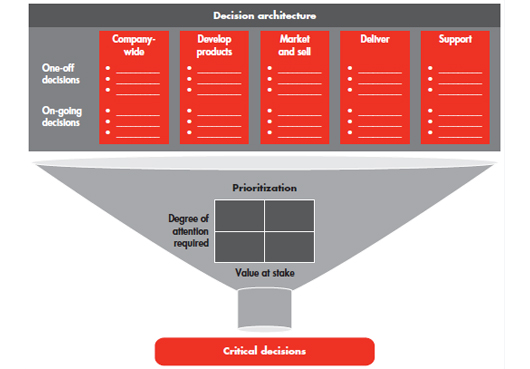
In practice, each company tailors this two-step process to its own situation. Some take a comprehensive approach, listing decision areas (such as brand management) and then identifying important decisions within each area (such as the target customer segment for each brand). Once they have a long list of decisions, they use surveys, interviews and workshops to assess the value and degree of attention required and thus pare down the list.
Other companies take a simpler approach. They create a high-level architecture with decision areas, assign priorities to each area and brainstorm critical decisions only in the areas with the highest priority. Both approaches can work, and both are likely to produce 20 to 30 decisions to focus on. Nike, for example, identified 10 major decision areas, including category selection, budgeting and targeting, and channel and sales strategy. Then the company came up with 33 key decisions under the 10 headings.
Using a decision X-ray to analyze critical decisions
Once you have a clear sense of your organization’s critical decisions and have highlighted those that most need improvement, it’s always tempting to jump right in and fix things. That’s understandable. But it’s usually more productive first to take a closer look at many of these decisions. How are they working right now? Where are the failings, exactly—decision quality, decision speed, execution of the decision (yield), the effort involved or some combination of the four? What aspects of the organization are holding the decisions back?
To reach that level of specificity, we use a tool called a decision X-ray. In a decision X-ray, leaders ask questions of everyone involved in the selected decisions. How do they rate quality, speed, yield and effort? Who plays what roles, and are the roles clear to all? How well does the process work? Where is the organization helping or hurting? What behaviors get in the way? An X-ray often uncovers issues that a broad survey misses. It can reveal the kinds of actions likely to improve problem areas. It also may turn up issues common to many key decisions.
At Nike, team members used surveys to get broad input on all 33 critical decisions. Then they conducted detailed X-ray-style interviews to get more insight into a few. One set of decisions, for instance, involved how much to invest in new product development. In the previous system, the business unit (such as apparel or footwear) would make the decision. But who should make the decision in the new system? Should it be the business unit, with input from the category organization? Or should the roles be reversed? Survey respondents had a range of views both on how the decisions worked today and on how they should work in the future, with perhaps predictable differences on country versus centre, and category versus sport. Decisions regarding retail strategy for each country showed similar differences.
Nike, of course, wasn’t just interested in diagnosing the issues. The company used the decision X-rays to help resolve them. In workshops, managers clarified how specific decisions should be made in the new matrix. They also proposed other practical changes, such as co-locating project teams that had previously been dispersed throughout the building. That made it easier for teams to communicate and collaborate, and for Nike to deploy teams quickly to the hottest opportunities, whether it was basketball in Poland or swimwear in Germany. The one-two punch of identifying the critical decisions and then X-raying them to determine specific fixes helped Nike get the new matrix working without missing a beat in performance.
Many attempts to reshape organizations inevitably have a scattershot quality—a little bit here, a little bit there. The teams leading the charge never really know whether the changes they’re working so hard on will have a real effect. But viewing the organization with critical decisions in mind transforms the process. You’re now focused on what matters—and you know that improving these decisions will generate better performance.
Marcia W. Blenko is a partner with Bain & Company and leads the firm’s Global Organization practice. Paul Rogers is the managing partner of Bain’s London office. Michael C. Mankins is a partner with Bain’s San Francisco office. He leads Bain’s Organization practice in the Americas and is a key member of the firm’s Strategy practice.
How to conduct a decision X-ray
A decision X-ray assesses the effectiveness of the particular decision and diagnoses what’s holding it back. You can gather people in a room (physical or virtual), conduct a series of interviews or send out a broader online survey. Start with gauging quality, speed, yield and effort. Then assess which organizational elements may be standing in the way of an effective decision. Of course, if an area is particularly strong, you’ll want to note that, too. Decision effectiveness is as much about building on strengths as it is about fixing weaknesses.
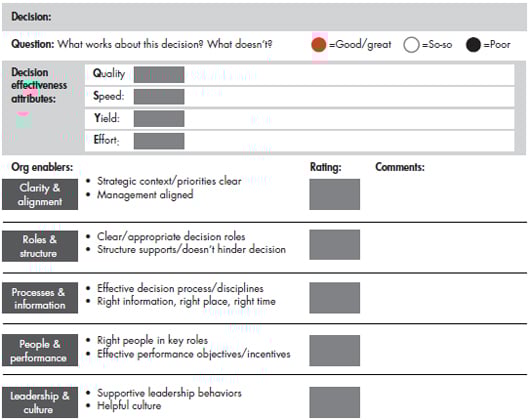
As part of the X-ray, it’s often helpful to sketch out a “day in the life of a decision.” This shows what a decision has to go through—the loops, disconnects and misalignments that slow things down and push people toward lowest-common-denominator solutions. Mapping the actual steps a decision goes through, rather than the ideal steps encapsulated in a process guide, often leads to a “How could we have let that happen?” moment. It also provides concrete ideas on how to fix the problem.
First published in 11月 2010