

論説
The leaders of UD Trucks in Japan, formerly Nissan Diesel, had laid the groundwork for a major transformation, focusing the company on sales to large, nationwide operators and growth in profitable after-sales service. But some important decisions weren’t working well. Decisions about pricing and service levels for key national accounts, for example, weren’t integrated across the network. Each branch set its own policy.
Assigning roles and establishing better processes for decisions like these would help, but they wouldn’t be enough to put UD Trucks on the road to success. The firm needed a major organizational realignment. Its structure was too complicated. The organization’s key performance indicators didn’t focus people on the right things. And the company’s culture didn’t yet support a truly integrated national strategy. How could UD Trucks turn its new strategy into a reality?
Decisions determine performance. If you want to outstrip your competitors, your company has to make better decisions than they do, make them faster and execute them more effectively.1
But people at every level make important decisions, so a company’s decision capabilities ultimately depend on its organization. Every element of the organizational system—the people, the processes, the incentives, the culture and so on—must explicitly reinforce good, quick decision making and execution.
If you accept those premises, then you have at your disposal a wholly new way of approaching organizational change. You no longer have to rely on hopes and prayers that your organizational initiatives will somehow have a positive impact. Instead, you can focus specifically on the changes to the organizational system that will most affect decision making and execution—and you can be confident that these will improve both financial performance and employee morale. The key to the new approach is to replace traditional questions about organizational change with questions focused squarely on decisions.
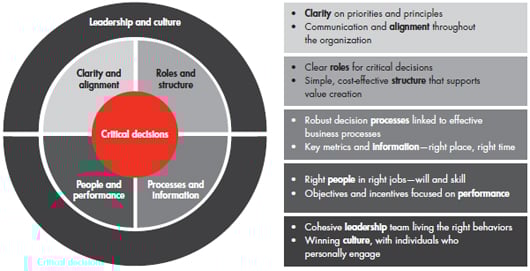
Clarity
• Traditional question: Do we have a clear and compelling mission and vision?
• Decision-centered question: Are we clear on our top three to five business priorities, and on what they mean for decision making and execution in each part of the organization?
When people understand a company’s priorities, they can make good decisions about what to do. British American Tobacco (BAT), for example, was once comprised of four competing companies. New CEO Martin Broughton eliminated the internal competition and set out a goal of regaining the No. 1 spot in the industry. A very few priorities and principles guided decisions under this framework. The company’s new focus on growth in premium global brands allowed people to worry less about local value brands. A new emphasis on achieving savings through global scale in procurement encouraged people to seek out suppliers that could deliver those savings. Clarity on the few priorities that would create value for BAT’s business provided the context people needed to make and execute decisions in line with those priorities.
Alignment
• Traditional question: Do we have effective internal communications?
• Decision-centered question: Are we helping everyone in the organization understand our objectives and strategy so that they have the context they need to make and execute decisions?
Though executives talk a lot about alignment, it’s hard to align a leadership team that is spread out over regions, functions and business units. Even harder—yet even more critical to effective decisions—is ensuring alignment throughout the organization, so that people at all levels can make and execute decisions in line with the company’s top priorities. One key to this is good communication: spreading the word about goals and priorities through clear, simple messages, usually repeated many times through many different methods.
A few years ago, the Zurich-based power equipment and automation company ABB transformed the way it made and executed decisions. Thanks to the company’s extensive communication, no one at ABB could miss the fact that things were changing. The five members of the executive team distributed a video explaining the core elements of the transformation. Each team member spent a huge amount of time out rallying the troops. Every employee got a weekly email from the CEO talking about the new ABB—what the priorities were, what the challenges were, how the company was doing. The email included a feedback tool so that employees could let the CEO know any questions or concerns.

Decide & Deliver
Learn more about the five steps that leading organizations use to make great decisions quickly and execute them effectively.
Roles
• Traditional question: Who should report to whom?
• Decision-centered question: What are the specific roles and accountabilities for our critical decisions?
Today, traditional job descriptions and reporting lines often say little about who should play particular roles in major decisions. That’s why many companies find it valuable to spell out those roles with a decision-rights tool such as RAPID®2, described in the previous article in this series. The letters in RAPID stand for each of the five major roles in any decision: Recommend, offer Input, Agree, Decide and Perform.
For RAPID to be effective, however, companies need accountability guidelines—broad principles that help managers know where decisions should sit. BAT’s guidelines, for instance, reflect the company’s need to balance strong global roles in key areas such as brand management and procurement with local autonomy in execution and customer relationships. Following such principles, managers can quickly use a tool such as RAPID to clarify roles in hundreds of decisions.
Structure
• Traditional question: Is our structure aligned with our strategy?
• Decision-centered question: Does our structure support the decisions most critical to creating value?
Structure is rarely the chief culprit behind poor decision making and execution. Senior leaders should scrutinize other organizational elements before shouldering the expense of a reorganization. But if a reorg is necessary, the key to success is aligning the structure with the business’s most important decisions. UD Trucks, for instance, consolidated 10 regional sales companies into a single national sales group that was better suited to the new integrated strategy. A guiding principle for the move: the new group could make better decisions about how to pursue the large, nationwide operators that were critical to the strategy’s success.
Processes
• Traditional question: Are our core business processes effective and efficient?
• Decision-centered question: Are our processes geared to produce effective, timely decisions and action?
Most companies spend a lot of time engineering and reengineering their business processes, but they often fail to consider the decisions involved. At the Internet company Yahoo!, for instance, every new product, such as a new version of the home page, moves through well-defined processes. Yahoo! people develop it, market it to advertisers and users, launch it and eventually make sure it operates effectively. But the company had originally designed those processes without specifying and coordinating the critical decisions each one entailed. So product development might consider a new product finished, even though the regions hadn’t yet weighed in on the degree of flexibility needed to meet local user needs.
To remove the blockages, team members carefully defined where the new-product development process stopped and the marketing process began. That helped to ensure coordination of decisions and kept things from slipping through the cracks.
Information
• Traditional question: Do our information systems support our business objectives?
• Decision-centered question: Do the people in key decision roles have the information they need when and how they need it?
In theory, every improvement in a company’s IT systems provides more or better information. But it’s easy for managers to get overloaded. So the real key is to think through exactly what’s required for critical decisions and figure out how to make that information available in a systematic way. Lafarge’s Aggregates & Concrete Division, under executive vice president Tom Farrell, realized that some of its most important decisions involved its fleet of heavy mobile equipment, which was scattered across 620 sites in 25 countries. Farrell invested in a system that captured information about equipment at each site—the location of individual machines, usage levels, maintenance logs and so forth— and married that data with a standard analytic process reflecting group best practices. This system allowed local managers to make betterinformed decisions about fleet size, maintenance schedules and equipment sharing between sites.
People
• Traditional question: Are we winning the war for talent?
• Decision-centered question: Do we put our best people in the jobs where they can have the biggest impact on decisions?
The key positions in any organization are those with the biggest impact on critical decisions. Since some critical decisions involve everyday operations, key positions can be anywhere in the organization, including on the frontline. The individuals who can best fill key positions are people with the skills to make and execute decisions well and quickly, and the will to do so. Looking at your organization from this perspective may change how you think about talent. One technology company, for instance, found that fewer than 30 percent of its mission-critical positions were filled by top performers. And it found that only 40 percent of its top performers were in key positions. This approach to deployment helped the company make the most of its talent pool and improve its decision effectiveness.
Performance-linked incentives
• Traditional question: Is our compensation competitive with our peers?
• Decision-centered question: Do our performance objectives and incentives focus people on making and executing the right decisions for the business?
Nearly every well-run company translates company goals and metrics into performance objectives and incentives for individual managers and employees. But the incentives have to encourage good decision making and execution. UD Trucks, for example, had been rewarding its salesforce mainly on the number of trucks sold in a given period, with only a small incentive for after-sales services. To ensure that incentives helped sales reps make the right decisions about their time and their interactions with customers, the company added new targets for truck inspections (a leading indicator of service revenue) and service profits. During the last recession, this focus helped UD Trucks make up for falling sales volumes with greater service revenue, keeping the operation profitable.
Leadership behaviors
• Traditional question: Do we have an effective leadership team?
• Decision-centered question: Do our leaders at all levels consistently demonstrate effective decision behaviors?
An organization’s leaders set the tone for handling decisions. But some may second-guess assigned decision makers or make snap decisions without adequate information. To avoid these traps, high-performing organizations define the behaviors they want to see and support people as they adopt those behaviors. When he was CEO of Gillette, Jim Kilts noticed a lot of hallway chatter after meetings—some people were passively resisting decisions made in those meetings. So he asked his team to agree to a specified code of behaviors, including open and honest debate and wholehearted support for a decision once made. Gillette’s executives at the time received four separate annual ratings on their behaviors, one from themselves, one from peers, one from direct reports and one from Kilts. The score affected a meaningful portion of their bonus pay.
Culture
• Traditional question: Do we have a highperformance culture?
• Decision-centered question: Does our culture reinforce prompt, effective decision making and action throughout the organization?
Lasting improvements in decision effectiveness often require changing a company’s culture. Though every high-performance culture has its own unique personality, all seem to encourage a remarkably similar set of behaviors—and all of those behaviors support decision effectiveness. People care passionately about winning. They orient themselves outward, focusing on customers and competitors rather than on internal politics. They think like owners and have a bias to action. They build teamwork, and they bring enthusiasm and energy to their jobs. Shinhan Bank has grown to be the second largest in Korea and consistently wins top marks for customer satisfaction. One key factor: its culture of accountability, performance and focus on the customer. This culture “is an invaluable asset unique to Shinhan, which other banks can’t match,” says bank president Baek Soon Lee.
A company that attacks its organizational weak spots will soon find that its decision making and execution improve significantly. For the team at UD Trucks, the list of challenges included structural change, resetting measures and incentives, establishing a clearer context for decisions and building a culture focused on nationwide success. These moves allowed the company to make and execute the decisions essential to achieving its goals and to deliver a multimillion-dollar improvement in operating income. With an organization that decides and delivers, your company can do the same.
Marcia W. Blenko is a partner with Bain & Company and leads the firm’s Global Organization practice. Paul Rogers is the managing partner of Bain’s London office. Michael C. Mankins is a partner with Bain’s San Francisco office. He leads Bain’s Organization practice in the Americas and is a key member of the firm’s Strategy practice.
1 See the book Decide & Deliver: 5 Steps to Breakthrough Performance in Your Organization (Harvard Business Review Press, 2010), from which this article is adapted.
2 RAPID® is a registered trademark of Bain & Company, Inc.
First published in 1月 2011