

M&A Report

概要
- Acquisitions to advance an energy transition now represent 27% of all deals in energy and natural resources.
- This comes at a time when energy and natural resources companies are more flush with cash than any other industry, depending on the sector or region.
- Energy transition deals have different risk/return profiles than previous deals, and they require fundamentally different approaches to value creation.
- It is critical to focus attention on revenue synergies, identifying business model opportunities by geography, product line, market, and specific customer.
This article is part of Bain's 2023 M&A Report.
How rapidly are energy and natural resources (ENR) portfolios changing? Our recent survey of M&A practitioners found that 80% of energy industry respondents have proactively evaluated separating or spinning off parts of the business. In the first nine months of 2022, divestitures activity totaled $250 billion—that’s more than any other industry.
Indeed, companies are racing to dispose of carbon-heavy assets. Enel, a global energy company based in Italy, recently announced plans to sell assets valued at $21.5 billion, representing 15% to 20% of the company’s enterprise value. The move was part of a strategy to streamline its business and push electrification across the full value chain in Europe, the US, and Latin America as well as to cut debt. In oil and gas, TotalEnergies is spinning off its Canadian oil sands operations and plans to list the new company on the Toronto Stock Exchange. The assets simply don’t fit with the company’s new low-emissions strategy.
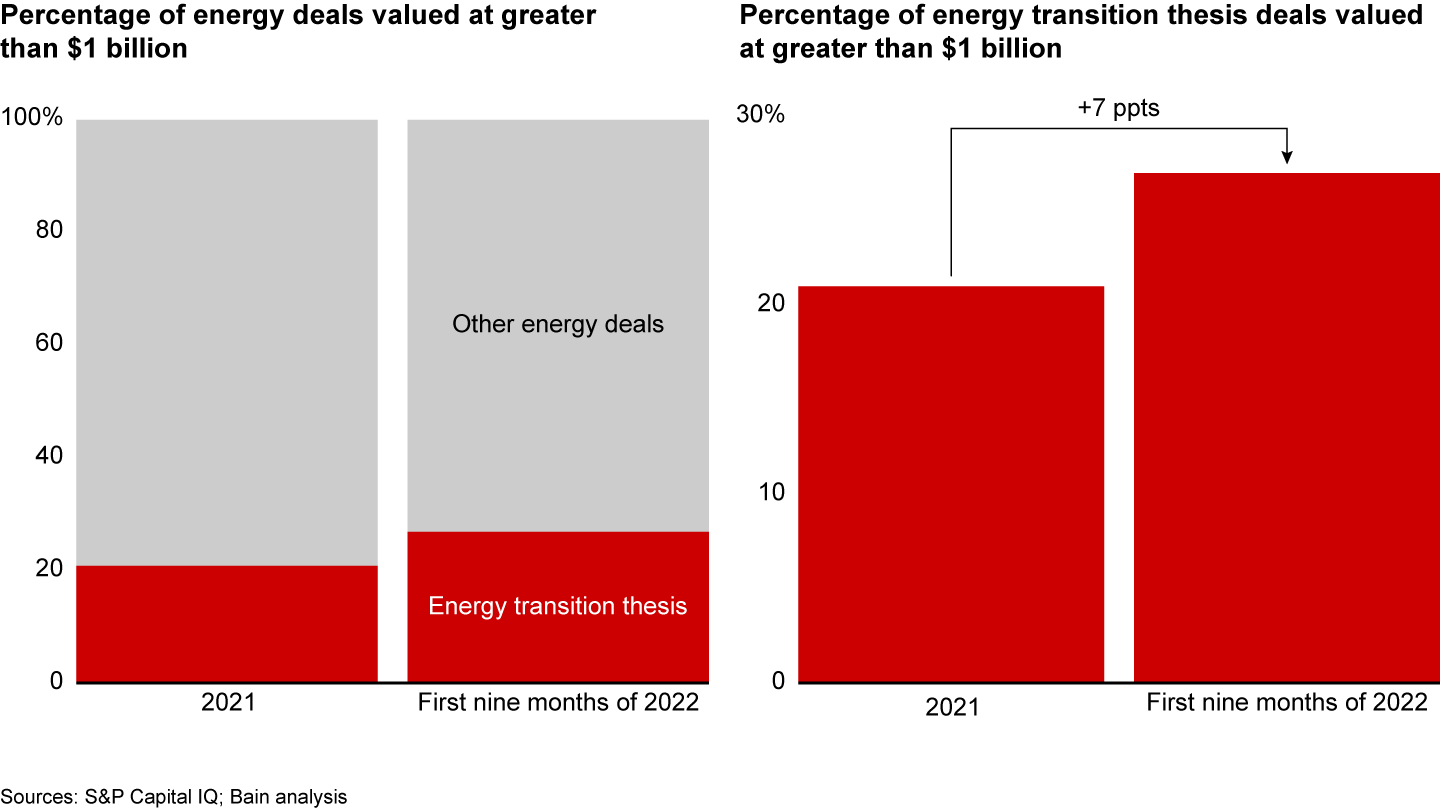
While these spin-offs are happening, acquisitions related to the energy transition as a percentage of all deal volume is steadily growing, from 21% in 2021 to 27% in the first three quarters of 2022 (see Figure 1). We think this trend toward portfolio rebalancing will accelerate in 2023 and the coming years. In the Bain M&A Practitioners’ 2023 Outlook Survey, 72% of energy and natural resources respondents said the most common investment thesis will be either expanding into new areas of business or building new engines of growth. (We refer to them as an Engine 2, a new business within an existing company that uses the scale benefits of the core business to grow faster than an independent start-up could.) This comes at a time when ENR companies are flush with more cash than any other industry ($300 billion), although with some discrepancies between sectors and regions. This will fuel their investments in the energy transition.
Figure 1

New types of deals, new challenges
In last year’s M&A report, we talked about why these deals are becoming so important. Now, we focus on the how. The new wave of M&A—namely, scope deals to enable energy transition—is becoming more competitive and has a different risk/return profile than previous deals, requiring fundamentally different approaches to value creation. Scale deals succeed based on rapid overall integration, capture of cost synergies, and full cultural integration. Scope deals, however, require a much more tailored approach when it comes to deciding what to preserve, what to integrate, and how to evolve the business strategy to make the most of the core strengths of the acquirer (if possible).
Scope deals to enable an energy transition are becoming more competitive.
In the chemical industry, for example, LyondellBasell formed a joint venture called Source One Plastics to build an energy-efficient, advanced plastic waste sorting and recycling facility in Germany, using LyondellBasell’s proprietary MoReTec technology and working with its customers, who are increasingly demanding renewable and circular solutions. Recognizing that the business model requires greater investment in technology and interaction with customers than its legacy commodity business, LyondellBasell created a separate business unit with its own leadership team, management processes, and salesforce.
Bain’s experience from hundreds of scope M&A transactions indicates that while returns can be comparable to scale M&A, there is a much wider range of outcomes. Three features of scope deals make them more difficult:
- By definition, scope deals occur outside the acquirer’s core business, geographies, or competencies. The risk is that the acquirer stumbles as it learns to manage an unfamiliar business.
- Scope deals often involve finding and knitting together new capabilities that serve as the source of competitive advantage in Engine 2 activities. This requires the acquirer to think several steps ahead and identify other potential businesses and companies to bolt on to the one currently being acquired. As transaction multiples have increased in recent years, we’ve observed the more aggressive acquirers being willing to incorporate anticipated synergies from future acquisitions into the purchase price of their initial deals.
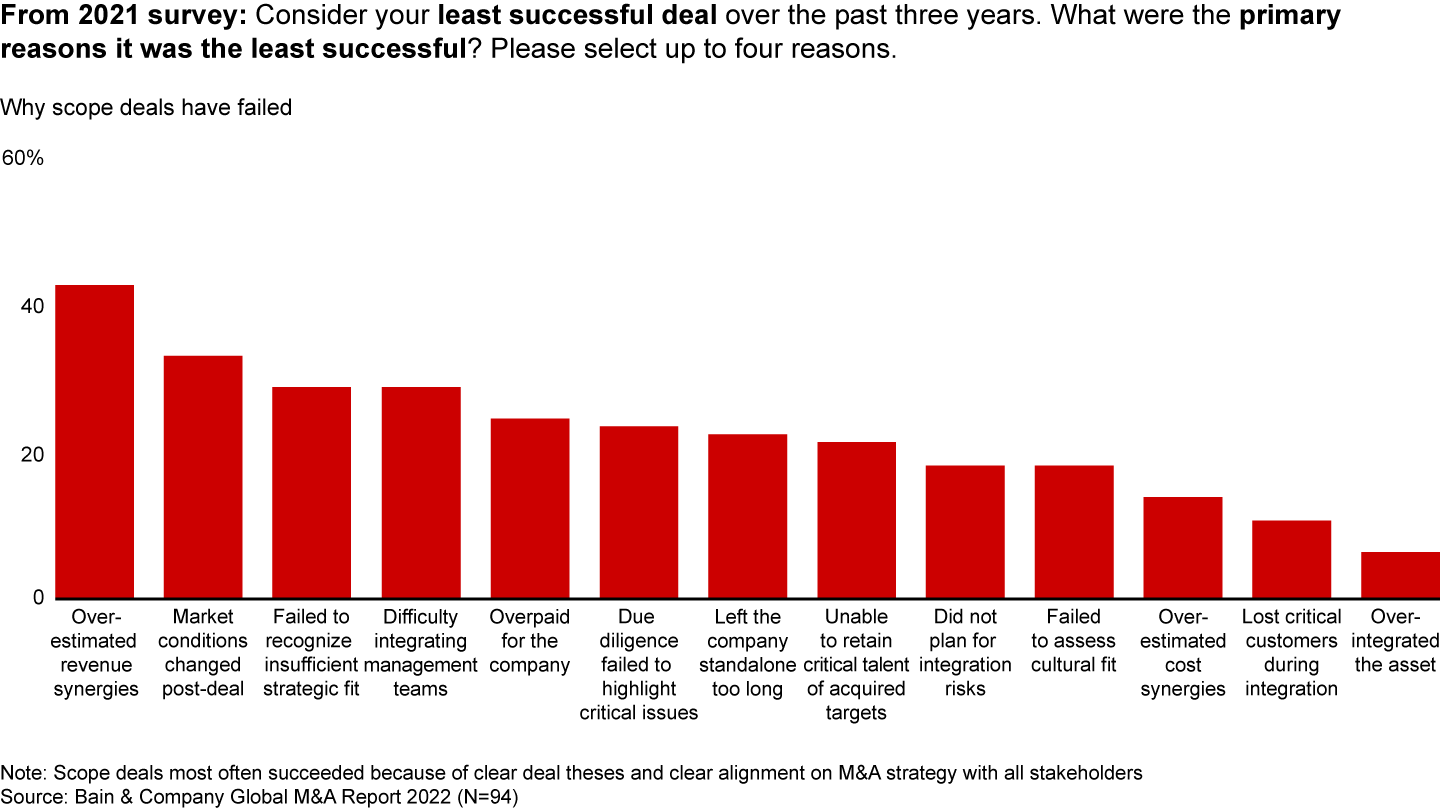
- Scope deals are typically aimed at generating revenue synergies, which inherently come with more risk and less control than cost synergies. In a 2021 Bain survey, M&A practitioners in energy and natural resources cited overestimated revenue synergies as the top reason for deal failure (see Figure 2). Among the causes: In scale transactions, companies are selling into familiar territory, often global commodity markets with established supply and demand patterns; in scope deals, customer needs and market dynamics are not as well known.
Figure 2

Evolving the M&A playbook for energy transition scope deals
Energy companies are relatively less experienced in energy transition scope deals than scale deals, but the reverse is becoming true in other industries as scope transactions represented roughly half of all deals valued in excess of $1 billion in 2021. Those industries have gained a head start in evolving a strong playbook for scope transactions. As a result, energy and natural resources industry dealmakers can learn from what works in other industries.
Reimagine your entire M&A process. Every element of the deal cycle, from M&A strategy to deal thesis to diligence and valuation to merger integration, must be managed differently. The starting point is a rigorous due diligence process. Revenue synergies, for example, have traditionally been treated in diligence as something of an art by dealmakers compared with the relatively more scientific approach common to cost synergies.
In scope transactions, it is critical to devote much more attention to revenue synergies, identifying opportunities by geography, product line, market, and specific customer. In the energy transition, customer requirements are changing, and it is important to develop a proprietary view into where and how that demand is changing—and over what time period. This can be developed through in-depth customer research and speaking to teams on the front line, as well as by using the pre-close period to develop more granular revenue targets for the new combined salesforce. For example, construction chemicals company Sika used focused sales plays to achieve ambitious revenue synergies. Immediately after closing the Parex deal, Sika systematically prioritized and introduced flagship stock-keeping units in these distribution channels, generating quick revenue synergies from a laser focus on what to cross-sell and to whom.
Scope deals require more attention to revenue synergies by geography, product line, market, and specific customer.
Build an integrated value chain to deliver energy transition products and services. Too many scope deals become one-off acquisitions as companies hope to gain access to new profit pools or high-growth markets but then fail to build out a complete portfolio. It’s necessary to define the desired target portfolio of integrated assets and then identify what will be accomplished organically and inorganically. Consider how Shell is building out its footprint of electric vehicle (EV) charging stations globally through its acquisition of ubitricity and others. Shell acquired Greenlots, which provides a software operating platform for EV charging companies that includes real-time charger health status, utilization data, dynamic pricing capabilities, and predictive analytics. Shell also bought a minority stake in microgrid developer GI Energy. Shell has an integrated oil and gas value chain that extends from production, refineries, pipelines, and ultimately through its retail gas stations. These recent EV-related acquisitions in combination show how Shell is following a similar integrated value chain approach, this time for renewable power generation all the way through delivery to the ultimate end user.
In another example, many energy companies are exploring carbon capture, utilization, and storage (CCUS) technologies to both abate the carbon emissions of their existing portfolio while they also develop new lines of business. In 2020, Petronas announced its ambition to achieve net-zero carbon emissions by 2050, recognizing the important role CCUS would have in achieving these targets. Petronas identified 19 potential sites to manage a carbon storage portfolio for emissions produced by its operations and establish a regional storage hub for carbon emissions as a revenue generator. Since that initial announcement, it has engaged in different acquisitions or partnerships, giving Petronas access to new and cost-effective CCUS technologies to capture the carbon emissions as well as transportation to market liquified carbon dioxide in the Asia-Pacific and Oceania regions. Petronas’s goal is to create a full CCUS ecosystem, and M&A and strategic partnerships have been a critical accelerator of these plans.
Start with a clear integration thesis, and integrate where it matters. Scope deals succeed when the acquirer preserves the unique attributes of the company it has just bought, integrating the two only where it matters—as well as when the two businesses begin to cross-pollinate, creating platforms for future growth. Shell is using its capabilities for developing oil and gas projects in harsh environments to build offshore wind farms. In November, Shell formed a partnership with Alternergy, a renewable energy company, to develop an initial one gigawatt of generation capacity in the Philippines. Shell’s experience with megaprojects brings industry-leading project capabilities and a global supply chain to more rapidly scale the new development.
As the industry turns to M&A to speed the energy transition, companies that achieve the most success will be those that acknowledge how different these deals are from the traditional scale deals that proliferated in their industry for decades. And they will master a new playbook, one that is thoughtfully revised for this time of historic possibilities.
Read our 2023 M&A Report
Overview
Hot Topics
Industry Views
Regional Perspectives
First published in 1月 2023