
Skip to Content
  • オフィス

    オフィス

    北米・南米
    • Atlanta
    • Austin
    • Bogota
    • Boston
    • Buenos Aires
    • Chicago
    • Dallas
    • Denver
    • Houston
    • Los Angeles
    • Mexico City
    • Minneapolis
    • Monterrey
    • Montreal
    • New York
    • Rio de Janeiro
    • San Francisco
    • Santiago
    • São Paulo
    • Seattle
    • Silicon Valley
    • Toronto
    • Washington, DC
    ヨーロッパ・中東・アフリカ
    • Amsterdam
    • Athens
    • Berlin
    • Brussels
    • Copenhagen
    • Doha
    • Dubai
    • Dusseldorf
    • Frankfurt
    • Helsinki
    • Istanbul
    • Johannesburg
    • Kyiv
    • Lisbon
    • London
    • Madrid
    • Milan
    • Munich
    • Oslo
    • Paris
    • Riyadh
    • Rome
    • Stockholm
    • Vienna
    • Warsaw
    • Zurich
    アジア・オーストラリア
    • Bangkok
    • Beijing
    • Bengaluru
    • Brisbane
    • Ho Chi Minh City
    • Hong Kong
    • Jakarta
    • Kuala Lumpur
    • Manila
    • Melbourne
    • Mumbai
    • New Delhi
    • Perth
    • Shanghai
    • Singapore
    • Sydney
    • Tokyo
    全てのオフィス
  • アルムナイ
  • メディア
  • お問い合わせ
  • 東京オフィス
  • Japan | 日本語

    地域と言語を選択

    グローバル
    • Global (English)
    北米・南米
    • Brazil (Português)
    • Argentina (Español)
    • Canada (Français)
    • Chile (Español)
    • Colombia (Español)
    ヨーロッパ・中東・アフリカ
    • France (Français)
    • DACH Region (Deutsch)
    • Italy (Italiano)
    • Spain (Español)
    • Greece (Elliniká)
    アジア・オーストラリア
    • China (中文版)
    • Korea (한국어)
    • Japan (日本語)
  • Saved items (0)
    Saved items (0)

    You have no saved items.

    後で閲読、共有できるようにするためにブックマークしてください

    Explore Bain Insights
  • 業界別プラクティス
    メインメニュー

    業界別プラクティス

    • 航空宇宙、防衛、政府関連
    • 農業
    • 化学製品
    • インフラ、建設
    • 消費財
    • 金融サービス
    • ヘルスケア
    • 産業機械、設備
    • メディア、エンターテインメント
    • 金属
    • 採掘・鉱業
    • 石油、ガス
    • 紙、パッケージ
    • プライベートエクイティ
    • 公共、社会セクター
    • 小売
    • テクノロジー
    • 通信
    • 交通
    • 観光産業
    • 公益事業、再生可能エネルギー
  • 機能別プラクティス
    メインメニュー

    機能別プラクティス

    • カスタマー・エクスペリエンス
    • サステイナビリティ、 社会貢献
    • Innovation
    • 企業買収、合併 (M&A)
    • オペレーション
    • 組織
    • プライベートエクイティ
    • マーケティング・営業
    • 戦略
    • アドバンスド・アナリティクス
    • Technology
    • フルポテンシャル・トランスフォーメーション
  • Digital
  • 知見/レポート
  • ベイン・アンド・カンパニーについて
    メインメニュー

    ベイン・アンド・カンパニーについて

    • ベインの信条
    • 活動内容
    • 社員とリーダーシップ
    • プレス・メディア情報
    • クライアントの結果
    • 受賞歴
    • パートナーシップを結んでいる団体
    Further: Our global responsibility
    • ダイバーシティ
    • 社会貢献
    • サステイナビリティへの取り組み
    • 世界経済フォーラム(WEF)
    Learn more about Further
  • キャリア
    メインメニュー

    キャリア

    • ベインで働く
      キャリア
      ベインで働く
      • Find Your Place
      • ベインで活躍する機会
      • ベインのチーム体制
      • 学生向けページ
      • インターンシップ
      • 採用イベント
    • ベインでの体験
      キャリア
      ベインでの体験
      • Blog: Inside Bain
      • キャリアストーリー
      • 社員紹介
      • Where We Work
      • 成長を後押しするサポート体制
      • アフィニティ・グループ
      • 福利厚生
    • Impact Stories
    • 採用情報
      キャリア
      採用情報
      • 採用プロセス
      • 面接内容
    FIND JOBS
  • オフィス
    メインメニュー

    オフィス

    • 北米・南米
      オフィス
      北米・南米
      • Atlanta
      • Austin
      • Bogota
      • Boston
      • Buenos Aires
      • Chicago
      • Dallas
      • Denver
      • Houston
      • Los Angeles
      • Mexico City
      • Minneapolis
      • Monterrey
      • Montreal
      • New York
      • Rio de Janeiro
      • San Francisco
      • Santiago
      • São Paulo
      • Seattle
      • Silicon Valley
      • Toronto
      • Washington, DC
    • ヨーロッパ・中東・アフリカ
      オフィス
      ヨーロッパ・中東・アフリカ
      • Amsterdam
      • Athens
      • Berlin
      • Brussels
      • Copenhagen
      • Doha
      • Dubai
      • Dusseldorf
      • Frankfurt
      • Helsinki
      • Istanbul
      • Johannesburg
      • Kyiv
      • Lisbon
      • London
      • Madrid
      • Milan
      • Munich
      • Oslo
      • Paris
      • Riyadh
      • Rome
      • Stockholm
      • Vienna
      • Warsaw
      • Zurich
    • アジア・オーストラリア
      オフィス
      アジア・オーストラリア
      • Bangkok
      • Beijing
      • Bengaluru
      • Brisbane
      • Ho Chi Minh City
      • Hong Kong
      • Jakarta
      • Kuala Lumpur
      • Manila
      • Melbourne
      • Mumbai
      • New Delhi
      • Perth
      • Shanghai
      • Singapore
      • Sydney
      • Tokyo
    全てのオフィス
  • アルムナイ
  • メディア
  • お問い合わせ
  • 東京オフィス
  • Japan | 日本語
    メインメニュー

    地域と言語を選択

    • グローバル
      地域と言語を選択
      グローバル
      • Global (English)
    • 北米・南米
      地域と言語を選択
      北米・南米
      • Brazil (Português)
      • Argentina (Español)
      • Canada (Français)
      • Chile (Español)
      • Colombia (Español)
    • ヨーロッパ・中東・アフリカ
      地域と言語を選択
      ヨーロッパ・中東・アフリカ
      • France (Français)
      • DACH Region (Deutsch)
      • Italy (Italiano)
      • Spain (Español)
      • Greece (Elliniká)
    • アジア・オーストラリア
      地域と言語を選択
      アジア・オーストラリア
      • China (中文版)
      • Korea (한국어)
      • Japan (日本語)
  • Saved items  (0)
    メインメニュー
    Saved items (0)

    You have no saved items.

    後で閲読、共有できるようにするためにブックマークしてください

    Explore Bain Insights
  • 業界別プラクティス
    • 業界別プラクティス

      • 航空宇宙、防衛、政府関連
      • 農業
      • 化学製品
      • インフラ、建設
      • 消費財
      • 金融サービス
      • ヘルスケア
      • 産業機械、設備
      • メディア、エンターテインメント
      • 金属
      • 採掘・鉱業
      • 石油、ガス
      • 紙、パッケージ
      • プライベートエクイティ
      • 公共、社会セクター
      • 小売
      • テクノロジー
      • 通信
      • 交通
      • 観光産業
      • 公益事業、再生可能エネルギー
  • 機能別プラクティス
    • 機能別プラクティス

      • カスタマー・エクスペリエンス
      • サステイナビリティ、 社会貢献
      • Innovation
      • 企業買収、合併 (M&A)
      • オペレーション
      • 組織
      • プライベートエクイティ
      • マーケティング・営業
      • 戦略
      • アドバンスド・アナリティクス
      • Technology
      • フルポテンシャル・トランスフォーメーション
  • Digital
  • 知見/レポート
  • ベイン・アンド・カンパニーについて
    • ベイン・アンド・カンパニーについて

      • ベインの信条
      • 活動内容
      • 社員とリーダーシップ
      • プレス・メディア情報
      • クライアントの結果
      • 受賞歴
      • パートナーシップを結んでいる団体
      Further: Our global responsibility
      • ダイバーシティ
      • 社会貢献
      • サステイナビリティへの取り組み
      • 世界経済フォーラム(WEF)
      Learn more about Further
  • キャリア
    人気検索キーワード
    • デジタル
    • 戦略
    前回の検索
      最近訪れたページ

      Content added to saved items

      Saved items (0)

      Removed from saved items

      Saved items (0)

      M&A Report

      M&A in Energy and Natural Resources: The Circular Economy Is Not Linear

      M&A in Energy and Natural Resources: The Circular Economy Is Not Linear

      The path to a low-carbon future now looks less straightforward, rockier, and more expensive than it did just a few years ago.

      著者:Whit Keuer and Arnaud Leroi

      • min read
      }

      レポート

      M&A in Energy and Natural Resources: The Circular Economy Is Not Linear
      en
      At a Glance
      • After three years of steady growth, energy transition deals plateaued in the first nine months of 2023.
      • Energy and natural resources companies are balancing deals between reinforcing the core businesses and promoting a low-carbon agenda.
      • To strike the right balance, the best companies will take a more targeted approach to their energy transition acquisitions.

      This article is part of Bain's 2024 M&A Report.

      Explore the report

      Companies in the energy and natural resources (ENR) industries face a strategic crossroads. Do they invest and pursue deals to shore up their legacy higher-carbon businesses, where profit pools are potentially poised to decline given the world’s ambition to accelerate to net zero, or do they shift their focus to businesses that deliver on the clean energy transition, where profit pools are growing rapidly from a much smaller base?

      That question is at the heart of M&A strategy for all ENR companies, and the year 2023 gave us a glimpse of how they are answering it. After three years of increasing growth, the volume of energy transition deals plateaued (likely temporarily) as companies readjust their priorities and demonstrate that the movement to a lower-carbon future and a circular economy is not linear. That path now appears less straightforward, rockier, and more expensive than it did just a few years ago.

      Look at the numbers. In 2020, 19% of M&A total deal volume (for deals in excess of $1 billion) was related to the energy transition, and that number increased to 21% in 2021 and 27% in 2022 before leveling at 25% for the first nine months of 2023 (see Figure 1). We see this as an initial stabilization before continued capital rotation toward the energy transition in the latter part of the decade.

      Figure 1
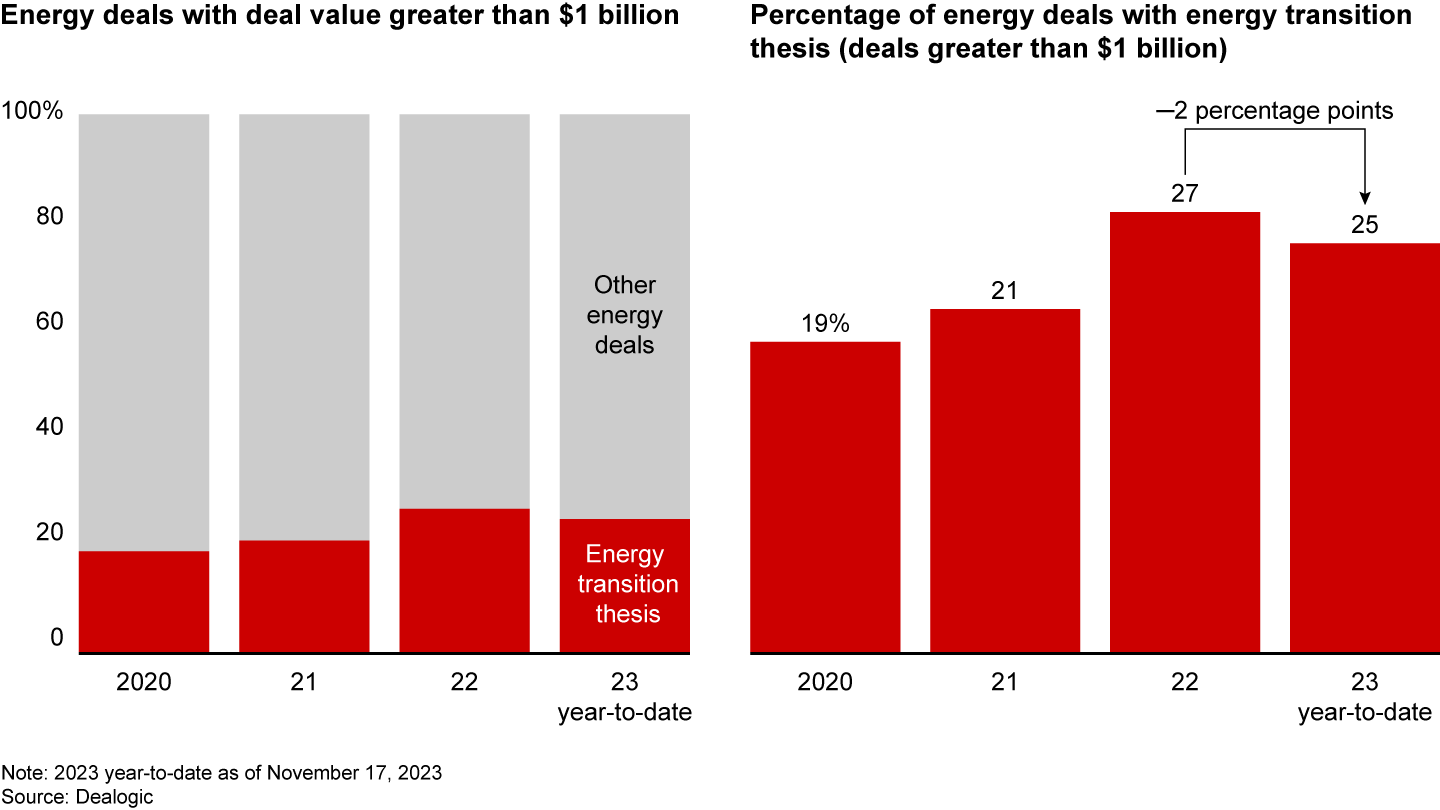
      The energy transition deal thesis sharply increased in 2022, but it has begun to plateau

      There are several factors influencing this shift.

      First, US government subsidies haven’t been enough to fully offset higher interest rates and supply chain costs, and geopolitical tensions are shifting some of the focus to energy security. A number of energy sectors have felt the impact—most prominently, the offshore wind markets. Ørsted had a record $4 billion impairment loss and canceled two high-profile projects in the US, for example.

      Also, equity markets have not valued energy transition investments. Valuation multiples for European international oil companies (IOCs) have traded at discounts to their more premium-rated US-based IOC peers. A specific goal for the European IOCs is to narrow and even close the structural valuation gap with US IOCs. Earlier this year, both Shell and BP signaled an intention to lean back into oil and gas, prolonging production. Similarly, market valuations for pure play renewable power companies have fallen, with the iShares Global Clean Energy ETF down 27% in 2023 as of December 1.

      A final reason for the shift: Energy transition investments typically involve project financing and modest debt levels, and today’s uncertain macroeconomic backdrop and higher interest rates have made project economics less attractive.

      This has made it even more difficult for energy companies to balance the dual challenge of continuing to spur performance in their core hydrocarbon businesses—in safety, productivity, cost, carbon, and capital productivity—while demonstrating that they also are worthy custodians of clean energy capital.

      This tension between improving performance in the core hydrocarbon business and advancing the fragmented, disorderly, and nonlinear energy transition can be seen in M&A activity throughout the industry. In oil and gas, ExxonMobil and Chevron recently invested more than $110 billion to acquire Pioneer and Hess, respectively. These are investments in their core businesses and are great examples of how companies are taking decisive action to enhance scale, reinforce the core components of their existing portfolios, ensure that their reserves and resources are abundant and competitive, and beef up their integrated value chains.

      But these large acquisitions do not need to be made at the expense of continued strategic investments in the energy transition. For example, ExxonMobil recently purchased lithium drilling rights on 120,000 acres in the US and aims to become a major US supplier for makers of electric vehicle (EV) batteries by 2030. It’s part of ExxonMobil’s long-term effort to reposition itself for the advancement of EVs and electrification in transportation. For its part, Chevron set an ambition to become a leader in renewable fuels by producing 100,000 barrels per day by 2030. It has a focused M&A strategy with two completed acquisitions and one joint venture—deals that advanced Chevron halfway toward that goal.

      As they rebalance their M&A strategies to reinforce the core to fuel investments during the energy transition, we see five things that ENR companies can do to improve their odds of success.

      • Clarify your business model for the energy transition. When it comes to making deals to scale their energy transition, different companies are placing different bets on where the profitability and growth will be across the value chain. Some are seeking to become green energy operators and lead the development and operation of energy transition assets; these companies work to transform their entire portfolios. Other companies are more targeted in their participation strategies, opting to establish leadership in specific emerging technologies or build technical expertise to become a differentiated service provider. Either way, companies need to clearly articulate their model.
      • Identify pinch points in value chains and where you need to be a first mover vs. a fast follower. In some markets, the first mover will have significant strategic advantages and be positioned to capture the majority of the profit pool. In circular plastics, for instance, it is critical to gain access to feedstocks by forming partnerships or joint ventures with local waste companies. Eastman Chemicals did this by entering into joint ventures with waste and recycling companies in France, which then feed their chemical recycling facilities. There is only so much recycled content in any given market, however, which creates a winner-takes-all dynamic and rewards the first mover. What makes a joint venture succeed? The most important things we found were overinvesting in partner fit assessment up front, having top management involved from the start (and staying involved), and establishing governance that takes a win-win approach. Joint ventures only work when everyone wins.
      • Determine the appropriate ownership structure across the value chain. Is it build or buy? And if it’s buy, decide whether to partner or pursue joint ventures vs. M&A. Bain analysis across industries found that among the 58 most successful Engine 2 businesses, 40 used M&A as a significant part of their scaling plans. In deciding whether to buy or build, companies must ask themselves three key questions: Does the capability or required asset exist? Is the return on investment higher if buying it than building internally? Can you articulate a parenting advantage? For companies that decide to acquire the expertise (rather than build it), it would be a mistake to then try to acquire via M&A all steps in the value chain, some of which may have different business models or require different capabilities to win. There are many nontraditional partnerships emerging that are crossing traditional industry boundaries. One example of such cross-industry collaboration is Engie’s partnership with Air Liquide to produce, store, and distribute green hydrogen.
      • Be more targeted in M&A. A recent Bain survey found that 66% of M&A practitioners in ENR are more selective in the deals they pursue. In this challenging environment, good corporate strategy is more important than ever to define the company’s M&A mission. For example, Phillips 66 has recently focused its energy transition mission on biofuels and pyrolysis oil that will leverage the strengths of its existing core business while paring back other organic and inorganic investments that don’t, such as the production of green hydrogen.
      • Pursue creative financing strategies for energy transition projects. Many companies’ balance sheets are stretched and don’t have capital available. Yet, there is a growth segment of private equity investors dedicated to the energy transition that are willing to participate on a project-specific basis. For example, BlackRock has agreed to invest $550 million in the world's biggest direct air capture project, which is being developed by Occidental Petroleum. In 2022, BlackRock raised $4.5 billion toward an eventual $7.5 billion climate investment goal from global pension funds, insurance companies, and sovereign wealth funds. Similarly, Brookfield Asset Management in 2022 collected $15 billion in capital for an energy transition fund, and the firm is currently collecting for a second fund that it expects to be even bigger. With tight balance sheets and availability of traditional equity and debt much more limited, particularly in oil and gas, companies should look to tap these nontraditional sources of capital more aggressively. There is meaningful dry powder that needs to be put to work.

      Read the Next Chapter

      M&A in Healthcare and Life Sciences: A Shrinking Margin for Error in Deals

      Read our 2024 M&A Report

      Download the PDF Explore the report
      著者
      • Headshot of Whit Keuer
        Whit Keuer
        パートナー, Dallas
      • Headshot of Arnaud Leroi
        Arnaud Leroi
        パートナー, Paris
      関連業種
      • エネルギー、天然資源
      関連するコンサルティングサービス
      • サステイナビリティ、社会貢献
      • 企業買収、合併(M&A)
      コンサルティングサービス
      • Circular Economy
      • Climate Change
      エネルギー、天然資源
      Finding the Sustainable Advantage in Chemicals

      The push for greener operations and products provides new opportunities for chemical producers that invest in new capabilities.

      詳細
      M&A Report
      Media M&A

      AI and other tech tools can boost bidding confidence in this highly competitive environment.

      詳細
      M&A Report
      Mining M&A

      The next frontier isn’t about avoiding failure; it’s about mastering repeatable success.

      詳細
      Circular Economy
      COP30: What Businesses Need to Do Now

      At this year’s COP30 in Brazil, the message for businesses was clear: Climate strategy can’t just be commitments—it must be about execution.

      詳細
      企業買収、合併(M&A)
      Sustainability and M&A in Machinery

      Bain Partner Michael Staebe outlines new sustainable solutions for machinery and equipment leaders.

      詳細

      Overview

      • Looking Back at M&A in 2023: Who Wins in a Down Year?

      • Looking Ahead: How the Big Backlog Will Shape the 2024 M&A Agenda

      Hot Topics

      • Generative AI in M&A: Where Hope Meets Hype

      • Regulation and M&A: How Scrutiny Raises the Bar for Acquirers

      Industry Views

      • Aerospace and Defense M&A

      • Automotive and Mobility M&A

      • Banking M&A

      • Building Products M&A

      • Consumer Products M&A

      • Energy and Natural Resources M&A

      • Healthcare and Life Sciences M&A

      • Insurance M&A

      • Media M&A

      • Payments M&A

      • Retail M&A

      • Technology M&A

      • Telecommunications M&A

      • Wealth and Asset Management M&A

      Regional Perspectives

      • Brazil M&A

      • India M&A

      • Japan M&A

      • Middle East M&A

      First published in 1月 2024
      Tags
      • Circular Economy
      • Climate Change
      • M&A Report
      • エネルギー、天然資源
      • サステイナビリティ、社会貢献
      • 企業買収、合併(M&A)

      クライアント支援事例

      サステイナビリティ、社会貢献 A Manufacturer Vows to “Push to Zero” Carbon Emissions

      ケーススタディを見る

      戦略 New products propel profitability for metals manufacturer

      ケーススタディを見る

      企業買収、合併(M&A) An OFS captures post-merger growth synergies

      ケーススタディを見る

      お気軽にご連絡下さい

      私達は、グローバルに活躍する経営者が抱える最重要経営課題に対して、厳しい競争環境の中でも成長し続け、「結果」を出すために支援しています。

      ベインの知見。競争が激化するグローバルビジネス環境で、日々直面するであろう問題について論じている知見を毎月お届けします。

      *プライバシーポリシーの内容を確認し、合意しました。

      プライバシーポリシーをご確認頂き、合意頂けますようお願い致します。
      Bain & Company
      お問い合わせ Sustainability Accessibility Terms of use Privacy Cookie Policy Sitemap Log In

      © 1996-2026 Bain & Company, Inc.

      お問い合わせ

      How can we help you?

      • ビジネスについて
      • プレス報道について
      • 採用について
      全てのオフィス