

論説

概要
- Private capital markets, which overshadow public markets in value and growth, are dogged by inefficient, opaque processes. Now they look set to experience a step change through tokenized assets and digital platforms powered by distributed ledger technology.
- The biggest opportunities lie in private debt, equity and real estate, given their relative inefficiency compared with public market infrastructure.
- The benefits of digital platforms include more efficient administration processes, embedded transparency and governance, and, eventually, an expanded set of product options and pools of investors.
- Four business models have emerged as viable over the near term. To succeed with each, market participants should take an end-to-end perspective along the entire value chain, from issuance through trading and custody.
Despite decades of technological advances, global capital markets remain characterized by fragmented and siloed networks, with limited interoperability between them. Reconciliation between systems requires extra, sometimes manual, steps. Many processes across the financial ecosystem thus continue to be prone to error and high costs. This applies to public markets but even more acutely to private markets.
As a consequence, a consensus across the global financial ecosystem has emerged: Digitized financial assets and distributed ledger technology (DLT) platforms will substantially improve transparency of information, automation, distribution and, ultimately, liquidity. Adoption of digital assets—assets and regulated financial securities that are represented digitally and administered on digital platforms—will expand beyond the first niche application of cryptocurrencies, with DLT removing many sources of inefficiency.
Exchanges, banks, technology companies and other financial market firms will need to make decisions soon about how to participate, as it takes time to build an economically attractive business model and the required capabilities and partnerships. Postponing this decision comes with the risk of losing strategic position as early movers gain share and replace or create new market infrastructure roles.
Despite uncertainty around the relevant legislation, dominant technologies and trustworthiness of some emerging firms in this space, we expect that digital assets will increasingly serve as substitutes for traditional financial products―not completely replacing them but rather operating side by side for many years. In the near term, DLT platforms can digitally represent traditional assets on a blockchain ledger to deliver more efficient administration, such as in managing collateral. But digital assets will also make inroads in issuance, trading, settlement, transfer and custody, because current systems for private assets involve expensive, manual tasks done by many intermediaries, resulting in cumbersome, duplicative and nontransparent processes.
Private markets beckon
In principle, any type of asset can be tokenized, in the sense that related rights of ownership or entitlement to cash flows, along with obligations, can be captured and stored via DLT. We have already seen oddities, such as shares in a professional athlete’s contract or fractional ownership of a painting. Yet while DLT has earned broad attention and support, the biggest opportunities do not lie in public markets, whose current technologies are fairly efficient and would be expensive and complicated to replace in the near term.
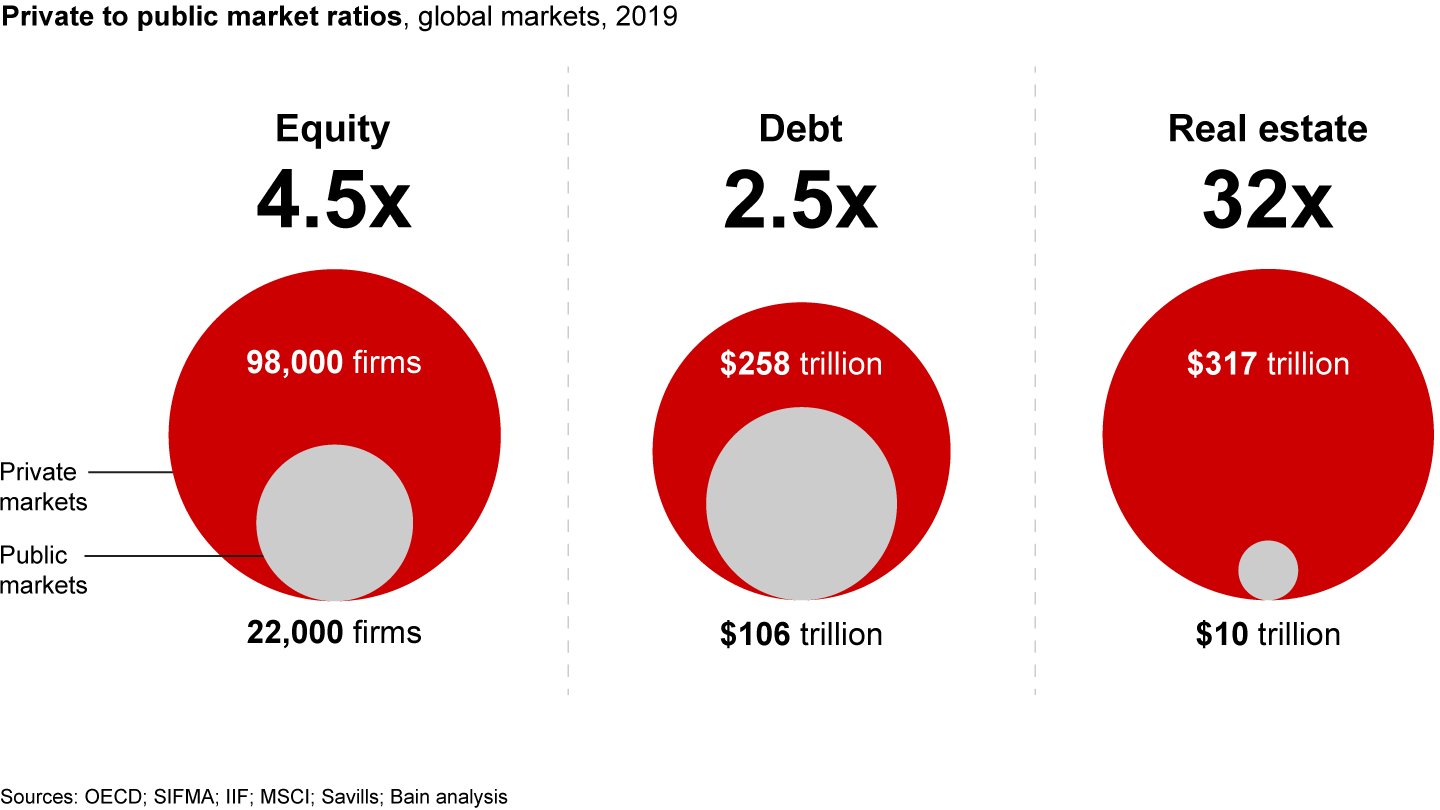
Instead, private markets, which lack such efficient infrastructure, offer the most significant commercial potential. The size of private markets across three major asset classes significantly exceeds public markets by a factor of 2.5 in the case of debt markets, 4.5 in equity markets and over 30 in real estate (see Figure 1).
Figure 1

Recent data suggests the magnitude of the opportunity:
- Equity. In the OECD member countries, of roughly 98,000 firms with more than 250 employees, only 22,000 firms are listed publicly. Digital assets will allow for more efficient administration of assets among alternative asset managers and enable a secondary market.
- Debt. Global debt amounts to $258 trillion, but only $106 trillion of that is traded as securities on the public capital markets.
- Real estate. Global real estate amounts to $317 trillion, but only $10 trillion of that is managed in funds and available to a broader investor base through the public real estate market.
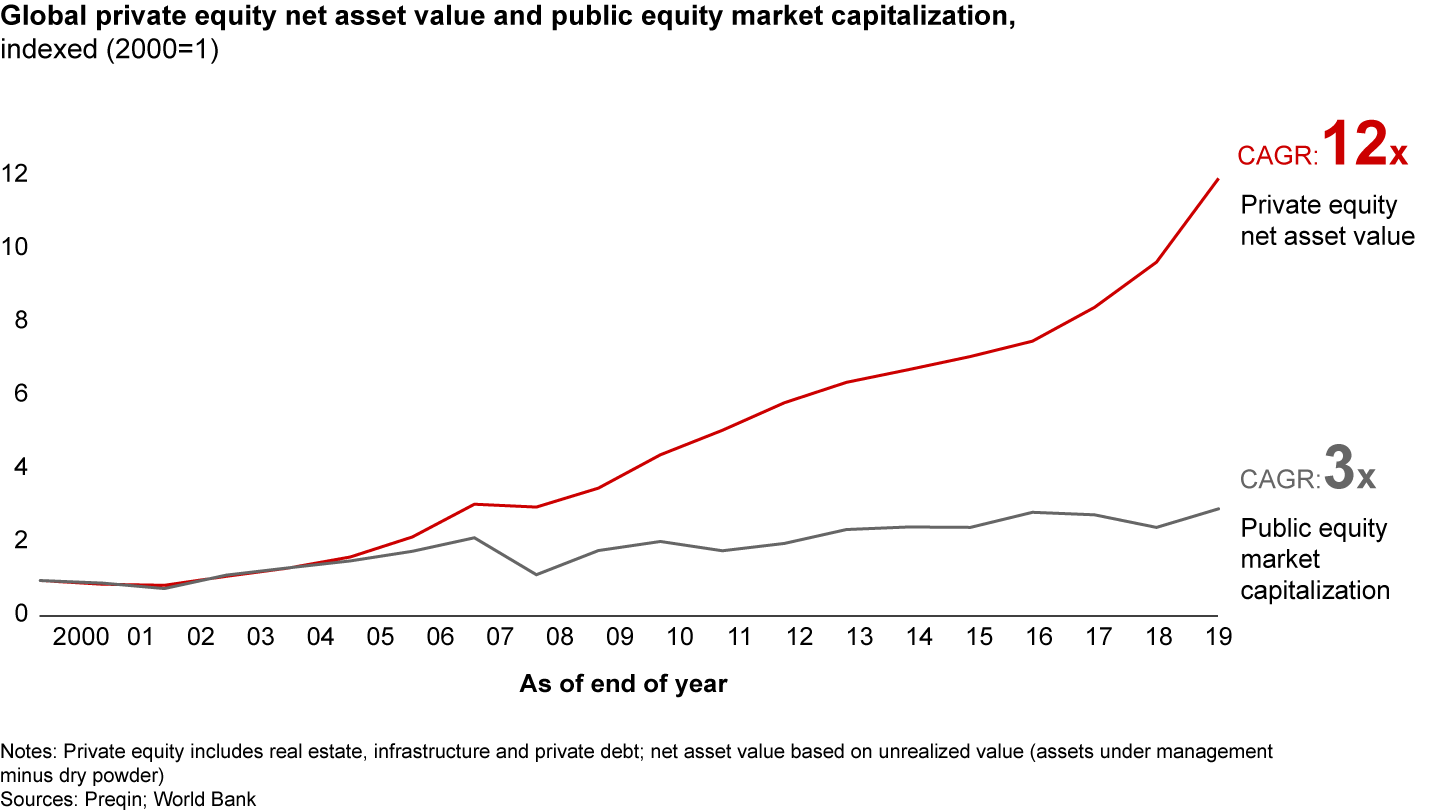
Over the past 20 years, the compound annual growth rate of private assets has been roughly four times that of publicly traded assets (see Figure 2). We expect growth to accelerate if private markets become more accessible to investors via digital assets.
Figure 2

Where the benefits lie
To be clear, digital assets are not a miracle that will make very small companies easy (or more desirable) to invest in. Nor will they circumvent retail investor protections by, say, allowing anyone to trade any private asset directly on a mobile app.
Rather, the near-term breakthroughs consist of automating workflows and data ranging from capitalization tables to share transfers and dividend or interest payments. Digital asset platforms will bring benefits in efficiency and cost savings, accessibility and transparency. This, in turn, will enable new private capital market innovations.
Efficiency. Digital platforms will allow alternative asset managers to create new, more efficient investment products with portfolios of tokenized private assets. Transfer and trading of private company shares currently have high documentation requirements for new shareholders, creating an administrative burden. Digital assets minimize that burden through smart contracts, where the terms of an agreement are programmable and thereby automated. Instead of settlement processes that take up to two weeks, embedded holder rights and an immutable record will ease verification of ownership, accelerate post-trade processes and remove intermediaries. Digital assets can also unlock more efficient settlement using digital fiat currency tokens and central bank digital currencies, as they become available.
Accessibility. Automating capitalization tables through DLT will make private assets such as private company equity, debt and real estate much more efficient to administer. Efficiency also allows for new types of private capital products that will be more readily available to a broader set of investors―for example, through 401(k) retirement savings plans.
The private company capitalization table administration business has developed over the past few years and is now starting to provide secondary trading platforms. These platforms are an efficient way for employee-held equity to be administered and transferred and, in some cases, a way for investors to trade pre-IPO shares. Examples include CartaX, Forge Global and Nasdaq Private Market. Secondary trading platforms provide significant benefits for employee share plans and existing shareholders, within current regulations. Currently, though, capitalization tables, share transfers and corporate actions are typically built on traditional, centralized technology with limited scalability.
Transparency. DLT-powered platforms are being introduced to administer private equity funds, including interactions between general and limited partners. One example is Broadridge’s blockchain fund administration platform, originally developed by Northern Trust.
In the future, such platforms can be extended to help minimize costs and administrative tasks at the individual asset level. Transfer of equity tokens will also feature transparency of price and governance, including right of first refusal, proxy voting and divided payments. Automated administration would allow investors such as pension funds to more easily coinvest in specific parts or assets within a private equity fund portfolio.
Likewise, in real estate, digital assets will remove intermediaries and replace manual, paper-based processes. Vertalo, for instance, has turned analog ledgers into tradable digital assets for previously illiquid properties. Vertalo currently focuses on administration, offering a better ownership experience by creating real-time transparency and streamlined execution.
Scanning the digital asset landscape, we see companies developing four useful business models.
- End-to-end institutional infrastructure operator. End-to-end solutions, such as those being developed by the Swiss stock exchange’s SIX Digital Exchange, Coinbase and Gemini, appear to hold the most promise. Establishing a regulated and institutional-grade end-to-end issuance, trading, settlement and custody infrastructure will allow a company to push for efficiency across the full value chain and provide market participants with integrated one-stop solutions. However, such a proposition requires large investments up front, along with the commitment to lead change across the ecosystem of institutional investors, alternative asset managers, regulators and other market participants.
- Digital asset broker-dealer. Trading in cryptocurrencies has been a relatively easy way to gain experience with digital asset technology and underlying regulations. On a global basis, volumes remain relatively low, given the appeal to a small group of investors. Nevertheless, increased digital asset adoption and market maturity will require broker-dealers and prime brokers serving the digital asset ecosystem.
- Technology provider. With the evolution of the financial system toward DLT platforms and digital assets, technology has become a key ingredient for success. With DLT, companies such as R3 have built a strong presence, connecting a broad set of market participants to develop new standards and approaches for DLT use cases such as digital assets.
- Specialist solution provider. Specialist solutions, while modular by definition, can be critical additions to the ecosystem as it evolves. A number of companies have demonstrated promising proofs of concept. Tokeny Solutions is building an institutional-grade, modular end-to-end platform for the issuance, transfer and management of tradable digital assets. Deutsche Börse’s HQLAx aims to improve collateral mobility among agents and custodians via DLT. Sygnum is using DLT to embed digital assets into regulated banking.
What it will take to succeed
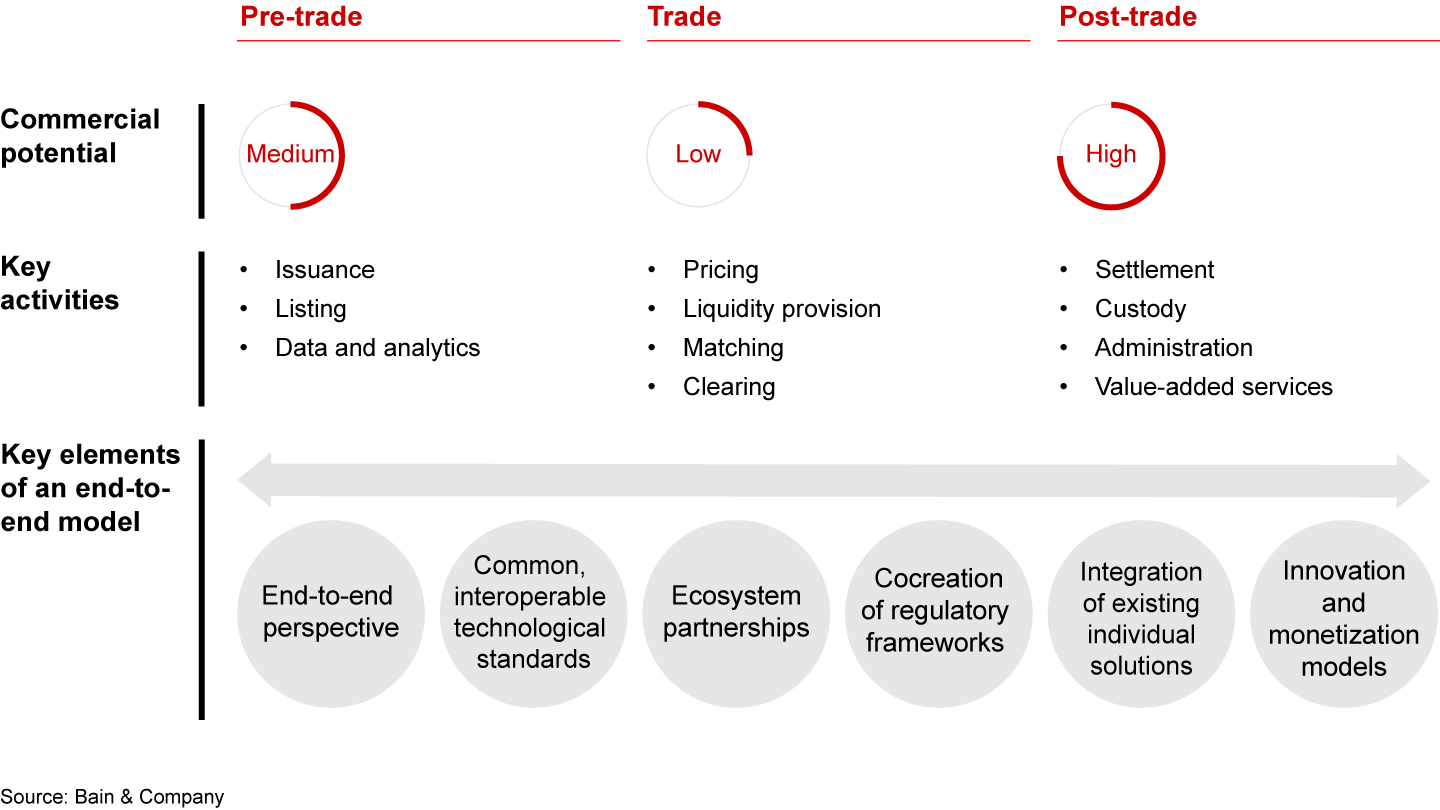
Any of these models can succeed if a company builds out the business with several characteristics (see Figure 3). These include:
- An end-to-end perspective, so the company can steer the adoption of digital assets rather than be steered, and maintain strategic options across still-developing revenue pools;
- Partnerships to accelerate the path to market, unlock mutual benefits and share risk (as with Börse Stuttgart’s joint venture with SBI Holdings of Tokyo to build a custody bridge between Germany and more than a dozen Asian markets);
- Integration of individual solutions in order to enhance the value proposition, by adding features from specialist firms and by linking to the legacy systems of incumbent firms;
- Application of common, interoperable technology, ensuring openness and flexibility as standards evolve;
- A dialogue with regulators to cocreate a robust regulatory framework that will establish trust and reliability, setting the basis for a secure institutional-grade infrastructure; and
- A focus on innovation and monetization models using data, analytics and value-added services on top of the core digital asset infrastructure.
Figure 3

Financial market infrastructure companies should chart a path now, focusing on which clients, asset classes, activities along the value chain, country markets and technologies to pursue. To inform the direction and pace of that path, executives should answer a set of key questions:
- What is our vision and ambition for digital assets? Given our firm’s culture and capabilities, do we want to be a first mover, fast follower or late adopter? What are the implications of each for the pace of investment?
- What is our business model? Should we target retail or institutional investors, or both?
- What is the potential value of solutions based on data and analytics?
- What assets should we focus on, and where along the value chain should we participate?
- Which countries should we do business in? Can we capture the home region and connect it with a second?
- What technology should we choose? Should we build it in-house, acquire it or obtain it through a partner?
- How do we define our ecosystem of partners?
- Do we have the right culture and people, especially software engineers and executives with a record of innovation?
With more start-ups emerging, incumbent companies gaining a foothold through partnerships and consortiums, and venture capital flowing to insurgent companies focused on digital assets, the time is ripe for interested market participants to make their play. Early movers that take a systematic end-to-end approach stand to land the best opportunities.
First published in 12月 2020