

記事
The global marketplace is minting a new set of consumers that’s bigger than the current shopping base of the US and Europe combined. Who are these new consumers and what is the best way to win them?
They’re younger. They’re literate. They’ve got increasing access to the Internet. They’re in Ukraine. They’re in the Philippines. They’re in Algeria. They’re in China and India. They’re the 30-year-old Brazilian woman living with her mother in a favela, who owns a TV and a cell phone with prepaid service but has never traveled by air. They’re the Russian retiree who opts for cheaper Western durable goods over new domestic brands. They’re the 23-year-old Indonesian woman with low brand loyalty who buys cosmetics in small amounts but buys them frequently, and sees a TV as her next big purchase.
Meet the 1.2 billion people who will move out of subsistence poverty by the year 2020. They’re the world’s newest consumers, those living in households where annual disposable incomes will surpass $5,000 for the first time. It will be their initial experience with discretionary income and they’ll have distinct ideas about how they want to spend it. These new consumers are already starting to develop tastes and demonstrate preferences in some categories. And consumer products companies that don’t act quickly enough will risk losing out to faster global or local competitors. In other categories, consumers won’t develop a taste for your product for years. But now may be the time to set the stage for attracting them when they’re ready.
Recent Bain & Company macro trend research highlighted the importance of the “next billion” consumers. We’ve now dug deeper into country and category trends to understand how consumer goods companies can benefit from this demographic boom.1 We found two important insights that can help companies as they pursue the next billion consumers.
First, the next billion opportunity extends beyond China and India. While China and India still will be the major developing markets, an army of about 350 million new consumers will come from more than 50 other countries, everywhere from Peru to Nigeria to Uzbekistan. That’s a population as big as the US. Companies not yet on the path to leadership in China and India can consider going straight to these markets. Not only are the consumer populations on the verge of expansion, but there also are attractive opportunities to acquire local players.
Second, our research found that in more product categories than anticipated, consumers behaved in a similar fashion across very disparate countries. Let’s use beer as an example. We expected that shopping patterns would vary dramatically across markets, as in some countries beer is made locally with inexpensive inputs, while in others it is expensively imported. But when we compared detailed basket spending for different income groups, we found that beer had a disproportionately higher share of spend from the same income group across most countries we analyzed. Even in countries as dissimilar as China and Brazil, middle-income consumers spend disproportionately more of their basket on beer when compared to other categories and income groups. For brewers pursuing growth, the implications are clear: There is an opportunity to replicate your entry and growth strategy across countries, taking a winning approach and key lessons from one market and repeating it in others. That isn’t the case for all categories, however, so companies need to look at their portfolio and determine which categories can be rolled out with the same strategies and which require different strategies from country to country. Understanding how shopping baskets differ across countries and income brackets can help prioritize when and how to reach the next billion.
Preparing for the next billion starts by identifying the markets that hold the most potential. That requires careful analysis across three dimensions: country, category and a company’s own capabilities.
Where to play?
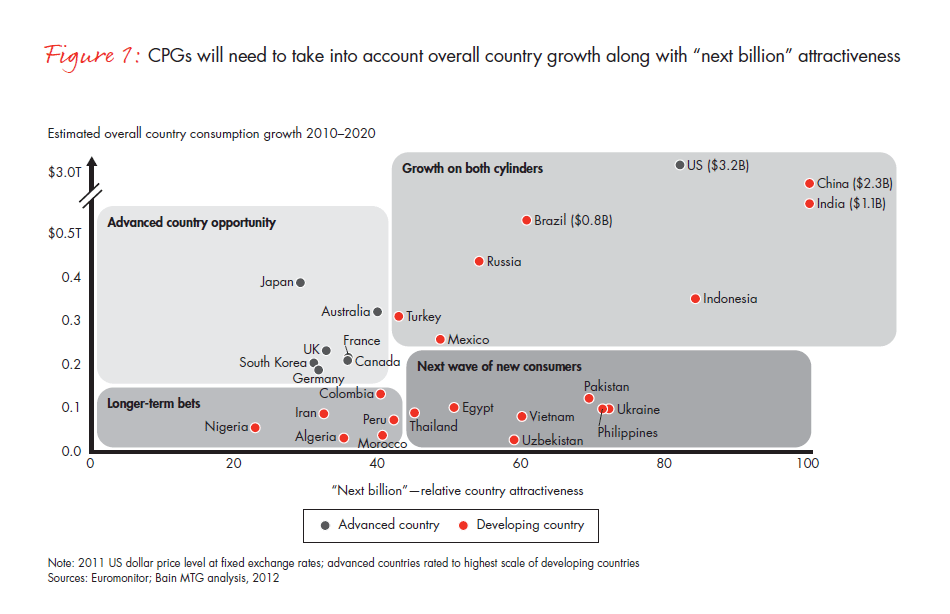
Each country is unique when it comes to the profile of its emerging consumer class and the other factors that govern the decision about where to invest: everything from income growth projections to competitive landscape to opportunities for inorganic growth. We’ve developed a weighted method of scoring the relative attractiveness of each country based on the opportunity size of the members of next billion within its borders, the group’s impact on that country’s population, its accessibility, the country’s overall growth rate, as well as the country’s political and economic risk. Given their scale, China and India still stand out as the most attractive, but others like Indonesia, Ukraine and the Philippines are surging and rank high on the list, too—they may be worthy of consideration, particularly for companies that may be too late to gain market leadership in China and India. Let’s look at four of the key factors we considered.
How big is the next billion opportunity in each country? Population is an important factor in sizing opportunity within a country. But wage rates differ and life expectancy varies. Lifetime purchasing per individual among members of the next billion in Mexico and Ukraine is expected to be twice as long as it is for their counterparts in Indonesia and Vietnam—and more than three times longer than that of Nigeria. While most consumer goods firms are aware that their core market is, on average, getting older or younger, few fully quantify this by determining how many years of remaining spending there are for the average consumer. More spending years are certainly better.
Do the next billion represent a massive wave of change in the country or will they have a lesser impact on the overall makeup of the country’s population? In Brazil, in the next 10 years, only 5% of the population will cross the threshold into the world of consumer goods spending—much of the country is already there. The opportunities in Brazil are greater in building share with existing consumers than in pursuing the next wave of consumers. But in Ukraine the equivalent percentage is 33%. These consumers are among the first in Ukraine to have access to discretionary income. If a player doesn’t establish a presence in Ukraine in the next decade, it will be harder and harder to steal share from players that are now there and are rapidly becoming entrenched. The next billion’s impact on the population makeup is important for understanding how quickly you need to respond to win. The fact is, the opportunity to get in on the ground floor will last longer in some countries than in others.
How accessible are these future consumers to brand marketing and messaging? In Morocco, 49% of the population uses the Internet, according to the International Telecommunications Union. But in Algeria, only 13% of the population has Internet access. Adult literacy approaches 100% in Ukraine, Russia and Uzbekistan. Literacy is lower in places like Pakistan (55%) and Morocco (57%). There’s no question that consumer goods companies will have unprecedented access to the next billion as Internet penetration is booming and adult literacy rates are accelerating in most places, making it easier to establish a brand or win a loyal following than it has ever been in a developing market. But in prioritizing countries, companies are carefully evaluating how access to mind share (and thus commercial opportunity) varies, market by market.
Overall market growth rate. While Indonesia and the Philippines both score high on the attractiveness of their share of the next billion, Indonesia’s overall consumption growth rate forecast far exceeds that of the Philippines. In other words, Indonesia has two growth engines: the next billion who will start spending in the next decade and growth among the rest of the population that has already moved above the poverty line. That means consumer goods players can move more quickly in Indonesia while laying plans for the emergence of new consumers in the Philippines. Or look at Brazil. If you’re considering just the next billion consumers, the country ranks toward the middle of the pack. But growth in overall consumption—including all members of the consumer class in Brazil—is relatively high. The next billion offers tremendous opportunity, and a country’s overall consumption growth rate projection further refines where to place bets (see Figure 1).
What to sell—and how?
Imagine the plight of two different consumer goods companies. The first has a large beverage portfolio consisting of three categories: soft drinks, spirits and beer. All of these are categories in which shopping patterns by income bracket are relatively consistent across the markets we examined. Therefore, the company may be able to deploy many common approaches to strategy development and commercial strategy from India to Russia.
Contrast this with a company that sells oral care products, over-the-counter healthcare brands and male toiletries. All fall within the broad definition of personal care categories, but these categories play very different roles in consumers’ shopping baskets by income bracket across countries. Very low-income shoppers tend to “overindex,” or spend relatively more of their money, on over-the-counter healthcare products. Getting into a market early to establish brand credibility and trust at low price points is important. Male toiletries account for less spend at lower-income levels so a strategy to trade up consumers as their incomes grow is more relevant. Finally, in oral care, the situation is even more varied. In some countries, lower-income consumers spend relatively more of their money on the category, but in other countries it’s wealthier consumers who overindex. The category requires separate strategies and approaches, country by country.
Bain research examined how shopping baskets across several emerging countries change by income bracket. We aimed to understand where and when consumers spend relatively more of their money on different product categories. We found many similarities across countries, but also a few differences. Understanding these similarities and differences can inform strategy and help avoid costly complexity.
Get in early. Categories like biscuits make up a disproportionate share of lower-income shopping baskets across many emerging markets. You can appeal to these consumers now by familiarizing them with your brand and generating trial. The rules for selling are to position the brand as high quality and value while keeping price points and costs low and ensuring relevant distribution.
Look ahead. Middle- and upper-middle-income consumers spend disproportionately more on such categories as tobacco and soft drinks. These categories often are large and sometimes with high growth. Winners in these categories will make the brand an early aspiration for the next billion, investing in brand equity, awareness and broad availability.
Earn your premium. It is no surprise that shoppers in higher-income brackets spend more on luxury comforts like wine and convenience items like frozen food. This clearly follows the same pattern we have long observed in developed markets. For these categories, invest in trading up the next billion consumers with innovation that justifies higher prices.
Know what’s different. Some categories reflect a range of consumption patterns based on the stage of category development or cultural norms. A single example: Oral care is a big portion of low-income shopping baskets in Brazil, but many of the estimated 150 million and more households in rural India have yet to use a toothbrush, relying instead on indigenous neem twigs to clean their teeth. As you look for commonality across different countries, there’s no substitute for knowing which categories remain local and must be deeply understood at the country level.
Can we do it?
From the asentamientos of Argentina to the kelurahans of Indonesia to the khutors of Ukraine, the next billion consumers will offer an exciting opportunity for consumer goods players. Of course, having the right talent, capabilities and processes is critical to realizing the growth and profit opportunity that this new population of consumers implies. Consumer products companies need to make smart investment trade-offs, share winning routines across similar markets and streamline decisions in an increasingly complex global market. With so much to gain, it’s no surprise that so many consumer products companies are actively stepping back and thinking through where and how critical work gets done. (For more on this, see Bain Brief “Winning operating models.”)
1In our research we conducted detailed statistical analysis using data from Euromonitor and Datamonitor. We also refer to data from the International Telecommunications Union and Euromoney.
First published in 9月 2012