

論説

The financial industry almost pushed the global economy off a cliff in 2008, and taxpayers had to bail out multiple banks. This near collapse of the financial system led regulators and bankers to realize that opaque products and hidden interdependencies made large global banks so complex that they obscured the nature and degree of their underlying risks. Regulators’ inability to resolve failing institutions without taxpayer support and risk to financial stability also signaled that the legal structure of global banks needed restructuring. Stress on the entire banking system strongly indicated that existing capital buffer and liquidity requirements were far too low.
Now regulators are trying to keep banks, especially systemically important banks, from ever nearing the cliff again. Fearing that one bank’s ills could contaminate the entire system, regulators in many countries have mandated that big banks become resilient to stress over multiple economic cycles, and that any bank overwhelmed by too much stress can be contained.
Regulators around the world have developed a new paradigm built around three core elements: strategy, resilience and resolvability (see Figure 1).
Our estimates show that only one-third of banks, at most, have adequately prepared for this transformation; these banks are based mainly in the US, the UK and Switzerland, where regulators were among the first to impose stringent reforms.
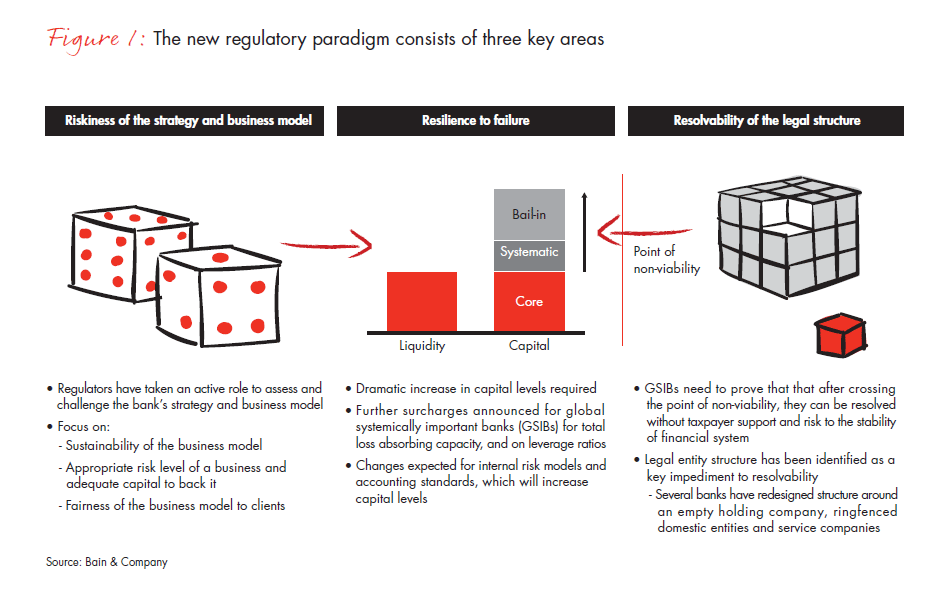
Forward-looking banks have responded by adjusting their strategy and structure to improve resilience and raise the degree of resolvability. Many US banks benefited from an earlier rebound in the markets after the crisis, allowing them to recover quickly and start adapting to regulators’ demands. European banks, however, suffered from continued low profitability and were forced to substantially reduce their balance sheets in order to meet capital targets and improve liquidity profiles.
Pressure from regulators, rating agencies and investors to shape up and shine light into the “black box” will only intensify. Big banks, and many smaller ones, will have to quickly come up to speed in adapting to the new regime. Otherwise, their transformations may resemble Frankenstein’s monster more than Cinderella.
Large and even some medium banks continue to be opaque, with interdependencies among their businesses that are hard to see. Questions remain about their management viability. If banks once treated regulators as an annoying but necessary evil, now regulators have become empowered, in dire situations, to make decisions for banks or induce them through capital surcharges to make changes on all aspects of their business models and legal structures.
The transformation requires banks to address each aspect of the new regulatory paradigm:
- Sustainability of the business model
- Resilience to failure
- Resolvability in case of failure
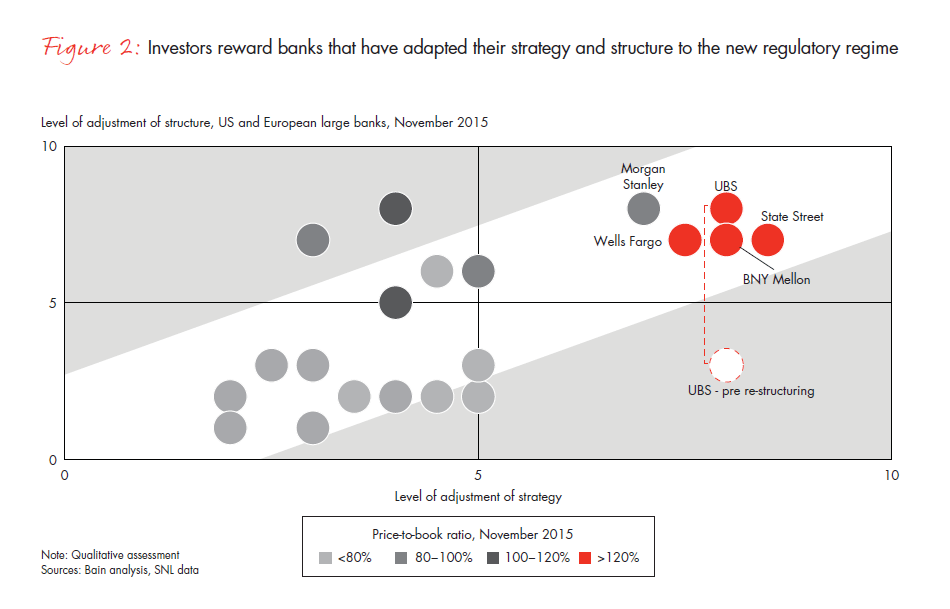
Our analysis shows that investors have rewarded those banks that are making the greatest progress toward a transparent, sensible business model and a resilient and resolvable structure (see Figure 2). But most banks still have a long way to go.
Working toward a more sustainable business model
Strategy now is viewed as part of the regulatory agenda. Regulators will frequently check the business model’s viability, and not just in the obvious areas of risk appetite, capital allocation and liquidity profiles. They will also assess whether banks regularly track backward- and forward-looking key performance indicators to help them steer the business. Essentially, regulators are testing whether banks can turn their strategies into sustainable business models over the entire economic cycle.
Successful strategy will focus on knowing where to play—determining a bank’s primary profitable businesses—and how to win, based on core strengths that afford a competitive edge. This involves making choic- es to strengthen the readjusted core, combined with a coherent disposal of non-core operations.
Liquidity and funding have always been crucial in a balance-sheet business, but the new regulations will force bankers to more explicitly consider trade-offs and asset/liability linkages.
Whereas they once could blend businesses that performed differently at each stage of the economic cycle, banks must lean toward keeping businesses that have steady cash flow and returns that provide a surplus on the cost of equity. Most will have to shed any cyclical or volatile business unless it is heavily overcapitalized to cover the downside risks and prove its viability.
This dynamic has already caused banks in the US, after stress tests, to increase the capital deployed against certain businesses, or to exit some businesses altogether. Many examples illustrate this trend. HSBC has exited various countries. US investment banks are getting out of physical commodities. UBS has substantially reduced its fixed-income business. Morgan Stanley has focused its wealth management business primarily on the US, while still serving high-net-worth clients in Latin America and the Caribbean. Investors have viewed these and other substantial steps favorably. Meanwhile, every bank that has announced only incremental changes to strategy has been punished by the market.
Bend but don’t break: the virtues of resiliency to stress
Improving resilience remains a big opportunity for banks to regain the trust of investors and regulators alike.
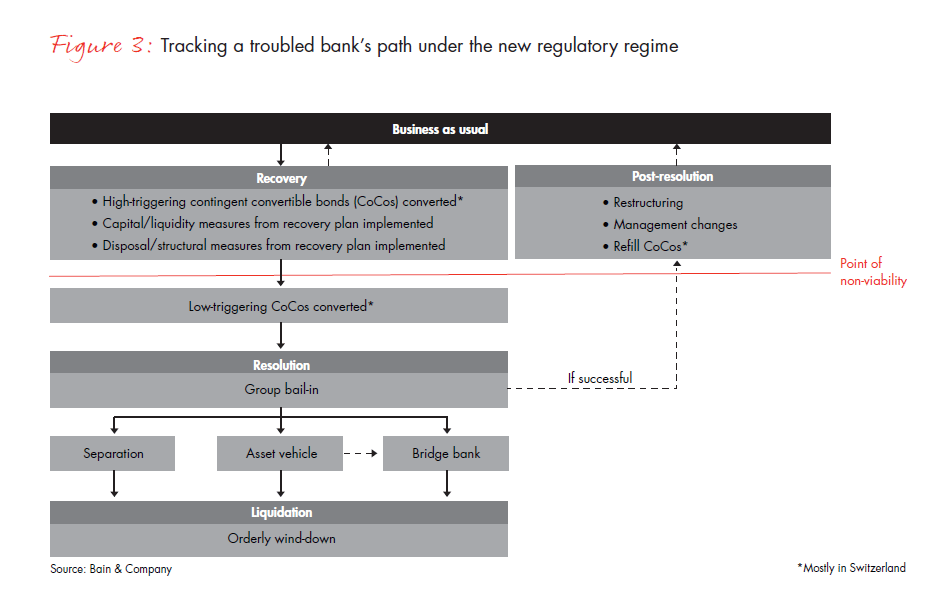
Resiliency begins with sufficient capital buffers, which large global banks will need to increase within the next five years. Their total loss-absorbing capital will need to include more core capital, which consists largely of shareholders’ equity, in order to ensure a “bail-in” for a troubled bank. Creditors will bear some of the burden by having part of the debt they are owed written off (see Figure 3).
Regulators also will be reviewing internal risk models over the next couple of years, as they suspect that these models are not conservative enough. Therefore, banks will need to actively collaborate with regulators on harmonizing risk measurement and establishing more comprehensive and fully consistent risk databases and reporting.
Reducing a bank’s complexity is the next frontier for resiliency, because large global banks as currently constituted cannot be managed well in case of distress. Many banks have multiple, subscale businesses that create substantial complexity. Bankers are increasingly asking, “Are we getting a decent return on equity from each and every business, especially in light of higher capital requirements? Can we reduce the cost to serve customers in the business by improving process efficiency?”
The options are to reduce or exit a business that is capital intensive; raise equity if management believes the business is viable; or internally build more capital from retained earnings (an option available more for US banks with strong earnings than European banks). Most global systemically important banks have chosen the first option, substantially reducing their risk-weighted assets and increasing their Tier 1 capital since 2008.
The road to resolution readiness in the event of failure
The toughest part of adapting to the new paradigm is resolution planning. This challenge will involve heavy analysis on a bank’s part and, if done poorly, can be quite costly and time consuming for senior management and the board.
If a bank faces a crisis, regulators will want to wind it down without taxpayer support or risk to the stability of the broader financial system. Most global banks have an intermingled legal structure that cannot easily be pulled apart—the nub of “too big to fail.” This runs counter to the common goal of ensuring that systemically relevant functions, such as payments, loans and customer deposits, will continue to operate and be accessible if the bank is disrupted. In response, regulators have implemented the new resolution framework, which has been designed to take any failing bank out of the system without taxpayer support.
The planning process starts by scrutinizing critical economic functions (CEF) and core business lines (CBL) that must be safeguarded in the event of a bank failure. For the CEF and CBL, banks will have to do a detailed dependency analysis, which identifies all the operational, financial and legal activities required to keep these functions running, any impediments to that goal and measures to remove the impediments.
So far, regulators have identified a bank’s legal structure as the most significant impediment to resolvability. A bank will have to redesign its legal entity structure, most likely around a holding structure that is capable of serving as a single point of entry for a bail-in. Investment banking will need to be structurally separated from retail banking. The structure must also be transparent and obvious to regulators. Each of these steps should help reduce systemic risk.
Banks in the US, UK and Switzerland have advanced the furthest in resolution planning and a path to a resolvable structure, as regulators forced them to develop a legal entity alternative that can be wound down over a weekend. UBS, for instance, created an empty holding company on top, a separate and autonomous Swiss entity, and is currently creating separate UK and US entities. Many larger Eurozone banks have just finished initial draft plans.
Fortunately for banks that demonstrate progress, the process does incorporate constructive feedback and incentives from regulators. UBS added a systemic capital buffer of 1.5 percentage points, but after it restructured, regulators reduced the buffer by 0.5 points.
Resolution planning is proving complicated for banks. It is significant enough that senior management will benefit by thinking strategically about how to align the new structure with the bank’s overall strategy. For some businesses that prove to be outside the core or not profitable enough, setting up a new structure could require too much capital to be worth the effort.
Implications for banks
Although it is a major challenge for banks, resolution planning also provides an opportunity for those that use this watershed event to improve their strategy and their business portfolio choices. There are several specific implications for senior management:
- Reduce exposure to risky assets. This can be accomplished by exiting risk-weighted, asset-intensive businesses by optimizing capital allocations, as well as through technical risk-weighted-asset optimization.
- Raise capital. Regulators want more capital and more core, “bail-in-able” capital if the bank goes down. This may consist of items such as share issuance, increased retained earnings and contingent convertibles, also known as CoCo bonds, in which converting to equity is contingent on a specified event.
- Accelerate the timing. Eurozone banks face greater urgency to ensure resolvability. This is due to the ECB’s new supervisory authority and two major enforcement areas: compliance with the new Supervisory Review and Evaluation Process (SREP), which becomes binding at the start of 2016 and establishment of transparent resolution plans.
- Get used to more intense regulator scrutiny. The ECB presence has become strikingly comprehensive and detailed. It supervises banks more frequently (quarterly for most banks), and insists on a forward-looking approach to determining the viability of their underlying business models.
Although all major banks have to comply with the mandate to build recovery and resolution plans, the leaders do not view this as a pure compliance exercise. Instead, they see it as an opportunity to sharpen their individual strategies and business models and remove excess complexity from their operations. Markets have rewarded these early leaders, while the more cautious lag further behind with each passing day.
Matthias Memminger and Jan-Alexander Huber are partners in Bain & Company’s Financial Services practice. They are based in Zurich and Frankfurt, respectively.
First published in 12月 2015