

記事
The following post originally appeared in the World Financial Review.
Contrary to today’s common wisdom, the key to success in a dynamic world is a simple business model that can be applied and reapplied in market after market—a Great Repeatable Model®. The most effective models are built on three fundamental principles: a clearly differentiated core, a set of nonnegotiable principles that everyone in the organization understands and well-functioning systems for learning and adapting to competitive threats or changing circumstances. IKEA, NIKE and the mutual fund company Vanguard are among the companies that have thrived for decades on the basis of a Great Repeatable Model.
What do a tiffin tin, a Billy bookcase and Michael Jordan have in common?
Each is central to a business success story that transformed its market. Each is emblematic of a company that learned to replicate and adapt its early successes over and over, often for decades, in a world of constant change.
This is an uncommon message, perhaps, in a world where siren-like voices of gurus, analysts and pundits preach “reinvention” to companies. Yet our data shows that simplicity, focus and continuous adaptation nearly always trump strategies of radical change or reinvention. Moreover, enduring success comes not from choice of market or industry, but from the essential design of a company. Our recent book Repeatability attempts to pinpoint the design principles that allow some companies to succeed even in tough and dynamic competitive arenas. We call those companies the Great Repeatable Models because they do what they do best again and again, expanding into one market after another, learning as they go.

Repeatability
Learn more about how executives use Repeatable Models® to build enduring businesses.
Let us illustrate with three quick examples and then describe some of the secrets of these models.
The Dabbawallas of Mumbai. Visitors to Mumbai can easily be overwhelmed by the scale and pace of India’s most densely populated city. Yet every day, amid the noise, traffic and bustle, the five thousand dabbawallas of the Nutan Mumbai Tiffin Box Suppliers’ Charity Trust deliver 200 thousand boxed lunches, cooked the same morning in people’s homes or by special caterers, to the right people and on time. At night the system reverses, and the dabbawallas return the color-coded lunch boxes—dabbas—to where they came from. The average box travels 60 kilometers on bikes, on trains, on pushcarts and on foot, and is handled by six different people.
Despite the complexity of this supply chain, the odds that the dabbawallas will deliver the wrong lunch to a customer are less than one in six million, a Six-Sigma-level quality statistic that has drawn attention from operations specialists across the world. The distinctive deliverymen, dressed in white cotton uniforms and white caps, pride themselves on making deliveries in the severest conditions. Their service ethos is so strong that when Britain’s Prince Charles asked whether he could meet some dabbawallas, they insisted he schedule the meeting between delivery cycles.
The association would look little changed to a time traveler from the 1890s, when Mahadeo Havaji Bacche founded it. The service ethos is the same. The lunch boxes and uniforms are largely the same. The bicycles, trains and pushcarts haven’t changed a lot either. But the barefoot dabbawallas don’t ignore the march of progress. Today they use mobile phones to coordinate deliveries and alert one another to problems. They take orders on the Internet and by text messaging. They track customer satisfaction through online polling. This careful blend of the old and the new has led to a steadily expanding business. In the nearly 125 years since its creation, the association has grown profitably at between 5% and 10% a year.
IKEA and the Billy Bookcase. From its iconic blue-and-yellow stores to its ubiquitous customer-assembled Billy bookcase, IKEA is one of the most recognizable and admired companies in the world. It turns over 23 billion euros from 626 million visitors to its 280 stores in more than 25 countries. In Europe, it is at least 12 times as large as its nearest competitor.
The core features of this hugely successful company have changed only incrementally since Ingvar Kamprad opened the first stores in Sweden during the 1950s. Since those early years, all wooden furniture has been sold in flat packs for self-assembly by the customer. Every store incorporates a flow that encourages cross-selling. Every product is designed to hit a target selling price, and the company has carefully maintained an egalitarian corporate culture. IKEA has not attempted to diversify into businesses that would require a different model, nor has it ever reinvented itself.
Instead, it has focused on maintaining its differentiations. It has made its economics more efficient and improved product design. It has carefully selected new product categories and geographic regions where its model can work. Everyone in the company has internalized a long-held set of relatively simple, transparent rules and principles, so decisions at every level of the organization tend to reinforce and improve the model. Furniture is a market with an enormous number of new entrants everywhere, lots of new technology in supply chain and materials, new Internet sales models and constant change in consumer needs. Yet IKEA’s repeatable model—like that of the dabbawallas—has adapted and endured.
The Swoosh of NIKE. NIKE practically defines athletic innovation, speed and constant change. In the 25 years from 1986 to 2011, the company grew from less than a billion dollars in size to nearly $21 billion, with earnings before interest and taxes of $2.8 billion. NIKE averaged a 20% annual total return to shareholders over the entire 25-year period. Not a bad performance in a market that many observers view as a low-growth commodity business.
NIKE’s repeatable model rests on four core interlocking capabilities: (1) brand management (the ubiquitous swoosh), (2) partnerships with elite athletes such as Michael Jordan, (3) award-winning design and use of new materials and (4) an efficient supply chain to Asia (it owns no manufacturing assets). These capabilities have allowed it to expand into one sport after another. In 1989, NIKE and its main rival, Reebok, were comparable in size, product line, brand recognition and profitability. Yet Reebok never found a repeatable formula; it careened from Ralph Lauren footwear to Boston Whaler boats, to Western boots, to golf clothing. It thus failed to create a learning organization, and it generated virtually no economic value in the stock market for two decades until it was sold in 2006 to Adidas. Meanwhile, NIKE posted a record-setting performance and redefined the rules of its industry. The company’s relentless ability to innovate and improve year after year enabled it to succeed in a highly dynamic market.
Three companies on three continents in three very different industries. Each business—food delivery, furniture, athletic shoes and equipment—looks like a commodity. Yet each company has had to deal with enormous change on many dimensions, from customer needs to channel shifts, to technology, to the Internet. What enabled them to successfully do so was the stabilizing effect of a repeatable model built on a set of core strategic and organizational principles.
The Principles of Repeatability
Once we identified the importance of repeatable models in our research, we set out to discover what features matter most and what insights other businesses can most readily adopt. Our starting point was a database of 200 companies. We examined 30 different factors that had emerged from our initial case examples and interviews with executives. What we found surprised us. We could explain between 40% and 50% of performance variation within an industry from companies’ adherence to just three design principles. This is a remarkable level of explanatory power, given the number of other variables that we considered—choice of market, scale, level of diversification, key metrics and so on.
Principle 1: A strong, well-differentiated core.
Differentiation is the essence of strategy, the root cause of competitive advantage and a major determinant of relative profitability among businesses. Successful companies focus on their differentiation, and they define it not as some artificial construct dreamed up in the boardroom, but as a set of daily activities that shape how everyone in the company—and particularly frontline employees—behaves. Their employees may be focused on supporting superior cost economics (Vanguard, Wal-Mart), developing unique product features (Apple) or maintaining a leading position in a network or economic system (Vodafone, Microsoft)—whatever the primary sources of differentiation may be. The Great Repeatable Models were sharply, almost obviously, differentiated relative to competitors along a dimension that also allowed for greater profitability. Their core activities, such as IKEA’s flat-package furniture design or NIKE’s world-class brand management, foster learning, constant change and improvement, and they erect further barriers to imitation.
Principle 2: Clear nonnegotiables.
A second factor in success is a common understanding among management and employees of the company’s core values and of the key criteria used to turn strategy into consistent decisions and actions. We call these principles the nonnegotiables, and they are embedded in the operations of Great Repeatable Models. Clear nonnegotiables improve the focus and simplicity of strategy by hardwiring a few simple values and prescriptions throughout the organization, which people understand and use to shape their actions and decisions. This has the effect of reducing the distance from management to the front line (and back). A belief in the management team’s values and the organization’s strategy is also the main driver of employee loyalty and commitment.
Principle 3: Systems for closed-loop learning.
The key to adaptability is continual learning, and the Great Repeatable Models have well-developed systems for learning and continuous improvement throughout the business. They stay in close touch with customers and employees through methods such as the Net Promoter® system. They learn from key operations as they move down the experience curve. They develop early-warning devices that allow them to anticipate fundamental change in the marketplace. Huawei, the rapidly growing Chinese challenger to network equipment incumbents such as Ericsson and Alcatel-Lucent, even has a permanent office of restructuring, which reports to the chairman and focuses on identifying external threats. These companies understand that an inability to adapt or to respond urgently to a potentially mortal threat can derail an otherwise successful business. Think of Kodak confronting digital technology, Nokia confronting smart phones or traditional airlines confronting low-cost carriers.
How Great Repeatable Models Succeed
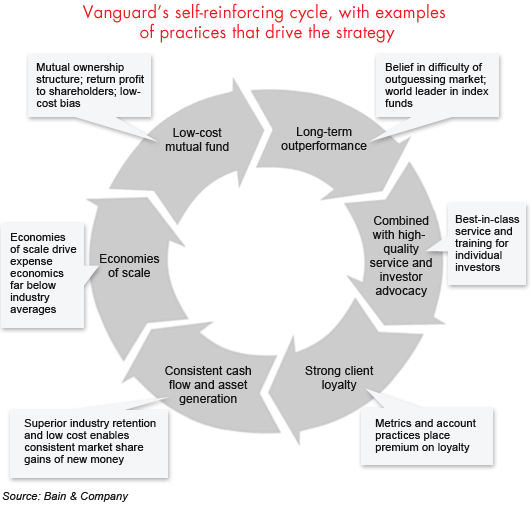
In our experience, the virtuous, reinforcing cycle found in the Great Repeatable Models usually works as follows: A clear, repeatable differentiation (design principle 1) makes common measures and beliefs easier to create and use (design principle 2), which drives more transparency, learning and adaptation (design principle 3). All that, in turn, pushes the entire business down an experience curve faster than less repeatable competitors.
The mutual fund company Vanguard is a great example of this virtuous dynamic. Vanguard was founded by John Bogle in 1974, with 11 mutual funds and $1.8 billion in assets. Bogle believed passionately in the proposition that no actively managed fund could outperform the market in the long run. His alternative was passive funds that simply tracked market indexes. The funds would need no managers or researchers and could therefore charge fees considerably lower than their actively managed rivals. Instead of providing stock-picking advice, which he saw as essentially useless, Bogle offered customers responsive service and advice on the types of investments that would be suitable for their needs.
Vanguard has remained true to this simple, stark differentiation, and the strategy has paid off handsomely. In 2009, in the depths of the financial crisis, it became the largest mutual fund company in the world, with $1.6 trillion of assets under management (capturing an amazing 45% of the new money coming into the market that year). Of course, it has diversified over the years into new forms of indexed funds and new customer segments. But it has never strayed from its core principles of low-cost investing, long-term customer loyalty (its churn rate is one-third that of the industry), employee egalitarianism and conservative investing—all combined in a repeatable business model.
Now let’s look at the second feature. The company is named for HMS Vanguard, a 74-gun ship commanded by Admiral Horatio Nelson, one of history’s greatest naval strategists. Nelson’s battles were fought generally by the rules of the day—conventional line-of-battle approach, training in close-order combat and signaling systems among ships. However, the line of battle typically extended beyond the horizon of sight. During the confusion and smoke of battle, communication became unreliable. Nelson’s solution to this problem was to spend so much time training his crews that each boat became a replica of his thinking and behaviors. In fact, he met with them so frequently that he named them his “band of brothers.” As a result, he could trust his subordinates to act as he would, rather than relying on cumbersome command and control tactics. Though they appeared to be separate, they acted in an uncannily coordinated way, as a single mind. The result was a series of victories with fewer casualties against larger French fleets.
Emulating Nelson, Bogle called his employees “crew members” and laid the foundations for a distinctive egalitarian culture. The culture is strongly rooted in the company’s differentiated value proposition. Vanguard’s activities and decisions are all guided by a set of statements called “Simple Truths,” which are remarkably consistent with the initial conception of the business, though they have been added to and embellished over the years. They include the following:
- Most investors cannot “beat the market” long term
- The best customers are loyal, long-term investors
- We do not pay for distribution of our products
- Low expense ratios drive high returns
- A mutual organization owned by the “funds” is best for investors
- Egalitarianism must define how we work together
The distinctive features of Vanguard’s business model reinforce each other. The company’s strong differentiation and leadership in the area of indexed funds both inform and reflect its investment philosophy. Its low-cost position—expenses charged to customers are one-sixth of those charged by competitors—is reinforced by its belief in not paying for distribution and its commitment to a mutual structure in which profits are shared with the investors. Vanguard’s heavy investment in telephone representatives and customer advisers not only reinforces its core beliefs in loyalty and the key role of employees, but also enables the company to obtain direct customer feedback in ways that competitors have trouble matching.
There’s More Than One Formula
We don’t mean to imply that there’s only one possible Great Repeatable Model in an industry. Our research shows that in fact there are multiple Great Repeatable Models in almost any industry, even in highly competitive, mature ones—which reinforces our finding that performance is more about managerial decisions than the business you happen to be in.
Take the airline industry, arguably the tougest way to make money. In the 10 years from 2000 to 2010, the airline industry destroyed more than $200 billion in shareholder value. Forty-eight US airlines filed for bankruptcy. Ninety percent of the top 100 global airlines did not even earn their cost of capital. Yet, amid all this horrible news, two very successful airlines created quite different Great Repeatable Models.
One of these is the low-cost carrier Ryanair, whose stock price more than tripled in the decade from 2000 to 2010. Its Great Repeatable Model strips the airline experience and cost model down to its basics. The company was one of the first to charge for checked bags. It pioneered online check-in, now mandatory for all passengers. This value proposition is deeply internalized, and it informs every decision. As CEO Michael O’Leary puts it, “We’re open about our policies: You’re not getting free food. We don’t want your check-in bags. We’re not going to put you up in hotels because your granny died. But we are going to guarantee you the lowest airfares in Europe, by a distance… And that’s what people really want—affordable, safe air transport from A to B.”1
Now consider Singapore Airlines (SIA), whose financial performance is about its only point of similarity with Ryanair. SIA has been profitable every year since its founding in 1972 and has won the Readers’ Choice Award for Global Airlines from Condé Nast Traveler an astonishing 22 of 23 times. Its secret: It offers passengers just the type of service that O’Leary derides. It can do this, however, because its organizational qualities relative to the competition have made it an extremely cost-effective operator. One detailed study of SIA’s economics concluded, “It’s intriguing that SIA has combined the supposedly incompatible strategies of differentiation—which it pursues through service excellence and continuous innovation—and cost leadership. Few firms have executed a dual strategy profitably… the dual strategy has become part of the airline’s organizational DNA over the years.”2
Delivering Lasting Advantage
As we noted earlier, there’s an interesting paradox about Great Repeatable Models. On the face of it, their advantages ought not to be durable. Their differentiation is stark. Their values and organizational structure are usually well publicized. Toyota—a perfect exemplar of a company with a Great Repeatable Model—even allows outside groups to study its factories and production system. So how can these companies enjoy a sustainable competitive advantage year in and year out if everyone knows their secrets? We’ve identified three answers that jointly and severally explain why Great Repeatable Models stay ahead:
They compress the distance from management to the front line. In effect, the very simplicity of the Great Repeatable Model raises a barrier to entry or imitation. When the typical company moves into new businesses and markets, it grows. Its risks and uncertainties multiply, and the claims on managerial attention increase. It also faces competition from new sources. All these external realities tend to create more and more organizational complexity—more systems, measures, conditions, special products, processes and coordinators at the interfaces. The company’s leaders become ever more distanced from the front lines of the business. Great Repeatable Models are different. Leaders don’t have to make so many decisions themselves if the people in the organization, like Admiral Nelson’s crews, all understand the value proposition, the values and the trade-offs—which is much more likely if those propositions and values and trade-offs are simple and clear to begin with. Leaders can, instead, focus on customer trends and market evolution so that they can more quickly recognize the factors and threats that demand immediate response.
They decide better and faster. In a world where the pace of change is increasing, the ability to decide and act more effectively than adversaries—to stay inside their decision cycle—is an enormous advantage both in operations and in innovation. It accelerates the delivery of results in complex markets and organizations.
"Great Repeatable Models’ learning processes help them recognize change early. Their strongly rooted cultures enable them to reach consensus quickly on a course of action, and their trust in employees enables people on the front line to make decisions faster."
They master the art of continuous improvement. Anyone with a background in finance knows that small differences compound to make very big ones. If a company could—through a superior system for continuous feedback and improvement—reduce overhead by just 15 basis points (0.15%) per year more than competitors and at the same time reduce variable costs by just 30 basis points (0.3%) per year, over 10 years this would increase its value (all else equal) relative to rivals by nearly 50%. About four-fifths of the gains would come from earning improvements and the rest from higher market value per dollar of earnings.
The advantages that flow from a simple business model are powerful even in a stable industry. They are trump cards in industries that are highly dynamic because other sources of competitive advantage—scale, dedicated distribution channels and the like—can swiftly become liabilities. Our world is complex, and it changes quickly. In such an environment, keeping your business simple and repeatable is a tremendously powerful—and sustainable—advantage.
About the authors
Chris Zook and James Allen are partners with Bain & Company and leaders of the firm’s Strategy practice. Their most recent book is Repeatability: Build Enduring Businesses for a World of Constant Change (Harvard Business Review Press, 2012), from which this article is adapted.
Notes
1 Daniel Michaels, “O’Leary Pilots Ryanair into Lead with ‘Mad’ Ideas for Cost Cuts,” Wall Street Journal, December 9, 2009.
2 Anna Teo, “SIA’s Success Secret Is a Tough Balancing Act,” Business Times, July 29, 2010.
First published in 7月 2012