

論説

The durability of North America’s exploration and production (E&P) shale operators has surprised many industry observers, who expected the drop in crude oil prices to clear the field. Three unique conditions have allowed them to continue to operate even while prices dropped. But it is unlikely that these conditions will continue in the future, and so those who survive will need to find a new way to work—and implement those changes quickly.
First, shale operators received deep price cuts from their suppliers—cuts that cannot be repeated if those suppliers want to stay in business.
Second, they have shifted rigs to the sweet spots, drilling out the easiest barrels in their portfolios.
Finally, they have benefited from a unique feature in the way they book reserves, which bases the valuation on the average price for the previous year. That allowed US shale operators to value reserves at around $95 per barrel throughout 2015, even though the average price that year was about $50 per barrel. That, in turn, allowed them to borrow funds at generous rates. But those advantages are going away in 2016 as they rebook their reserves at 2015’s average price.
At a time when oil prices are low and expected to stay that way, shale producers have survived by scaling back drilling activity and costs. John Norton, a partner with Bain's Oil & Gas practice, describes new opportunities for controlling costs and reveals the key lever for the future health of the industry.
Even with these one-time advantages, few shale operators are making money. Fifteen of the largest shale-focused independents1 recorded a cumulative $6 billion loss in the first nine months of 2015, excluding the impact of impairments and derivative gains. Predictions for 2016 don’t look much better. Analysts are forecasting negative earnings per share for about 60% of the 50 largest shale independents—raising the question of whether operators can survive a prolonged downturn with less than 25% of production hedged for 2016 and with financing likely to become more restrictive.
Facing a long-term prospect of low oil and gas prices, upstream operators need to look at more significant transformations of their businesses and organizations. This is especially important in short-cycle unconventional operations, since the majority of a well’s production comes in the first three to four years. Bain & Company research finds that North American shale operators need to reduce their all-in costs by at least an additional 30%, beyond all of the 2015 cost cutting, to achieve a 10% rate of return on new wells. At today’s prices, even the top-performing companies in the sweetest portion of the Eagle Ford are not achieving a 10% internal rate of return (IRR) on new wells (see Figure 1).
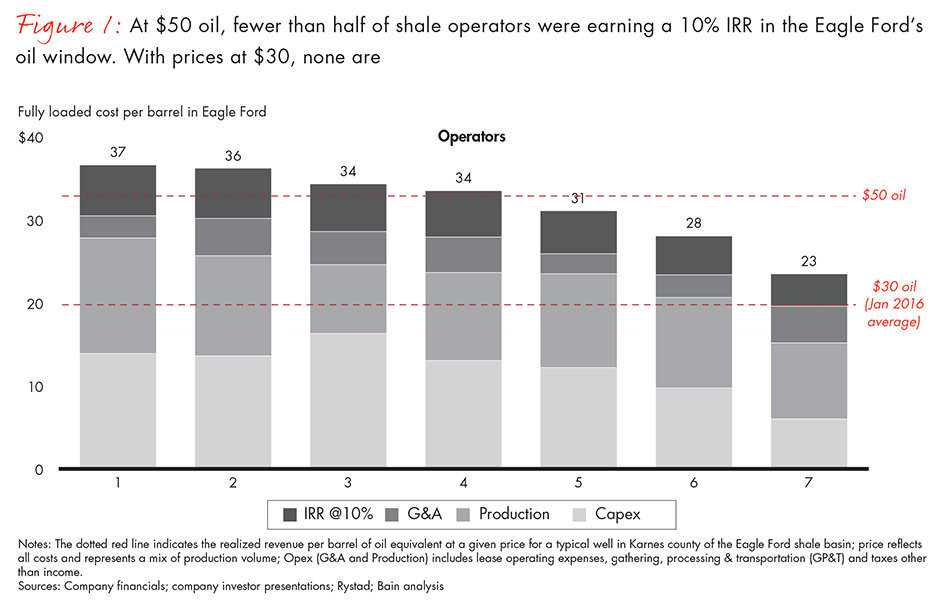
Cutting costs by nearly one-third is no simple feat, and in this price environment operators cannot afford to take an iterative approach. The oil and gas industry has experienced a tremendous shock over the past two years, and companies that want to survive will need to change the way they operate—rapidly and significantly. Three key imperatives stand out.
Know your true cost position
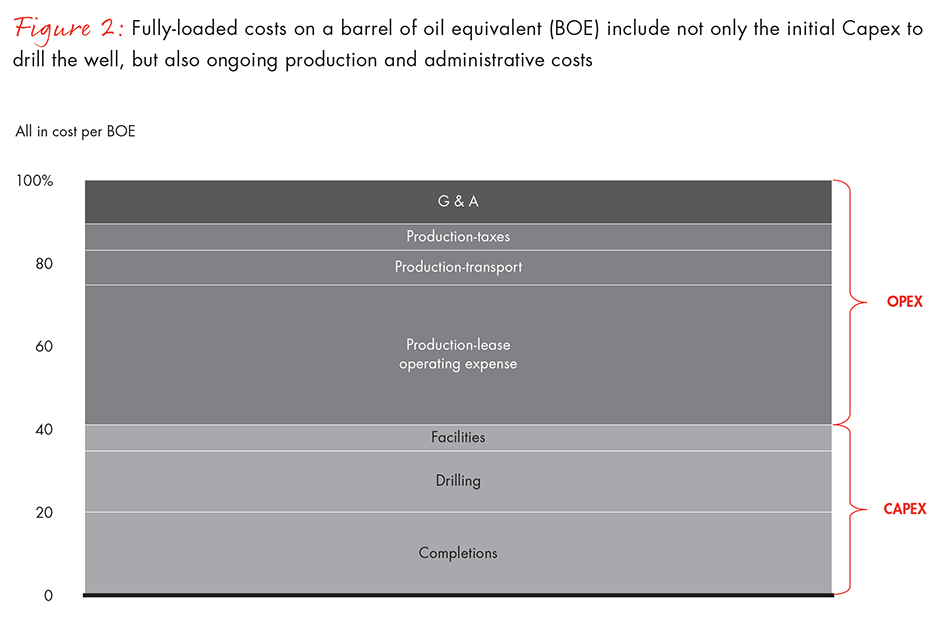
We are often surprised by how many unconventional operators do not have a clear picture of their fully loaded cost per barrel produced (see Figure 2). An accurate view of costs starts with production expenses, capital costs, drilling and completions, facilities operations, transportation, taxes and all other administrative costs. But to get a true picture of the cost position, operators also need to take into account well productivity—or estimated ultimate recovery (EUR). With the total allocated costs and accurate estimates of recovery potential, operators can calculate the true economics for every barrel.
Set the new course
With a clear understanding of well economics, companies will recognize the magnitude of required change and can begin setting cost and well productivity targets. Setting across-the- board targets is unrealistic and not very practical. Instead, companies should develop cost and value driver trees, which allow them to see precisely where costs occur and where value comes from. With that data, companies can benchmark their performance against industry top performers.
Every company will identify specific opportunities, but in our work with shale operators, four key targets show up time and again as having the potential to fundamentally change the economics of upstream unconventional operations.
- Lease-operating expenses (LOE). While most operators have significantly reduced their well capital costs and drilling time over the past several years, few have focused as robustly on LOE, despite the fact that on a per-barrel basis they are actually almost as large as capital costs (see Figure 2). Our analysis of the 15 leading shale operators showed an average decrease of just 8% in these expenses per barrel since 2012 compared with nearly 40% or more improvement in well capex and drilling time. Industry leaders are rigorously benchmarking all the components of LOE, triangulating data from various sources, including joint venture partner costs, public records, investor disclosures and proprietary databases like Bain’s Oil & Gas Global Experience Center, and are setting overall cost-reduction targets for LOE of 20% or more per barrel.
- General and administrative (G&A) costs. Although many companies have trimmed G&A costs over the past year, a longer-term view shows that G&A costs, on a per barrel basis, have actually risen by 26% since 2012 for the largest 50 shale independent operators. Over the past decade, as the price of crude increased to more than $100 per barrel, companies took on more G&A projects, competed for talent and, in general, were comfortable with higher administrative costs. Now they need to strengthen the muscles necessary to rein in those costs. Bringing G&A costs in line starts with benchmarking total G&A costs on the basis of operated production and then cascading that target to each function and sub-function. Translating the identified opportunities into true savings often requires a zero-based approach. As with each of these categories, the size of the opportunity will vary by operator, but overall the industry allowed its costs to slip out of control in the price run-up after 2009. To remain competitive, companies should now target savings of at least 30% beyond what they achieved in 2015.
- Procurement. With suppliers representing roughly two-thirds of the overall cost base, procurement is an obvious area to attack. At this point, everyone has renegotiated supplier contracts and, given the state of suppliers, further negotiations are unlikely to produce any additional savings. Now the real work begins. Procurement teams need to look beyond short-term tactics and take a more proactive approach—for example, working further upstream in project design and collaborating with the engineering and design teams to reduce complexity in design standards before that complexity becomes locked into long-term procurement costs. Companies with the most advanced procurement programs have deployed cross-functional teams comprising operations, engineering, procurement and finance executives to identify specific opportunities in the most promising categories, including oil country tubular goods (typically the largest cost category in drilling capex), agency contractors (which run at a higher day rate than company employees) and hydraulic fracturing services (which make up 70% of completions capex).
- Productivity. Productivity may be the most important lever for the long-term health of unconventional drilling. With data from tens of thousands of unconventional wells, advanced analytic tools and techniques, and a current lull in field activity, now is the time for the industry to tackle this issue. The CEO of one leading shale operator described improvements in well recovery from advanced completion techniques as “overwhelmingly more important” than cost-focused metrics. According to the US Energy Information Administration (EIA), current recovery factors for unconventional wells range from 3% to 7%, with only exceptional cases reaching as high as 10%. Even so, the industry has taken an industrial and incremental approach to improvement, rather than a more rigorous scientific tack—but given current economics it cannot continue to survive with such low recovery rates. Increasing recovery rates by only 1% in the Eagle Ford would raise volumes and lower the fully loaded, break-even point of an average well by $4 to $5.
Create lasting change—quickly
Few signs point to a quick resolution of the market conditions that have driven down oil and gas prices. More common are estimates like that of the International Energy Agency, which has forecast that prices won’t begin to recover until 2017 and may not reach sustainable levels until 2020. If estimates like these are correct, this downturn will last much longer than the one energy producers experienced during the 2008–2009 recession. Anything less than forceful, resolute and rapid action looks like a doomed strategy.
To survive, senior executives of unconventional upstream operators will need to commit to making lasting, sustainable change that positions their companies at the lean end of the spectrum. Every change in corporate culture requires leadership from the top to reinforce new behaviors. Leaders must continuously set the tone for change, keeping expectations high and motivation on target. The transformation that oil and gas companies now face is no exception. Focus from the top will be essential in driving change that goes well beyond cost cutting; companies will need to do more with less to generate the productivity and production gains necessary to thrive in a period of historically low prices—and continue to surprise those who expect them to fail.
John McCreery and John Norton are partners with Bain & Company in Houston, and Whit Keuer is a principal in Bain’s Dallas office. They work with Bain’s Global Oil & Gas practice.
1 EOG Resources, Chesapeake Energy, Pioneer Energy Services, Anadarko, Devon Energy, Southwestern Energy, EQT, Cabot Oil & Gas, Antero Resources, Range Resources, Continental Energy Corporation, SM Energy, WPX Energy, Concho and Newfield Exploration Company (Source: Yahoo! Finance).
First published in 3月 2016