

論説

For a decade or more, Western European and North American telecommunication companies have focused on capturing growth in the consumer market, as mobile phone usage became nearly universal and telcos sold broadband, TV and other data services to users at home and on the go. Now, however, these companies need to gradually shift their management focus toward protecting and growing the business market, where executives see new opportunities and untapped potential. In fact, over the next three years, growth in business services is forecast to surpass the consumer market and become one of the key growth engines for telecom companies. While forecasters expect the consumer market to continue to grow at about 0.6% annually, the business-to-business (B2B) market could grow at about 2.6%, largely due to the demand for mobile data and addressable IT services (see Figure 1).
The challenge for many telecom executives is how to identify the opportunity that lies beyond the market that historically fueled their profit pool and reshape their companies and priorities to capitalize on the situation.
Christophe Van de Weyer, a partner with Bain's Telecommunications practice, discusses three ways that telcos can focus their efforts to embrace this opportunity.
Pivoting to embrace this new opportunity will not be easy. Because consumer revenues generate most of the profit, telcos have relegated the B2B universe to a second-level priority. Therefore, they have not allocated sufficient resources—or they have assigned responsibility at too low a level in the organization. When they do pursue business markets, they often diffuse their efforts with too many projects in too many IT adjacencies, failing to recognize the strong opportunity in the traditional core connectivity business across small office and home office (SOHO), medium enterprise (ME) and corporate customers. Most of the B2B opportunity still lies in reducing churn, increasing wallet share, maximizing account profitability and managing migration to IP technologies. One European mobile telco operator has targeted 5% growth in its B2B services, with two-thirds of that in its core business, mainly through identifying underpenetrated customer segments, reducing churn, cross-selling fixed-line services and monetizing data.
Finally, management often challenges the profitability of B2B units in telcos, which tend to run lower than the consumer business due to high levels of customization, sophisticated buyers and the lower margins inherent to an IT business. To build a robust B2B business, management needs to understand the longer investment payback times and also consider indirect benefits such as protecting the connectivity business.
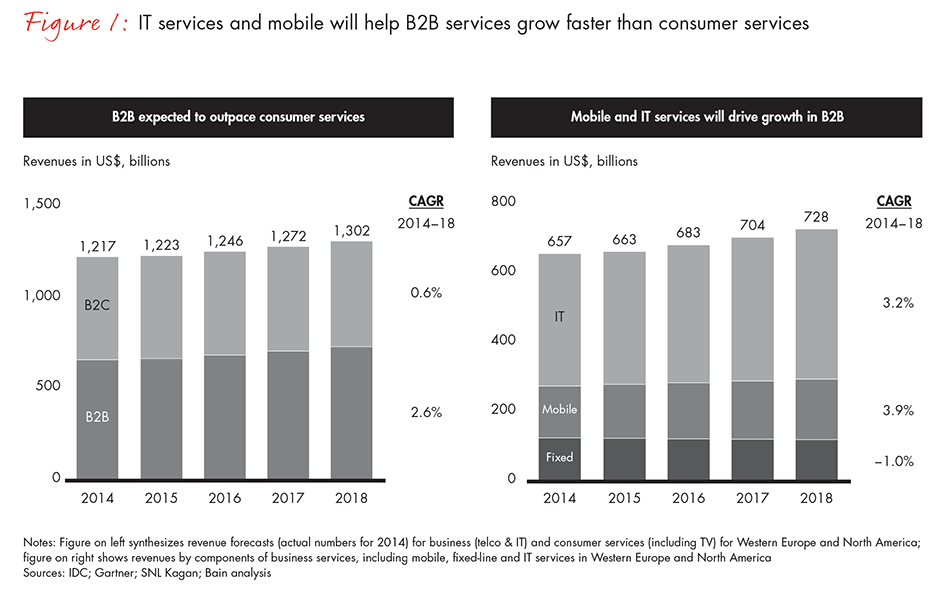
To win in the expanding market for business telecom and IT services, telcos will need to prioritize the B2B opportunity and embrace three essential capabilities.
- Understand customers better and tailor products and services to meet their needs. Telcos will need to adapt their offerings to deliver effective products and services to small and medium businesses as well as larger corporate customers.
- Add one or two growth domains to the core business. Start by focusing on achieving full potential in the core connectivity business and then, based on opportunity, selectively add a few new IT growth domains close to the core business. In many cases, this will require finding partners with the capabilities to help deliver.
- Industrialize the product portfolio with a scalable and modular set of offers. Invest in solutions that are modular and reusable to avoid the temptation to systematically develop bespoke solutions. Address the needs of small and medium customers with standard converged bundles. For corporate customers, use customized solutions based on standardized building blocks.
Understand customers better and tailor products and services to their needs
Successful telcos develop more detailed pictures of customers’ needs, and then use those insights to segment customers more effectively (see Figure 2). For SOHO, they might consider two dimensions: whether telco services are used in the office or on the go, and the number of connections required (one or for a team). Consider two common SOHO businesses: a plumber and a small law firm. The plumber is on the go, spending most of the time in the field, so the most pressing needs will likely be a high mobile usage allowance and the ability to replace a damaged or lost smartphone quickly. For a small law firm, business continuity, data recovery and security may be more important.
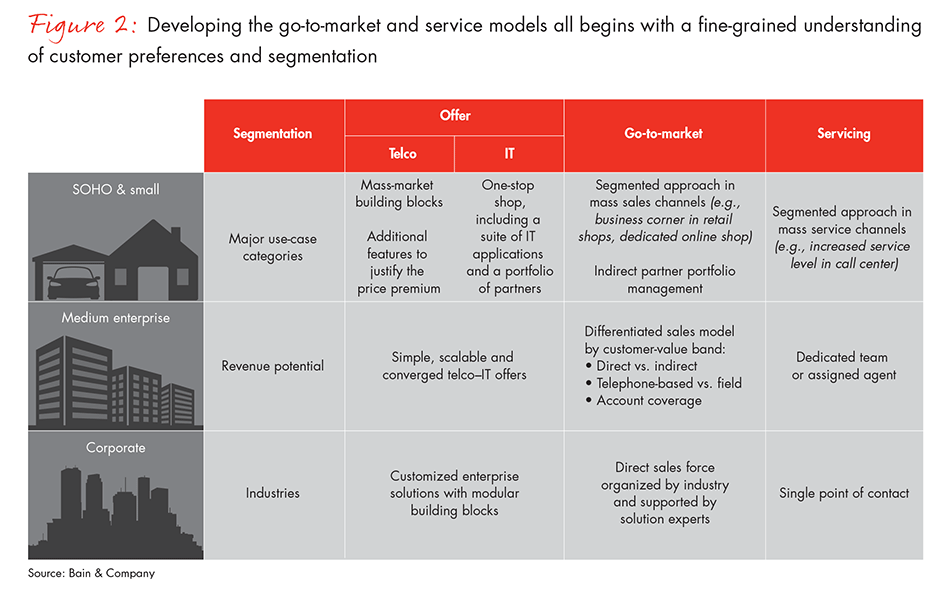
Defining the right go-to-market and service model for each segment is also critical. SOHO customers often prefer to engage through consumer channels, calling in for service or visiting retail stores. They expect quick resolutions to problems and differentiated treatment from the mass market, and they may be willing to pay a significant price premium to jump the queue at the store or be routed quickly on the phone to an expert familiar with business services.
For small and medium businesses, revenue potential is often the most relevant segmentation dimension. Telcos can differentiate the go-to-market strategy by value: indirect at the low end (fueled by campaigns), over the phone in the middle and a direct salesforce at the high end.
At the corporate level, segmenting by industry can be effective because telcos can dedicate their salesforce teams to understand and tailor offers based on the needs of clients by industry. Based on the industry attractiveness and their ability to win, telcos might decide to disproportionally allocate resources to specific industries.
Add one or two growth domains to your core business
Leading telcos start from the core connectivity business and then focus on one or two IT adjacencies where they can excel, which are based on market attractiveness and ability to win. IT categories with strong opportunity include enterprise mobility, machine-to- machine interaction, communication and collaboration (such as private automatic branch exchange or unified communications), infrastructure (including storage, area networks and managed services) and security and data analytics. In most cases, telecoms will need to form partnerships or make acquisitions to gain the necessary talent and marketplace recognition in these new business spaces.
For example, one European mobile operator focused on enterprise mobility and machine-to-machine (M2M) communications. The M2M business is a strong growth candidate and close to their mobile core business, so they can leverage their existing positions across countries. The operator saw further upside in moving up the M2M value chain and attracting more international customers by leveraging global alliances.
Another integrated European telecom operator chose to focus on cloud services and security as IT growth domains. Both were attractive because they showed solid growth prospects and potential for healthy margins, while allowing the operator to leverage and protect its strong position in connectivity by offering dual convergence within fixed and mobile telecom services and also between telecom and IT services. By forging the right partnerships and acquiring an IT service provider with a solid reputation for storage, cloud and network security, the operator accessed the necessary capabilities without the need for direct investments in cloud infrastructure. Future acquisitions may target security firms to further increase credibility. The telco anticipates that these capabilities will help reduce customer churn and allow it to capture a greater share of customers’ spending.

How Telcos Can Capitalize on B2B Market Growth
The B2B market offers more growth opportunity than the consumer market over the next three years. Here's how telcos can succeed.
Build a scalable and modular product portfolio
Developing scalable, repeatable and modular product portfolios is the best way to meet a wide range of customer needs in a cost-effective way. Successful telcos aim to provide 80% of customer solutions with standard building blocks, which they complement with no more than 20% custom development. For small businesses, the ratio can go higher, with nearly all components standard. This strategy increases sales effectiveness and efficiency by providing a clear catalog with standardized offers for each target market, while also optimizing and improving the automation of processes from design through order and delivery. By limiting customization, telcos also keep the complexity of their processes in check.
One integrated telco’s three-year program to develop a more modularized approach to its IT offers simplified its solutions catalog by more than two thirds, which helped increase revenues and reduce the workload. It also found that making its portfolio more scalable and modular improved communication between departments: The head of technical delivery said that marketing and technical people are speaking the same language for the first time.
Another large integrated European telco that standardized its IT product catalog reduced workload by 25% by standardizing and automating the full order-to-cash cycle. Over the long term, management aims to increase revenues by achieving a higher service-level agreement of compliance toward customers and higher customer satisfaction overall.
Putting your B2B plan into action
While these strategies may seem straightforward, for most telcos it will require a complete rewiring of the way they operate their B2B business and include implementing four enablers.
- Reflect B2B focus in talent allocation and organization structure. The B2B team should get its fair share of top talent and report high enough in the organization to reflect the importance of the division with representation on the executive committee.
- Invest in future-proof technological and commercial capabilities. On the technology front, telcos need to build advanced capabilities in the growth domains they pursue. Some will need to acquire or partner with other firms to attract the right capabilities. They will also need to build up salesforce capabilities to start selling solutions that deliver value to customers, rather than selling individual products or services that may be more susceptible to price comparisons.
- Enable your organization to market and sell in the digital era. Customers are better informed than they used to be, not only about offers from their own telcos but also about competitors as well. They expect shorter sales cycles, too. Most telcos will need to develop new capabilities to win in this environment, including content marketing that promotes thought leadership and a “smart view” of customers that incorporates predictive analysis of customer purchases based on their activity. Implementing a continuous improvement program with pervasive “test, learn, act” cycles will help them refine their go-to-market approach.
- Continuously improve through customer feedback loops. As in the consumer market, customer feedback loops are a powerful tool to improve operations, frontline behaviors and customer loyalty. However, B2B environments can be more complex because the customer comprises a range of people, including users, decision makers and those who pay the bills. Telcos will need to measure multiple dimensions of the relationship at different times, including end-user and episode satisfaction, as well as overall relationship healthiness. For example, the rollout of B2B customer feedback loops at one South African telco prompted management to make a step change in customer advocacy. The subsequent improvements raised B2B revenues by 15% and brought 60% of revenues derived from customers at risk of churning back into low-risk territory.
Some telcos will take longer than others to adapt their organizations and strategies to make the most of the burgeoning opportunity in B2B services. Meanwhile, their business customers’ appetite for IT and telecom services grows daily, as their increasingly digital businesses require greater mobility, more storage, tighter security, machine-to-machine communication, data analysis and much more.
Telcos that wait too long to look beyond their consumer models or that struggle with organizational focus are likely to miss the opportunity. Those who act rapidly to gain a better understanding of their B2B customers and their needs will emerge as leaders.
Christophe Costers is a principal and Christophe Van de Weyer is a partner with Bain & Company in Brussels. Both work with the firm’s Global Telecommunications practice.
First published in 4月 2016