

論説

概要
- Global managers responding to our December survey praised their companies’ disciplined cost management, hybrid work, ethical leadership, and employee morale, but worried about their supply chain and adaptability to change.
- Asian executives reported the highest tool use and satisfaction, including relatively high usage of Web3 and Blockchain and satisfaction with ESG and DEI efforts.
- Growth, purpose, leadership, stakeholder value, and deployment of tools that support flexibility should be areas of management focus in 2023.
Judging from the news, executives would have had every reason to feel uneasy heading into 2023. A global economic downturn, the Great Resignation, soaring inflation, military conflicts, trade wars, crippled supply chains, slumping housing markets, new strains of Covid-19—the doom and gloom seems to be everywhere.
So, it was a surprise to find optimism among the more than 1,000 executives and managers who responded to our December survey on management tools and trends. Overall, executives are as positive as we’ve seen them in the 30 years of this survey. They report not only surprisingly high assessment of their own performance and future, but also a high level of satisfaction with the management tools they employ.
Representing companies from a variety of industries around the world, this group generally described their companies as disciplined cost managers and effective hybrid workplaces with ethical leadership teams and strong employee morale (see Figure 1).
Figure 1
This mirrors interviews we’ve conducted with executives, who express confidence in their resilience. Having made it through nearly three years of a global pandemic, weathered an unprecedented shift in work norms, navigated complex supply chain woes, and met whole new customer needs, they feel ready to deal with a weaker economy. Many welcome opportunities to return to traditional leadership practices and to fix inefficiencies that may have crept in with Covid.
The public, and workers in particular, also seem to have a higher level of trust in their business leaders right now than they do in heads of other institutions. According to the 2023 Edelman Trust Barometer, based on a global survey, business is more trusted today than government, the media, or nongovernmental organizations, and employees particularly trust their own employers.
Not everything was rosy in our survey. Respondents were less confident about the state of their supply chain and how well they adapt to change, for example. But there was optimism on many topics. Just half of the managers responding believed that bureaucracy and organizational silos were impeding their growth and innovation. Fewer than half thought their digital transformations were going too slowly. More disagreed than agreed that competitors adapt to change more effectively.
There’s nuance in many of these findings, with differences by company size, region, and even respondent role. Results were often directionally similar for companies of all sizes, but materially different on certain topics. For example, larger company respondents consistently rated themselves higher than those from smaller companies on their ability to capture and exploit the full value of data science and the success of corporate sustainability efforts, including those focused on environmental, social, and governance (ESG) and diversity, equity, and inclusion (DEI) practices.
Regional differences manifested, too. Just 39% of North American managers said navigating global politics was taking more time and complicating their strategy, but 68% of managers in Asia felt it was. And 63% of respondents in Asia said their company would reduce its dependence on international markets, vs. 31% in North America. Leaders in Asia, following years of significant investment in robots, were far more optimistic about robotic labor in 2023, with 68% agreeing they would use more robotics to replace human workers this year. Only 26% of their North American counterparts agreed.
Corporate executives are more positive than division and team leaders, and all of them more so than employees surveyed recently by Gallup. In our survey, 83% of corporate leaders agreed that almost all people in their company were fully engaged and proud to work at the company, while 75% of division heads and 68% of team leaders agreed. Gallup’s State of the Global Workplace: 2022 Report found, however, that only 21% of employees are engaged at work.
Other notable discrepancies include the fact that 80% of corporate leaders believe sustainability efforts are meeting or exceeding expectations, but only 45% of team leaders agree; that 85% of corporate leaders believe their leadership team can always be trusted, while 63% of team leaders think so; and that 76% of team leaders think their employees’ jobs won’t be automated, while 57% of corporate executives expect robotics to replace human workers.
Fewer management tools, higher satisfaction
Managers appear to be increasingly sophisticated in their use of tools, jumping on fewer fads and carefully selecting the tools they use. Back when we first launched this survey, tools had much higher usage rates than they do today, with some tools employed by more than 70% of companies. In 1993, 72% of respondents used Total Quality Management, for example. Half as many use it today, but those who do, like it more: Satisfaction has increased from 3.78 to 4.29. While managers are adopting fewer tools, their satisfaction with the tools they are using has increased. In a change from previous surveys, none of this year’s heavily used tools have low satisfaction scores—leaving the upper left quadrant of our graphic empty (see Figure 2). This suggests managers are better able to ignore excessive hype and find the approach that matches their company’s needs.
Figure 2
This could mean that companies have come to realize that good management relies on using the right tools in the right places in the right ways at the right times. If so—given the pressure on leaders to create value for all stakeholders, and its high satisfaction levels and relatively low usage—we expect penetration of Stakeholder Strategies to grow.
There is a danger that managers have adopted a “set and forget” mentality on some things that will make it difficult to adapt quickly enough to the unpredictable conditions 2023 will likely bring. Valuable tools like Mission and Vision Statements, used by 88% of respondents in 1993, but only 28% of this year’s, may be getting too little focus right now. Complacency with ESG and DEI programs could also be a danger. Managers closest to the trenches were much less confident than corporate executives that their ESG and DEI efforts were meeting their objectives: Only 45% of team leaders and 64% of division leaders agreed with that statement, compared with 80% of company leaders.
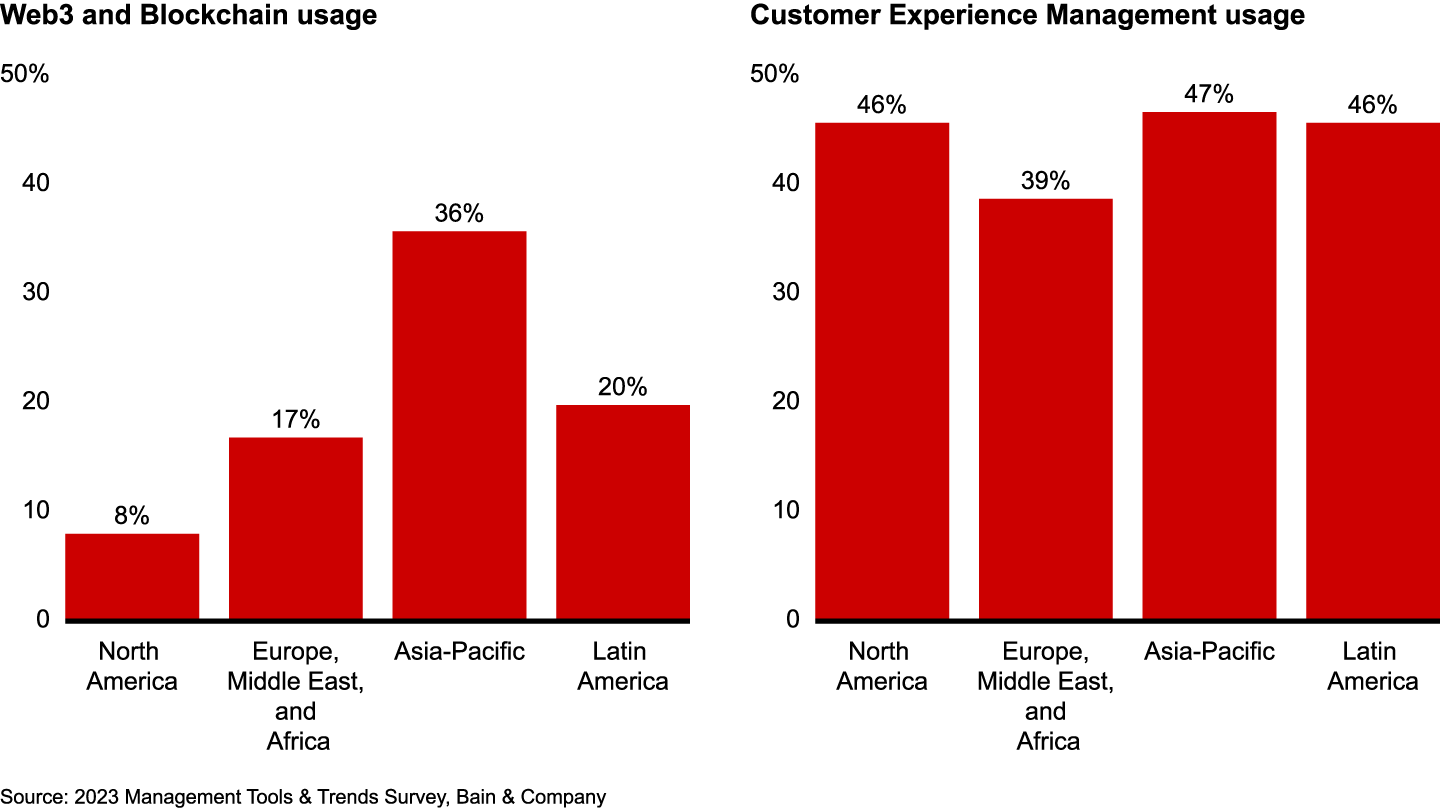
Tool usage was highest among companies in Asia, at eight tools per company, vs. six in the US and less than that in Europe. Certain tools were more popular in Asia, including Web3 and Blockchain, used by 36% of respondents compared with 8% of North American managers (see Figure 3). Tool satisfaction was higher in Asia and Latin America as well. There is a significant spread, for example, between their high level of satisfaction with DEI and ESG tools and those of their counterparts in Europe and North America where customers and regulators set a high bar.
Figure 3

Four lessons for 2023
Taken together, the survey highlights the value of focusing on four topics in 2023:
Invest in growth, not just cutting costs.
Some 62% of respondents expect to implement significant cost reductions in 2023, and 79% felt they were disciplined cost managers. While cost reduction may be necessary in an economic down cycle, it’s important to balance that with investments that will position a company for growth when the economy begins to strengthen. Historically, like a race-car driver hitting a curve, it’s those that brake early and then accelerate rapidly at the apex of the turn that tend to gain market share and come out of a downturn especially well.
Rededicate to purpose and leadership.
Nearly two-thirds of US adults now believe a company’s primary objective should be making the world a better place. True commitment to purpose is central to meeting employee and customer expectations. Purpose is important regardless of economic cycle, and 2023 respondents from companies using Purpose, Mission, and Vision Statements reported a high level of satisfaction with them.
Create broad stakeholder value.
Companies that learn to align, integrate, and benefit all stakeholders will build more successful and resilient businesses. Research by the Drucker Institute, for example, has found that a portfolio of 100 effective and consistent creators of stakeholder value significantly outperforms the S&P 500 Index over three or more years.
Use tools that support flexibility.
Is executive optimism well grounded or overly rosy? Predictions are always tricky, but certain tools are built to help manage changing outlooks. Dynamic Strategic Planning and Budgeting, for example, used by just 27%, helps management quickly adjust to new data. It’s not enough to have a strategic plan; executives need to be able to rapidly adjust as situations change, one of the principles and insights that Covid-19 reinforced. It will be important to continue to monitor events carefully and constantly challenge hypotheses and assumptions to figure out how to adapt. (For more on how to do this, please see our colleagues Michael Mankins and Mark Gottfredson’s article in Harvard Business Review, “Strategy-Making in Turbulent Times.”)
Looking forward
Companies are optimistic about expanding their tool usage in 2023 and open to using new tools. Among the most popular tools, which more than 80% of those surveyed expect to adopt, are Customer Experience Management, Digital Transformation, and Employee Engagement Systems. Respondents who are optimistic about 2023 revenue—as measured by their confidence that their company’s sales growth would outpace their closest competitor’s—are more likely to predict higher tool adoption than respondents pessimistic about corporate sales growth. Seventy-five percent of optimistic respondents say they will use Corporate Venture Capital in 2023 vs. 38% of pessimists, for example. But the pattern doesn’t always hold: Nearly as many pessimists (80%) as optimists (88%) believed they will be using Digital Transformation.
Over 30 years of tracking how executives use management tools, it's clear that the popularity of any individual tool may rise and fall, but when the right tool is used for the right reasons with the right resources, it can be an important contributor to a company’s success.

About the Research
Data powered by Dynata, a leading global first-party data and insights platform.
First published in 1月 2023