

論説

Marketers have long wanted to get inside the heads of their customers. Getting onto the smartphones they hold in their hands may be the next best thing. According to a Bain & Company survey, people interact with their phones an average of 13 times per hour. That means during the 16 hours or so people are awake, they’re doing something with their phones more than 200 times per day. People use their devices for communication, information, entertainment, socializing—and, more and more, they are consulting their phones whenever they’re in the market to buy a product or service.
Many consumers, particularly millennials, now use their smartphones for most—and sometimes all—the steps involved in making a purchase. They research and compare products, check reviews, hunt for bargains and coupons, buy, pay and arrange delivery. Even consumers who purchase their products someplace else—on their PCs, on their tablets or in a physical store—often start the buying process on their phones. Some 70% of smartphone users do research on their phones prior to making a purchase in a physical store, according to a survey by Google.
And the evidence suggests that when smartphone users shop, they buy. Already loyal customers find mobile apps an easy way to boost their spending. According to an analysis by Google, Walgreens customers who use the retailer’s app spend, on average, six times more than those who use other channels. And, according to that analysis, Macy’s in-store customers who also use the department store’s app spend eight times more than those who don’t. Consumers are also paying attention to the ads that appear on their phones. According to the Bain survey, 50% of the mobile ads viewed by consumers had a moderate or high influence on a purchasing decision.

Don't Miss the Moment on Mobile Marketing
A look at how marketers can capture the mobile opportunity.
Given these trends, you’d expect companies to be falling all over themselves to target consumers on their phones. But they’re not. Many marketers are at risk of missing their mobile moment.
People are increasingly attached to their phones; that’s where they consume 25% of their media. But companies overall spend just 13% of their marketing budgets on mobile advertising. And much of that advertising isn’t suited to the medium. Mobile consumers have extremely short attention spans. Experience shows that advertisers have three seconds or less to grab their interest. Yet, most of the video advertising that appears on mobile devices is repurposed from ads produced for television, meaning it’s too long and too slow.
Ownership of smartphones has been growing at a rate of 43% a year since 2010, and there are now 2.5 billion phones in use worldwide, twice the installed base of PCs. Nonetheless, marketers are underinvesting in mobile, and they’re missing out on major opportunities to interact with their customers.
Why this disconnect? While it often takes time for advertising spending to catch up with the growth of a new medium, something else is at work here: Companies are viewing mobile through the prism of digital media in general. They’re bringing into mobile the expectations, practices, rules and measurements they use in other forms of online advertising. But mobile, once seen as a subset of digital, should now be considered its own medium, one with enormous possibilities and new rules of engagement.
Some companies are allowing themselves to be misled by their own metrics. Marketers naturally want clear, demonstrable returns on their investments, but the methods they use for calculating mobile’s effectiveness are incomplete. Conventional digital metrics, which typically attribute an action to the last place a consumer clicked, often miss the nonlinear aspect of buyer behavior. While 94% of smartphone owners use their devices to search for a store, that activity shows up in conventional metrics only when a consumer actually uses her phone to buy something. The manufacturer and retailer may never acknowledge that mobile was involved in the transaction.
By using measurement methods designed for a world in which mobile did not loom so large, companies may be misunderstanding the true nature of the consumer’s “new journey,” one that can start on the phone and end up in another channel. Many marketers, in short, are underestimating the true value of mobile.
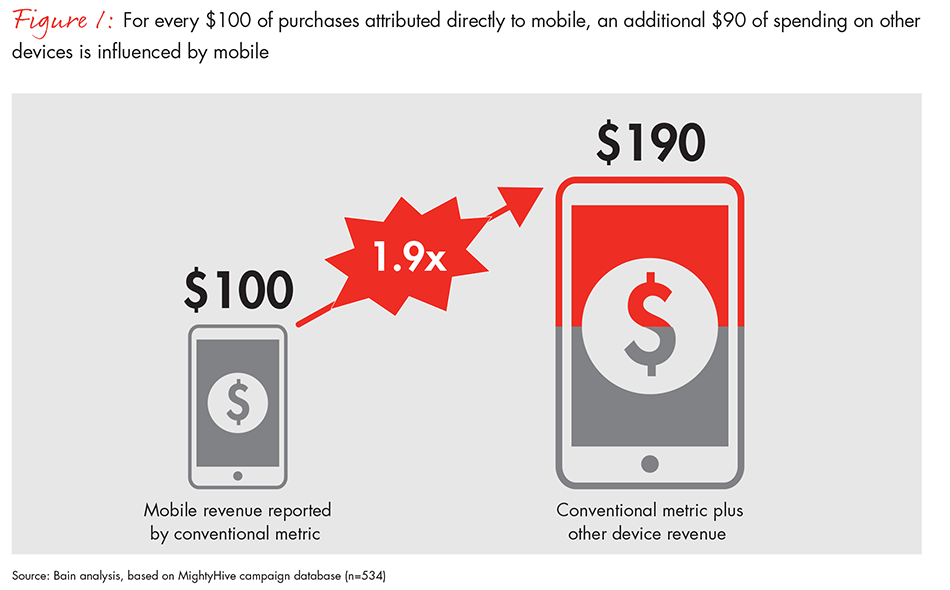
Recognizing that conventional metrics don’t fully capture the contribution made by mobile, some companies have begun using estimates or proxies. A Bain & Company analysis of 534 marketing campaigns shows that for every $100 of revenue attributed to mobile display ads by conventional metrics, an additional $90 should be attributed to mobile for purchases made on another device. By applying this 1.9x multiplier to the revenue attributed to mobile by conventional metrics, companies can get a better estimate of the power of the platform (see Figure 1).
But no metric, however precise, can quite capture the qualitative aspect of mobile, what marketers refer to as the “magic” of this medium. Red Lobster and Angie’s Boomchickapop, for example, have recognized that there is an opportunity to engage with customers on their phones in ways that just aren’t possible with other media, even other digital media. Brands can create an intimate connection, reaching consumers at the precise instant when they are ready to shop—and to buy. Marketers like to call this narrow window, when a consumer is primed to make a decision and take action, a micro-moment.
In an effort to capture more of these occasions, brands are conducting focused, scalable experiments in mobile marketing—with strong results. Red Lobster, for example, targeted mobile customers with advertising when those customers were near one of its restaurants during prime dinner hours, reaching potential guests at those micro-moments when they were most likely to stop in for a meal.
Red Lobster ventured into mobile marketing using a test-and-learn approach. When it studied its guests, it found out just how important mobile was in their lives. About 75% of the traffic on RedLobster.com originates on a mobile device, and about 60% of the traffic on the site happens during dinner hours (3−8 PM).
Since about three-quarters of the US population lives within driving distance of a Red Lobster, the company saw an opportunity to test mobile advertising on a broad scale. Red Lobster reached out directly to consumers who were near one of its restaurants and on their mobile phones at dinnertime—at the micro-moments when they were ready to make a purchasing decision. As part of this effort, the company increased its investment in mobile engagement in two geographic markets with a large concentration of stores, then compared the results with a similar-sized control area.
Because Red Lobster couldn’t directly link specific purchases to mobile ads, it used store visits as a proxy to gauge the mobile campaign’s impact. Within the test areas, mobile users who saw a Red Lobster ad on their devices were 31% more likely than those who didn’t see an ad to visit a restaurant that day and 17% more likely to do so the next day.
Over time, Red Lobster has found mobile advertising to be an effective tool to help it achieve its business goals, including driving sales growth across its restaurants and contributing to increased awareness of signature events such as Crabfest.
Laura Beaudin, a partner with Bain's Customer Strategy practice, shares three ways marketers can effectively target consumers—and increase traffic—through mobile campaigns.
Angie’s Boomchickapop, a brand that features eight flavors of gluten-free, non-GMO bagged popcorn, used a large-scale test-and-learn approach with the goal of boosting sales and market share in six metropolitan areas across the US. Building on the insight that its target shoppers—young, active females—were often looking for healthy snacks, the company developed a mobile-first strategy to reach those consumers during the micro-moments when they were most likely to want to munch. Boomchickapop targeted mobile users when they were near retail locations on weekends (Friday−Sunday), prime days for popcorn consumption. The six-city, cross-platform campaign lasted four weeks, and was followed by mobile-only “sustain” efforts running about four times a month.
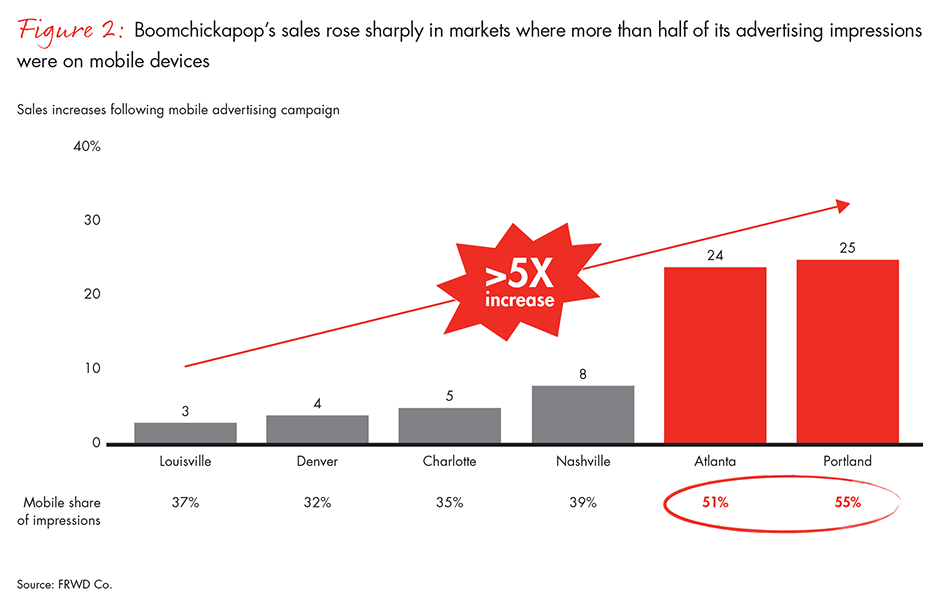
Boomchickapop recorded a 23.4% lift in sales in the test markets and calculated an ROI of $1.30 for every $1 it spent on the digital campaigns. By testing different levels of mobile impressions in each of the six markets and looking at a broad business measure (retail sales) instead of a narrow metric, the company was able to learn from the results.
Sales increased fastest in cities where customers received a bigger share of advertising impressions on mobile phones. The top two geographies in terms of mobile’s share of impressions were five times more effective in lifting sales than the four other locations (see Figure 2). Mobile was also the most productive channel for driving customers to the store locator on Boomchickapop’s website. The company was so encouraged by the results that it plans to invest heavily in mobile in future campaigns.
Both Red Lobster and Boomchickapop have capitalized on the visceral power of mobile marketing. While other media, including television and radio, can reach millions of people, those audiences tend to be episodic, tied to specific programs. By contrast, mobile phones are almost always “on”; many consumers are connected during virtually all their waking hours. While people passively watch or listen to other media, they interact with their phones on a personal level. Herein lies mobile’s potential for magic.
In planning its mobile-intensive digital campaign, Boomchickapop aimed to build a bond with young, female customers by developing targeted creative materials, including a fast-moving, brightly colored video 15 seconds long, set to an up-tempo jingle.
Boomchickapop’s magical marketing on mobile outperformed its other campaigns, including those that offered coupons. The message here is that ads with sizzle get noticed, even more than ones that offer discounts. Digital marketing is as much art as it is science. The medium is full of numbers. It has all sorts of algorithms and predictive models. Even with the best math, though, mobile marketers still need to create advertising catchy enough to resonate with customers. In short, mobile marketing needs both math and magic. (For more on this topic, see the Bain Brief “The Math, the Magic and the Customer.”)
Marketers who are willing to look beyond their own conventional metrics, invest in mobile, test mobile-first campaigns and embrace the magic of the medium have an opportunity to leap ahead of their competitors. Here’s how you can go about it:
- Figure out how much time your target customers spend on mobile (it’s probably a lot), and how mobile fits into their purchase journey. With mobile, you can reach customers and the precise moment they’re most likely to make a purchase.
- Don’t be deceived by your own measurements. Mobile probably plays a bigger role than you realize in your customers’ buying decisions.
- Look at broad business results, such as retail sales, not narrow metrics. Where possible, use estimates and proxies to build a full picture, and once you have the data, double down on mobile and keep testing.
- Test and learn, and test at scale. Much testing of mobile advertising is too small, too timid or too slow. Be bold. With focused campaigns, you can make a big, meaningful shift into mobile.
- Optimize your digital campaigns for mobile. Avoid repurposed video from television or another platform. Be creative. Look beyond discounts and aim for magic.
Now is the time to take the next step on your mobile journey. Your customers are already there—and they’re waiting for you to make the most of your mobile moment.
Laura Beaudin is a partner in the Customer Strategy & Marketing practice and leads Bain & Company’s global marketing excellence work. Wendy Grad is a manager in the firm’s Digital practice. Elizabeth Spaulding is the global practice leader of the Digital practice. All three are based in San Francisco. John Grudnowski is the founder and CEO of digital agency FRWD, based in Minneapolis.
Special thanks to Bain team members Tedde Tsang, William Grogan and Hanna Morrill for their contributions to this brief.
First published in 12月 2016