

The Visionary CEO’s Guide to Sustainability

概要
- Emerging financing and collaboration models can help agriculture clear long-standing barriers to sustainability.
- These models can accelerate farmer adoption of the necessary production changes by distributing risk and monetizing ecosystem benefits.
- Many companies stand to benefit from more sustainable food systems. Asking five key questions will help them jump-start their efforts.
This article is part of Bain's 2024 CEO Sustainability Guide
This article is excerpted from the World Economic Forum report 100 Million Farmers: Breakthrough Models for Financing a Sustainability Transition.
Our global food system has a significant impact on the environment. It accounted for more than 30% of global greenhouse gas (GHG) emissions in 2020, over 80% of tropical deforestation and biodiversity loss, and 70% of global freshwater withdrawals. It also has the potential to sequester substantial amounts of carbon.
We know the practices, technologies, and inputs that could begin to reduce—and ultimately reverse—the food system’s impact on climate and nature while at the same time building resilience, boosting productivity, and enhancing the nutrient density of crops. Yet we struggle to deploy these solutions at the scale and pace required. Currently, an estimated 15% of global cropland is farmed using regenerative practices.
Transforming the global food system demands greater investment: at least $300 billion in additional capital annually through 2030, according to the Food and Land Use Coalition. Without new approaches, it will be hard to raise that much capital.
Regenerative agriculture, one part of that transformation, illustrates the challenge. Its potential benefits are well understood, but farmer adoption has not scaled quickly enough due to economic, technical, and social barriers. Even though longer-term returns can be positive, the economic risks farmers face in the early transition years—up-front investments required, uncertainty in yields as soils are reconditioned—can pose a major barrier to getting started at all (see Figure 1).
Figure 1
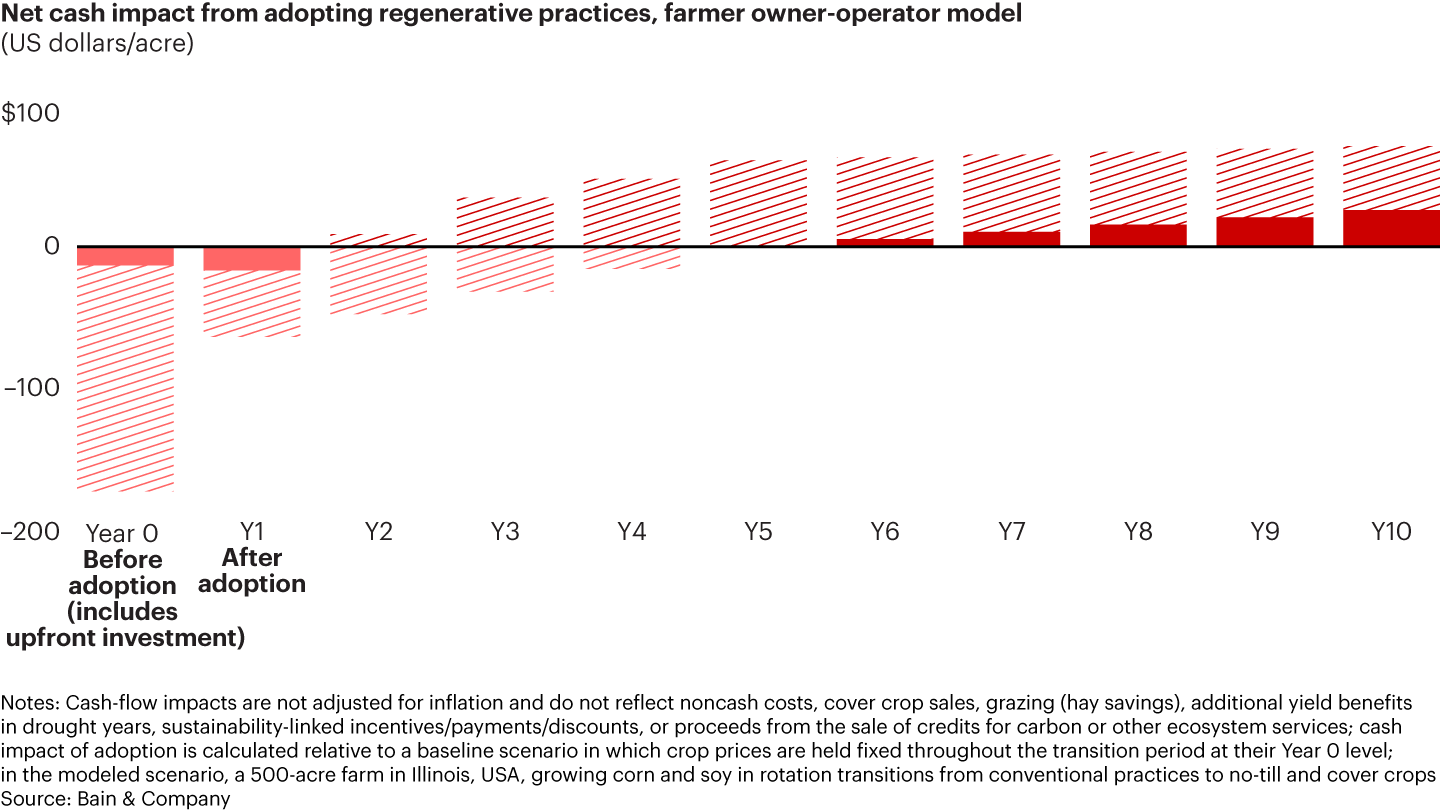

To date, few actors, including those that stand to benefit from the many advantages of regenerative agriculture, have stepped up to share that risk. However, innovative financing and collaboration models are now emerging that use up-front payments or guarantees to defray the risks for farmers and in some cases offer other supports, like affordable working capital loans, equipment and input financing, and technical assistance.
Monetizing the benefits of regenerative agriculture
Regenerative agriculture can deliver many valuable outcomes to a wide set of participants in today’s food system, but so far, few are paying for them. The benefits include a lower carbon footprint for food production; reduced water use, runoff, and pollution; improved biodiversity; higher nutrient density in food; and more resilient farming operations. These outcomes are highly valuable to downstream agri-food companies that need reliable and resilient supply chains, aim to produce nutritious foods, and want to deliver on Scope 3 carbon commitments. Farm lenders and insurers of farms could lower risk in their agricultural portfolios, while local water companies would benefit from cleaner water.
Monetization of these outcomes could occur in several ways. For example, a wide range of actors could pay for verified environmental outcomes like GHG emission reduction and removal or lower freshwater pollution. Agri-food companies could pay premiums for commodities produced in a way that delivers the desired outcomes or agree to longer-term offtake contracts that reflect the more reliable supply they expect to receive. Monetization of resilience could take the form of more favorable lending and insurance terms for farmers to reflect lower portfolio risk.
Today, only one ecosystem outcome market is relatively developed: the monetization of carbon outcomes through carbon offsets and Scope 3 reduction programs, called “insets.” Markets for water quality, water conservation, farmland resilience, enhanced biodiversity, and higher nutrient density of food have been slow to develop, in part because of a lack of agreement on how to measure things like biodiversity. Another factor is insufficient data on the precise relationship between regenerative practices (such as reduced or no tillage, cover cropping, and nutrient management) and better environmental and economic outcomes.
Before the many benefits of regenerative agriculture can be fully monetized, a blend of catalytic, concessional, and commercial investment capital will be needed to kick-start programs that provide farmers with the requisite financial and nonfinancial support. This investment capital can be recouped over time as food system actors recognize and increasingly value the benefits delivered by regenerative practices.
Emerging financing and collaboration models
Coordinating these capital sources and channeling their investment efficiently require backbone entities. So does coordinating support and services for farmers. Entities that take on this coordination role must have a strong understanding of a number of factors, including the optimal deployment of regenerative practices, the expected economic and environmental outcomes for the farms they assist, and the financial and nonfinancial support that is most likely to incentivize farmers. Their ability to accurately forecast farms’ agronomic and environmental performance under regenerative management will be key to structuring robust financing vehicles.
A range of models are being tried today. No one program yet incorporates all the essential elements to accelerate and scale up farmers’ transition to sustainable practices, but two “farmer-allied” models do show promise. The first builds on grower associations and the inherent trust they have with farmers, who often face a bewildering array of offers and programs, not always tailored to their needs and mostly inconsistent with one another.
One example of this type of model is the Soil and Water Outcomes Fund (SWOF), a program affiliated with the Iowa Soybean Association. Despite evidence that using conservation tillage and cover cropping could bring both soil health and financial benefits to US corn, soy, and wheat farmers, more than 90% of them surveyed in 2022 cited uncertain return on investment as a barrier to adoption. We estimate that $25 billion to $80 billion in financing—or more—will be needed to help US farmers reach an agronomically optimal level of low- or no-till farming and cover crops.
SWOF is beginning to address that need by providing participating farmers across 19 states with up-front payments, along with technical assistance to support their transition. SWOF’s financing comes in part from monetizing and selling environmental credits to corporate buyers, like PepsiCo, Cargill, and Target, who benefit from a more sustainable supply chain. It has also raised catalytic capital from government sources, including the USDA’s Partnerships for Climate-Smart Commodities.
SWOF serves as a coordinator between farmers and other parties, quantifying environmental outcomes from individual farms with robust data and modeling, negotiating purchases from multiple buyers simultaneously, and optimizing financing flows. It’s a model that is now being emulated in different crops, including cotton, and in other regions of the US. But even leading programs such as SWOF need greater financial services involvement in order to provide farmers with a full suite of solutions to support their transition.
The second model, in which financial services providers with the necessary advanced analytical capabilities catalyze progress, is exemplified by Crédit Agricole. Through a partnership with Canadian multinational McCain Foods and GAPPI, the bank is offering up to €40 million of new debt on attractive terms to 800 potato farmers adopting regenerative methods. With McCain making the interest payments and Crédit Agricole providing the loans, the partnership shows how aggregating capital from a variety of sources can help unlock more financial support for growers. In partnership with France Carbon Agri, the bank launched a platform to monetize agricultural carbon outcomes. And at the same time, it is building its own internal capabilities. For example, relationship managers can use its Trajectoires RSE Agri tool to discuss regenerative agriculture more effectively with farmers.
Steps to accelerate change
Such innovative models show promise but need to be built out, scaled up, and replicated much more quickly. Financial services companies will play an important part, improving the financial health of their clients while building new revenue streams and progressing on their own environmental commitments and regulatory obligations.
But with less than 4% of overall climate finance going to the agriculture, forestry, and other land use sector today, far more engagement is necessary. Of more than 50 regenerative agriculture pilot programs studied in the US, only 15% include a financial institution of any size. Yet these players have a lot to gain from a more resilient portfolio and can bring valuable advanced analytical, risk management, and financial engineering capabilities to partnerships with others in the value chain.
Indeed, every company that benefits from regenerative agriculture must contribute. Efforts like the World Economic Forum’s First Movers Coalition for Food aim to leverage the procurement power of member companies to give growers confidence and speed the adoption of sustainable farming for high-GHG agri-food commodities. Downstream agri-food companies, including processors, consumer products companies, and retailers, will benefit from greater certainty of supply and delivery on climate and nature commitments. All food system actors must develop the capabilities to effectively participate in the kind of collaboration critical to sustainable agriculture.
Companies keen to accelerate the transition to sustainable food systems will benefit from considering five questions:
- How much value can our company create by ramping up our commitment to transitioning to sustainable food production while continuing to meet our commercial ambitions?
- What investments, products, services, and procurement strategies will help us reach our targets?
- How can we help farmers obtain the financing and other support they need?
- Do we have the right partners, in the right models, to provide the support needed?
- What operating model changes will we have to make?
Read our 2024 CEO Sustainability Guide
More from the report
First published in 9月 2024