

論説
Pharmaceutical deal making is approaching fever pitch, yet many combinations risk damaging shareholder value. That risk comes into sharp focus when you consider the industry’s leading long-term value creators—10 companies that consistently outperformed the industry over a 20-year period based on total shareholder return (see Figure 1).
With their sustained success, these companies refute the widely held assumption that serendipitous innovation is the key to success in pharma. Likewise, all 10 winners have prospered despite industry-wide trends such as declining R&D productivity and the demise of the primary care blockbuster model.1
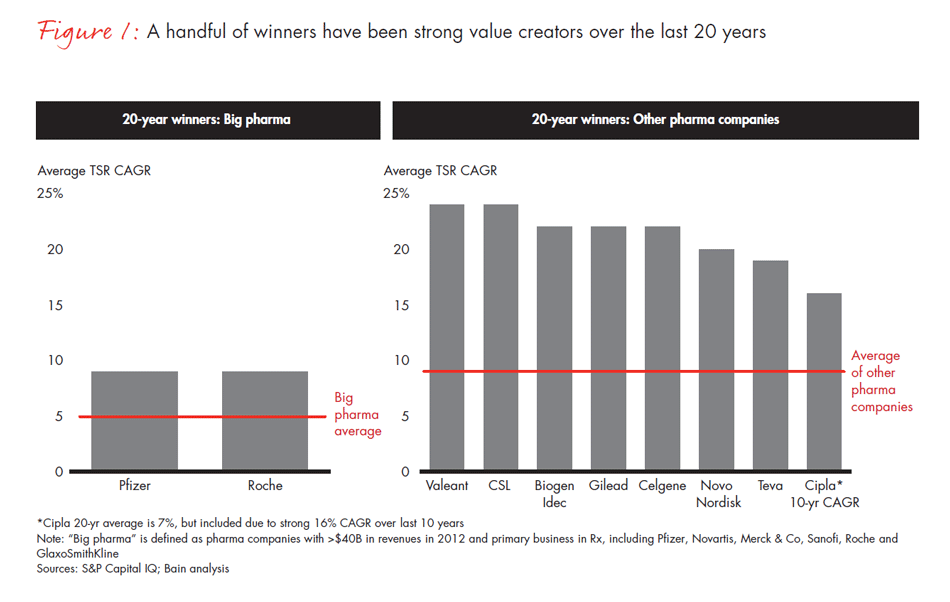
Three recurring factors explain the success of the winning companies. First, they all focused on building leadership in categories and capabilities. Second, they all developed distinct capabilities in one of four repeatable business models. Finally, our winners all used targeted M&A strategies to build their leadership positions—with valuable lessons about the kind of deal making that delivers sustained value.
The benefits of focus
Over the past 20 years, and especially since 2000, building leadership in a category has become a crucial route to success in pharma. Seven of our 10 leading value creators, including Roche in oncology and Novo Nordisk in diabetes care, generated at least 50% of their revenues from one therapeutic area or primary care. In two cases—Biogen Idec in neurology and Celgene in oncology—more than 90% of revenues came from a single therapeutic area.
Category leaders have privileged access to all stakeholders in the category. This allows them to identify and satisfy unmet customer needs, often at the intersection of science and marketing. Their product and regulatory functions benefit from more expertise and stronger relationships, enabling them to get innovations to market faster and with a higher success rate. They are well placed to understand and price the best business development opportunities, and are a preferred partner for smaller companies to develop and market their products. Lastly, their market presence and strong customer relationships improve commercial efficiency.
For example, Gilead Sciences built its success in HIV/ AIDS therapies on the insight that a lower pill burden and fewer side effects were the keys to fostering better adherence in HIV patients and improving long-term outcomes. Ultimately, Gilead expanded its HIV/AIDS market from therapy to prevention. The vast majority of Gilead’s products were acquired inorganically, often in earlier clinical development stages. For 10 years, Gilead was the only approved manufacturer of multi-class combination products for HIV/AIDS.
Gilead is now transferring its capabilities across product areas in virology by developing combination products for Hepatitis C. It has, however, been less successful outside its core category. For example, Gilead has acquired companies focused on respiratory and cardiovascular products. These categories only contribute 5% of Gilead’s current valuation.
In this short video, Nils Behnke, a partner in Bain's Healthcare practice, shares insights drawn from two decades of data, and outlines three things these companies do well.
The power of leadership in a category
To better understand the relationship between category leadership and value creation in pharma, we analyzed a data set of 1.2 billion Medicare Part D prescriptions, using prescriber overlap as a proxy for shared customers, cost and capabilities. We found that the prescription market breaks down into at least 22 different category-based markets that differ significantly from traditional therapeutic and disease areas.
Leading category positions are highly predictive of profitability and value creation in pharma. We created the Category Leadership IndexSM score to capture this trend. The Category Leadership Index score is the revenue weighted average of a company’s relative market shares (RMS) in the categories in which it competes. In 2013, the Category Leadership Index score showed a strong correlation between operating margins and weighted average RMS across the major pharma categories. For the typical pharma company, a 0.1 increase in its Category Leadership Index score can be expected to boost operating margins by 2 percentage points (see Figure 2).
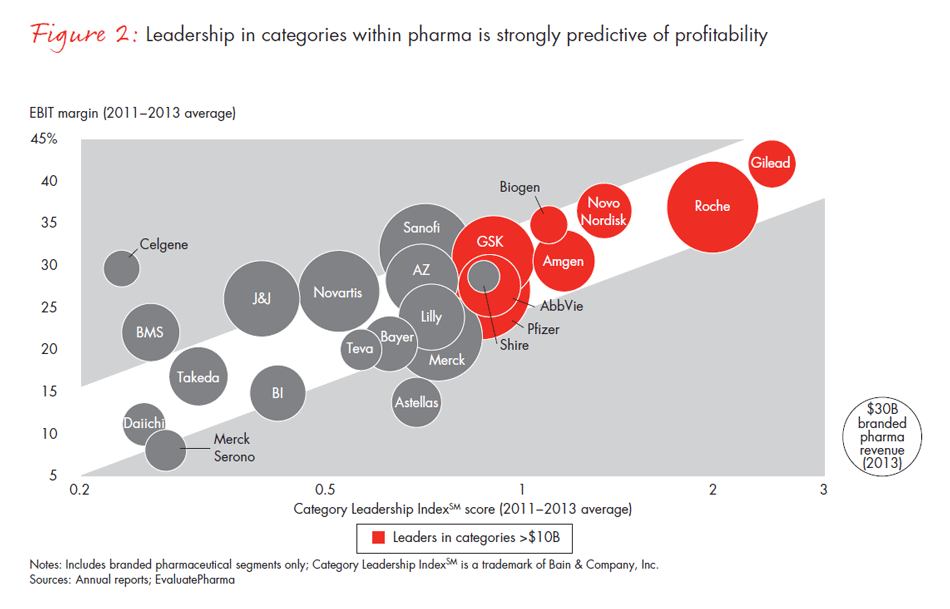
Category leadership yielded scale economies for our winning companies. As a result, they incurred significantly lower sales, general and administrative expenses, which boosted their profits. Even more striking, late-stage development programs from category leaders (RMS > 0.75) were more than twice as likely to result in regulatory approval as similar programs from followers (p=0.01).2
Repeatability rules
All of our top value creators built distinct capabilities in one of four repeatable business models:
Disease solution providers beat the competition by offering differentiated products and services based on deep understanding of the disease and customers. Gilead’s unique HIV combination therapies drove an eightfold increase in the company’s share of the HIV/AIDS drug market. Novo Nordisk’s leadership in diabetes care largely explains why its 2013 EBITDA margin was 23 percentage points higher than we would have expected from its relative share of the pharma market as a whole.
Breakthrough innovators create one-of-a-kind products, with—at least initially—less emphasis on sophisticated commercial capabilities. For example, Celgene changed the game in multiple myeloma by developing innovative applications for thalidomide. Roche built its leadership position in oncology on subsidiary Genentech’s breakthrough work in developing humanized monoclonal antibodies.
Commercial optimizers extract maximum value from proven, not always highly differentiated, products. The leading example here is Pfizer, which built a dominant position in the branded primary care category by figuring out how to commercialize acquired assets, especially products that lacked significant clinical differentiation.
Finally, value players such as Cipla and Teva have achieved leadership in generics by deploying differentiated business capabilities to build scale and portfolio breadth in their target geographies. Both companies achieved success by developing differentiated business capabilities. Cipla has focused on manufacturing low-cost generic drugs for fatal diseases that afflict large populations in developing countries. Teva has succeeded in the US and other Western markets by successfully challenging the intellectual property positions of originator companies and being first to market with new generics.
The pharma industry continues to evolve, with potential disruptions affecting all parts of the value chain, from R&D to patient care. The future success of today’s market leaders will be determined by how they react to these changes. Pfizer has already started to apply its commercial optimizer model in specialty businesses. And many companies struggle to repeat breakthrough innovation in a particular disease area, because competitors soon close the gap with similar products. To stay ahead of the competition, breakthrough innovators often evolve into disease solutions providers in the categories they helped create. In oncology, for example, Roche has been building a sophisticated business system on the strength of its breakthrough cancer therapies.
Future winners will actively disrupt current business models, including their own. For example, pricing models will increasingly shift from per-pill pricing to outcome-based and at-risk models. Disease solution providers will move to own “episodes of care,” including diagnostics, drugs, devices and treatment protocols.
The importance of M&A
M&A in the pharma industry has a mixed record. In 2010, Bain analysis showed that 46% of pharma/biotech deals created underperforming companies, compared with 41% for M&A deals across all industries.3 Yet most of our winners deployed focused M&A strategies to build category leadership positions. Between 1992 and 2012, the eight core pharma companies on our list (excluding Teva and Cipla) generated 70% of their cumulative revenue inorganically. The bulk of this (80%) came through M&A.
One excellent example is Pfizer. Since 2000, Pfizer has largely filled its commercial pipeline by acquiring the product portfolios of competitors like Warner-Lambert, Pharmacia, Wyeth and King Pharmaceuticals. Pfizer built leading positions across primary care by skillfully marketing a series of marginally differentiated products. Today, eight of Pfizer’s top 10 drugs are No. 1 sellers in competitive markets. Pfizer has also prospered by controlling costs: Despite four large acquisitions, the company’s employee head count currently stands at approximately 80,000, down from about 90,000 in 2000.
Recent pharma M&A activity suggests that more companies are pursuing deals to help them lead within specialty categories. For example, the 2014 asset swap between Novartis and GlaxoSmithKline (GSK) left both companies with stronger positions in their target markets: Novartis in oncology, GSK in vaccines and consumer health. GSK’s Category Leadership Index score increases by nearly 9% as a result of the deal, which could add as much as $5 billion to its market value.
GSK became the largest player in vaccines by acquiring Novartis’s vaccines unit. Novartis acquired GSK’s oncology portfolio, allowing it to solidify second place in this category, behind Roche. GSK and Novartis also merged their consumer divisions in a joint venture that created a leading consumer health business.
The future of pharma
Category and capability leadership hold the keys to superior value creation and even survival in pharma. Companies that stick to the old model of diversifying assets and spreading R&D bets across many categories will likely find themselves running conglomerates of subscale businesses. As the innovation bar for attractive reimbursement rises, they will face low profitability and negative returns on R&D. Category leaders will have more resources to invest in product development, commercialization and acquisitions. Because assets owned by subscale companies will be worth more in the portfolios of market leaders, current owners will risk being consolidated by the winners.
Copying today’s proven business models does not guarantee future success. Inevitably, today’s leaders will use their market influence to raise the bar for competitors. However, there is good news for companies still building their category leadership positions.
First, our data shows that winning in pharma depends on scale within categories rather than across the broader pharma market. In an increasingly fragmented industry, categories are often defined far more narrowly than the traditional therapeutic and disease areas. Over the past decade, for example, Astellas has achieved leadership positions in urology and transplants and is currently shaping a narrower category, uro-oncology. In the future, there will be many similar opportunities to define and lead new categories in pharma.
Second, we found that today’s pharma category leaders only use a small fraction of the tools and tactics successfully employed in other industries. For example, the standard commercial model in pharma relies on unit-based pricing, a narrow product definition (pill or vial) and long-established promotional techniques. All three elements are ripe for disruption.
Third, pharma companies still operate in a high-margin environment. As a result, they often focus on defending their positions rather than doing things differently. Current leaders face a particular dilemma: Leaders that change too early risk losing attractive cash flows from established business models; those that move too late risk being disrupted by emerging competitors. In the recent history of the industry, it seems to us that leaders have more often erred on the side of holding on to old models for too long, leaving room for more aggressive players to disrupt them.
The winning pharmacos featured here all had to make tough choices about where—and where not—to focus their efforts and investments. While some choices were not immediately popular with the markets, clear vision and strong leadership has delivered results.
Questions for pharma leaders
- What are the core categories in which you can maintain or develop a leadership position?
- How will you win in these categories?
- What is your repeatable business model? Does it set you up for success for the future?
- What moves can you make to preempt emerging competition in your core business?
- What M&A moves are necessary to build and defend category leadership positions?
Nils Behnke is a partner in Bain & Company’s San Francisco office and is part of its Global Healthcare and Strategy practices. Michael Retterath is a partner in Bain’s New York office and a member in the Global Healthcare practice. Todd Sangster is a principal based in Bain’s San Francisco office and is part of the Global Healthcare practice. Ashish Singh is a Bain partner in Boston and leads the firm’s Global Healthcare practice.
1. Pfizer’s total shareholder returns slumped between 2000 and 2008 due to patent expirations and other factors, but the company’s returns increased at a 14% CAGR from 2008 to 2012, outperforming all big pharma competitors except Sanofi.
2. Data set includes new molecules only. Life-cycle extensions of on-market products are not included.
3. For US-listed buyers, the analysis compared 13-month returns after the deal with the performance of relevant S&P 500 healthcare indices over the same time period. For buyers listed outside the US, the analysis measured performance relative to the S&P Global 1200 Healthcare Index. Figures exclude deals in which the buyer acquired less than 50% ownership of the target.
Category Leadership IndexSM is a trademark of Bain & Company, Inc.
First published in 9月 2014