

論説
When it comes to cost cutting, companies can take one of two routes. One way involves targeted cost cutting, with tightly focused initiatives to realign the cost structure in a particular business, geography, function or process. It might include trimming indirect costs, outsourcing business processes or using Lean Six Sigma to eliminate waste. This tried-and-true approach to realigning costs works under normal circumstances.
But companies in industries that are going through disruptive change often need a more comprehensive approach. In our experience, zero-based budgeting (ZBB) provides a practical way for companies to radically redesign their cost structures, cutting as much as 25% of spending on overhead and support functions, while boosting efficiency and competitiveness.
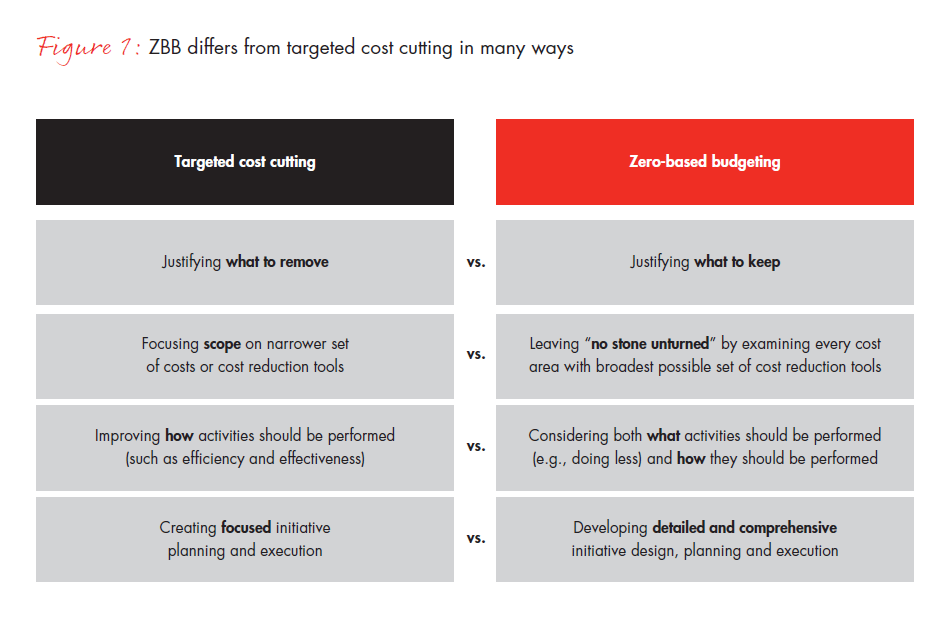
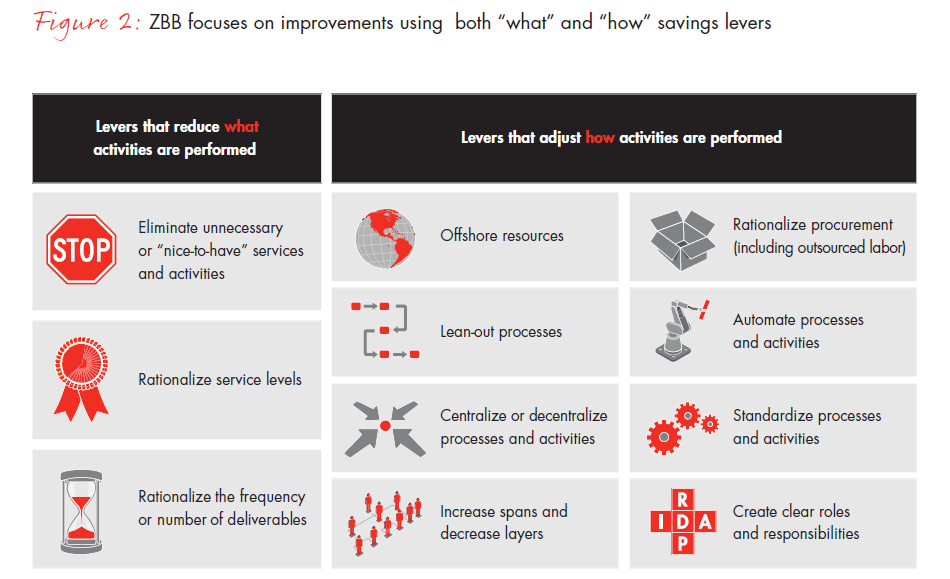
This broad-reaching approach to cost transformation differs from targeted cost cutting in several ways (see Figure 1). It starts by reenvisioning the business and asks what activities and resources are needed to compete under current and future market conditions (for three to five years), as opposed to what needs to be trimmed or removed. ZBB examines every area of spending with a more complete set of tools than with targeted cost cutting. The approach also analyzes which activities should be performed and at what levels and frequency, as well as how they could be better performed—potentially moved offshore, outsourced, streamlined, standardized or automated with refined organizational structure and responsibilities (see Figure 2).
The ZBB approach strengthens capabilities in ways that will provide true competitive differentiation, while intentionally downgrading other areas that overdeliver on noncritical functionality. When a company uses ZBB to redesign the pared-down activities, the risk of unintended consequences is lower because the approach is so comprehensive. For example, executives can be confident that they’re not cutting costs in one part of an organization only to find that the root cause was somewhere else. Finally, ZBB is done in one comprehensive effort, rather than successive rounds of targeted cost cutting that can drain employee morale.
Paul Cichocki, who leads Bain's Performance Improvement practice in the Americas, discusses how zero-based budgeting offers a way to reconsider a company's entire cost structure and align resources with long-term strategies.
There is no doubt that the clean-slate approach to cost reduction can be daunting. However, we have found that companies that transform their cost structure through ZBB generally follow a common set of actions.
1. Build a winning team. A ZBB program is only as good as the people running it. That’s why a program begins with forming a core team of high-potential and experienced project leaders from various parts of the organization. The team reports to a corporate steering committee and an executive sponsor. As the program gains momentum, more people take part in initiative teams, with as much as 5% of staff providing input on the work. In other words, ZBB is not a hands-off exercise.
2. Define the new mission to reflect evolving market conditions. The new ZBB team begins by redefining the function’s mission and orienting the function to up-to-date objectives, given current business challenges. For example, a finance function’s mission might shift from “provide world-class financial support to management” to “provide efficient low-cost transactional support while providing top-quartile decision support services.” Having identified the mission, the team then designs principles that support the new mission.
3. Aim high. While redefining the mission, the team works to set an ambitious cost target—large enough to ensure transformational rather than incremental thinking. The team determines a realistic cost goal by collecting both internal benchmarks across business units and regions and peer company benchmarks. However, the cost goal is not yet a firm commitment. That commitment comes from the bottom-up analysis later in the ZBB process.
4. Document the existing state. The company needs a baseline for all its costs and processes. Creating that fact base means listing and defining all the existing activities and processes and creating a database of all the costs and headcounts associated with each activity and process.
5. Create the ideal state that will best support the company’s strategy. Putting aside the existing state of the company, the team envisions each function in an ideal state with a blank sheet of paper. This is the opportunity to explore which activities can be removed or which service levels can be reduced to match evolving company needs. This task allows the team to describe the activities that can become more efficient and update the organizational structure to match those changes.
6. Compare the existing and ideal state. Comparing the existing with the ideal state, the team can identify the savings opportunities and associated risks and costs of moving from the existing to ideal state. The team then assigns priorities to each initiative based on the size of the opportunity and the difficulty of achieving it.
7. Build the future state from the bottom up. This is a more pragmatic and thorough version of the ideal state that takes into account practical constraints like transition costs and risks. Working from the bottom up, teams project future costs and resources for each prioritized activity and service, yielding firm cost and savings commitments.
8. Refine the organization. Company leadership then takes all the data and analysis collected by the various teams and designs the organization needed to support the future state. At this point the leadership must ensure that the design is consistent with organizational best practices for spans, layers and effective decision making.
9. Create an implementation plan. At this stage, the team begins a quarter-by-quarter implementation plan (including the formation of an implementation team), and an internal and external communication plan. Finally, there is a new program office to champion and communicate achievements, monitor savings, embed new capabilities and sustain the cultural change.

Zero-based budgeting
Zero-based budgeting provides a practical way for companies to radically redesign their cost structures while boosting efficiency and competitiveness.
One manufacturer’s experience with ZBB
The scale of the effort may sound daunting, but in practice the actions build on one another in a systematic way, resulting in a focus that typically achieves a dramatic transformation for the business. To see how it works in action, let’s look at the recent experience of one manufacturer.
The company had been struggling to contain overhead costs and operational complexity that was hampering its ability to respond to customer and stakeholder needs. Nowhere was that more clear than in its IT department. During the boom years, as the size and global reach of the company grew, so had its IT spending. The IT department created a ZBB team to lead the program. In workshops, the team examined the strengths and weaknesses of the current IT department, comparing its efficiency and effectiveness with peers. The company set the goal of reducing IT costs by 25% after taking into account industry benchmarks, future needs and the revamped strategic agenda. The company dissected its entire IT function, ultimately halting some activities and projects, decreasing service levels on others and redesigning processes that helped it reach maximum efficiency.
Along with a revised mission statement that now highlighted cost advantage and innovative use of technology, the team identified six areas of focus: IT’s service offerings, capabilities, processes, application and software management, organization and governance. The team analyzed costs of the existing state, created an ideal state and compared them with estimated top-down cost savings for 24 existing activities in application development, maintenance and infrastructure. The team then used these estimates to identify the largest savings opportunities and build future state designs from the bottom up.
Two large opportunities were third-party maintenance contracts and PC support and management. As the team learned, the company was frequently paying for higher service levels than they actually needed. For example, after upgrading their enterprise resource planning software, they were able to lower the maintenance tier from premium to standard, generating savings of more than 15%. At the same time, many full-time employees had multiple and often redundant computers. Scaling back both of those areas helped IT pare down costs without compromising service and still deliver fast, tangible savings. Two years later, the IT department has now completed its plan and reduced spending by 25%, and has freed up resources and improve effectiveness in critical support areas.
The company also brought its quality function through the ZBB process. The quality function’s costs had grown beyond peer benchmarks. Leadership was ready to scale back but needed to do so without compromising service delivery. They found opportunities to automate customer complaint functions and move some work offshore, as well as quick results gained by streamlining and coordinating audits, meetings and approval processes. In the end, the company realized savings of more than 20%.
Why might your company pursue zero-based budgeting?
Companies can ask a number of questions to determine whether ZBB is an appropriate approach:
- Has your company grown through a series of acquisitions, resulting in unnecessary overhead costs?
- Is your company the product of a recent merger?
- Have you experienced profit or cost pressure from a competitor?
- Have industry dynamics (such as regulatory reform) caused profit pressure?
- Is your overhead unnecessarily complex? Are your overhead costs significantly greater than benchmarks? Have your function budgets grown without achieving significant economies of scale?
By Paul Cichocki
First published in 6月 2012