

論説

You can feel it when you walk in the door. People are bustling through the halls. Knots of employees are engaged in animated conversation. Office doors are open. You hear laughter. The business could be 100 years old, with thousands of employees, but it still feels like a start-up. Why? Because this company has a Founder’s Mentality® culture—a high-energy, high-performance culture. Walk into a company that has lost the Founder’s Mentality and you can feel the difference. It’s quiet—too quiet. Employees are trapped in meeting rooms. The halls are empty and doors are closed. There is no buzz, no spark. Workers are going through the motions.
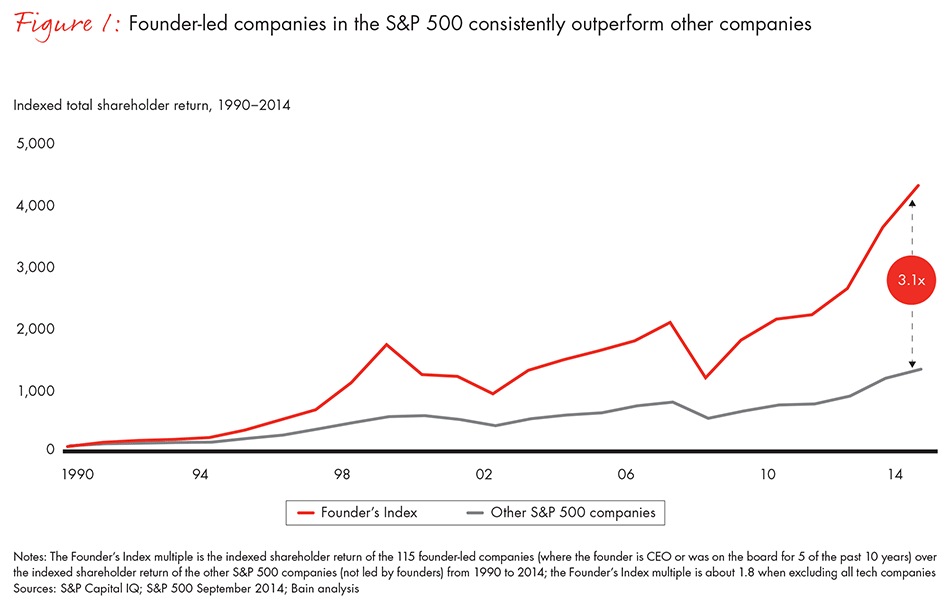
The energy of the Founder’s Mentality culture stems from a fundamental sense of mission and an urgency that many large organizations lack. Most companies that survive long enough to become large corporations had a Founder’s Mentality culture at one time, but most companies lose it along the way. People who launch successful companies start with a mission, usually to fill unmet needs—a new technology or a better way of serving customers. Everyone is deeply invested in seeing the company win and, because they are, sustained success is far more likely. The proof is in the differentiated performance data: Total returns to investors by S&P 500 companies led by their founders were three times higher than at other S&P 500 companies from 1990 to 2014 (Figure 1).
The Founder’s Mentality culture is easy to lose and difficult—but not impossible—to regain. When a company has the Founder’s Mentality, you see three things that drive growth. First, employees have an ownership mindset; they act like they own the place and they care what happens. Second, no matter how big and powerful the company is, employees still feel a sense of insurgency. They are out to upset the status quo because they are determined to fill a need in the market that competitors are not addressing. Finally, a Founder’s Mentality culture focuses everyone’s attention on the front line. Whatever they do, they think about how it can help the front line succeed in serving customers.
If a company wants to create a Founder’s Mentality culture, the first priority is to define (or redefine) the noble mission with which everyone aligns. For DaVita Inc., it took a near-death experience to redefine the mission and reclaim the Founder’s Mentality culture. In 1999, the company, then known as Total Renal Care, was on the path to bankruptcy. It had grown quickly into a chain of 460 kidney dialysis centers across the US, but by 1999, it was losing $60 million a year and was in danger of missing payroll. Employee turnover was about 40% a year, and patient outcomes were worse than at other centers. Total Renal Care was being investigated for Medicare and Medicaid fraud, and its share price, at $1.71, was 95% below the peak. Shareholders were suing.
Amazingly, Total Renal Care pulled out of its death spiral under turnaround CEO Kent Thiry. The turnaround involved all sorts of initiatives, but company insiders say it was the reinvention of the culture that enabled the changes that saved the company. Even as the company triaged the business, closing centers and making emergency repairs to stop the bleeding, the new management put a lot of energy into fixing the culture. After a series of town hall meetings to get employee suggestions, the company changed its name to DaVita (“giver of life”) to reaffirm its core mission. Centers were given autonomy, but with accountability and total transparency; each center’s DQI (DaVita Quality Index) scores were posted, making it clear that the top priority was excellent patient care. A decade later, its revenues had quadrupled to more than $6 billion in 2010, and they more than doubled again, to nearly $14 billion, in 2015.

Founder's Mentality
Fast-growing companies can become global leaders without losing the values that helped them succeed. Bain’s research explores how large incumbents can also reignite their growth by recapturing their Founder’s Mentality®.
Getting back on track
To embed and sustain a Founder’s Mentality culture, leaders often have to rewire the organization, as Thiry did at DaVita. Restoring a sense of mission is an essential first step. This gives everyone in the organization a shared ambition and purpose, providing an “internal compass” that guides employees to the needed behaviors. When Total Renal Care was on the brink of bankruptcy, the CEO flew some 700 leaders to an off-site where they defined a culture to support the new customer-centric mission. They identified seven core values: service excellence, integrity, team, continuous improvement, accountability, fulfillment and fun. The overarching theme became community—DaVita would be a community that also happened to be a company.
AB InBev, a global beer conglomerate, has a repeatable formula to infuse its aggressive Founder’s Mentality in the companies it acquires. The culture reflects the ambitions of InBev’s founders when they started building the company in 1989. Among the “10 Principles” that AB InBev brings to its acquisitions are “zero complacency” and “we are never completely satisfied.” The AB InBev philosophy often stands in stark contrast to the culture of the acquired company. When InBev bought Anheuser-Busch in 2008, for example, the 150-year-old company still had the founder’s legendary paternalistic culture. But the culture was also formal and there was little sense of urgency. One of the first steps InBev took was to gut the inner sanctum of top executives at the headquarters in St. Louis, Missouri, sending a powerful signal that the old culture was a thing of the past.
To make the Founder’s Mentality more than an attitude, companies need to take a systematic approach to renew and reinforce a high-performance culture. This includes following through with changes in the operating model: the talent systems, organizational structures, accountabilities, governance and ways of working that reinforce the desired mindsets and behaviors. The cultural transformation also requires the visible commitment of top leaders, who “walk the talk.”
-
Talent systems. Any effort to change a culture has to start with a talent system that hires, develops and rewards players with the right cultural DNA. Companies that have a Founder’s Mentality culture openly celebrate winning behaviors—and make the tough calls when needed. Founder’s Mentality companies recruit people who fit into the culture and contribute to it. And they provide the training and development to reinforce the culture and desired behaviors. Compensation and career advancement practices also align with core values. At DaVita, for example, HR looks for people who will be a good fit in the community-oriented culture, and managers reinforce DaVita values by rating employees on the DQI scores of their centers and on how they demonstrate company values in their work.
Netflix, which maintains a strong Founder’s Mentality culture, pays extremely close attention to talent issues. From the outset, the company has consciously sought hires with strong spikes in analytics. These workers helped Netflix create a data-driven business model for DVD rentals that could be adapted to video streaming, enabling Netflix to survive the passing of DVDs. Like other companies that retain their Founder’s Mentality, Netflix is a demanding culture. Its philosophy is to hire only “A” players; Netflix believes it’s a waste of time for A players to work with B players or to try to turn Bs into As. The company pays its hires top-of-market compensation and gives them lots of latitude in how they do their jobs, while holding them to very high performance standards. Employees who can’t meet those standards are let go—with generous severance.
-
Organization design. Complexity is antithetical to maintaining a Founder’s Mentality culture. Founders hate bureaucracy, largely because it keeps them from maintaining close links to the front line and customers. As companies become larger and there are more operations, divisions and locations, organizations grow in complexity. Leaders lose the direct connection with the front line, and the focus of employees shifts from the noble mission to meeting the needs of the bureaucracy.
Even very large companies can avoid this trap. Leaders should simplify structures, eliminate layers and reduce unnecessary decision-making “nodes.” Netflix, for example, has kept its focus by using a highly aligned/loosely coupled structure, which has few formal connections among different groups. Instead, Netflix leaves it up to managers to coordinate as needed with other parts of the company. The assumption is that everyone is on the same page, so an executive in one part of the organization can trust that an executive in another function will do the right thing. No formal coordination is needed, and cooperation is a given.
DaVita’s brush with death gave management the opportunity to adjust the organization in ways that embed the new values and culture. The philosophy since the turnaround is to “own your center” or region. The organization has been flattened to bring the front line and leadership closer together. On the front line, caregivers are empowered to do what it takes to help their patients, and are responsible for maintaining high customer satisfaction.
-
Ways of working. The ultimate measure of how successfully an organization has embraced a Founder’s Mentality culture is the difference in how employees, managers and executives go about their work every day. What counts is what these people do when nobody is looking. Do employees tackle assignments, participate, share ideas, collaborate and interact with coworkers and customers in ways that are consistent with the desired culture? Are they thinking like founders?
At AB InBev, workers are told to be frugal—to treat every dollar as if it were their own. Ripping out the ornate offices of the top executives at Anheuser-Busch was more than symbolic. InBev had taken on $45 billion in debt to finance the takeover, just as the global financial crisis was unfolding. Rather than spend a modest amount of money to remodel the space, InBev executives left it unfinished and moved in, working in the gutted space with their desks jammed together. AB InBev also sold off corporate planes and furloughed pilots. The Anheuser-Busch dress code was scrapped, and headquarters workers started coming to the office in jeans—because, as the InBev people pointed out, the customers don’t wear suits. As important, people are working smarter. For the first time, they have easy access to the data they need to make decisions. And instead of memos and formal presentations, the AB InBev culture encourages informal face-to-face communication.
At Netflix, after going to such lengths to get the right people in place, the company leaves it to employees to act in the company’s best interest. Management assumes employees will exhibit "adult behavior," and has eliminated a lot of traditional HR rules. There are no performance reviews and there is no set vacation policy; employees are free to take time off as needed.
The Founder’s Mentality engenders a specific type of corporate culture, which can benefit companies of all sizes and ages. Companies that retain—or regain—the Founder’s Mentality are stronger competitors, better innovators and faster to respond to changes in the market. At a time when traditional business models are being upended and insurgents are coming at large organizations from all directions, it takes a Founder’s Mentality to stay on top.
Julie Coffman is a partner in Bain & Company’s Chicago office. She is a leader in the Global Healthcare and Organization practices. Atul Aggarwal is a New York–based partner in Bain’s Results Delivery practice. Shih-Yu Wang is a manager for Bain’s Organization practice and is based in San Francisco.
Founder’s Mentality® is a registered trademark of Bain & Company, Inc.
First published in 6月 2017