

論説
The oil and gas industry faces a shortage of talent that threatens its ability to meet the world’s demand for hydrocarbons.
According to the International Energy Agency’s 2010 forecast, the demand for energy will increase 1.2 percent per year until 2035, with hydrocarbons continuing to supply at least half of the world’s energy needs over that period. However, the dearth of skilled technical talent poses as much a threat to the industry’s ability to meet demand as the decreasing availability of oil and gas reserves. And leaders in the exploration and production (E&P) sector regularly tell Bain & Company that this impending shortage represents their greatest corporate challenge.
The forces behind the talent shortage
Five factors contribute to the shortage of skilled technical talent:
• Rapid industry growth. Whether in the oil sands of North America, the gas fields of Australia or the deep waters off Brazil, the industry is experiencing burgeoning growth. Some countries will see a 100 percent to 300 percent increase in production from 2010 to 2030, according to Rystad Energy. Brazil’s Petrobras estimates that it will need 21 percent more workers in 2015 than in 2011, with the majority of those workers needed in its E&P division to support the company’s ambitious production growth.
• Highly specialized and experienced jobs. E&P requires a huge range of operational, technical and commercial skills, ranging from geological and subsurface specialties to complex engineering and project management capabilities. These jobs demand the ability to make decisions that are based on deep and varied experience, in ambiguous and technically challenging situations. Consider the case of remotely operated vehicles (ROVs), which are critical to the construction and inspection of subsea facilities. Training operators for ROVs takes 18 months, and they typically need five years of experience to become highly proficient in their jobs. As the deepwater industry booms, ROV companies are struggling to find and train sufficient staff to meet the double-digit growth in demand.
• An aging workforce. Because of the high level of training and experience required, the oil and gas industry is a middle-aged person’s game. The Society of Petroleum Engineers estimates that up to 50 percent of skilled workers could retire within the next five to seven years, presenting an immense challenge to the industry.
• Constraints on supply. Developed countries are seeing declining numbers of engineering graduates, as well as increasing competition for workers from clean technology and other high-tech sectors. Developing countries often cannot find enough in-country technical graduates and senior staff to meet national staffing requirements across a range of vital industries.
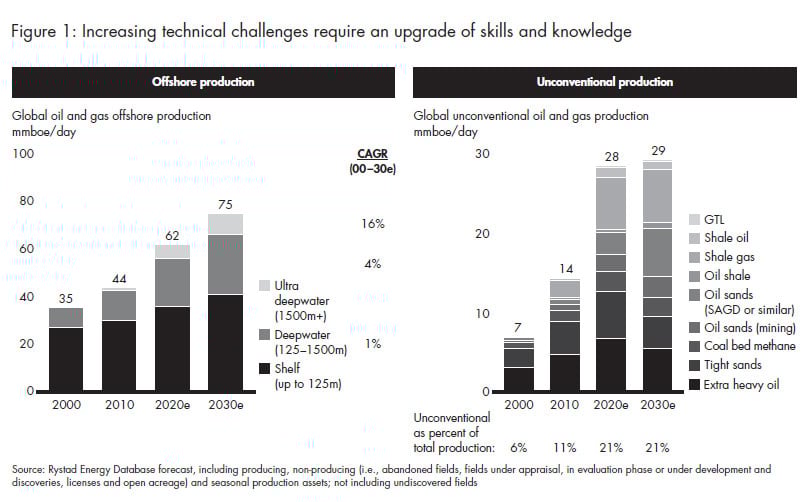
• Rising technical complexity. Halting the decline of production from the world’s mature fields depends on finding people with the right skills and experience for emerging conditions. Companies are exploring for oil and gas in often difficult-to-access reserves, such as at increasing depths offshore, in the Arctic and in unconventional resources like tar sands and shale deposits (see Figure 1). People with experience in these more unusual conditions are, by definition, more scarce.
Even more serious, a shortage in skilled technical talent has major implications for the industry’s entire pipeline of top leadership, which tends to move up from the ranks of experienced managers of skilled technical positions. With what’s known as the Big Crew Change looming ahead, companies face an even more significant challenge: crew change at the top. The industry will have to groom tomorrow’s leaders quickly from thin ranks.
Taking a strategic approach
From our work with clients in the oil and gas industry and across many other sectors, Bain has found that companies often lack a long-term approach in addressing this issue. Their one-size-fits-all talent management strategies frequently do not take into account the unique needs of critical functions within the firm.
Companies often view matching the best-skilled technical professionals to a particular job as an unnecessary luxury, considering the extreme staffing shortages they face. Firms recruit dozens of engineers, for instance, but the new hires are not necessarily targeted at the most strategic specialties needed for the future. E&P firms also tend to think quite locally about talent and fail to track and coordinate local talent development at the regional and corporate levels. The result is that many of these companies struggle to find the right way forward to address their talent challenges.
Leading companies in E&P and across a range of other industries proactively shape the supply and demand for the positions that will increasingly make or break their businesses in the years ahead. When Bain analyzed top-performing companies that handle this challenge effectively, we found that they share four strategies that the oil and gas industry can learn from:
Build a deep understanding of the talent gap
Many companies lack a detailed picture of the talent challenges they face, but a rigorous analysis of the mismatch between supply and demand makes these challenges visible.
Understanding the demand side begins with some fundamental questions: What will the business look like over the next five years? How are the business’s needs changing? How many employees will the company need in each discipline, subdiscipline, geography or functional unit? What skills must those people have? Leading companies construct scenarios based on quantitative factors like the number of new wells and active rigs, and qualitative factors like technical complexity and portfolio needs.
On the supply side, leading companies ask: How many mission-critical workers, such as geologists and well engineers, do we have in each key discipline? What are their experience levels? How rapidly are workers gaining the experience they need?
Companies can do this analysis by region, by business unit, by nationality and by gender. Company leaders then analyze functions at a detailed level for specialized subdisciplines to truly understand the potential future talent shortages.
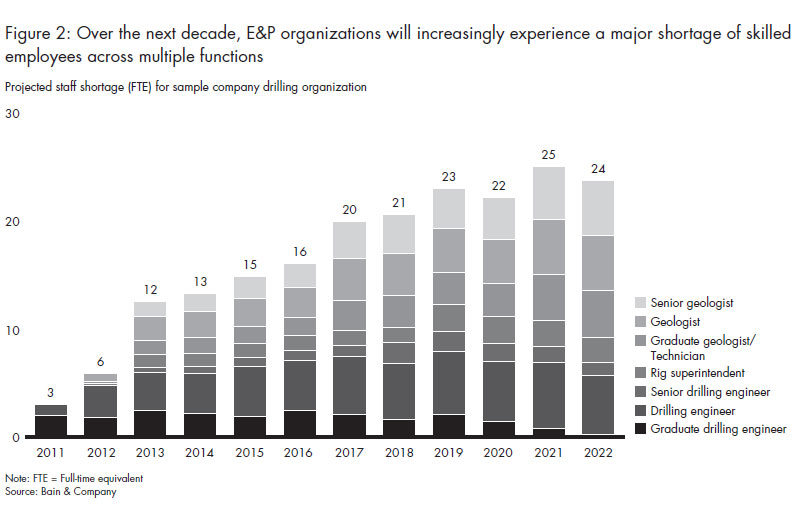
Combining these analyses shows a company’s most acute talent needs (see Figure 2). Seeing these skills gaps in one place typically spurs companies to address deficiencies right away with better human-capital processes. One forward-thinking example comes from a South African mining company. The firm badly needed mine managers, engineers and technical experts to help turn the safety and performance of its mines around. The company first took the time to understand the skills each leadership role required. It then assessed the pool of potential leaders and modeled their likely advancement paths. The result was a clear picture of both leadership capabilities and bench depth for every critical role in the company.
Make the most of available talent
We often ask CEOs to tell us how many of their top managers occupy their most critical positions. Those who answer the question often reveal an alarming mismatch: Average and even poor performers fill most of their company’s strategic roles, while many top performers occupy nonstrategic positions. In our 2008 survey of 760 companies across six geographies, less than 25 percent of respondents strongly agreed that “our best people are in the jobs where they add most value.”
In contrast, leading companies have mapped their existing talent and expertise, so it takes less time to allocate human resources to the most valuable problems. For instance, a leading oilfield services provider maintains a custom-built database of detailed “career networking profiles” that allows it to match the interests and skills of top talent with the company’s needs.
The leaders also identify top talent early in their careers so that they can be groomed for emerging opportunities. These companies give their rising stars leadership development, mentoring and training opportunities. We have observed that oil and gas companies around the world are refocusing their efforts on mentoring and development. The French oil giant Total, for example, established Professor Academy, where retired geologists and engineers mentor younger workers, while Petrobras established Petrobras Mentor, which pairs younger workers with older mentors. Shell has increased the duration of assignments given to employees so that they can build leadership capabilities in one environment and have long-term accountability for the delivery of projects and business results.
Reduce the demand for talent
Companies most commonly respond to a talent-supply gap with upgraded recruitment efforts. But expanding the supply pipeline may take several years to have a noticeable effect. Firms have another, often overlooked, lever to pull: lowering the demand for talent. By redesigning their organizations in ways that reduce the need to spread out highly skilled leaders and technical experts, companies can narrow the supply gap, sometimes quickly.
One of the most effective methods for reducing demand involves stripping out organizational complexity. Companies can streamline decision making at the functional level—for instance, by eliminating regional structures where possible. Or they can more effectively deploy a critical resource across their entire portfolio so that skilled technical talent does not sit underutilized in one region.
Supermajors like ExxonMobil, Shell and BP are increasingly structuring themselves along the lines of functional units. They are centralizing functions and moving skilled technical workers across geographies so that they are fully deployed. Given a limited supply of workers, a functional structure potentially gives companies a better way to allocate scarce human resources to the most demanding and valuable parts of their portfolios. Independent and national oil companies (NOCs) are also following this trend and centralizing activities, for instance, to create a critical mass of capability.
Companies can also strip out complexity from jobs. Much work has been done throughout the industry to simplify work processes, reduce costs and standardize designs. Some North American shale gas producers, for example, have looked at every aspect of their operations to develop more repeatable processes and reduce cycle times.
Increase the supply for talent
With the oil and gas industry growing at a breakneck pace in many countries, at a certain point, it will not matter how efficiently companies recruit and deploy skilled technical talent. The industry will need to use unconventional approaches to create its own supply. Leading companies are recruiting and developing new talent in nontraditional places and pooling expertise so it can go further. Shell, for example, has found a novel way to identify hard-to-find, skilled technical workers and centralize them in one place as a global service unit.
Traditionally, oil and gas technology centers have been located close to a company’s headquarters in North America or Western Europe. But in 2006, Shell created what is now known as the Shell Technology Centre Bangalore (STCB) in India to provide advanced engineering analysis and remote support services to its global oil and gas operations. Shell targets recruits from the top Indian technology institutes based on their potential and natural capacity to learn, rather than on their technical knowledge of the oil and gas industry. STCB now has more than 700 highly skilled employees, with many more being transferred to the center to become technical experts or on-call specialists in research and development.
Managing a scarce resource
The oil and gas industry can expect to face a shortage of talent for some time. Companies that plan to expand in rapidly developing countries, in particular, will see the wisdom in hiring promising managers early and investing in their training. For companies in developed countries, the talent crunch will mean finding better ways of identifying and engaging engineering graduates. Ultimately, the oil and gas companies that approach their talent supply strategically and employ the broad set of actions discussed earlier will likely be the winners in today’s and tomorrow’s increasingly talent-constrained environment.
John McCreery, a Bain & Company partner in the London office, leads the firm’s Oil & Gas sector. Peter Jackson is a Manager in the London office.
First published in 12月 2011